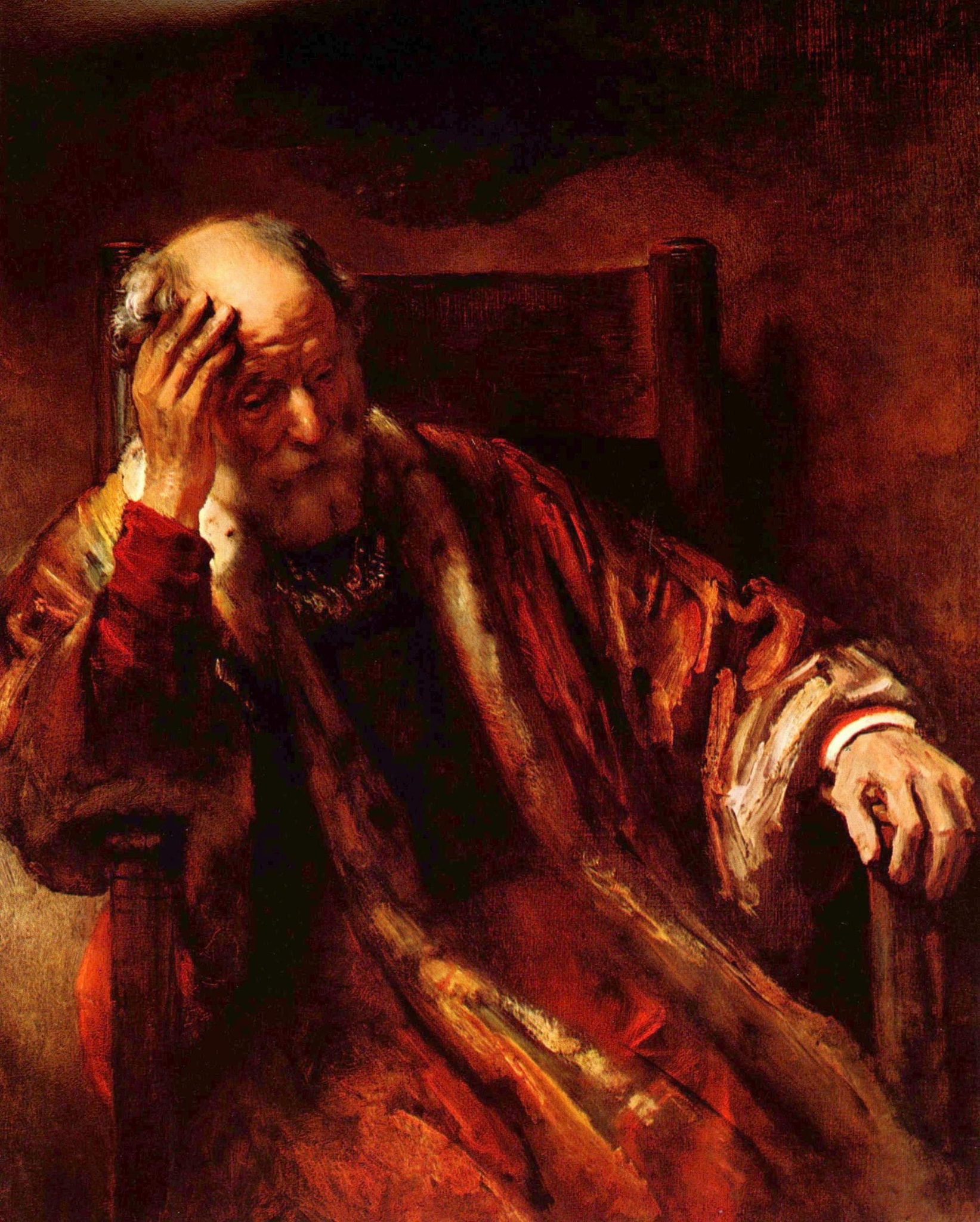
An Old Man in an Armchair

by Rembrandt van Rijn

An Old Man in an Armchair stages a solitary figure caught between worldly dignity and inner reckoning. A warm beam isolates the bald head and right hand while the robe dissolves into rough, animated brushwork, turning the chair into a site of meditation and time’s weight [1].

Study Print Studio

Create a personal study print

Build a companion study sheet around the part of this painting that speaks to you most. Choose a detail, shape an interpretation, and walk away with something personal and display-worthy.

Fast Facts

Year
1652 (signed; generally dated 1650s)
Medium
Oil on canvas
Dimensions
111 × 88 cm
Location
National Gallery, London
See all Rembrandt van Rijn paintings in London
An Old Man in an Armchair by Rembrandt van Rijn (1652 (signed; generally dated 1650s)) featuring Beam of light on bald crown and face, Left hand pressed to forehead, Right hand gripping the chair arm, Chair’s vertical post (baluster) behind the head

Click on any numbered symbol to learn more about its meaning

Meaning & Symbolism

Rembrandt’s image makes meaning by orchestrating light, gesture, and degrees of finish into a moral drama. The head, tilted and pressed by the left hand, receives a shaft of amber light that models the smooth crown and furrowed brow with extraordinary tenderness; the right hand, brighter than the surrounding gloom, clasps the chair’s arm like an anchor. Between them, thought and touch—cognition and feeling—form the painting’s living circuit. Around this still center, the robe erupts in vigorous, summary strokes of red and brown, its fur collar catching crisp highlights and a small flare of yellow satin. These flashes of shimmer read as generalized status, yet their very brilliance is made to feel provisional, almost slipping back into the surrounding murk. The vertical baluster of the chair, one of the few crisply described props, rises behind the head like a sentinel, framing the cranium and intensifying the sense that the seat functions less as comfort than as a solemn throne of self‑reckoning 1. In this lighting scheme—head, right hand, and chair upright clearly articulated while the rest dissolves—Rembrandt’s selective finish guides our attention to essentials and away from anecdote 1. As a mid‑century tronie rather than a commissioned portrait, An Old Man in an Armchair refuses biographical specificity and instead proposes a type: age clothed in borrowed finery, subject to inner audit. In this genre, exoticized or anachronistic costume and studio props serve as painterly problems and psychological cues, not identity markers 15. Here, the fur and chain conjure dignity, but the sagging robe and slack posture say that honor cannot brace the body against time. Crucially, the surface itself argues. The picture exemplifies the experimental rough manner: broad, tactile applications, dryly dragged lights over warm grounds, and abrupt pivots between impastoed accents and near‑abstract passages. That roughness is not negligence; it is rhetoric. It lets the robe feel restless—life in motion—while the face, more delicately modeled, becomes the still point of contemplation. The paint’s abrasions and clots read like the abrasions of age: a truth‑telling texture suited to subjects of wisdom and moral gravity 14. This pictorial argument carries added charge because the work sits in an attribution corridor—now labeled “Probably by Rembrandt”—that itself dramatizes the stakes of looking. Technical and connoisseurial debate has swung from “Follower of Rembrandt” to the current, more affirmative position; leading scholars have pressed for full authorship, citing the picture’s experimental role in Rembrandt’s early‑1650s reinvention 123. Regardless of the final verdict, the image functions as a manifesto for Rembrandt’s late pictorial ethics: meaning arises where light selects, where touch varies, and where finish becomes a moral index. The old man’s closed eyes, the illuminated knuckles, the sentry‑like chair post, and the robe’s turbulent skin all conspire to declare that what endures is not the chain on his chest but the clarity of inward sight. That is the meaning of An Old Man in an Armchair—and why An Old Man in an Armchair is important: it crystallizes the Baroque turn from outward display to interior truth using light and paint as instruments of conscience 145.

Explore Deeper with AI

Ask questions about An Old Man in an Armchair

Popular questions:

Powered by AI • Get instant insights about this artwork

💬 Ask questions about this artwork!

Interpretations

Formal Analysis: Rough Manner as Moral Optics

The painting’s rough manner—dryly dragged lights, abrupt impastos, and broad, summary passages—creates a calibrated field where finish becomes an ethical tool. Rembrandt articulates the head, right hand, and chair upright with high resolution, while allowing robe and ground to dissolve into suggestion. This distribution of attention engineers a hierarchy of meaning: cognition and agency are given clarity; trappings are provisional. The tactic anticipates his late practice of focal “islands” within painterly fog, compelling the eye to work for coherence and, in doing so, to internalize the theme of discernment. The facture is not mere style; it is an argument that seeing should be selective and value-laden, privileging inner reckoning over spectacle 15.

Source: National Gallery, London; 'Origins and Meanings of Rembrandt’s Late Style' (scholarship on rough manner)

Genre & Market: The Tronie as Studio Laboratory

Read as a mid‑century tronie, the work leverages anachronistic dress, fur, and chain not as identity markers but as studio problems—surfaces for testing light, touch, and expressive typology. Such character studies circulated widely and were prized precisely for their non-portrait status: they offered collectors a summa of painterly invention and psychology without the social contract of likeness. Here, the shimmer on fur and satin provides reflective “targets” for the beam that otherwise rations illumination, while the aged face supplies a topography for nuanced modeling and introspective affect. The result is a market-savvy hybrid: a showpiece of technique that encodes a generalized psychology of age, aligning with Dutch practice across Rembrandt’s circle 14.

Source: National Gallery, London; National Gallery of Art, Washington (Dutch tronies context)

Reception & Attribution: Meaning in the Corridor

The canvas has traveled from “Follower of Rembrandt” (2010) to “Probably by Rembrandt,” while Ernst van de Wetering publicly argued for full authorship (2014). This flux is not paratext; it reframes the painting’s stakes. If experimental and autograph, the picture becomes a hinge-work in the early‑1650s reinvention of Rembrandt’s handling; if partially studio, it testifies to the transmissibility of his late ethic—selective finish as moral index—within workshop practice. The object thus teaches how connoisseurship, technical imaging, and institutional caution co-author meaning over time. In either case, the image functions as a manifesto: light selects, touch discriminates, and finish signals value, a lesson underscored by its own curatorial biography 123.

Source: National Gallery, London; National Gallery 'Close Examination' (2010); Ernst van de Wetering via The Guardian

Psychological Interpretation: Haptic Seeing and Inward Sight

The composition makes the viewer’s eye mimic the sitter’s inward turn. The illuminated brow and the right hand’s anchoring grip generate a head–hand circuit—thought stabilized by touch—while the dark periphery withdraws into uncertainty. Rough, tactile passages solicit haptic imagination, so that “feeling” the paint becomes a metaphor for feeling one’s way through age and memory. By concentrating finish where mind and agency reside, the painting stages slow looking as a form of contemplation; the chair’s upright, crisply lit, acts like a sentry that cordons off a psychic interior. It is not a narrative of who this man is, but a picture of how consciousness gathers itself under pressure of time 1.

Source: National Gallery, London

Social History: Dignity, Decline, and the Vanitas Without Emblems

Fur, chain, and satin propose status, yet the sagging robe and slack posture counter with human limitation. This is a vanitas stripped of skulls or hourglasses: worldly honor flickers, but the body’s temporality prevails. In the Dutch moralizing climate, such tension reads as a gentle admonition—the value of interior clarity over external show. Crucially, Rembrandt’s rough manner aligns rhetoric with theme: the robe’s turbulent skin mirrors life’s unruly passage, while the face’s calmer modeling claims the still point of judgment. The painting thus participates in a broader 17th‑century valorization of truthful depiction (waarheid) over polish, binding social critique to surface procedure and making facture the bearer of ethical content 156.

Source: National Gallery, London; 'Origins and Meanings of Rembrandt’s Late Style'; Rembrandt in Southern California (exhibition guide)

Related Themes

About Rembrandt van Rijn

Rembrandt van Rijn (1606–1669) was a leading Dutch Golden Age painter and printmaker whose Amsterdam years (from 1631) produced virtuosic portraits and ambitious history paintings. In the early 1630s he favored polished finishes, saturated color, and theatrical staging—qualities on display in this 1633 canvas. Although prolific, this is his only known painted seascape [2][4].
View all works by Rembrandt van Rijn

More by Rembrandt van Rijn
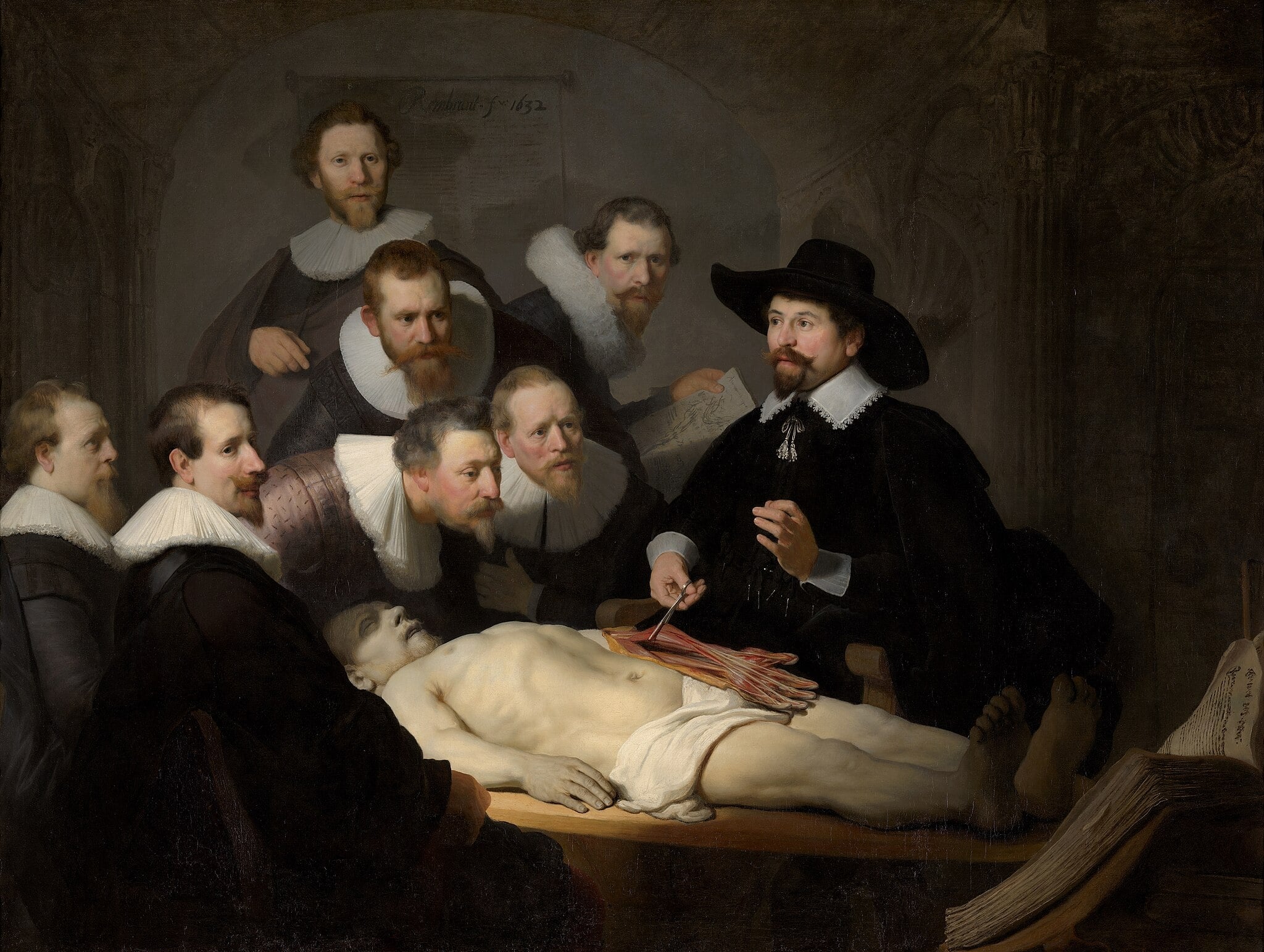
The Anatomy Lesson of Dr. Nicolaes Tulp by Rembrandt van Rijn

The Anatomy Lesson of Dr. Nicolaes Tulp

Rembrandt van Rijn (1632)

Rembrandt van Rijn turns a civic commission into a drama of <strong>knowledge made visible</strong>. A cone of light binds the ruff‑collared surgeons, the pale cadaver, and Dr. Tulp’s forceps as he raises the <strong>forearm tendons</strong> to explain the hand. Book and body face each other across the table, staging the tension—and alliance—between <strong>textual authority</strong> and <strong>empirical observation</strong> <sup>[1]</sup><sup>[2]</sup>.
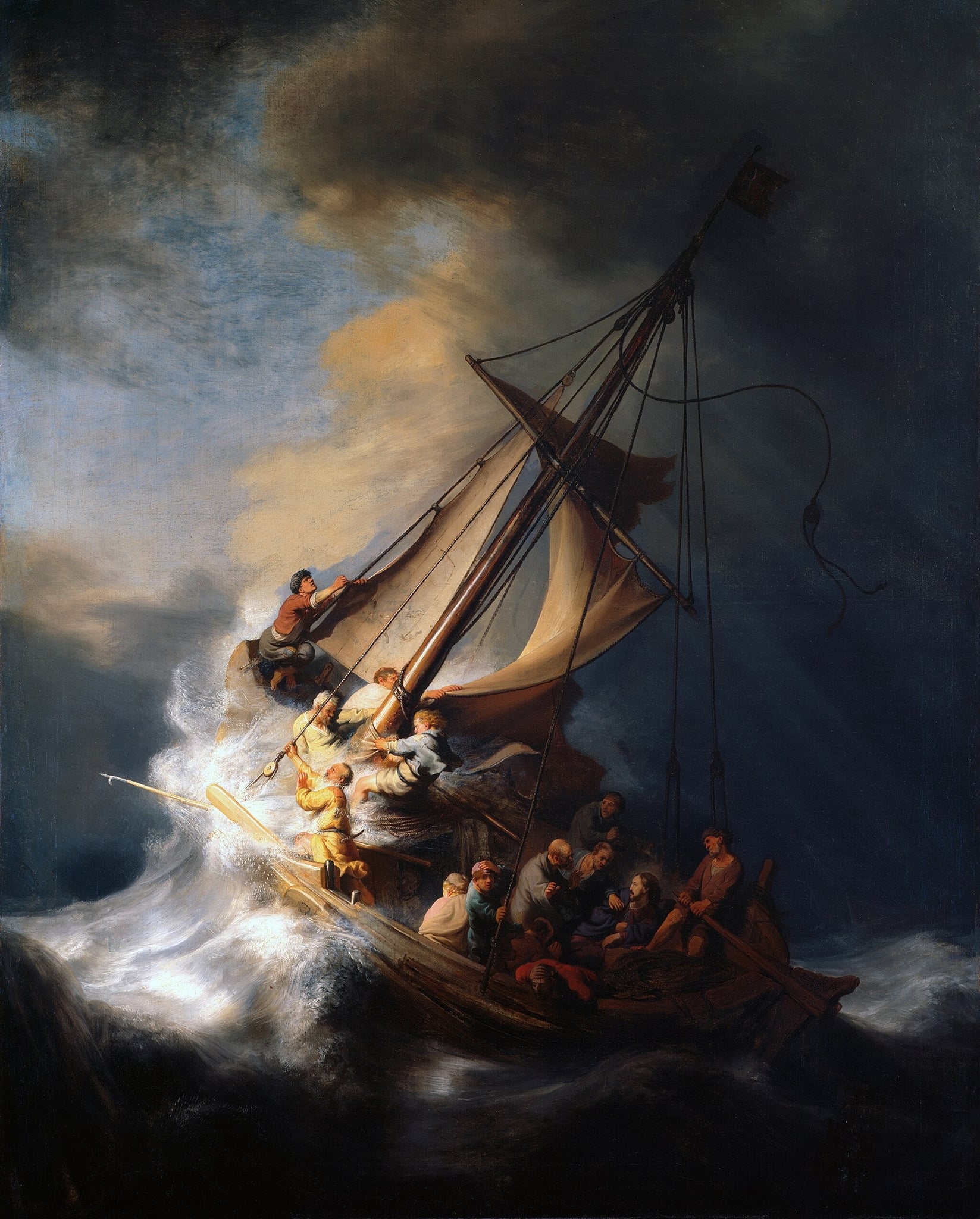
The Storm on the Sea of Galilee by Rembrandt van Rijn

The Storm on the Sea of Galilee

Rembrandt van Rijn (1633)

Rembrandt van Rijn’s The Storm on the Sea of Galilee stages a clash of <strong>human panic</strong> and <strong>divine composure</strong> at the instant before the miracle. A torn mainsail whips across a steeply tilted boat as terrified disciples scramble, while a <strong>serenely lit Christ</strong> anchors a pocket of calm—an image of faith holding within chaos <sup>[1]</sup><sup>[3]</sup>. It is Rembrandt’s only painted seascape, intensifying its dramatic singularity in his oeuvre <sup>[2]</sup>.
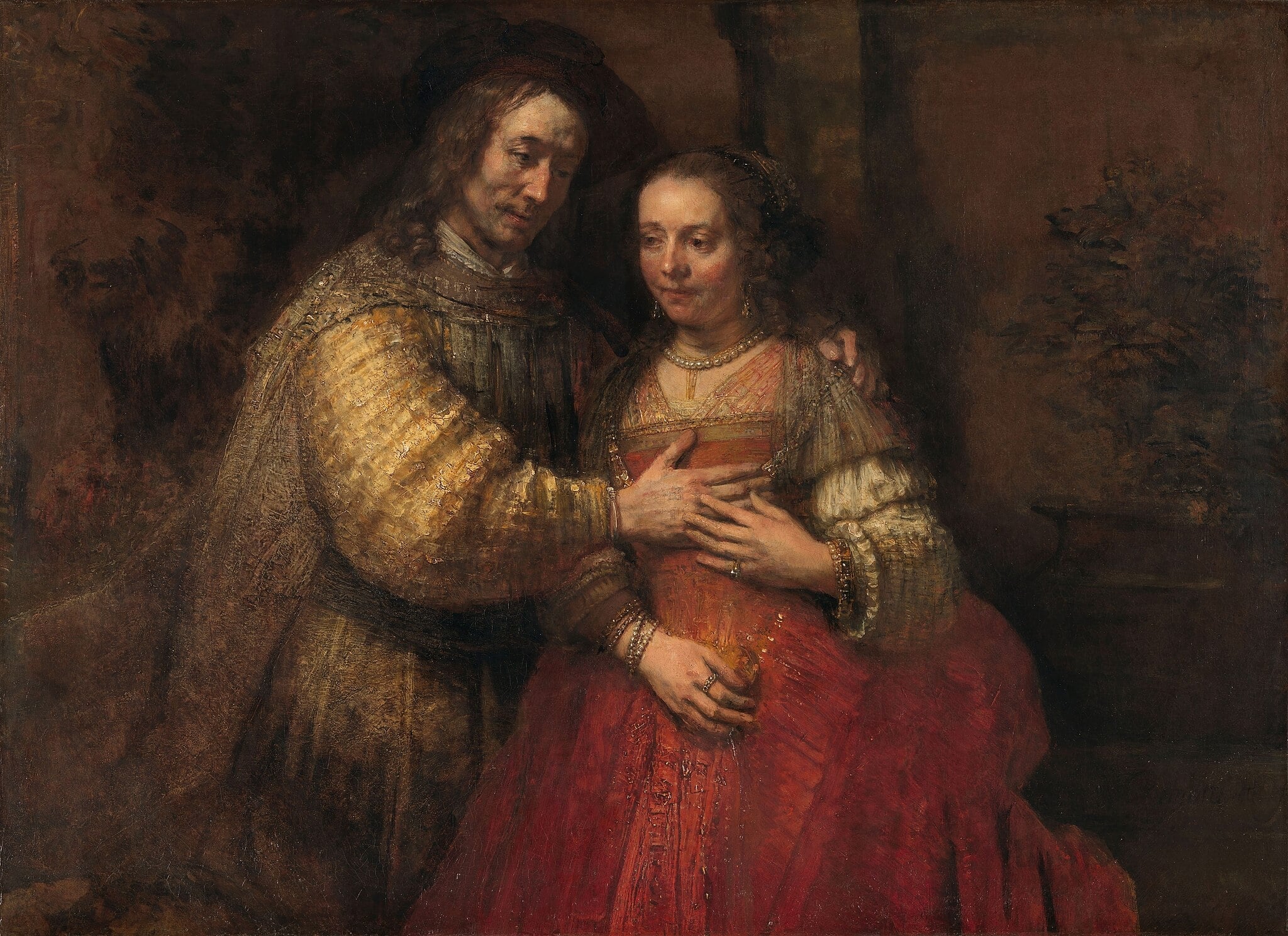
The Jewish Bride by Rembrandt van Rijn

The Jewish Bride

Rembrandt van Rijn (c. 1665–1669)

The Jewish Bride by Rembrandt van Rijn stages an intimate covenant: two figures, read today as <strong>Isaac and Rebecca</strong>, seal their union through touch rather than spectacle. Light concentrates on faces and hands, while the man’s glittering <strong>gold sleeve</strong> and the woman’s <strong>coral-red gown</strong> turn paint itself into a metaphor for fidelity and tenderness <sup>[1]</sup><sup>[3]</sup>. This late masterpiece embodies Rembrandt’s <strong>material eloquence</strong>—impasto as feeling—within a hushed, dark setting <sup>[1]</sup><sup>[2]</sup>.
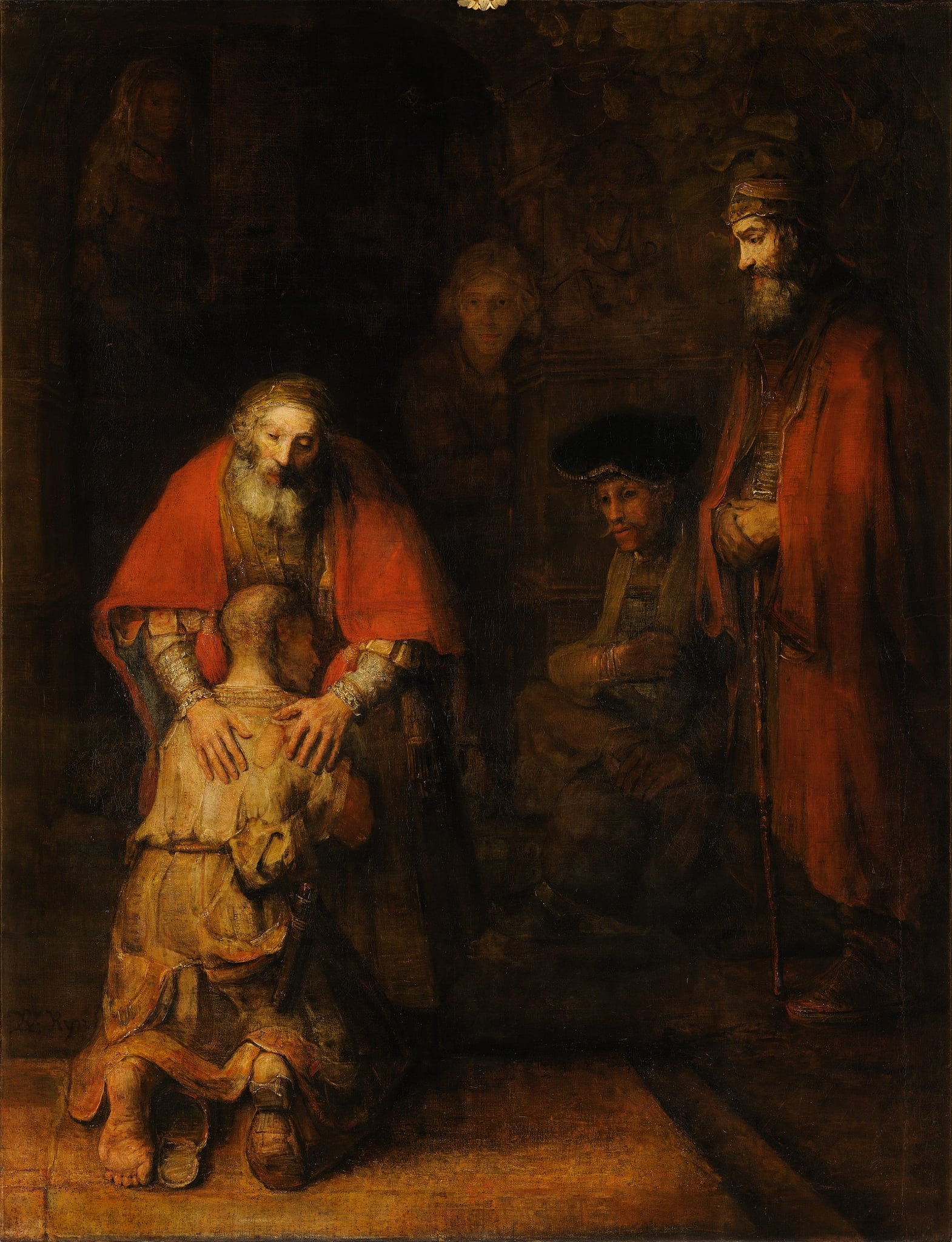
The Return of the Prodigal Son by Rembrandt van Rijn

The Return of the Prodigal Son

Rembrandt van Rijn (c. 1661–1669 (probably completed by 1669))

Rembrandt van Rijn’s The Return of the Prodigal Son is a late-life meditation on <strong>mercy</strong>, <strong>homecoming</strong>, and <strong>restored dignity</strong>. In a hush of dusk-like light, a ragged son kneels into his father’s <strong>embrace</strong>, while an upright elder brother holds back in shadow. The image concentrates meaning in illuminated <strong>faces, hands, and feet</strong>, turning a parable into a timeless human reckoning. <sup>[1]</sup><sup>[2]</sup>
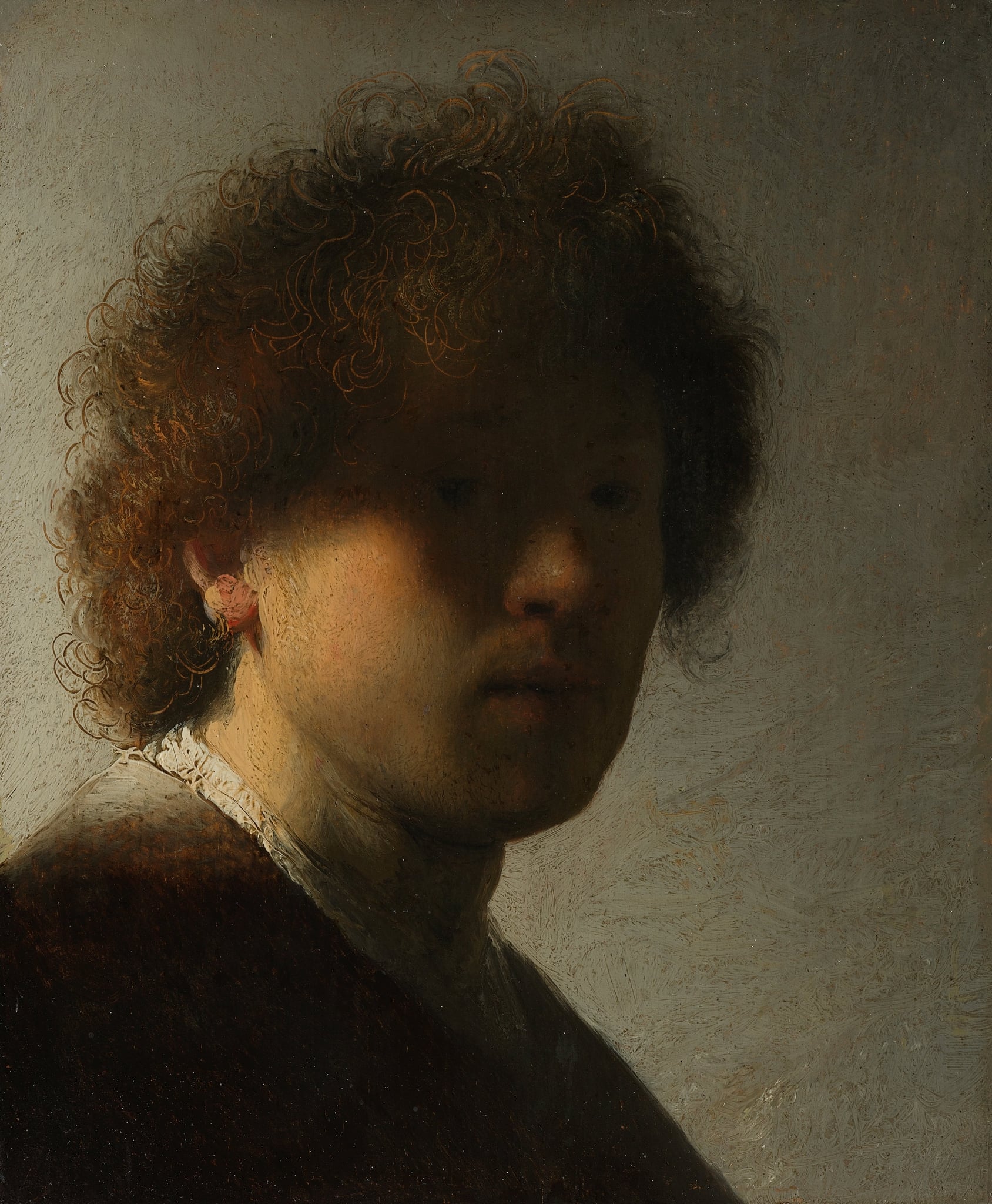
Self-portrait (with tousled hair) by Rembrandt van Rijn

Self-portrait (with tousled hair)

Rembrandt van Rijn (c. 1628)

A young Rembrandt van Rijn tests how <strong>light both reveals and withholds</strong> by letting his face emerge from darkness while his <strong>scratched, backlit curls</strong> flare like a rough halo. The small oak panel makes <strong>process itself the subject</strong>, turning hair, stubble, and a raking highlight into a statement of identity-in-formation <sup>[1]</sup><sup>[5]</sup>.
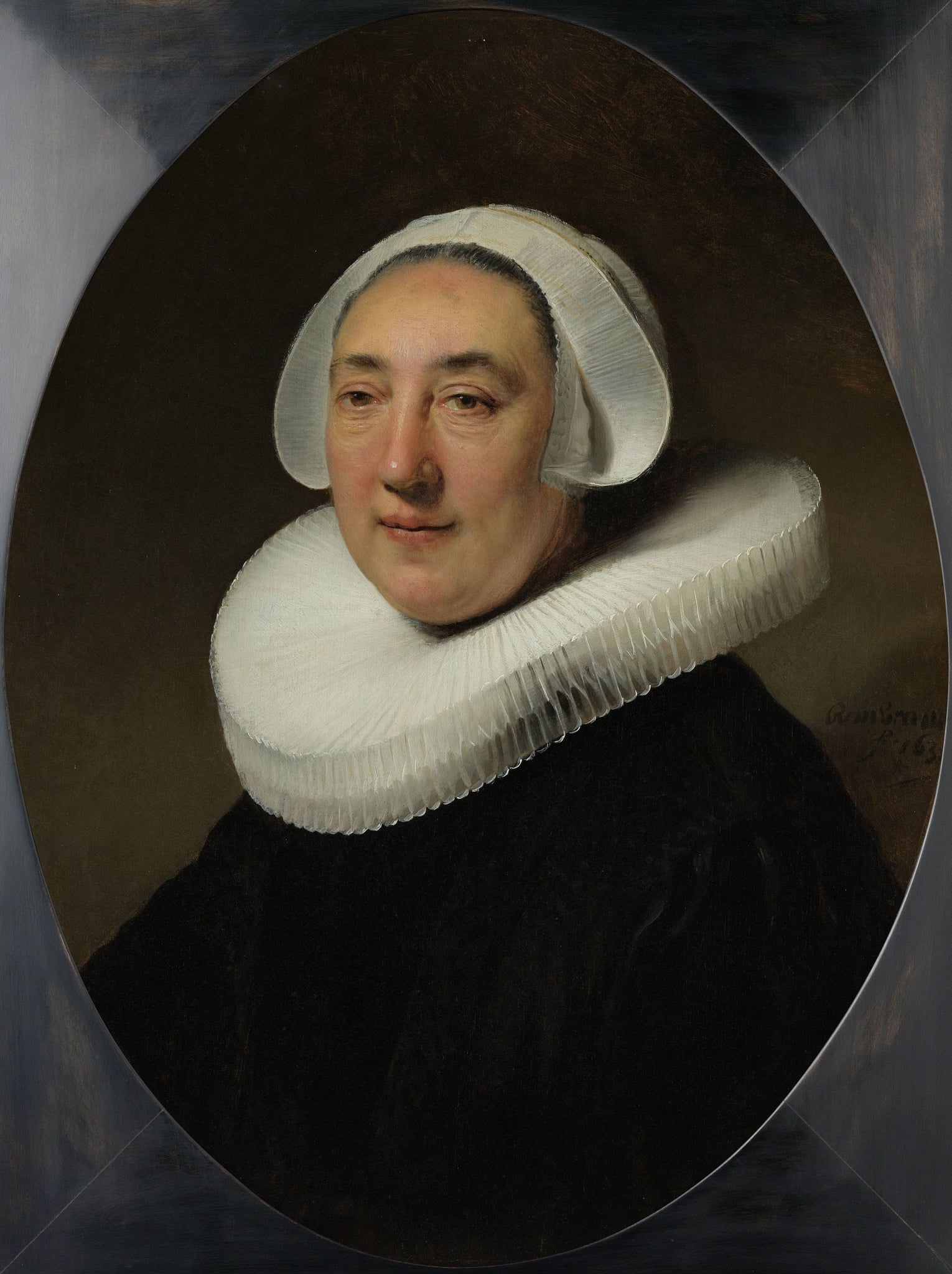
Portrait of Haesje Jacobsdr van Cleyburg by Rembrandt van Rijn

Portrait of Haesje Jacobsdr van Cleyburg

Rembrandt van Rijn (1634)

Rembrandt’s 1634 Portrait of Haesje Jacobsdr van Cleyburg stages a Dutch burgher within a feigned <strong>oval</strong> opening, illuminated by selective <strong>chiaroscuro</strong> that models warm skin against brilliant <strong>millstone ruff</strong> and sober black dress. The painting balances <strong>modesty and status</strong>, making virtue visible while quietly declaring prosperity through immaculate linen and craft <sup>[1]</sup><sup>[4]</sup>.