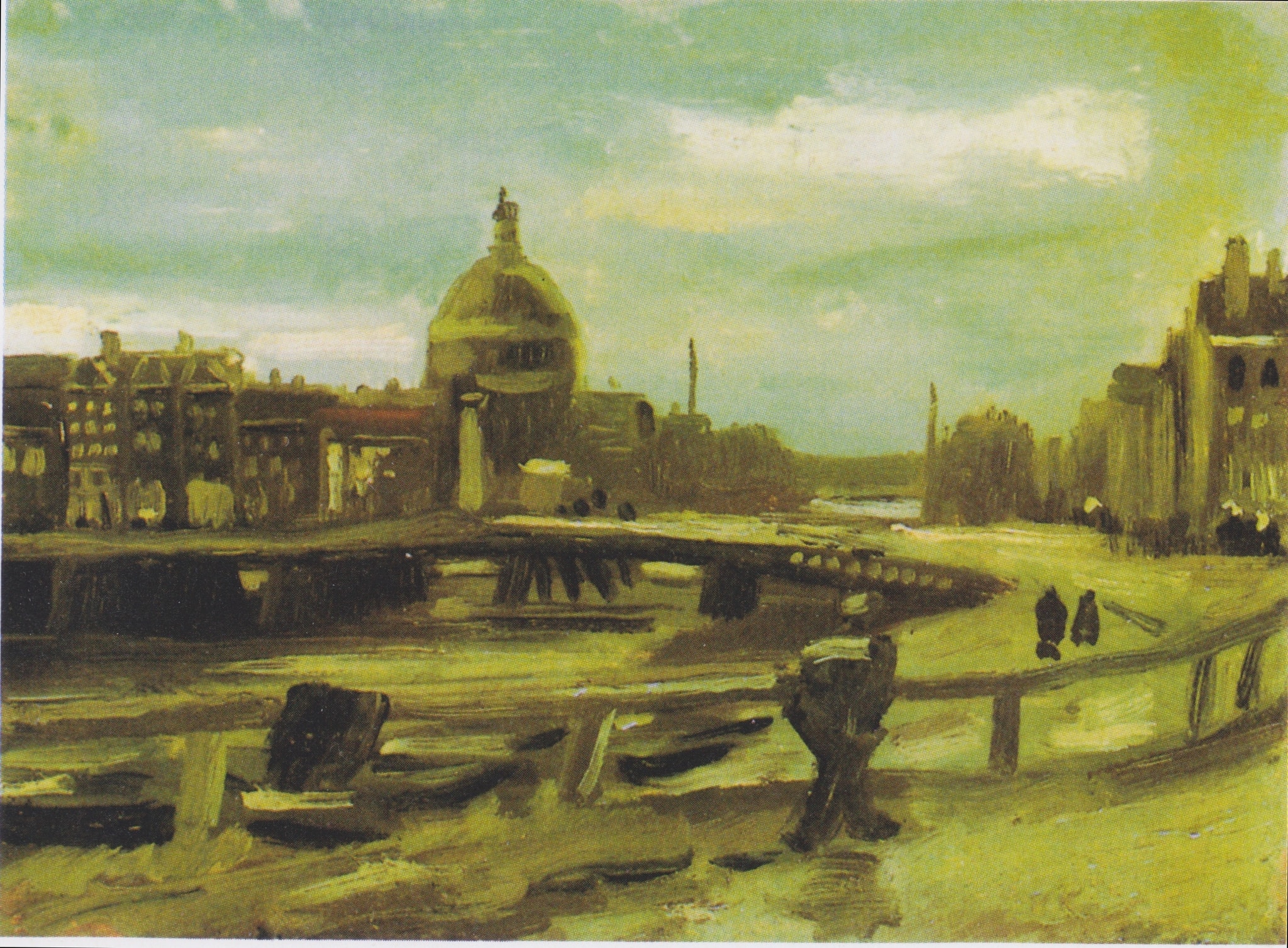
The Singel near the Lutheran Church in Amsterdam

by Vincent van Gogh

In The Singel near the Lutheran Church in Amsterdam, Vincent van Gogh renders the canal belt in earthy greens and umbers under a cool, washed sky. A diagonal bridge and bundled figures press forward while the domed Lutheran church holds steady in the middle distance, turning a city view into a meditation on passage and refuge [1].

Study Print Studio

Create a personal study print

Build a companion study sheet around the part of this painting that speaks to you most. Choose a detail, shape an interpretation, and walk away with something personal and display-worthy.

Fast Facts

Year
1885
Medium
Oil on panel
Dimensions
19 × 25.5 cm
Location
Rijksmuseum, Amsterdam
See all Vincent van Gogh paintings in Amsterdam
The Singel near the Lutheran Church in Amsterdam by Vincent van Gogh (1885) featuring Domed Lutheran Church, Diagonal Bridge, Canal Waters, Stooped Worker

Click on any numbered symbol to learn more about its meaning

Meaning & Symbolism

Van Gogh builds Amsterdam from a tight, earthen register—olive, brown, and smoky blue—then organizes it with two commanding vectors: the canal’s dark horizontal band and the bridge that cuts diagonally across it. The bridge functions like a carpenter’s brace, locking the composition while urging the eye from the rough, planklike strokes in the foreground railing to the church’s dome. In the right foreground a stooped figure, modeled in a few heavy swipes of paint, leans into the quay; farther along, two small silhouettes move together across the pale path. Their reduction to compact, weighty forms intensifies the city’s bulk, as if human effort must push against the damp air and the slow mass of water. Against this flux stands the Ronde Lutherse Kerk: a dark, rounded silhouette that rises with quiet authority, its cupola crisply profiled against a rinsed sky. The visual argument is declarative: transit and toil meet refuge and permanence in a single glance. The Rijksmuseum notes that he came to Amsterdam with a small panel and paint box and, after seeing Rembrandt and Hals, worked with “quick strokes,” a speed and bluntness that the picture wears openly in its chiseled brushwork and economical light effects 12. What registers first is the materiality of the paint. The strokes are broad and sculptural, laid down in confident, summary marks that compress detail into value blocks—dark for the canal and buildings, mid‑tones for the bridge, and chalky lights for the quay and sky. That touch is not merely stylistic; it is an ethic of looking borrowed from the Dutch Golden Age masters he had just studied—how to state form with decisive contrasts and how to let black and deep earths do the labor of modeling, both matters he reflects on in his letters from October 1885 2. The panel’s small size (19 × 25.5 cm) and reported immediacy—even a possible fingerprint in wet paint—underscore its status as an on‑the‑spot notation, a portable test of lessons freshly learned at the museum 34. In this sense the picture is a hinge between traditions: its somber Hague‑School inflection and peasant‑period gravity persist, but the handling has loosened; the air breathes; edges quiver; the city is not diagrammed but felt. The pale, reflective path along the quay—neither sunlit nor shadowed—acts as the painting’s inner weather, an austere corridor that answers the church’s spiritual mass without rhetoric. Situated just months after The Potato Eaters, the canvas still speaks the language of Van Gogh’s Dutch period: an empathy for ordinary life and labor, an attraction to humble places, and a palette disciplined by earth colors 56. Yet it also anticipates the subsequent metamorphosis. The bridge’s diagonal insistence, the compressed silhouettes, and the sky’s open, brushed passages already court the expressive speed that will explode in Paris and Arles. Topographically, the choice of the Singel with its double span and the recognizable dome was not picturesque tourism; it was a modern realist wager that an urban crossing at workaday scale could carry symbolic charge 47. Thus the painting’s meaning is not allegory imposed after the fact but structure made legible: movement across, stillness above; the laboring present and the enduring city; the painter’s own passage from dark realism to freer facture. That is why The Singel near the Lutheran Church in Amsterdam matters—because it captures, in a single brisk session, Van Gogh translating Old Master gravity into a living, contemporary city with a new, urgent hand 125.

Explore Deeper with AI

Ask questions about The Singel near the Lutheran Church in Amsterdam

Popular questions:

Powered by AI • Get instant insights about this artwork

💬 Ask questions about this artwork!

Interpretations

Technical/Material Analysis

Van Gogh’s panel is a compact laboratory for an Old Master–derived ethic of value: forms are hewn from blacks and deep earths, with light rationed to the quay and sky. This isn’t merely style but method—an adoption of Rembrandt/Hals’s decisive contrasts and permissive brush, which Van Gogh had just re‑studied in Amsterdam. The “quick strokes” noted by the Rijksmuseum are not shorthand for carelessness but for a sculptural syntax that compresses detail into tonal architecture; the canal’s dense, near‑black band does the modeling a contour might. His October letters explicitly defend black as a living color and praise summary handling, aligning the panel’s material bluntness with a principled way of seeing forged in the museum and tested en plein air 12.

Source: Rijksmuseum; Van Gogh Letters (Huygens ING/Van Gogh Museum)

Urban Modernity & Speed

Executed on a 19 × 25.5 cm panel carried to Amsterdam, the work reads as a modern note taken at city tempo. The bridge’s diagonal behaves like a vector of circulation, while the small, weighty figures punctuate the flow—micro‑events within a larger traffic system. Curators stress the “quick strokes”; Martin Bailey even reports a possible fingerprint in wet paint, an index of immediacy. This speed isn’t impressionist colorism yet; it’s a brisk, infrastructural modernity: vectors, bands, silhouettes, and glare stitched into a legible whole. The panel’s portability and shorthand brushwork thus perform a metropolitan economy of attention—how to seize a crossing, a dome, and a weathered path in a single, urgent session 13.

Source: Rijksmuseum; Martin Bailey, The Art Newspaper

Transitional Oeuvre Reading

Dated just months after The Potato Eaters, the panel still speaks the somber Dutch idiom—earth pigments, compressed figures, a moral weight to ordinary life—yet its facture loosens, air enters, and edges vibrate. The result is a threshold image: Hague‑School sobriety refitted for an urban site while anticipating Paris’s freer touch. Within a year, Antwerp and then Paris would catalyze Van Gogh’s chromatic expansion; here, the transformation begins at the level of handling rather than hue. The bridge’s diagonal insistence and the canal’s planar mass are compositional habits he will accelerate later; this Amsterdam note shows the pivot from tonal gravitas to speed and clarity of statement, a structural rehearsal for the brighter phases to come 45.

Source: The Met Museum (Timeline of Art History); Van Gogh Museum

Sacred Topography

The domed silhouette of the Ronde Lutherse Kerk anchors a secular scene of crossings, rails, and damp air, proposing a quiet refuge within worldly transit. Without narrative iconography, Van Gogh frames a Protestant urban spirituality through mass and profile: the cupola’s crisp edge against a rinsed sky stabilizes the painting’s traffic of diagonals and horizontals. This is not allegory supplied after the fact but structure-as-meaning: a stable dome rising from a working canal belt. The church’s 17th‑century architecture and prominence on the Singel confirm its topographic inevitability; Van Gogh’s choice to hinge the composition on it binds Amsterdam’s civic flows to a vertical, contemplative axis—permanence against passage 17.

Source: Rijksmuseum; Ronde Lutherse Kerk (architectural history)

Social Lens: Class and the Workaday

Figures are reduced to weighted silhouettes, their anonymity amplifying a class reading continuous with Van Gogh’s peasant focus: ordinary bodies negotiating infrastructure rather than vistas. The stooped form in the foreground leans into the quay as if into labor itself; farther along, two compact shapes traverse the pale path, their mass echoing the city’s bulk. In his Dutch period, Van Gogh ties empathy to earth palettes and blunt touch; here that ethic migrates to the city, where work appears as motion through public space. The tonal austerity refuses spectacle, insisting on the workaday scale as a worthy subject—an urban extension of his earlier commitment to humble life and labor 45.

Source: The Met Museum; Van Gogh Museum

Related Themes

About Vincent van Gogh

Vincent van Gogh (1853–1890) developed a radical, emotion‑driven use of color after moving from Paris to Arles in 1888, seeking southern light and an artists’ community. In Arles he created the Sunflowers series to decorate the Yellow House ahead of Gauguin’s visit. His late work fused impasto, high chroma, and symbolic motifs that shaped modern painting [2][5].
View all works by Vincent van Gogh

More by Vincent van Gogh
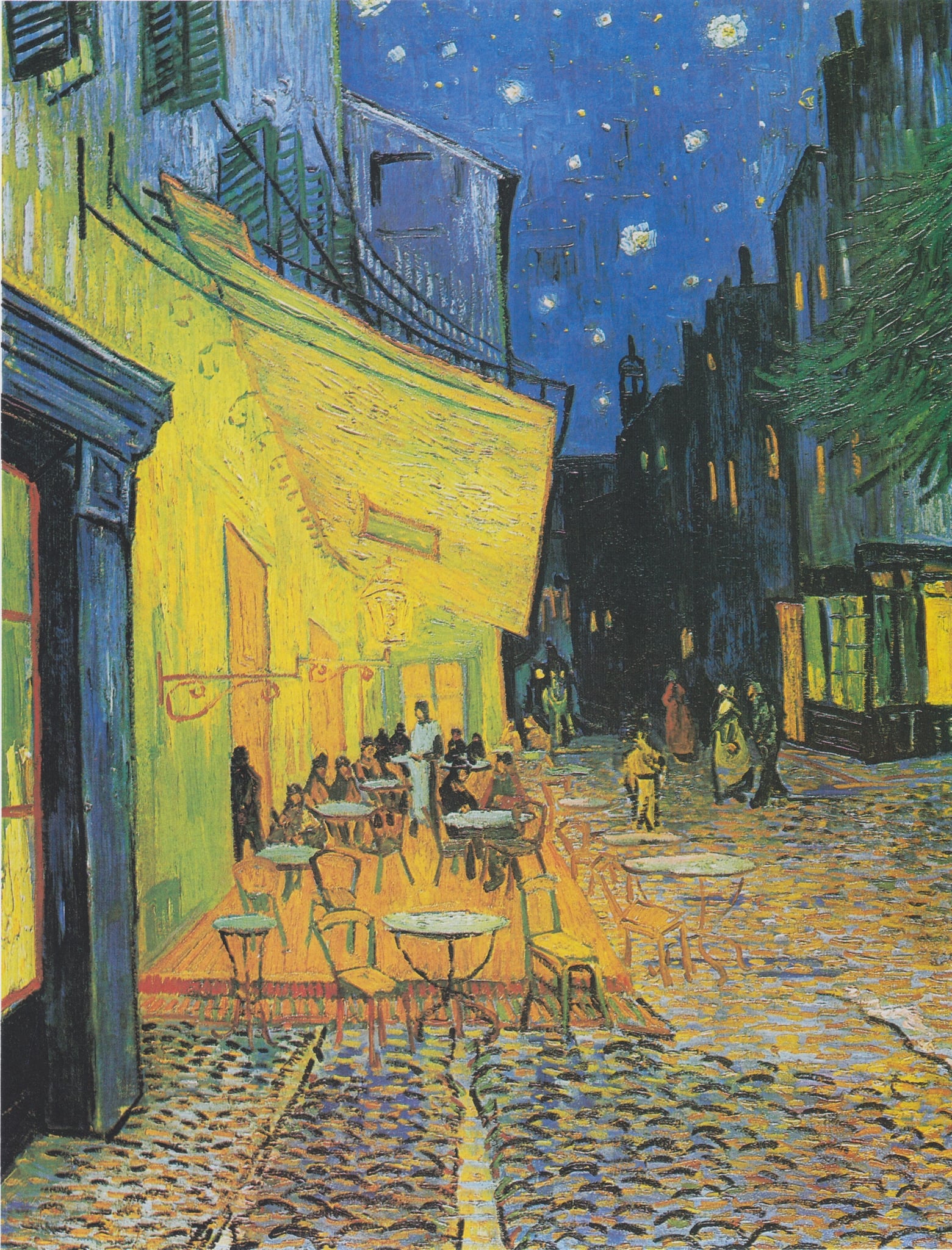
Café Terrace at Night by Vincent van Gogh

Café Terrace at Night

Vincent van Gogh (1888)

In Café Terrace at Night, Vincent van Gogh turns nocturne into <strong>luminous color</strong>: a gas‑lit terrace glows in yellows and oranges against a deep <strong>ultramarine sky</strong> pricked with stars. By building night “<strong>without black</strong>,” he stages a vivid encounter between human sociability and the vastness overhead <sup>[1]</sup><sup>[2]</sup>.
Red Cabbages and Onions by Vincent van Gogh

Red Cabbages and Onions

Vincent van Gogh (1887)

In Red Cabbages and Onions, Vincent van Gogh turns everyday produce into a drama of <strong>complementary color</strong> and <strong>restless brushwork</strong>. Hot red contours cinch violet cabbages and pale yellow bulbs against a cool, striated blue table, while a mustard‑yellow patch in the upper right tilts the space and sharpens the chromatic clash. The result asserts ordinary food as a locus of <strong>resilience</strong> and <strong>experimentation</strong> <sup>[1]</sup><sup>[2]</sup>.

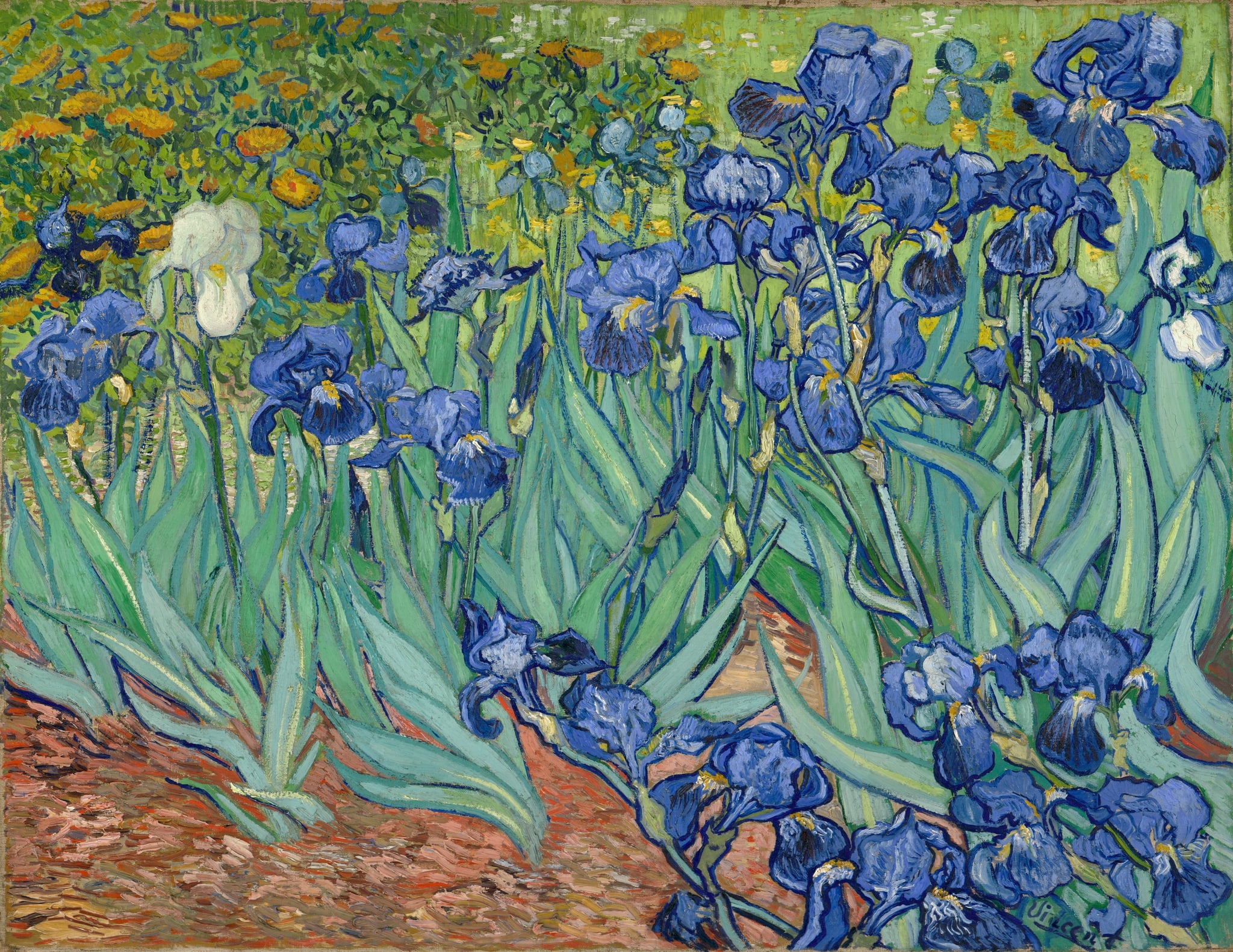
Irises by Vincent van Gogh

Irises

Vincent van Gogh (1889)

Painted in May 1889 at the Saint-Rémy asylum garden, Vincent van Gogh’s <strong>Irises</strong> turns close observation into an act of repair. Dark contours, a cropped, print-like vantage, and vibrating complements—violet/blue blossoms against <strong>yellow-green</strong> ground—stage a living frieze whose lone <strong>white iris</strong> punctuates the field with arresting clarity <sup>[1]</sup><sup>[2]</sup>.
Sunflowers by Vincent van Gogh

Sunflowers

Vincent van Gogh (1888)

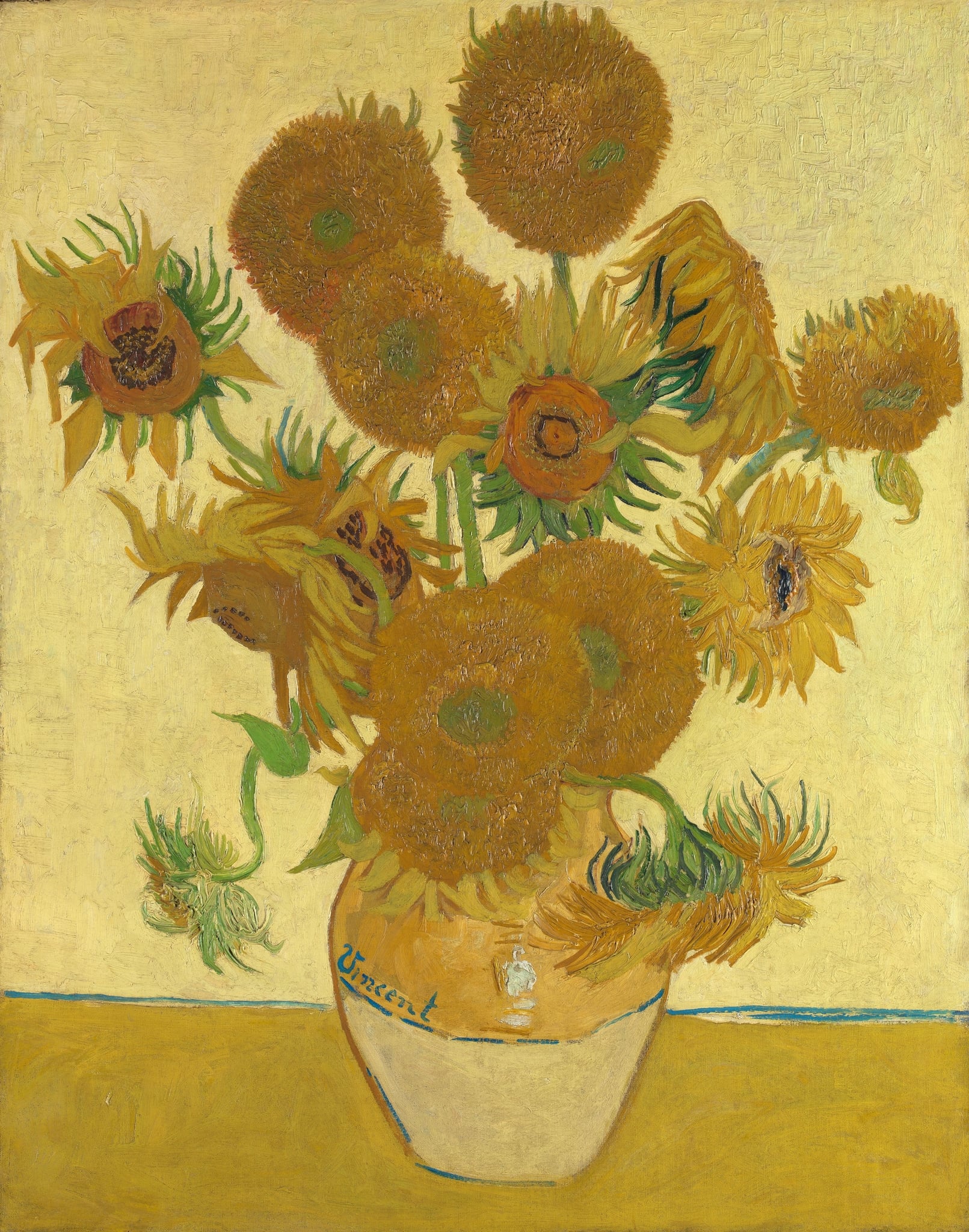
Vincent van Gogh’s Sunflowers (1888) is a <strong>yellow-on-yellow</strong> still life that stages a full <strong>cycle of life</strong> in fifteen blooms, from fresh buds to brittle seed heads. The thick impasto, green shocks of stem and bract, and the vase signed <strong>“Vincent”</strong> turn a humble bouquet into an emblem of endurance and fellowship <sup>[1]</sup><sup>[2]</sup>.

Garden with Courting Couples: Square Saint-Pierre by Vincent van Gogh

Garden with Courting Couples: Square Saint-Pierre

Vincent van Gogh (1887)

In Garden with Courting Couples: Square Saint-Pierre, Vincent van Gogh turns a small Montmartre park into a stage where <strong>spring</strong>, <strong>intimacy</strong>, and <strong>urban leisure</strong> converge. Short, shimmering strokes fuse pink chestnut blossoms, curving paths, and paired figures into one pulse of <strong>renewal</strong> and <strong>togetherness</strong> <sup>[1]</sup><sup>[2]</sup>.

In the Café: Agostina Segatori in Le Tambourin by Vincent van Gogh

In the Café: Agostina Segatori in Le Tambourin

Vincent van Gogh (1887 (Jan–Mar))

Van Gogh casts Agostina Segatori at a tiny, tambourine‑like café table, turning Le Tambourin into a <strong>stage of modern life</strong>. Cool greens and greys make the red <strong>flame‑plume hat</strong> and the foaming <strong>beer</strong> flare, while folded arms and a set‑aside <strong>parasol</strong> register private fatigue amid public display <sup>[1]</sup><sup>[2]</sup><sup>[3]</sup>.