Tree Roots

by Vincent van Gogh

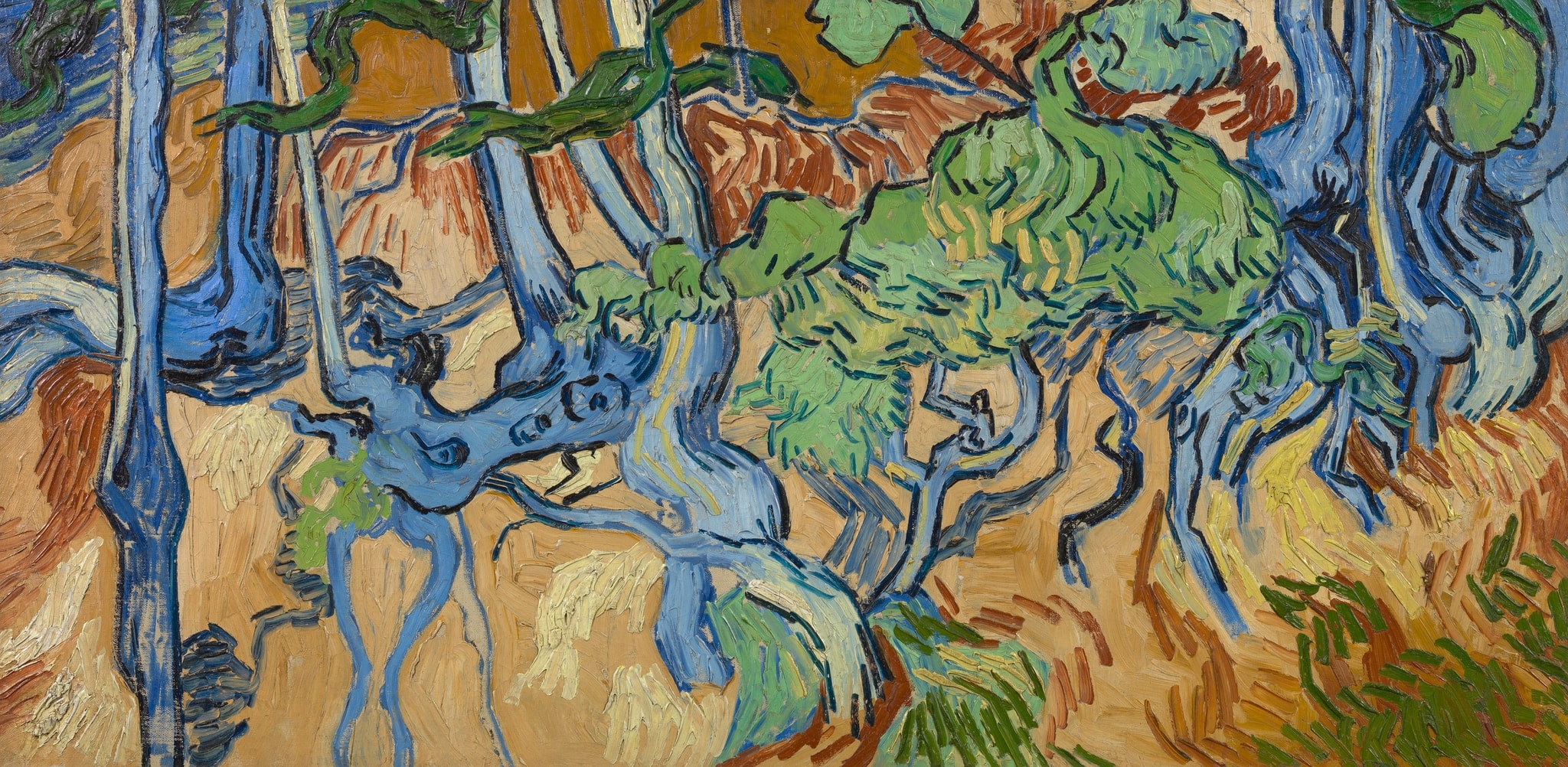
Tree Roots is a late Auvers canvas in a rare, elongated "double‑square" format that compresses the view to nothing but interlaced trunks and roots. Thick, cobalt‑blue contours and vibrating oranges/ochres forge a field of near‑abstraction, turning a roadside bank into a charged meditation on resilience and exposure [1][6][2].
💰

Market Value

$130-180 million

How much is Tree Roots worth?

Study Print Studio

Create a personal study print

Build a companion study sheet around the part of this painting that speaks to you most. Choose a detail, shape an interpretation, and walk away with something personal and display-worthy.

Fast Facts

Year
1890
Medium
Oil on canvas
Dimensions
50.3 × 100.1 cm
Location
Van Gogh Museum, Amsterdam
See all Vincent van Gogh paintings in Amsterdam
Tree Roots by Vincent van Gogh (1890) featuring Interlaced blue roots and trunks, Exposed sandy bank, New green shoots and leaf-clumps, Diagonal thrusting strokes

Click on any numbered symbol to learn more about its meaning

Meaning & Symbolism

Van Gogh locks our gaze into a trench of trunks and roots, cropped so tightly that sky and horizon vanish. Across the double‑square span, heavy Prussian‑blue and cobalt outlines bend around sinewy forms, cutting through sandy ochres while smaller strokes of sap and viridian signal shoots that refuse to die back 18. The left half masses thick blue trunks that pivot and knot; the right half accelerates into curling, twig‑like tendrils beneath a thicket of leafed green, the paint laid in short, pressurized dashes. This horizonless press of matter is decisive: by denying distance, Van Gogh converts a slope near Rue Daubigny into an all‑over cadence of thrust and counter‑thrust, where direction lines surge diagonally upward even as roots burrow down 25. That structural contradiction—rising vectors in a subject about anchorage—embodies the motive force of the picture: being held and being torn at once. The museum’s observation that the lower left remains unfinished heightens that sense of interruption; a pale ground peeks through under sketchy, vertical strokes, as if the action of painting had been caught mid‑breath 2. The iconography of roots was long prepared in Van Gogh’s thought. Years earlier he wrote of rendering “life’s struggle” in “gnarled black roots… frantically and fervently rooting… yet half torn up by the storm” 3. In Auvers he would write that his own life felt “attacked at the very root,” a phrase that retrospectively seems to key the subject’s urgency 4. Yet Tree Roots resists being reduced to mere despair. Andries Bonger remembered that the morning before the shooting Van Gogh painted a sous‑bois full of sun and life; the chromatic evidence is here: hot ochres broken by yellow streaks, and living greens punched across the surface 2. The painting’s importance lies in how these emotional vectors are carried not by motif alone but by formal means—by the elastic contour that binds disparate parts, by the near‑abstract tessellation of color fields, and by the panoramic, double‑square sweep that Van Gogh adopted in Auvers precisely to stretch landscape into a new register 62. Within the broader sous‑bois tradition, his radical cropping and surface‑filling rhythms push close‑up woodland to the brink of abstraction, a move scholars cite when identifying him as a forerunner of twentieth‑century nonobjective painting 7210. Technically, the final, dark blue bounding lines weld this complexity into legibility, keeping the tumult coherent while allowing the viewer to feel the heave of ground and sap 8. Because the exact site has been identified on Rue Daubigny, about 150 meters from the Auberge Ravoux, the image can be anchored to Van Gogh’s last walking loop, underlining its immediacy as a plein‑air encounter rather than a studio conceit 5. In that light, the painting reads as a testament to vitality: not a farewell, but a last, concentrated attempt to translate nature’s underlying structures—the knots, bifurcations, and shoots of survival—into color‑driven form. The meaning of Tree Roots, then, is double: it is both a symbol of attachment and exposure and an experimental field where line and color carry feeling as powerfully as representation. Why Tree Roots is important is that it makes this double meaning visible at full scale and at the very end: a culmination in which biography, site, motif, and pictorial invention lock together into one restless, living surface 125.

Explore Deeper with AI

Ask questions about Tree Roots

Popular questions:

Powered by AI • Get instant insights about this artwork

💬 Ask questions about this artwork!

Interpretations

Formal Analysis: All-over field and the double-square

Tree Roots replaces depth with an all-over screen of thrusting contours and interlocked color patches that run the length of the late Auvers double‑square format. The horizonless crop behaves like a woven lattice: Prussian‑blue bounding lines seam together ochres and greens, preventing collapse into chaos while keeping the eye in restless circulation 18. This is sous‑bois pushed to its limit—close‑up woodland recoded as a rhythmic surface—aligning the work with the “almost abstract” patterning scholars identify across Van Gogh’s forest interiors 6. The elongated canvas is not just a size but a device: it amplifies diagonal vectors and lateral spread, allowing roots to read as forces rather than objects. In this register, representation yields to pictorial structure, staging a laboratory of color‑line interactions that prefigure modernist flatness 126.

Source: Van Gogh Museum; Cincinnati Art Museum; ARTE technical dossier

Psychological Interpretation: Roots as an index of strain and persistence

Van Gogh had long coded roots as a sign for “life’s struggle”—“gnarled… frantically and fervently rooting… yet half torn up by the storm” (1882) 3. In Auvers he wrote, “my life, too, is attacked at the very root” (ca. July 10, 1890) 4. Read through these letters, Tree Roots visualizes ambivalence: anchorage and exposure, growth and wounding. Yet the palette resists elegy. Andries Bonger recalled that the picture painted that morning was a sous‑bois “full of sun and life,” a testimony the museum uses to temper fatalistic readings 2. The result is not a coded farewell but a heightened record of psychic dynamics externalized as vector and color—a mind mapping its pressures onto matter. The painting thus becomes an affective diagram, where survival and strain are rendered as interlocked formal tensions 234.

Source: Van Gogh Letters; Van Gogh Museum

Topography & Last-Day Chronology: Rue Daubigny as stage

The motif’s exact site—an eroded marl bank with timber trees on Rue Daubigny, c. 150 meters from the Auberge Ravoux—has been confirmed by the Van Gogh Museum using historical photography 5. This anchors Tree Roots within Vincent’s final walking loop and corroborates curatorial claims that he worked on it the morning of July 27, 1890, before the shooting that evening 2. Far from a studio allegory, the painting reads as a plein‑air confrontation with a local cut bank, where exposed roots supplied a ready‑made structure for the all‑over field. The identification also clarifies scale relations (trunks vs. tendrils) and the steepness of the slope, aligning observed features with compositional diagonals. Topography here is not backdrop but engine: site conditions—erosion, timbering, sprouting—generate the picture’s form and its volatile, time‑bound charge 259.

Source: Van Gogh Museum; The Art Newspaper (Martin Bailey)

Reception & Influence: Proto-abstraction and modernist lineage

Museum texts emphasize the canvas’s near‑abstraction, its “virtually unrecognizable forms, powerful lines, and vivid colours,” positioning Van Gogh as a forerunner of twentieth‑century nonobjective painting 12. In the sous‑bois tradition, he radicalizes cropping and surface saturation, trading picturesque woodland narrative for a field of optical energies 6. The painting’s legibility depends less on motif than on structural equivalences (line = force; color = temperature), a shift modernists would codify. Read this way, Tree Roots is less epilogue than prototype: it models how a fragment of nature can be retooled into pattern, presaging the formalism of abstraction while preserving phenomenological bite. Its double‑square spread and contour welding anticipate later concerns with the edge, the all‑over, and the autonomy of the picture plane 126.

Source: Van Gogh Museum; Cincinnati Art Museum

Technical/Process Study: Unfinishedness and blue welding lines

The lower left shows pale ground and sketchy verticals, evidence of an interrupted session that supports its status as the likely last painting 12. Across the surface, heavy applications of Prussian blue and cobalt form terminal outlines that “weld” disparate passages into coherence—a late‑period strategy noted in technical dossiers 8. Seen up close, the picture toggles between laid‑on impasto and scumbled passages; ochres are slit by yellow streaks, and greens oscillate between sap and viridian, producing micro‑contrasts that keep the surface optically active 18. The process is additive and corrective: bounding lines are drawn last to bind color fields, revealing a choreography in which drawing completes painting. Unfinishedness here is not deficit but diagnostic—a window onto Van Gogh’s stepwise construction of an all‑over image 128.

Source: Van Gogh Museum; ARTE technical dossier

Work Regimen & Format Innovation: Auvers as a pressure cooker

In roughly seventy days at Auvers, Van Gogh produced about 70–75 paintings, often working outdoors in the morning and continuing later—an industrial tempo that contextualizes the canvas’s urgency 7. The elongated double‑square format, frequently used in these weeks, let him stretch landscape into a panoramic band where lateral motion competes with vertical rooting—an ideal armature for the roots’ thrust and counter‑thrust 27. The regimen matters: speed sharpened decisions, favoring brisk, pressurized dashes and late contouring that keep the image both legible and volatile. Tree Roots thus documents not just a subject but a method under pressure, where format, schedule, and site conspire to push representation toward an experimental brink 27.

Source: Associated Press; Van Gogh Museum

Related Themes

About Vincent van Gogh

Vincent van Gogh (1853–1890) developed a radical, emotion‑driven use of color after moving from Paris to Arles in 1888, seeking southern light and an artists’ community. In Arles he created the Sunflowers series to decorate the Yellow House ahead of Gauguin’s visit. His late work fused impasto, high chroma, and symbolic motifs that shaped modern painting [2][5].
View all works by Vincent van Gogh

More by Vincent van Gogh
Café Terrace at Night by Vincent van Gogh

Café Terrace at Night

Vincent van Gogh (1888)

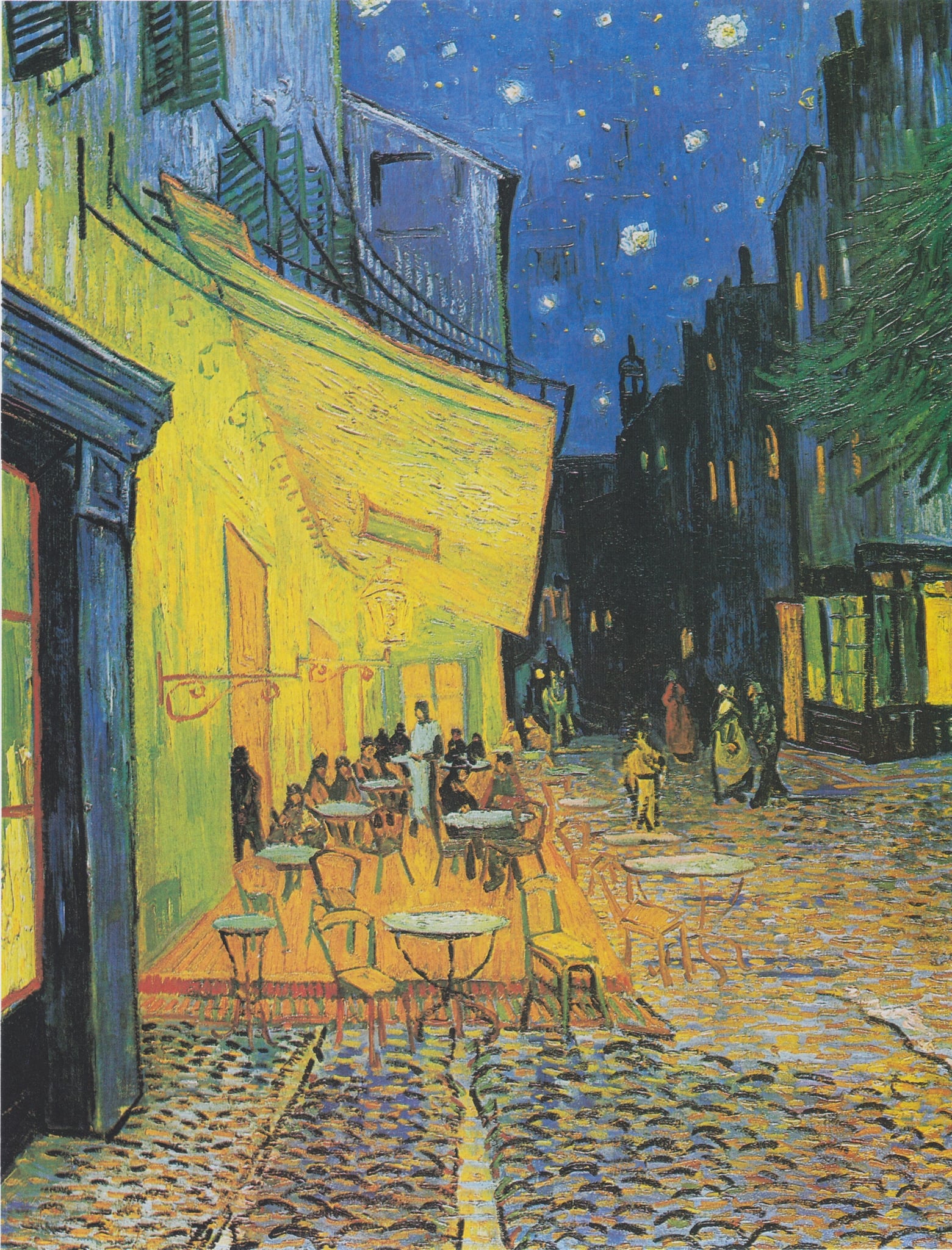
In Café Terrace at Night, Vincent van Gogh turns nocturne into <strong>luminous color</strong>: a gas‑lit terrace glows in yellows and oranges against a deep <strong>ultramarine sky</strong> pricked with stars. By building night “<strong>without black</strong>,” he stages a vivid encounter between human sociability and the vastness overhead <sup>[1]</sup><sup>[2]</sup>.
Red Cabbages and Onions by Vincent van Gogh

Red Cabbages and Onions

Vincent van Gogh (1887)

In Red Cabbages and Onions, Vincent van Gogh turns everyday produce into a drama of <strong>complementary color</strong> and <strong>restless brushwork</strong>. Hot red contours cinch violet cabbages and pale yellow bulbs against a cool, striated blue table, while a mustard‑yellow patch in the upper right tilts the space and sharpens the chromatic clash. The result asserts ordinary food as a locus of <strong>resilience</strong> and <strong>experimentation</strong> <sup>[1]</sup><sup>[2]</sup>.

Irises by Vincent van Gogh

Irises

Vincent van Gogh (1889)

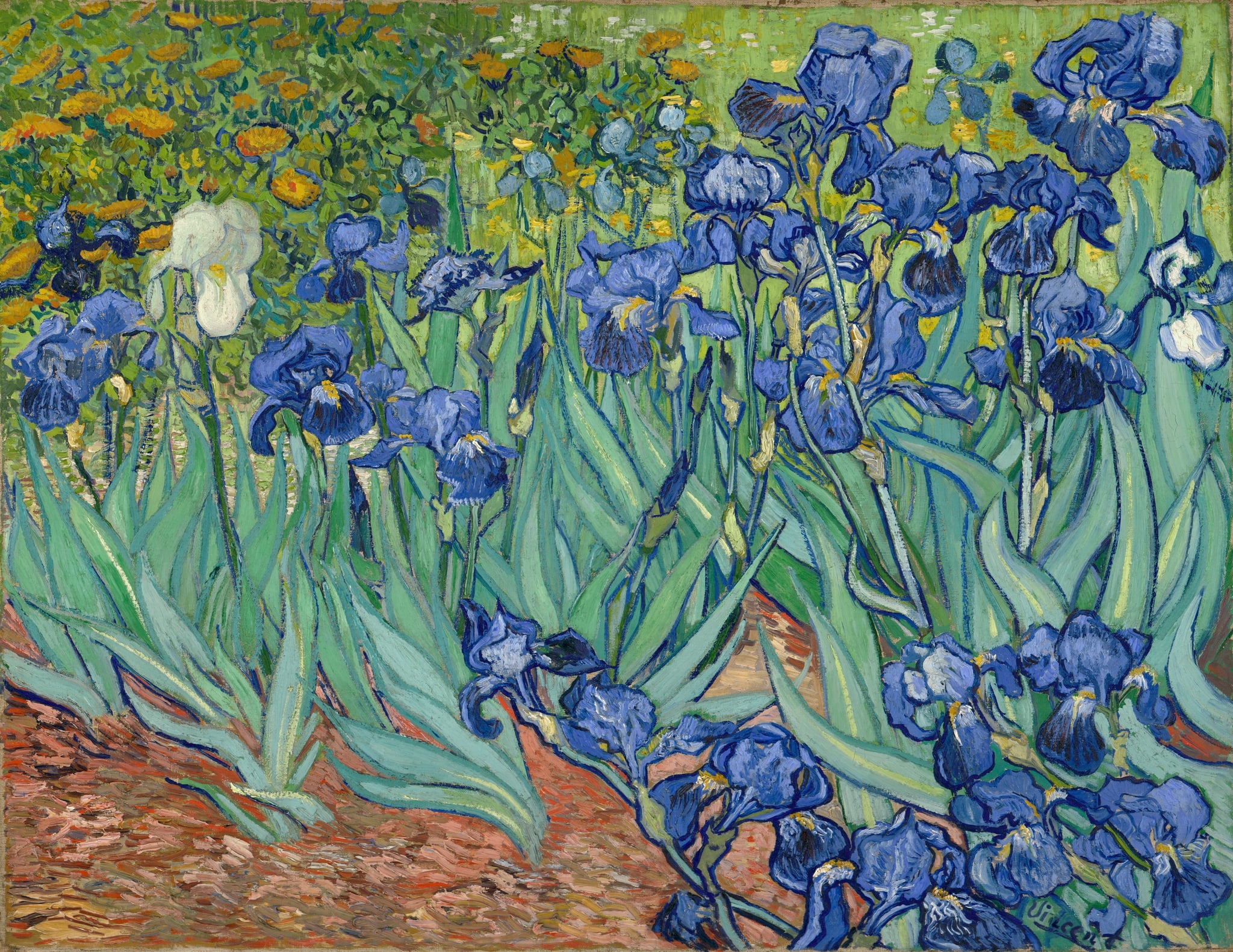
Painted in May 1889 at the Saint-Rémy asylum garden, Vincent van Gogh’s <strong>Irises</strong> turns close observation into an act of repair. Dark contours, a cropped, print-like vantage, and vibrating complements—violet/blue blossoms against <strong>yellow-green</strong> ground—stage a living frieze whose lone <strong>white iris</strong> punctuates the field with arresting clarity <sup>[1]</sup><sup>[2]</sup>.
Sunflowers by Vincent van Gogh

Sunflowers

Vincent van Gogh (1888)

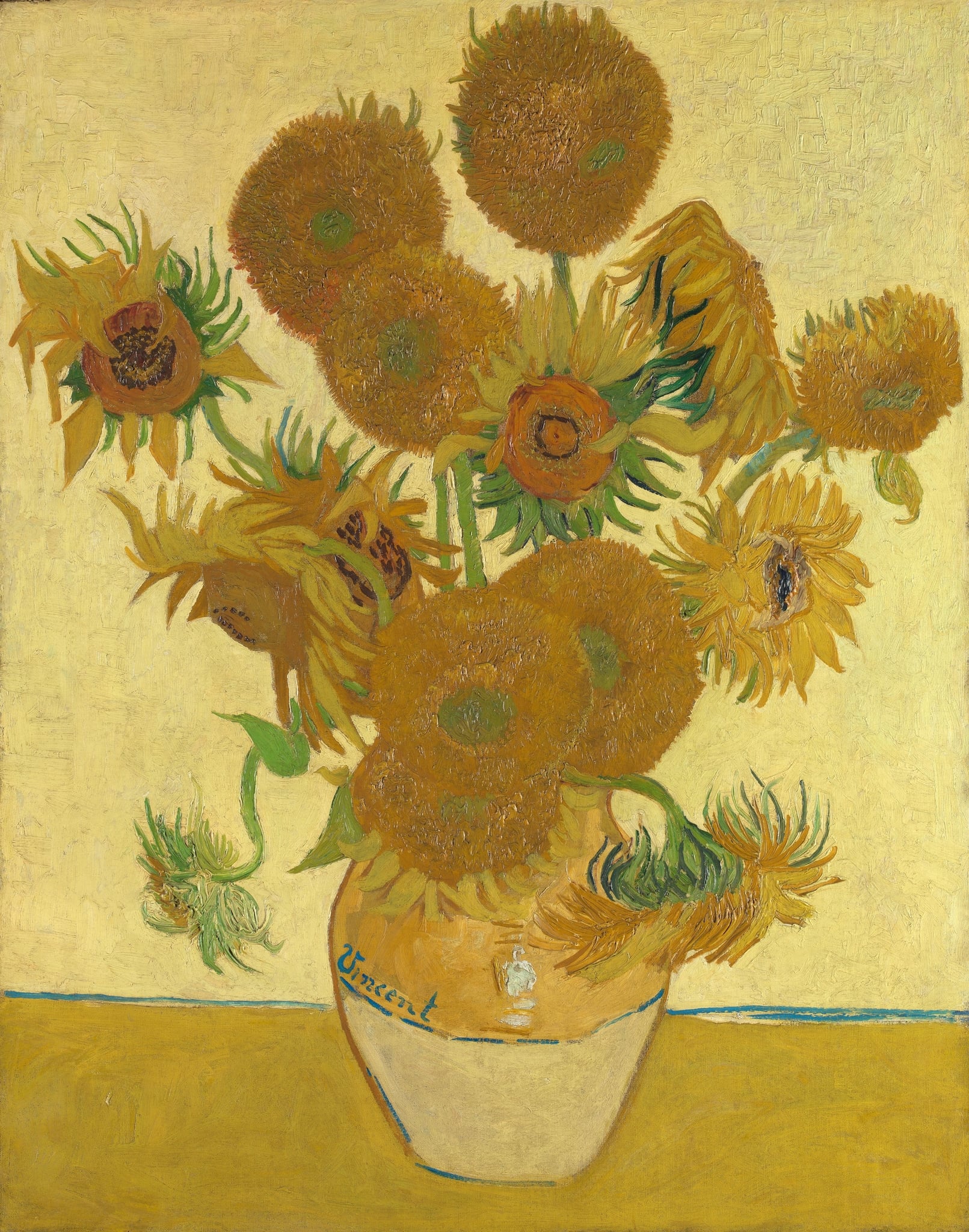
Vincent van Gogh’s Sunflowers (1888) is a <strong>yellow-on-yellow</strong> still life that stages a full <strong>cycle of life</strong> in fifteen blooms, from fresh buds to brittle seed heads. The thick impasto, green shocks of stem and bract, and the vase signed <strong>“Vincent”</strong> turn a humble bouquet into an emblem of endurance and fellowship <sup>[1]</sup><sup>[2]</sup>.

Garden with Courting Couples: Square Saint-Pierre by Vincent van Gogh

Garden with Courting Couples: Square Saint-Pierre

Vincent van Gogh (1887)

In Garden with Courting Couples: Square Saint-Pierre, Vincent van Gogh turns a small Montmartre park into a stage where <strong>spring</strong>, <strong>intimacy</strong>, and <strong>urban leisure</strong> converge. Short, shimmering strokes fuse pink chestnut blossoms, curving paths, and paired figures into one pulse of <strong>renewal</strong> and <strong>togetherness</strong> <sup>[1]</sup><sup>[2]</sup>.

In the Café: Agostina Segatori in Le Tambourin by Vincent van Gogh

In the Café: Agostina Segatori in Le Tambourin

Vincent van Gogh (1887 (Jan–Mar))

Van Gogh casts Agostina Segatori at a tiny, tambourine‑like café table, turning Le Tambourin into a <strong>stage of modern life</strong>. Cool greens and greys make the red <strong>flame‑plume hat</strong> and the foaming <strong>beer</strong> flare, while folded arms and a set‑aside <strong>parasol</strong> register private fatigue amid public display <sup>[1]</sup><sup>[2]</sup><sup>[3]</sup>.