Religion
Religious symbolism in Western art evolves from doctrinal sign to reflexive visual language, as artists mobilize recurring motifs—gesture, light, crowning, sacrificial instruments—to negotiate the relation of human history to divine agency.
Member Symbols
Featured Artworks
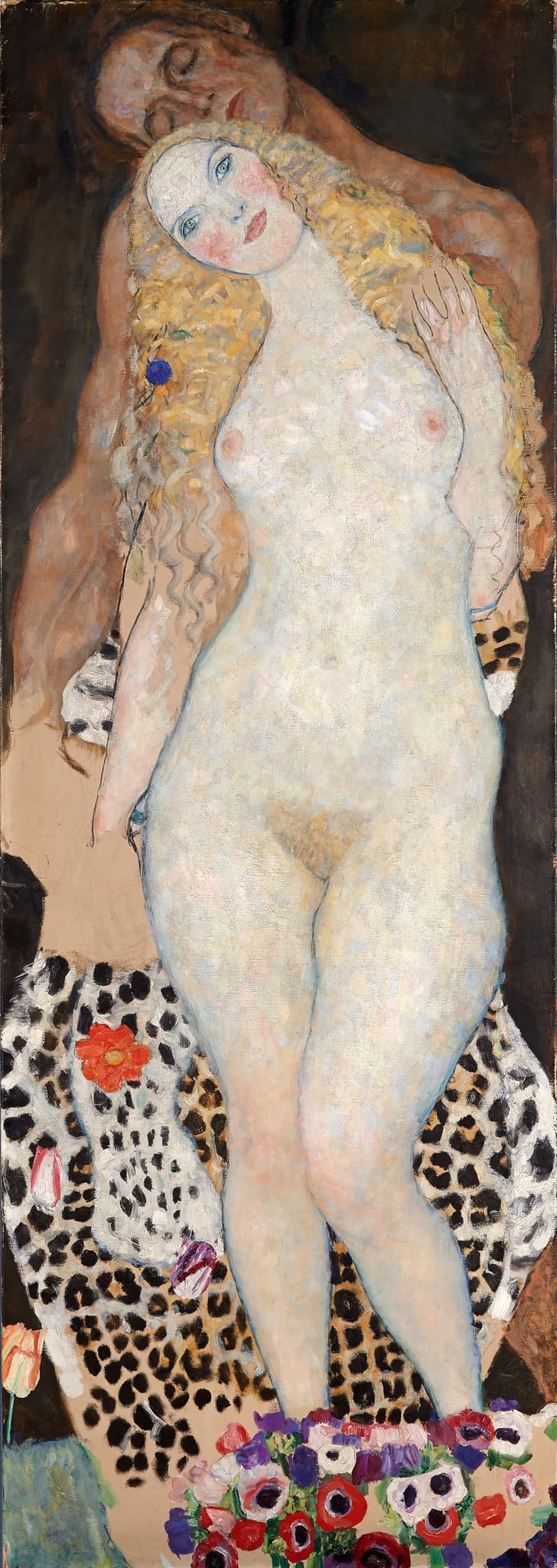
Adam and Eve
Gustav Klimt (1916–1918 (unfinished))
Gustav Klimt’s Adam and Eve recasts the biblical pair as a <strong>sensual, timeless allegory</strong> rather than a didactic tale. Eve’s <strong>luminous, opalescent body</strong> and direct gaze dominate, while Adam recedes in shadow, enfolding her amid a <strong>leopard pelt</strong> and a <strong>carpet of anemones</strong> that signal erotic vitality and fertility <sup>[2]</sup><sup>[3]</sup>.
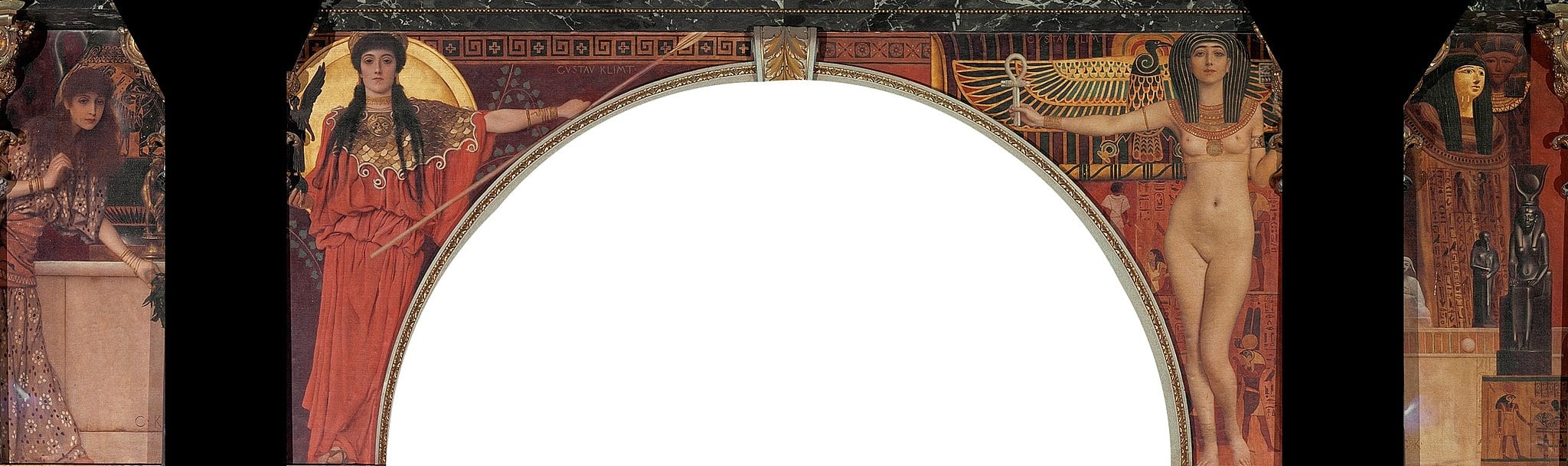
Ancient Greece and Egypt
Gustav Klimt (1891)
Gustav Klimt’s staircase pair Ancient Greece and Egypt stages two <strong>female allegories</strong> flanking an empty arch: a robed, animated <strong>Athena</strong> to the left and a frontal, nude Egyptian goddess aligned with <strong>Nekhbet’s vulture</strong> to the right. Klimt fuses collection-based citations with <strong>ornamental gold, red, and black</strong> to declare a canon in which Western art passes through Greece’s humanist clarity and Egypt’s sacral permanence <sup>[1]</sup><sup>[2]</sup><sup>[3]</sup>.
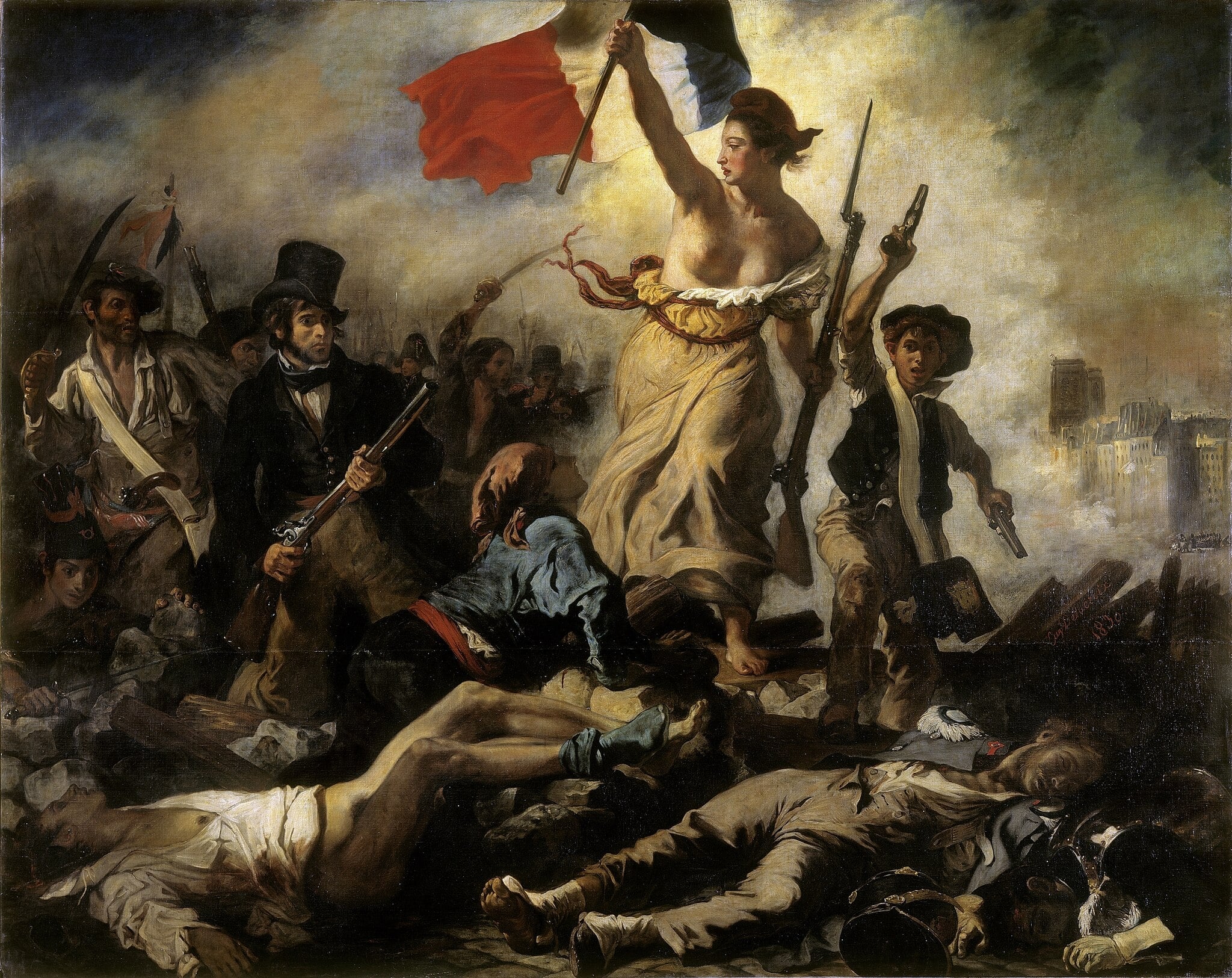
Liberty Leading the People
Eugene Delacroix (1830)
<strong>Liberty Leading the People</strong> turns a real street uprising into a modern myth: a bare‑breasted Liberty in a <strong>Phrygian cap</strong> thrusts the <strong>tricolor</strong> forward as Parisians of different classes surge over corpses and rubble. Delacroix binds allegory to eyewitness detail—Notre‑Dame flickers through smoke, a bourgeois in a top hat shoulders a musket, and a pistol‑waving boy keeps pace—so that freedom appears as both idea and action <sup>[1]</sup><sup>[2]</sup>. After its 2024 cleaning, sharper blues, whites, and reds re‑ignite the painting’s charged color drama <sup>[4]</sup>.
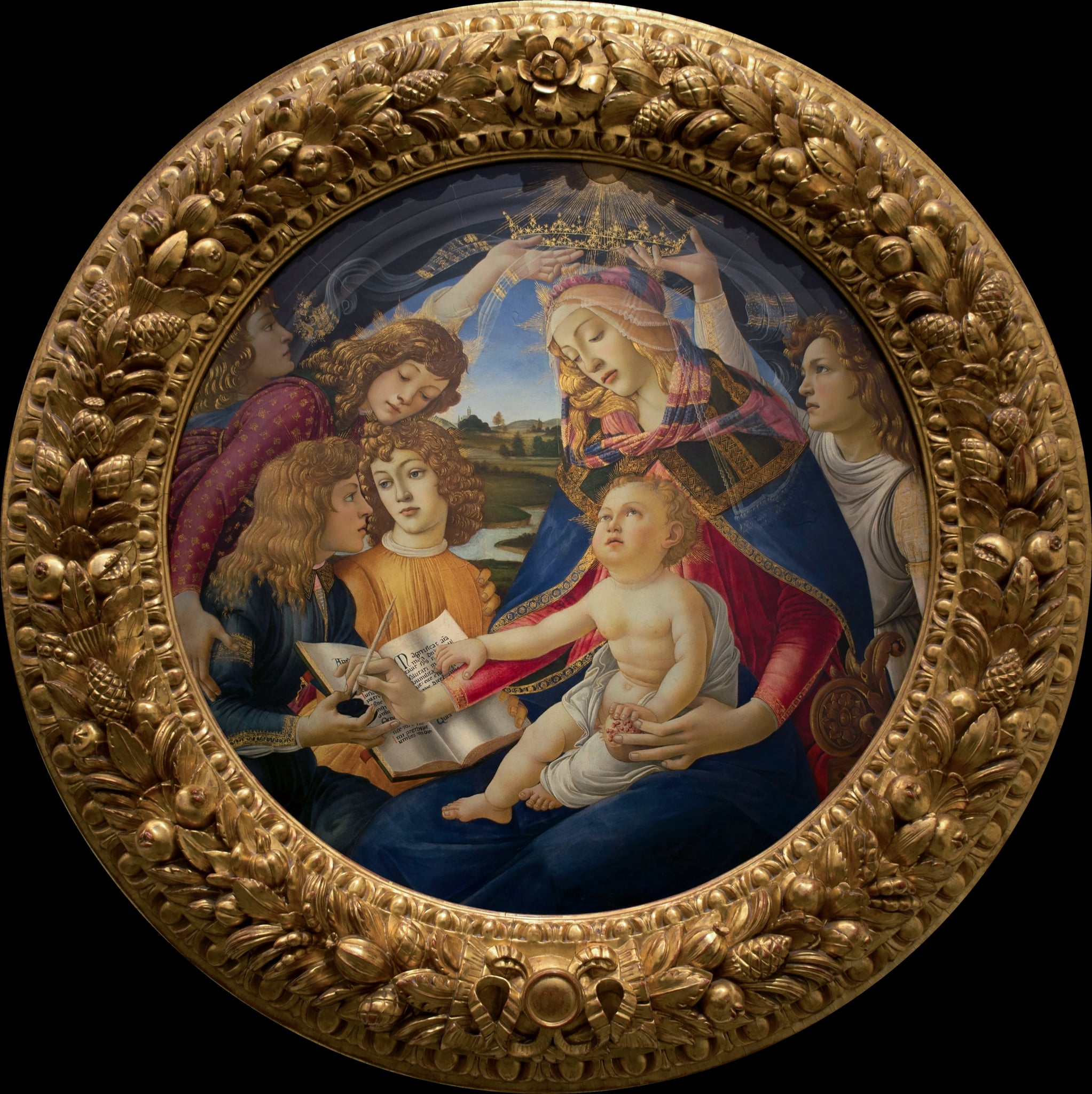
Madonna of the Magnificat
Sandro Botticelli (c. 1483)
Botticelli’s Madonna of the Magnificat is a circular panel where the Virgin, <strong>crowned by angels</strong>, writes the <strong>Magnificat</strong> as the Christ Child guides her hand. A split <strong>pomegranate</strong> in the Child’s grasp prefigures the Passion while the wingless, courtly angels and a Tuscan view bind sacred mystery to Florentine life <sup>[1]</sup><sup>[2]</sup>. The tondo’s swirl of fabrics and gold makes theology visible as a choreography of <strong>praise, prophecy, and sacrifice</strong>.
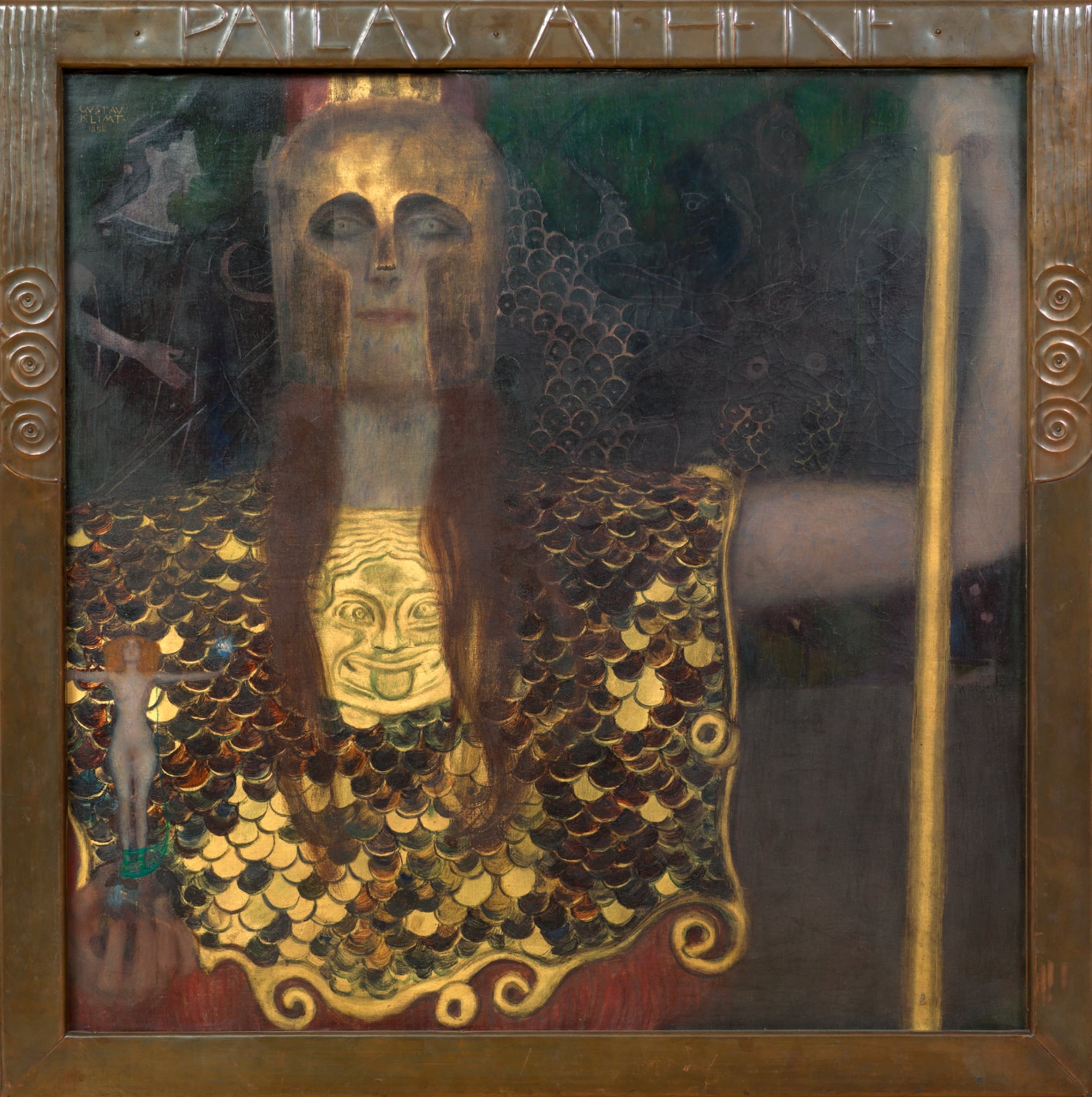
Pallas Athena
Gustav Klimt (1898)
Pallas Athena confronts the viewer as a <strong>frontal icon of power</strong>: helmeted, impassive, and armored in <strong>gleaming scale aegis</strong> crowned by a <strong>gorgoneion</strong>. Klimt fuses archaic authority with modern ornament to proclaim <strong>Vienna Secession</strong> ideals—reason, strategy, and artistic truth held in a single, implacable image <sup>[1]</sup><sup>[2]</sup>.
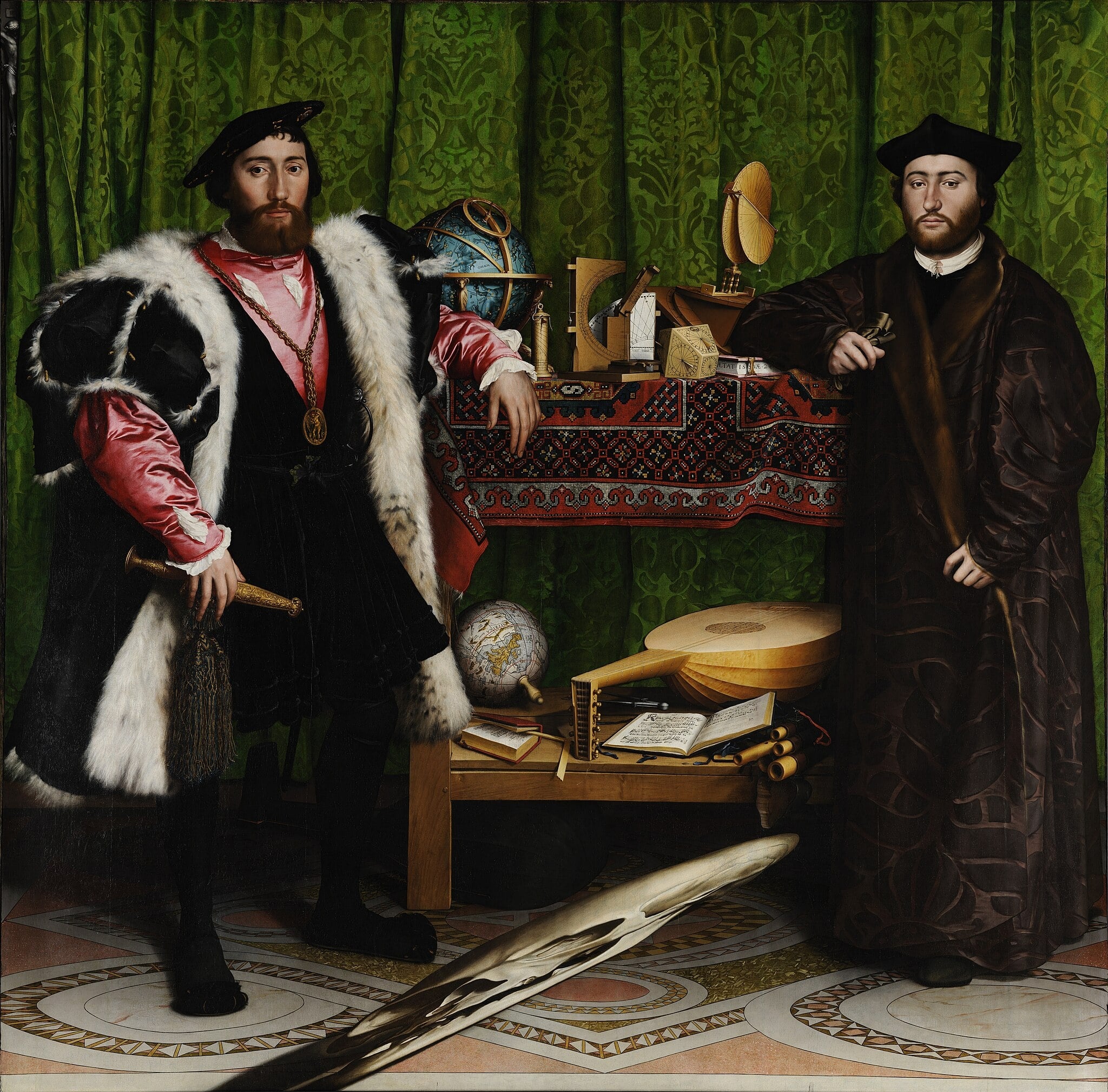
The Ambassadors
Hans Holbein the Younger (1533)
Holbein’s The Ambassadors is a double-portrait staged before a green curtain, where shelves of scientific instruments, books, and musical devices enact <strong>Renaissance learning</strong> while an anamorphic <strong>skull</strong> and a veiled <strong>crucifix</strong> counter it with mortality and salvation <sup>[1]</sup><sup>[2]</sup>. The work balances worldly status—fur, velvet, Oriental carpet—with a sober theology of limits amid the <strong>Reformation’s discord</strong> <sup>[1]</sup><sup>[2]</sup>.
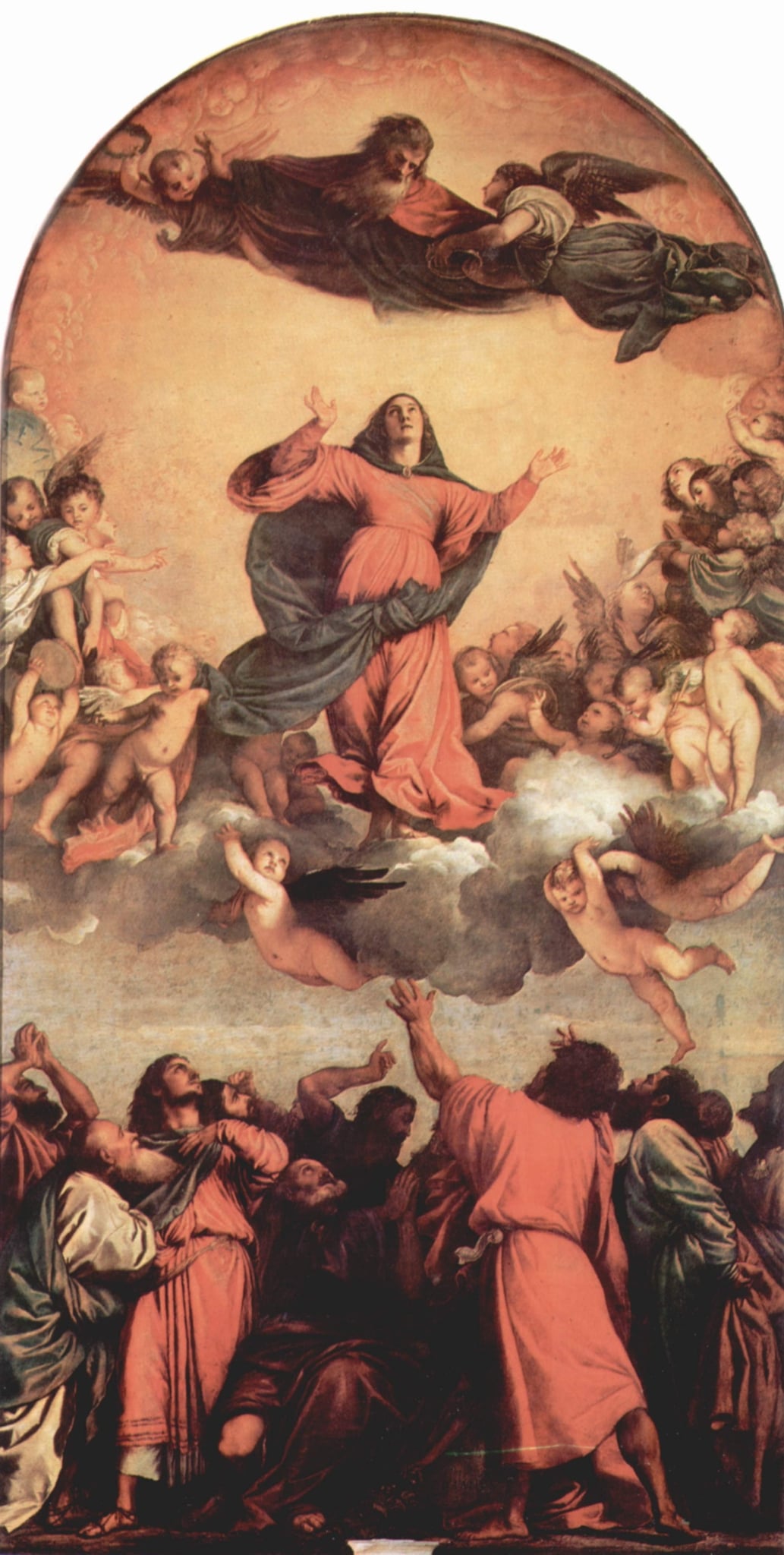
The Assumption of the Virgin
Titian (1516–1518)
Titian’s The Assumption of the Virgin stages a three-tier ascent—apostles below, Mary rising on clouds, and God the Father above—fused by radiant light and Venetian <strong>colorito</strong>. Mary’s red and blue drapery, open <strong>orant</strong> hands, and the vortex of putti visualize grace lifting humanity toward the divine. The painting’s scale and kinetic design turned a doctrinal mystery into a public, liturgical drama for Venice. <sup>[1]</sup><sup>[2]</sup>
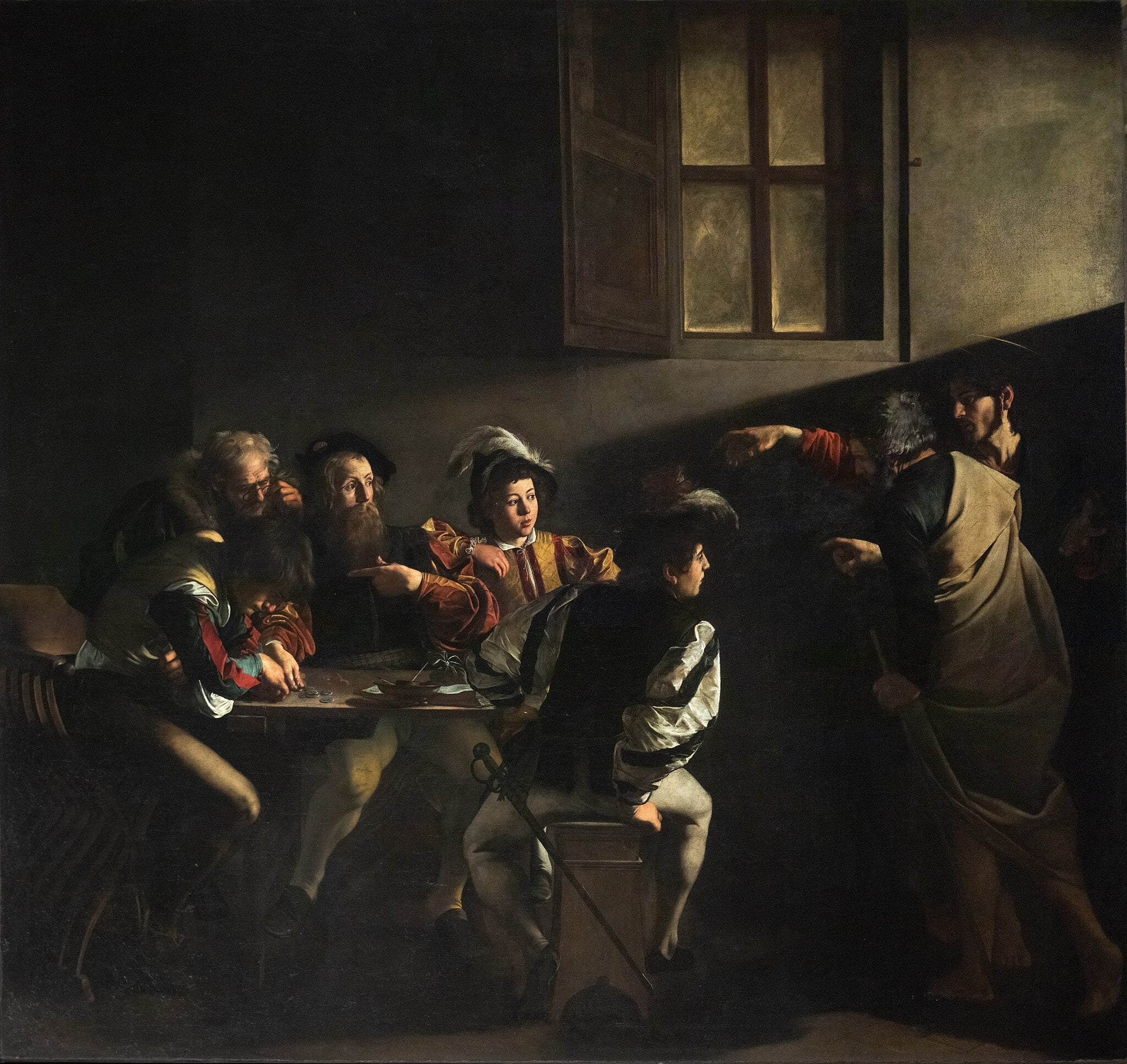
The Calling of Saint Matthew
Caravaggio (1599–1600)
Caravaggio’s The Calling of Saint Matthew stages the instant when <strong>divine grace</strong> pierces ordinary life. A diagonal <strong>beam of light</strong> and Christ’s <strong>Sistine‑echoing hand</strong> single out Matthew at a money table, suspending time between hesitation and assent <sup>[2]</sup><sup>[3]</sup>. The painting fuses Baroque <strong>tenebrism</strong> with contemporary dress to dramatize conversion as a public, present-tense event <sup>[1]</sup><sup>[2]</sup>.
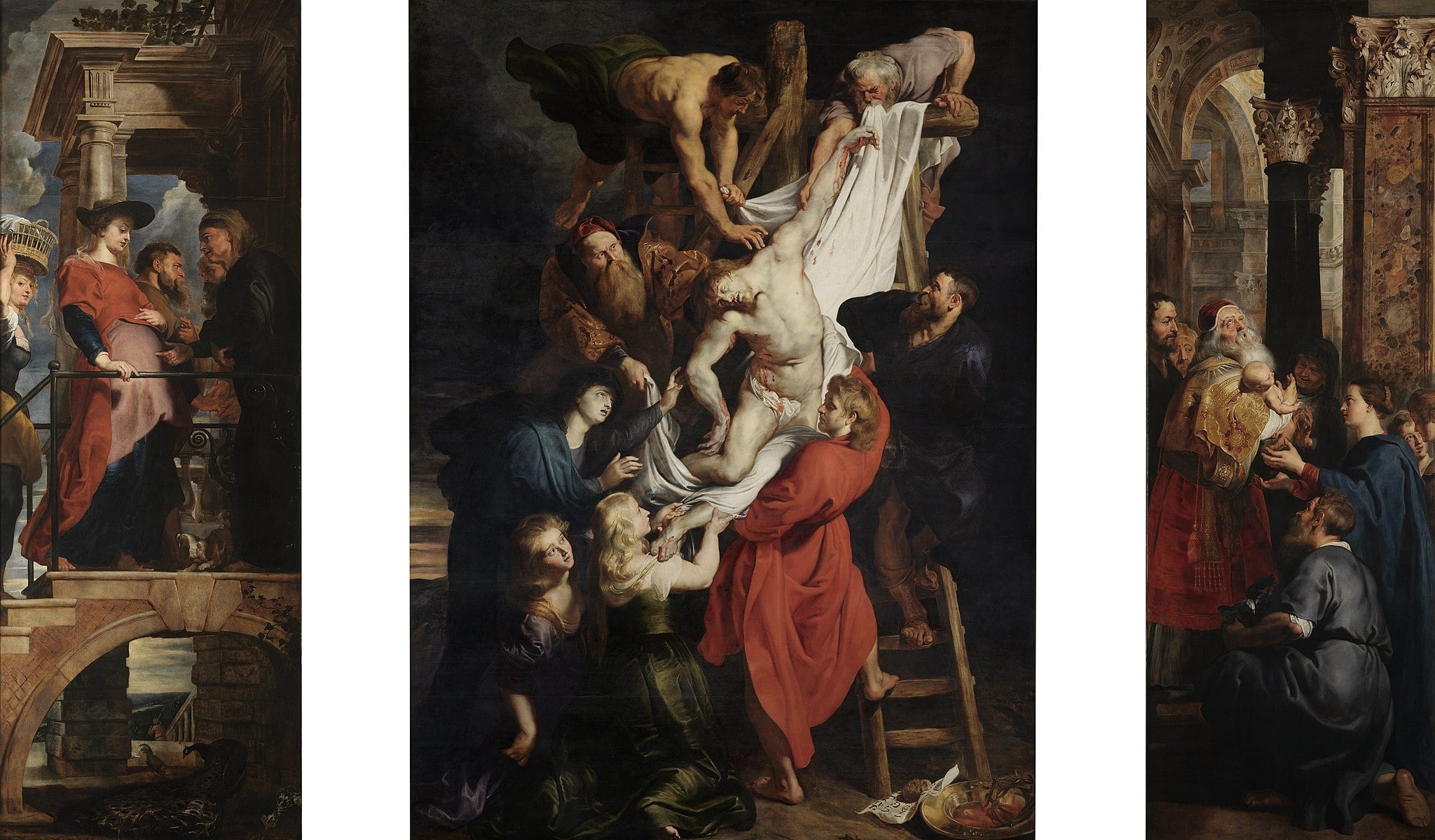
The Descent from the Cross
Peter Paul Rubens (1611–1614)
At night beneath a black sky, The Descent from the Cross stages a solemn transfer of Christ’s body along a luminous <strong>white shroud</strong> that cuts diagonally across the scene. The flanking wings—<strong>The Visitation</strong> and <strong>The Presentation in the Temple</strong>—frame the central tragedy with beginnings and revelation, turning the triptych into a single arc from Incarnation to Redemption. Rubens fuses <strong>Baroque chiaroscuro</strong> with tender, communal gestures to make grief a shared act of devotion.
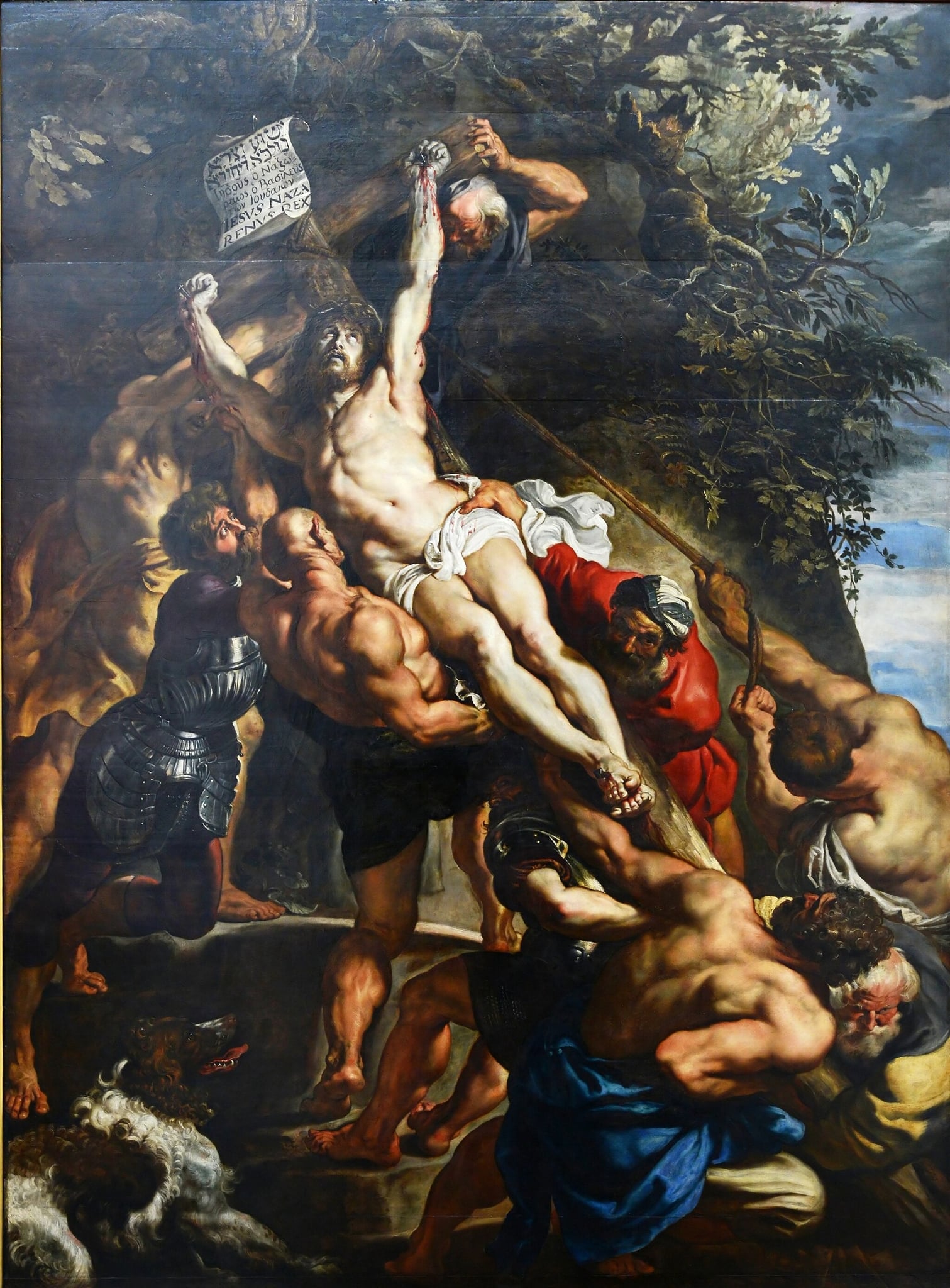
The Elevation of the Cross
Peter Paul Rubens (1609–1610)
A single, surging diagonal drives The Elevation of the Cross as straining executioners heave the timber while Christ’s pale body becomes the calm, radiant fulcrum. Rubens fuses muscular anatomy, flashing armor, taut ropes, and storm-dark landscape into a Baroque crescendo where <strong>divine light</strong> confronts <strong>human violence</strong> <sup>[1]</sup><sup>[3]</sup>.
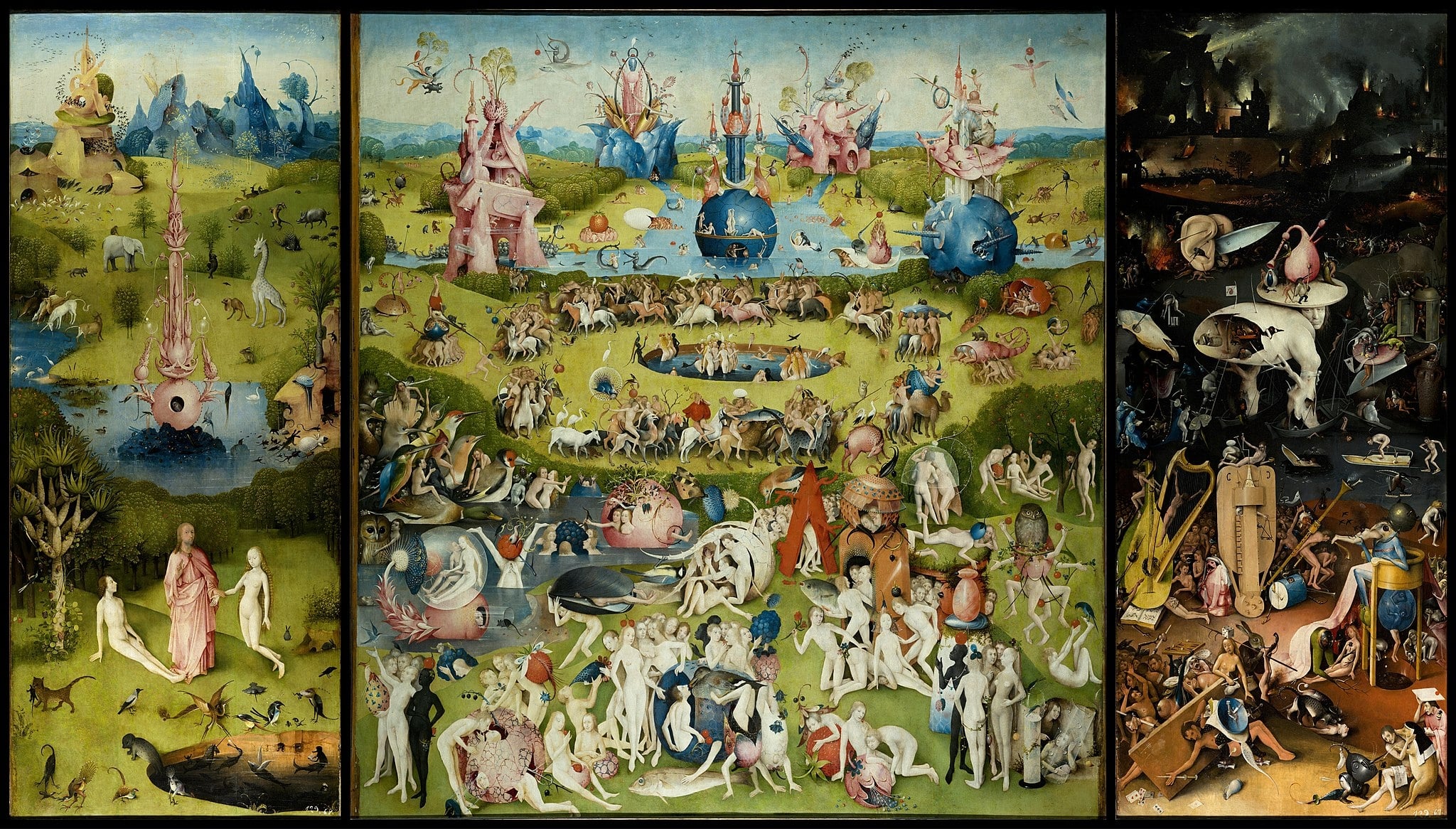
The Garden of Earthly Delights
Hieronymus Bosch (c.1490–1500)
The Garden of Earthly Delights unfolds a three‑act moral narrative—<strong>innocence</strong>, <strong>seduction</strong>, and <strong>retribution</strong>—from Eden to a punitive <strong>Musical Hell</strong>. Bosch binds the scenes through recurring emblems (notably the <strong>owl</strong>) and by echoing Eden’s crystalline fountain in the center’s fragile, candy‑colored architectures, then in Hell’s broken bodies and instruments. The work dazzles with invention while insisting that <strong>sweet, ephemeral pleasures</strong> end in ruin <sup>[1]</sup>.
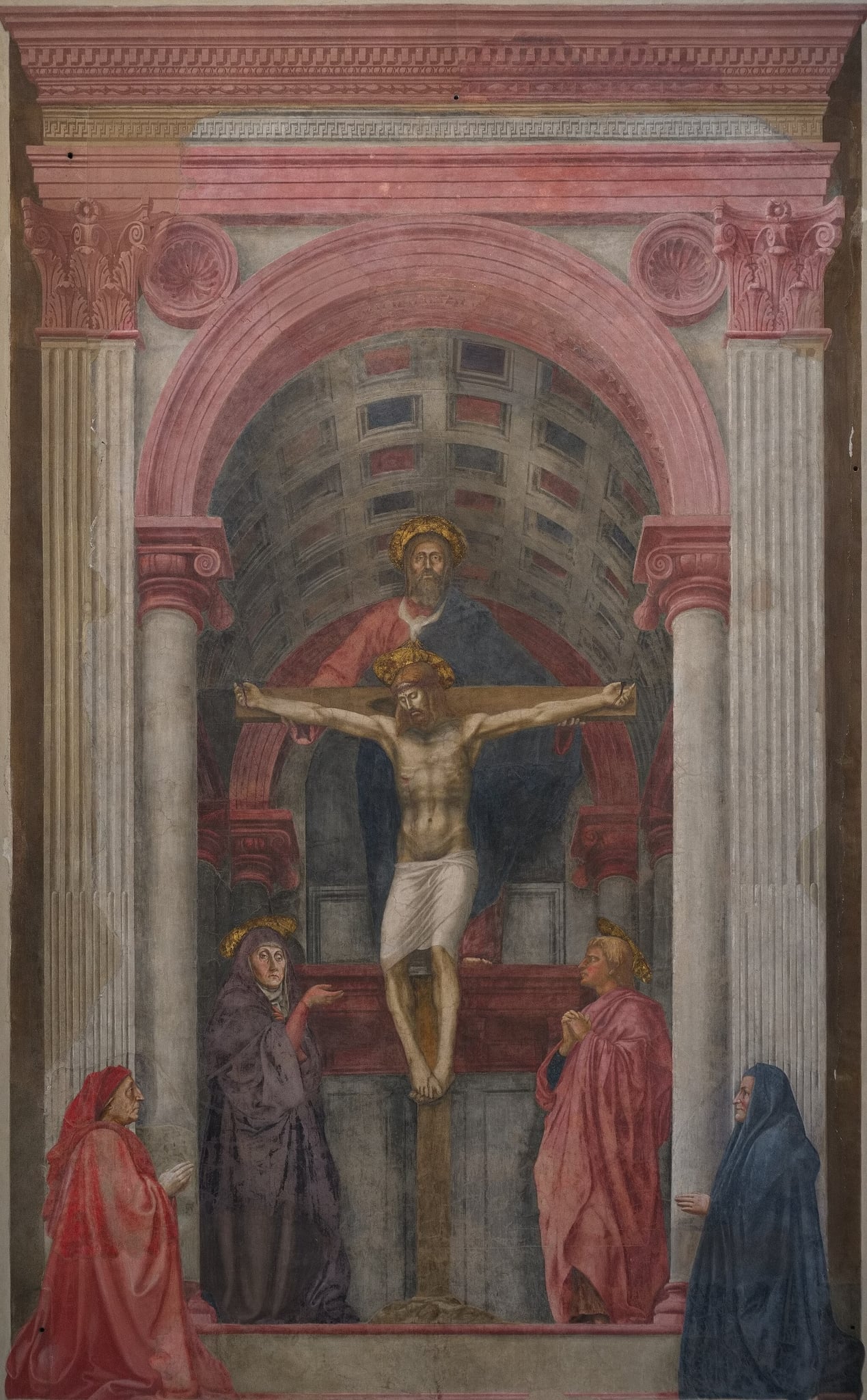
The Holy Trinity
Masaccio (c. 1425–1427)
Masaccio’s The Holy Trinity stages salvation as a rigorously ordered reality: a "Throne of Mercy" Trinity set inside a mathematically precise, coffered barrel vault. With <strong>one‑point perspective</strong>, the fictive chapel opens to the nave, placing kneeling donors at our eye level while Mary presents Christ and John prays in grief <sup>[1]</sup><sup>[2]</sup>.
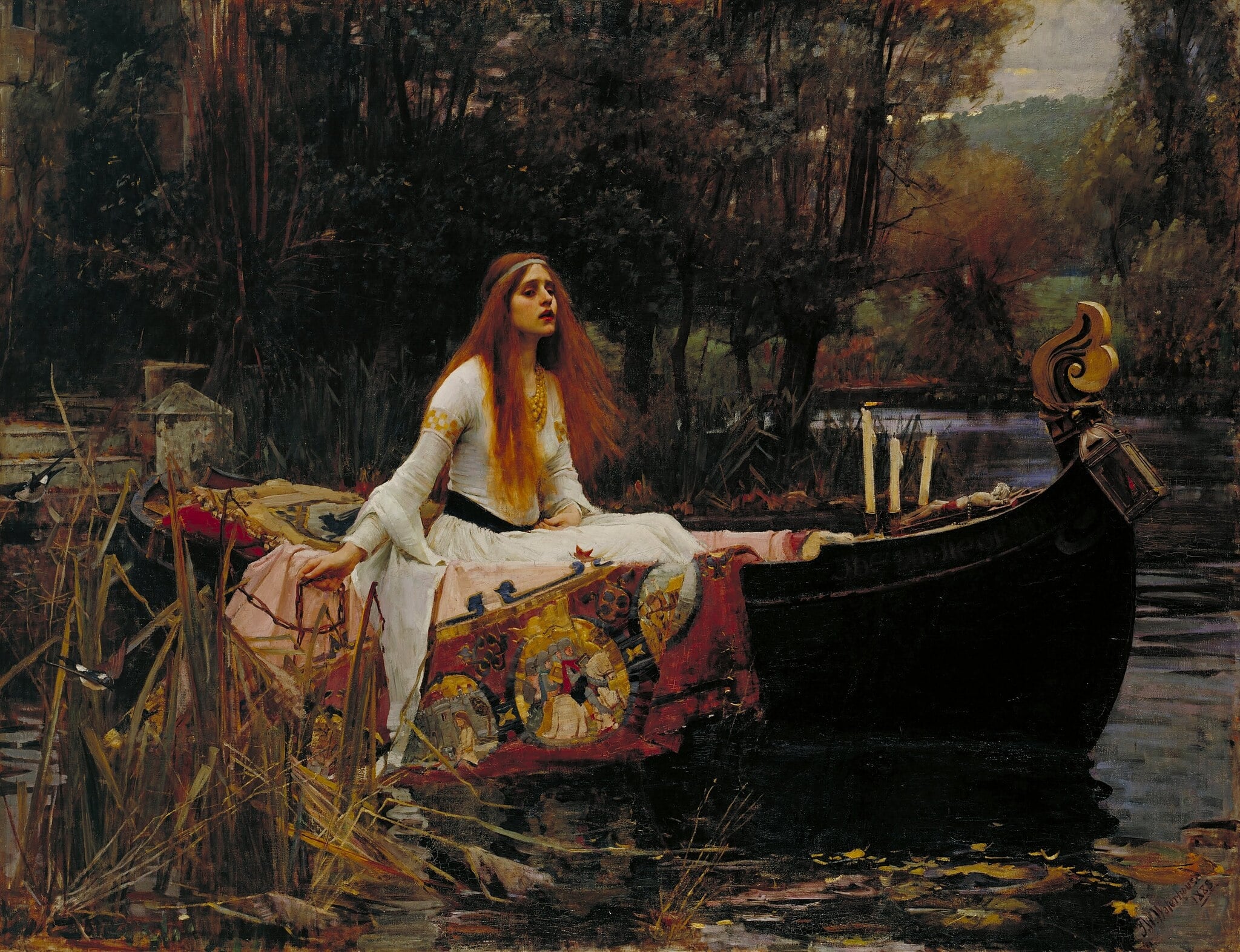
The Lady of Shallot
John William Waterhouse (1888)
John William Waterhouse’s The Lady of Shallot (1888) fixes on the instant the cursed heroine releases her chain and sets her black, coffinlike boat adrift. The extinguished candles, the small crucifix, and the tapestry trailing into the water stage a <strong>funerary voyage</strong> toward Camelot and a choice of <strong>experience over enclosure</strong> <sup>[1]</sup><sup>[2]</sup>.
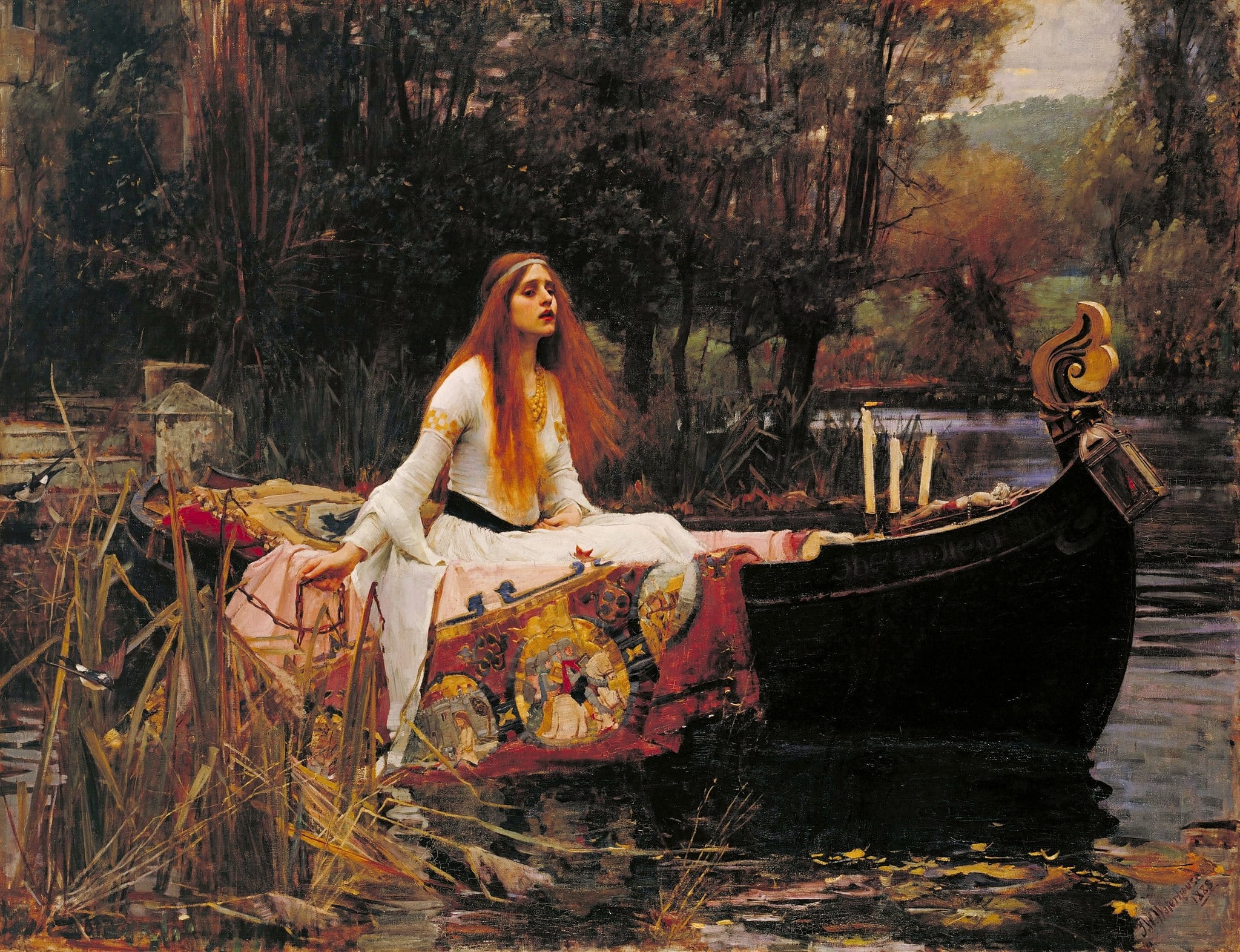
The Lady of Shalott
John William Waterhouse (1888)
John William Waterhouse’s The Lady of Shalott fixes the tragic instant when the cursed Lady chooses to loose her mooring and drift toward Camelot. The released <strong>chain</strong>, the guttering <strong>candles</strong>, and the tapestry spilling over the boat narrate a passage from sheltered artifice to fatal reality. Waterhouse fuses late <strong>Pre-Raphaelite</strong> symbolism with elegiac atmosphere to stage beauty caught between <strong>agency</strong> and <strong>doom</strong> <sup>[1]</sup><sup>[2]</sup><sup>[3]</sup>.
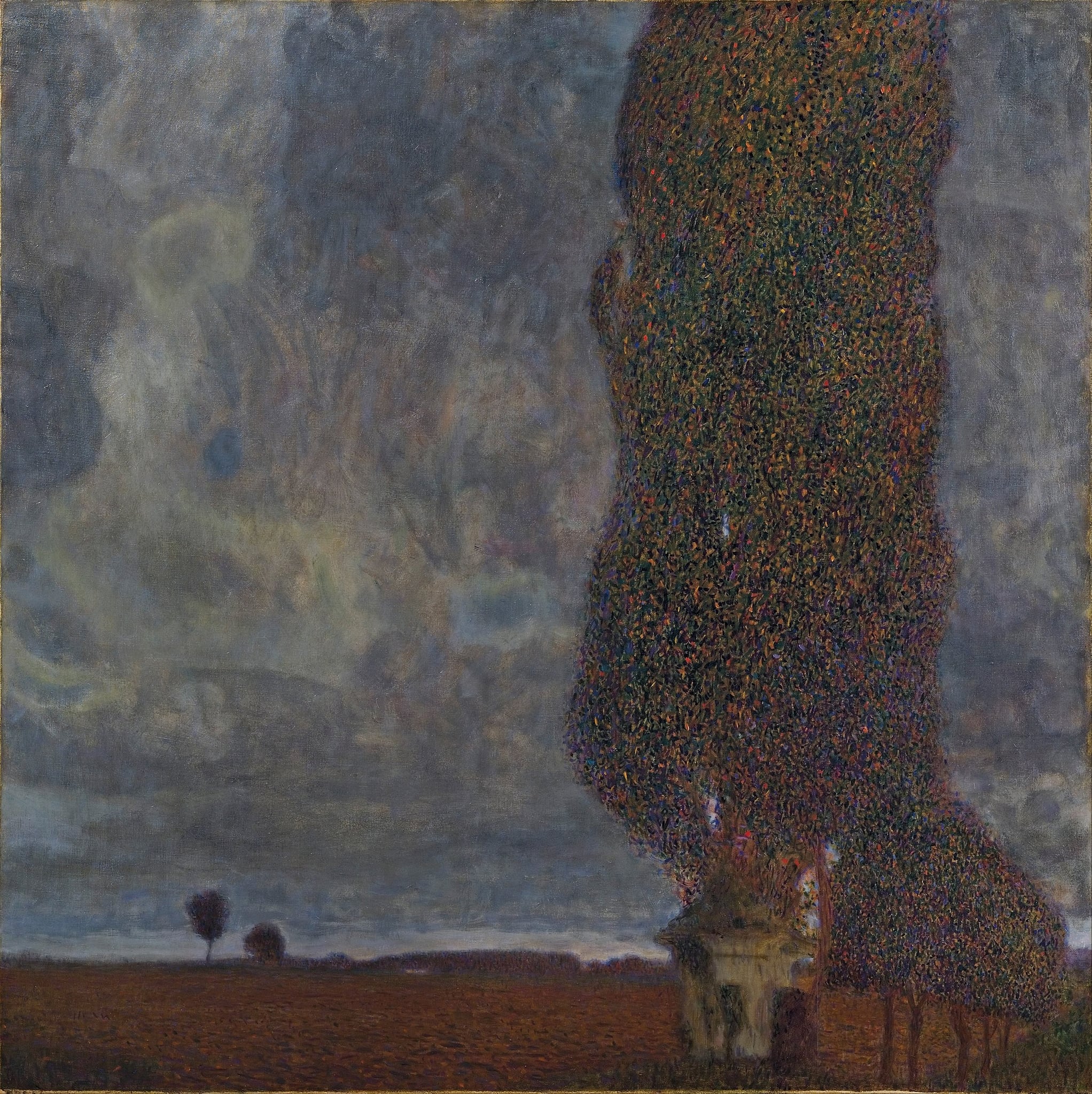
The Large Poplar II (Gathering Storm)
Gustav Klimt (1902/03)
In The Large Poplar II (Gathering Storm), a monumental poplar rises like a <strong>sentinel</strong> at the right edge while a low, rust-toned plain and tiny chapel anchor the horizon. Klimt devotes most of the square canvas to a <strong>charged, near-monochrome sky</strong>, making weather the protagonist and turning the tree’s flecked canopy into a shimmering, ominous <strong>mosaic</strong> <sup>[1]</sup><sup>[2]</sup>.
The Last Supper
Leonardo da Vinci (1495–1498)
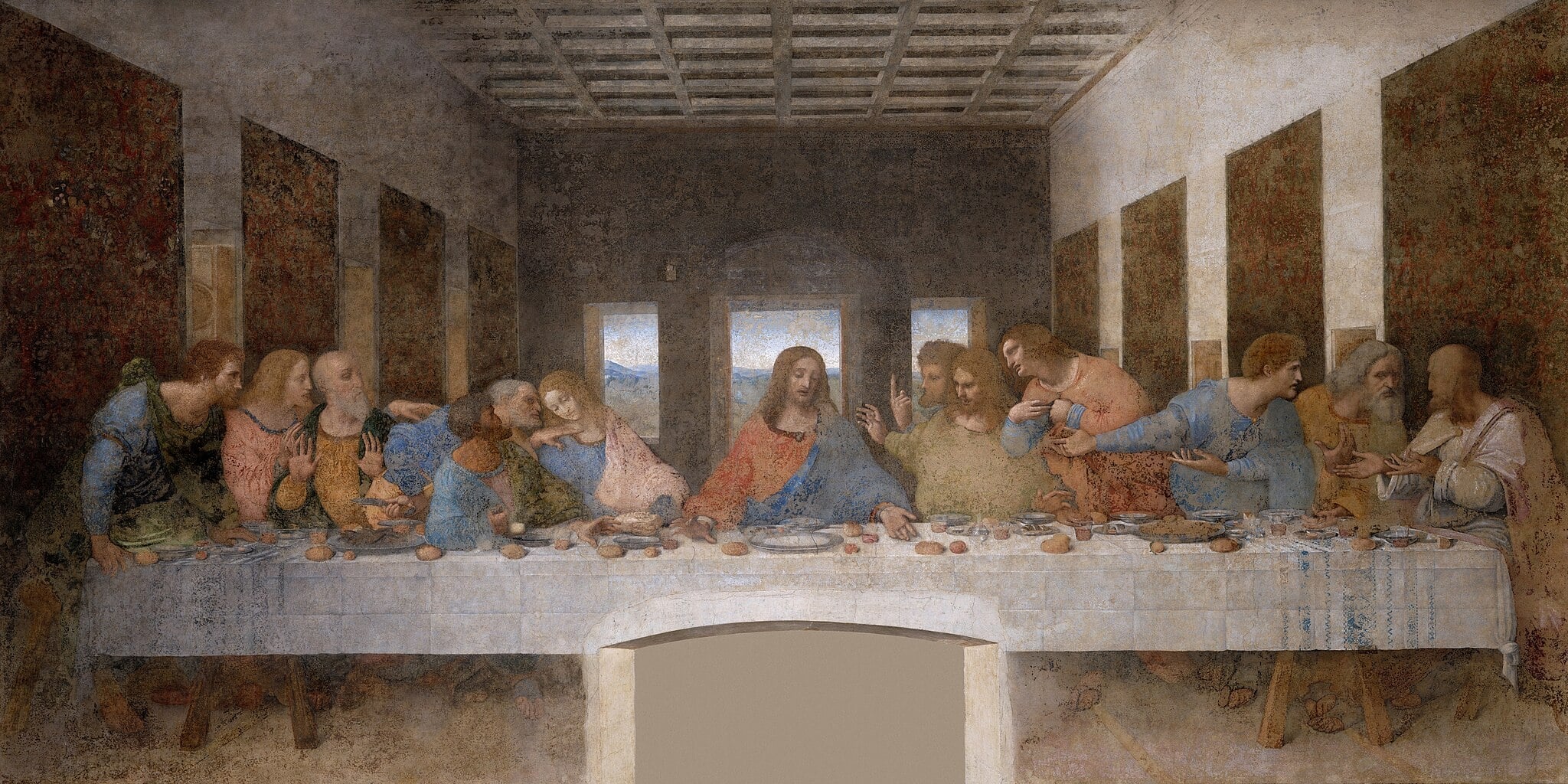
Leonardo da Vinci’s The Last Supper captures the instant after Christ declares a coming betrayal, freezing divine calm amid human tumult. At the center, Christ’s <strong>triangular stillness</strong> aligns with a one‑point perspective that funnels all space to his head, while bread and wine announce the <strong>Eucharist</strong>. Four flanking trios surge outward in shock, doubt, and protest, with Judas recoiling in shadow and clutching a <strong>purse</strong> of silver <sup>[1]</sup><sup>[3]</sup>.
The Storm on the Sea of Galilee
Rembrandt van Rijn (1633)
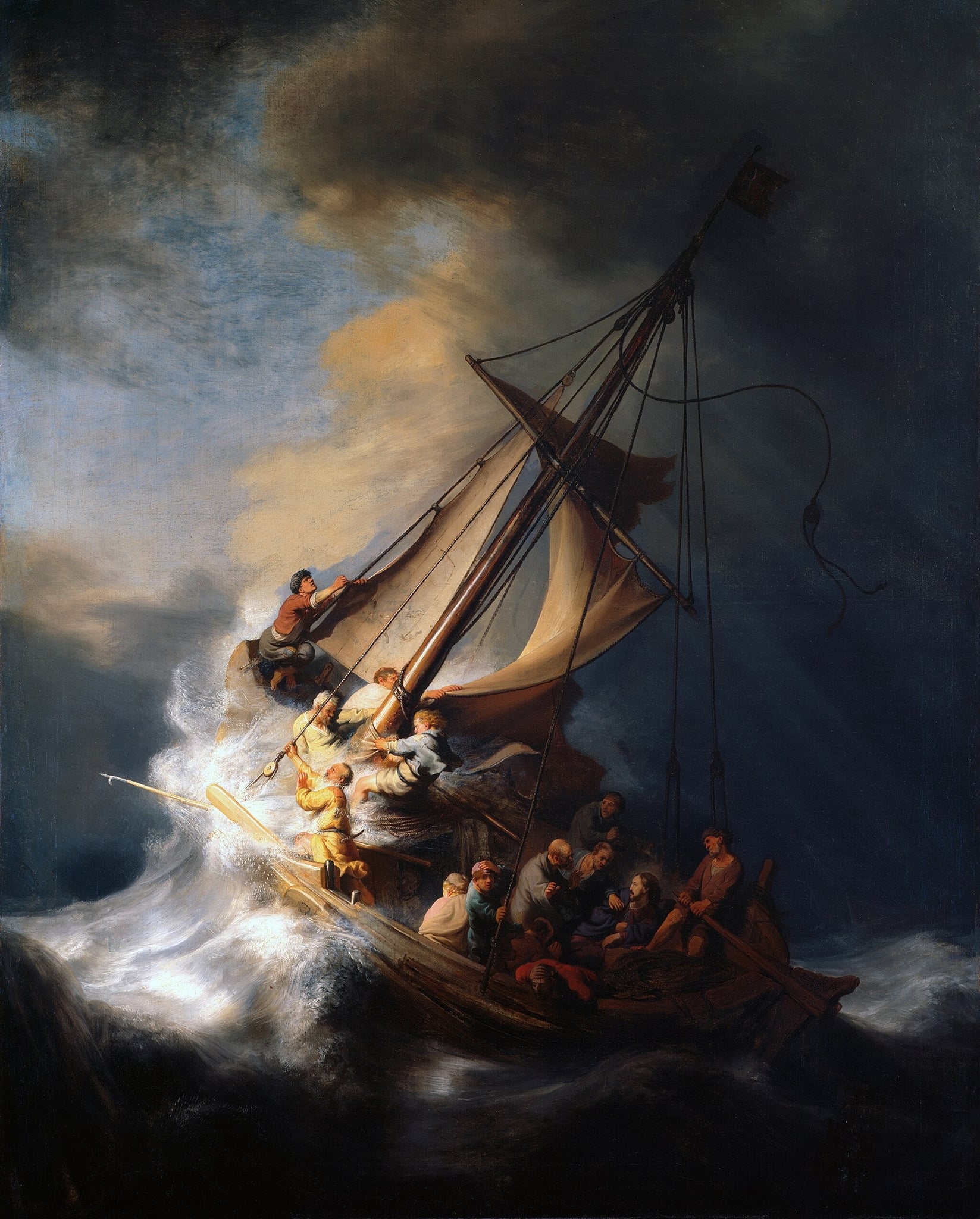
Rembrandt van Rijn’s The Storm on the Sea of Galilee stages a clash of <strong>human panic</strong> and <strong>divine composure</strong> at the instant before the miracle. A torn mainsail whips across a steeply tilted boat as terrified disciples scramble, while a <strong>serenely lit Christ</strong> anchors a pocket of calm—an image of faith holding within chaos <sup>[1]</sup><sup>[3]</sup>. It is Rembrandt’s only painted seascape, intensifying its dramatic singularity in his oeuvre <sup>[2]</sup>.
The Yellow Christ
Paul Gauguin (1889)
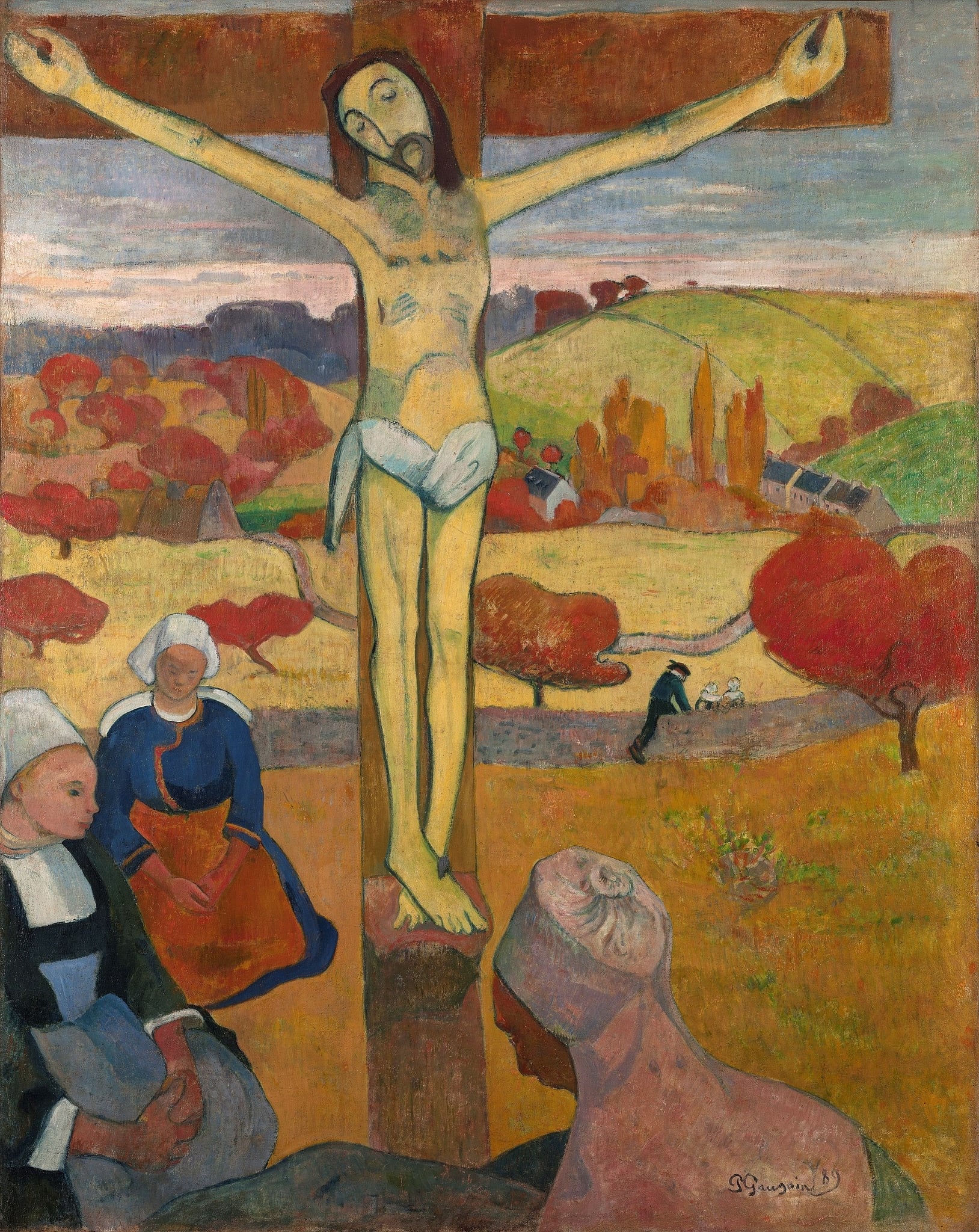
Paul Gauguin’s The Yellow Christ (1889) fuses sacred narrative with everyday Brittany, rendering a lemon‑<strong>yellow</strong> Christ in a rural autumn landscape. Through <strong>Synthetist</strong> color and <strong>Cloisonnist</strong> contours, the work declares spiritual meaning over naturalism, placing devotion among kneeling Breton women beneath a banded, hope‑tinged sky <sup>[1]</sup><sup>[3]</sup>.
Virgin of the Rocks
Leonardo da Vinci (c. 1483–1494)
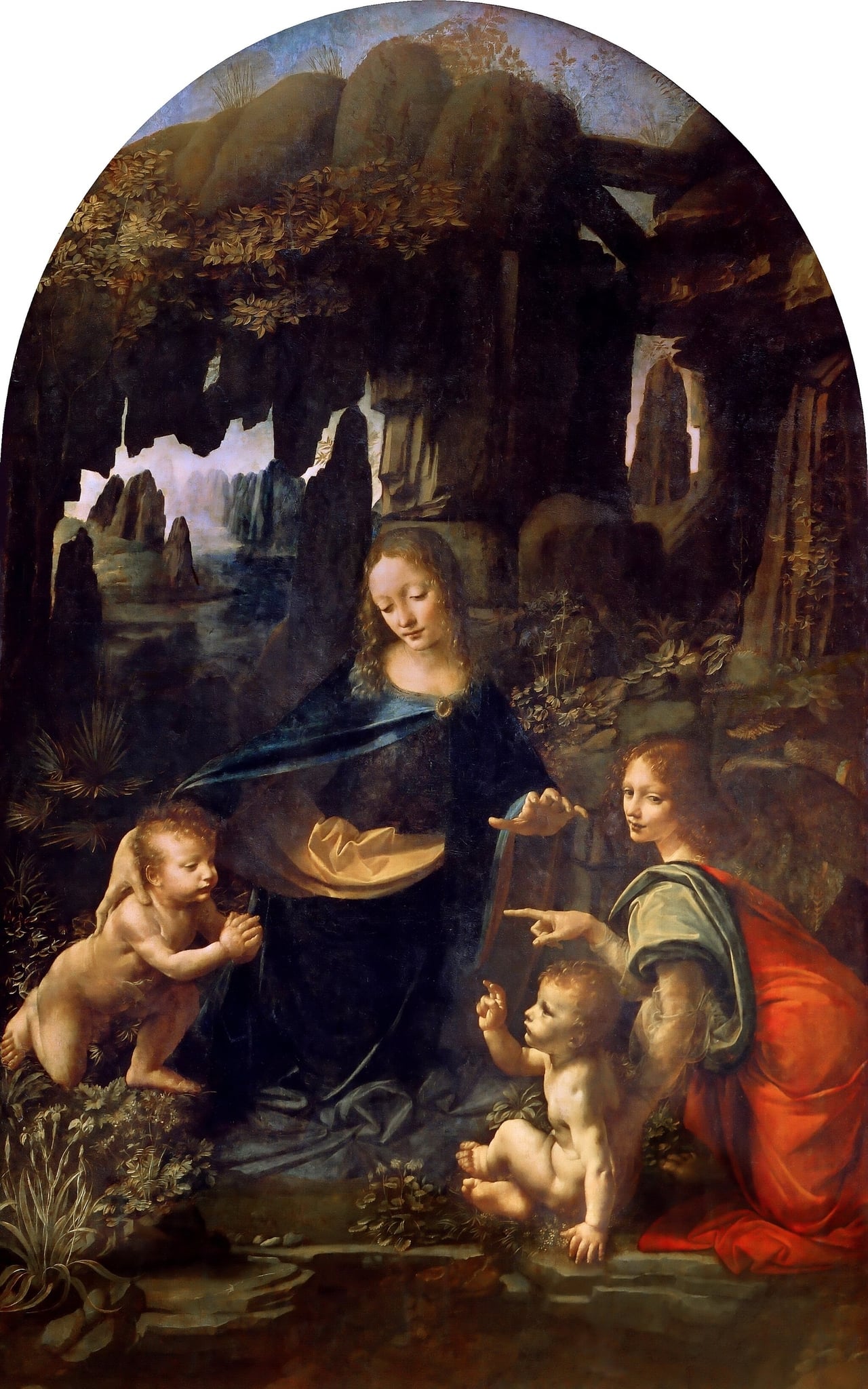
In Virgin of the Rocks, Leonardo da Vinci fuses sacred narrative with the natural world, staging the Holy Family and an angel inside a cavern where rock, water, and foliage form a living chapel. The angel’s pointing hand and outward gaze guide the viewer to the kneeling infant John as Mary shelters him and blesses the <strong>Christ Child</strong>, binding the group in a pyramidal, breath-like <strong>sfumato</strong>. By omitting overt markers like halos, Leonardo makes <strong>grace</strong> feel immanent within creation itself <sup>[1]</sup><sup>[2]</sup>.
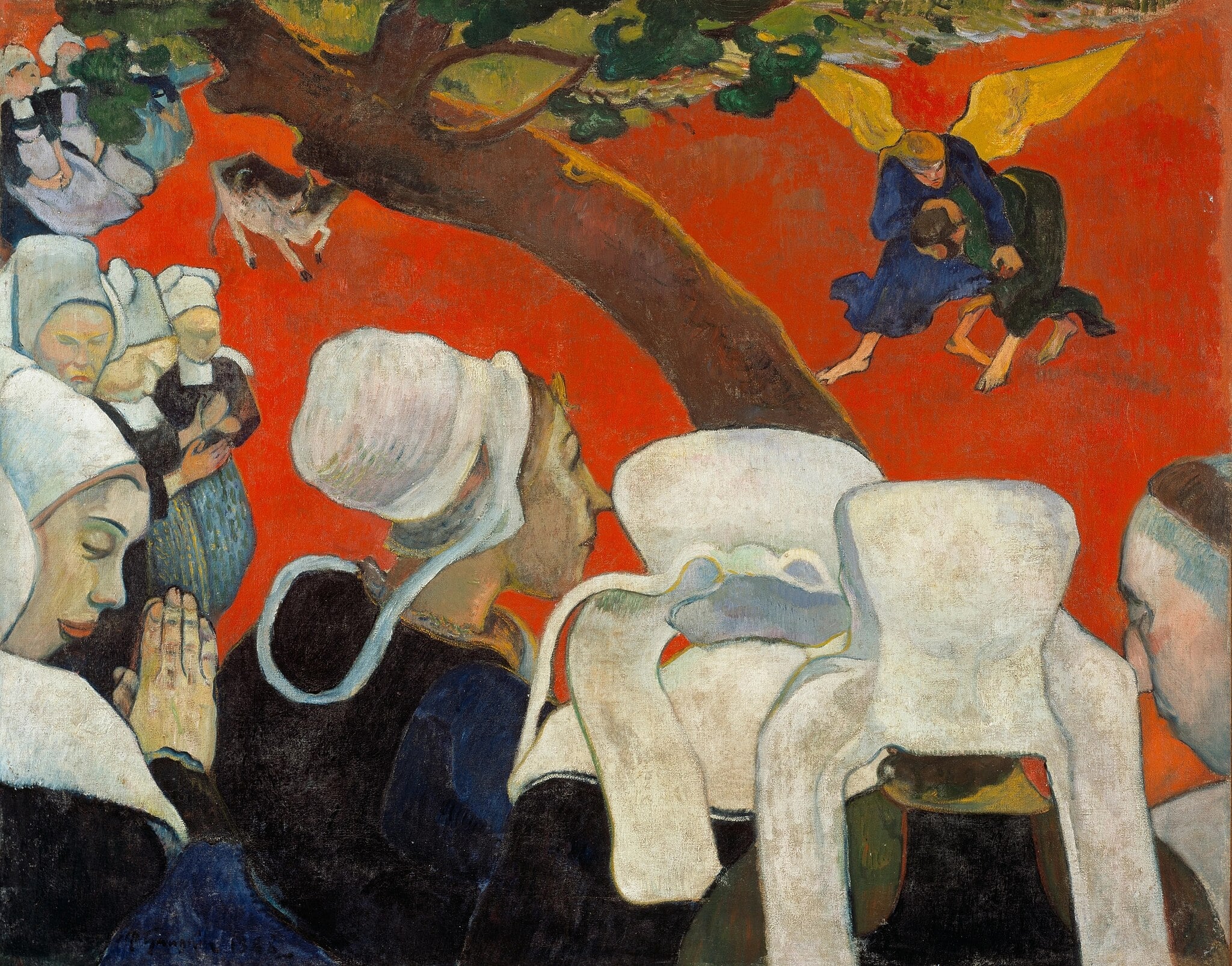
Vision After the Sermon
Paul Gauguin (1888)
Paul Gauguin’s Vision After the Sermon (1888) stages a divide between lived ritual and <strong>collective vision</strong>: Breton women pray in the foreground while, across a diagonal tree, Jacob wrestles an angel on a <strong>flat red field</strong>. With <strong>bold contours</strong> and <strong>non‑naturalistic color</strong>, Gauguin turns faith into pictorial form, making inner experience the painting’s true subject <sup>[1]</sup><sup>[2]</sup>.
Related Themes
Related Symbolism Categories
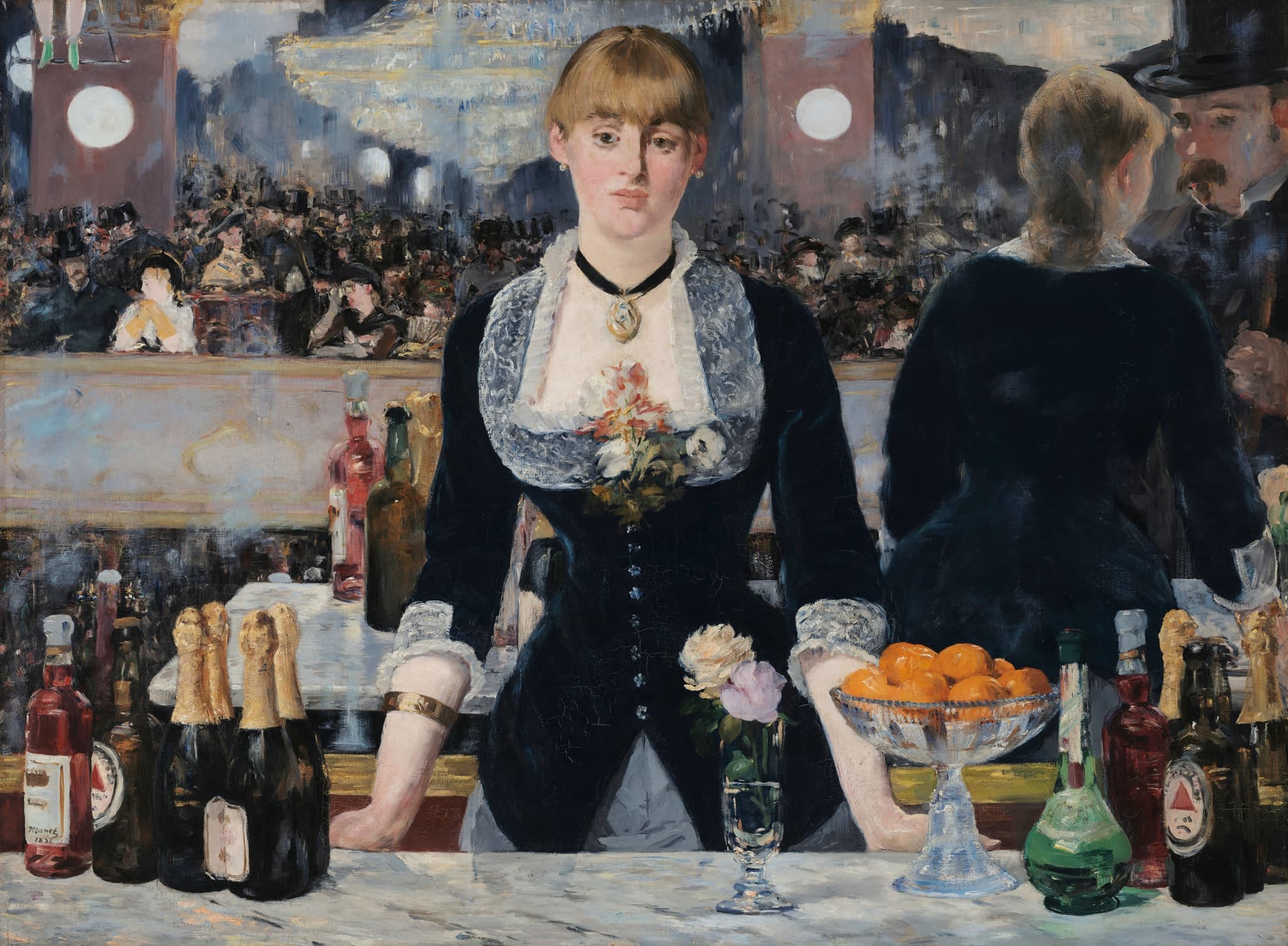
Ritual
Ritual symbolism in modern and early modern painting transforms repeated social, religious, and corporeal practices into visual structures that regulate time, desire, and collective belief, making habit itself a bearer of meaning.
Figure
Figure symbolism in modern painting turns the human body into a calibrated sign-system in which posture, gesture, and gaze encode shifting relations among desire, labor, authority, and spectatorship.
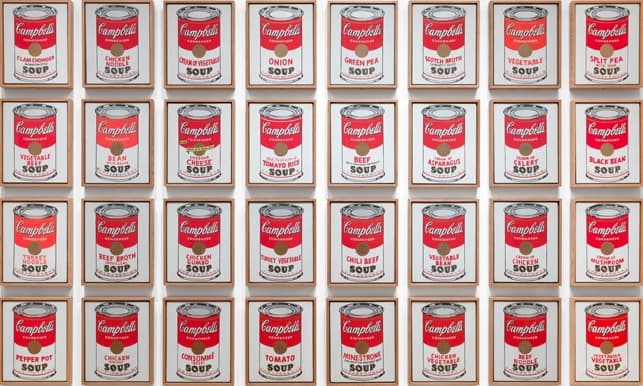
Symbolism
The Symbolism category here traces how modern and contemporary artists redeploy a heterogeneous repertoire of signs—from religious mirrors and dynastic portraits to tricolor flags and corporate emblems—to interrogate vision, power, national identity, and consumer culture across changing regimes of representation.
Within Western art history, religious symbolism constitutes not a fixed code but a continually renegotiated visual language through which artists articulate doctrine, ritual experience, and interior faith. From the early Renaissance to modernism, images deploy a relatively stable repertory of signs—gestures of witness, radiant or calm bodies, crowns, instruments of the Passion, Trinitarian emblems—yet these are recast to address shifting debates about authority, subjectivity, and the very visibility of the divine. The works considered here demonstrate how such symbols function semiotically: they do not merely label sacred figures but organize whole pictorial systems that bind narrative time, theological claim, and the viewer’s position into a single optical event.
Gesture is a primary carrier of religious meaning, especially where overt markers such as haloes are minimized or absent. Leonardo’s Virgin of the Rocks (alluded to in the entry on the angel’s pointing hand and outward gaze) depends on the angel’s doubled action—indicating the kneeling John while looking outward—to stage mediation as both iconographic function and viewer address. Semiotic weight falls on a single pointing hand and gaze, which together form an indexical sign: they direct attention toward John and at the same time acknowledge the beholder. Theologically, this gesture externalizes the invisible act of recognition—John’s intuition of Christ—by making the angel a witness whose testimony extends beyond the painted space to the spectator, thereby embedding the viewer in the chain of response.
Caravaggio radicalizes this gestural semiotics in The Calling of Saint Matthew. Christ’s extended hand, consciously echoing Michelangelo’s Creator in the Sistine Chapel, functions as what we might call a Christological “second creation” sign: the same contour that once conferred physical life now bestows vocational and spiritual life. The hand thus condenses typology (Second Adam), narrative (the call), and sacramental theology (grace as efficacious word) into a single visual motif. Around it, a flurry of human hands—Matthew’s incredulous self-pointing and the hesitant gestures of his companions—multiples the sign’s meaning into a field of possible responses, from resistance to acceptance. Gesture here is not illustrative but argumentative: it stages the contested interface between divine summons and human freedom.
The organization of bodies into groups likewise becomes a sign-system of belief and doubt. In Titian’s Assumption of the Virgin, the apostles at the base are more than narrative witnesses; their astonishment, enacted through flung arms and torsioned torsos, embodies the passage from empirical shock to faith. The group as a whole functions metonymically for the Church on earth, whose visible perplexity is the necessary prelude to doctrinal assent. Their gestural turbulence finds its structural counterpoint in Christ’s triangular pose in Leonardo’s Last Supper (described in the entry on Christ’s triangular pose): there, the apostles break into agitated clusters of debate around betrayal and belief, while Christ’s stable, centered triangle operates as an icon of ontological and Trinitarian order. Both works use apostolic groupings and hand movements as a syntax of human reaction, against which the signs of divine stability are legible.
That stability is often expressed not only through geometry but through calibrated contrasts of light and calm. Rembrandt’s The Storm on the Sea of Galilee (evoked under Christ’s calm figure) renders the boat as a theatre of panic: torn sail, tilting mast, scrambling disciples. Against this, Christ appears as a small but luminous nucleus of composure, his untroubled posture and selective illumination marking an inner, nonmeteorological sphere of authority. Semiotic force resides in antithesis: turbulence is the negative ground that makes the sign of divine calm legible, and the painting’s implied miracle—the stilling of the storm—has already been visually anticipated by that pocket of stillness.
Light itself, particularly when decoupled from natural sources, becomes a privileged signifier of divine agency. In The Calling of Saint Matthew, the diagonal beam that slices across the rear wall does not emanate from the window’s cross-shaped muntins; rather, it aligns with Christ’s entry, making visible the advent of grace that exceeds “nature.” In Titian’s Assumption, a different strategy prevails: a continuous gradation from earthy chiaroscuro at the apostles’ level to a suffused gold atmosphere around Mary, and finally to the brightness encircling God the Father, figures salvation history as vertical movement from darkness to light. The swirling cloud of putti that ferries Mary upward is not merely decorative but operates as a luminous vortex—a visible vehicle of grace that sutures human astonishment below to divine reception above. Angelic putti, in this configuration, are semiotic mediators: they visualize what doctrine names but cannot otherwise depict, namely, the invisible action of God drawing a soul heavenward.
Crowns and related regalia constitute another cluster of signs concerned with rank, but their iconographic nuance shifts with context. Botticelli’s Madonna of the Magnificat crystallizes the “Crown of Mary” motif: angels lower a delicate diadem as the Virgin writes the Magnificat, her hand guided by the Christ Child. Here the crown is not a generic symbol of honor; synchronized with the act of inspired authorship, it marks Mary’s queenship as coextensive with her role as scriptural voice and participant in salvific prophecy. The panel stages coronation, inspiration, and maternal intimacy at a single pictorial hinge—the meeting of her quill and the Child’s directing hand—so that regal status, textual praise, and Christological destiny form one composite sign. By contrast, the crown of thorns and nails that anchor the still-life zone in Rubens’s Descent from the Cross function not as royal insignia but as the compressed “alphabet” of Passion devotion. Placed low in the composition, they draw the beholder’s contemplative gaze downward, away from Baroque muscularity and pathos toward a meditative focus on suffering as the ground of redemption.
Trinitarian symbolism depends on even more economical yet conceptually dense signs. In Masaccio’s Holy Trinity, the dove of the Holy Spirit is a minute but pivotal device: inserted along the central axis between God the Father and the crucified Son, it completes the theological relation that the monumental architecture merely frames. The bird’s downward orientation, aligned with the vertical of the cross and the fictive chapel’s perspectival recession, makes procession and presence optically tangible. A related logic informs Christ’s extended hand in Caravaggio and his triangular pose in Leonardo: seemingly incidental details—finger joints, body angles—are mobilized as icons of creation, redemption, and the triune structure of God.
Across these examples, one notes a diachronic shift from relatively explicit, didactic symbolism to more reflexive and psychologically inflected deployments. In Botticelli and Masaccio, symbols such as crowns or doves are hieratically presented and clearly legible within a shared devotional culture. By the Baroque, Rubens and Caravaggio integrate symbols into dynamic narratives and lighting schemes that solicit the viewer’s affective participation; the Arma Christi or the call-sign of Christ’s hand appear at thresholds where the beholder is invited to move from looking to inward enactment. With Klimt’s Adam and Eve, the process reaches a modernist inflection: Eve’s luminous, pearly body functions as a quasi-religious sign of life-force and generative power, echoing but also subverting earlier Marian luminosity. No overt Christian symbols appear, yet the painting replays Edenic themes in the register of erotic vitality and cosmological polarity (day/night), revealing how religious iconography can be transposed into a symbolic language of the psyche.
Religious symbols in art thus evolve less by disappearance than by transfiguration. Gestures of witness, signs of light, crowns, and Passion instruments remain structurally similar, but their semiotic status shifts—from catechetical markers embedded in liturgical images, to complex visual propositions about the relation between seen and unseen, history and transcendence, individual subject and communal belief. The continuity of form coupled with transformation of function underscores the resilience of religious symbolism as a medium through which art continually rethinks, rather than merely repeats, the sacred.