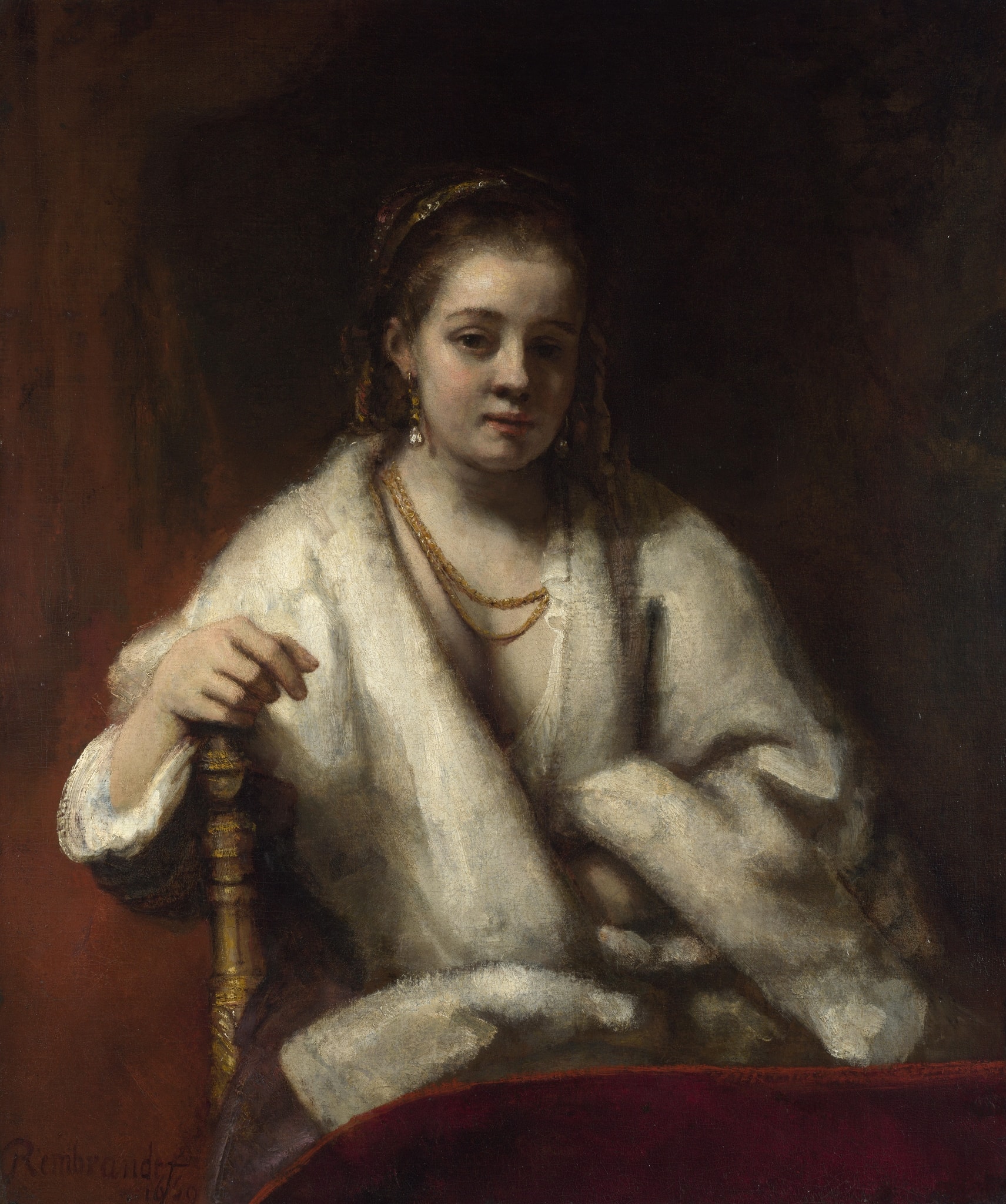
Portrait of Hendrickje Stoffels

by Rembrandt van Rijn

In Portrait of Hendrickje Stoffels, Rembrandt van Rijn stages an intimate encounter in which a young woman leans from darkness into golden, directional light, her fur-trimmed wrap and jewelry catching the eye while her expression remains inward-looking. The thick impasto of the robe, the subtle glint of a gold chain and pearl earring, and the anchoring red table edge fuse touch, time, and tenderness into a single, contemplative presence [1]. Painted in the mid‑1650s, the work distills Rembrandt’s late style: psychological depth, restrained palette, and moral chiaroscuro [1].

Study Print Studio

Create a personal study print

Build a companion study sheet around the part of this painting that speaks to you most. Choose a detail, shape an interpretation, and walk away with something personal and display-worthy.

Fast Facts

Year
c. 1654–1656
Medium
Oil on canvas
Dimensions
101.9 × 83.7 cm
Location
National Gallery, London
See all Rembrandt van Rijn paintings in London
Portrait of Hendrickje Stoffels by Rembrandt van Rijn (c. 1654–1656) featuring Golden, directional light (moral chiaroscuro), Pearl earring, Gold chain, Fur‑trimmed wrap

Click on any numbered symbol to learn more about its meaning

Meaning & Symbolism

Rembrandt asserts intimacy through structure as much as subject. The sitter’s left hand settles on the chair finial while the right gathers the robe across her midriff, creating a triangular poise that stabilizes the body and slows the viewer’s look. A red table edge presses forward as a low, warm horizon—an understated counterweight to the deep backdrop—so our attention returns to the illuminated face and chest. Light falls from high right, pooling at the eyes and mouth; this is not cosmetic illumination but moral chiaroscuro, a way of weighting certain zones of consciousness and withholding others. The lavish, fur‑trimmed wrap is worked in creamy, broken impasto, while the exposed skin remains comparatively smooth; that friction between textures turns touch into meaning, insisting that surface sensation can carry inner life 1. Technical studies confirm Rembrandt’s pursuit of greater reserve: X‑rays show the left hand was once outside the wrap and later reworked within it, a quiet revision that intensifies modesty and interiority 2. Symbols are present but never programmatic. The pearl earring and gold chain snare the light; in Dutch painting, such adornments often play a vanitas role—luxury that dazzles even as it reminds us that beauty and wealth are passing 3. Rembrandt had used chains elsewhere as meditative signs of value and virtue; here the chain’s soft glimmer reads less as boast than as question: what truly endures when fashion fades 4? The painting’s limited gamut—brown‑black depths, umbers and creams, a punctuation of scarlet—tightens the drama to presence itself. Rather than staging a public identity, Rembrandt frames a private morality of looking, in which we witness a person held at the seam of worldly allure and inward reflection. That stance is biographically resonant. In the mid‑1650s Rembrandt’s household stood under scrutiny and strain, while his art turned ever more to informal, uncommissioned images shaped by empathy and candor; this portrait belongs to that arc, in which late style becomes a language for human contingency 15. What we finally confront is not costume or narrative but character under light. The downward cast of the sitter’s gaze and the shadowed corners of the mouth withhold easy sentiment; she appears neither staged nor submissive but self‑possessed, her presence thickened by paint itself. The brushwork’s tactility is not display; it is argument—arguing that truth in portraiture arises where material and mind converge. In this sense, the work modernizes the genre: instead of heraldry or anecdote, Rembrandt gives us a person whose reality is built out of gradations of tone, edits visible in the paint, and signs that oscillate between status and mortality. The result is a humane image that dignifies everyday life while inviting ethical attention, a portrait that asks us to measure brilliance against brevity, tenderness against time 123.

Explore Deeper with AI

Ask questions about Portrait of Hendrickje Stoffels

Popular questions:

Powered by AI • Get instant insights about this artwork

💬 Ask questions about this artwork!

Interpretations

Technical Art History: Revision as Ethics

X‑radiography shows the sitter’s left hand was first painted outside the wrap and later pulled within it—a classic pentimento that shifts the portrait’s moral temperature from display to reserve 2. Rather than a minor tweak, this reworking reprograms the gesture that mediates body, textile, and viewer, tightening the circuit of intimacy. In Rembrandt’s late practice, such revisions are not errors but ethical edits: decisions in paint that calibrate proximity, modesty, and psychological focus. Seen alongside the smoother handling of skin against the broken impasto of fur, the change also heightens haptic contrast, so that touch becomes a site of meaning rather than mere sensual bait. Conservation thus reveals compositional conscience: restraint is built, unbuilt, and rebuilt in the layers we now read as character 12.

Source: National Gallery, London (object record; Teachers’ Notes)

Comparative Iconology: Jewelry as Question, Not Boast

The pearl and chain catch high light but refuse triumphal glitter. In Dutch painting, pearls and gold frequently carry vanitas overtones—luxury poised against time’s attrition 3. Rembrandt’s broader iconography of chains (cf. “Aristotle with a Bust of Homer”) shows how such ornaments can index value as an intellectual and moral problem, not just a social credential 4. Here, the chain’s subdued shimmer reads as a thought about worth: What persists when fashion fades? The painting integrates this inquiry with the moral chiaroscuro of the face, where illumination renders thought, not ornament. The result is a displacement of status by conscience—an iconographic tactic that moves jewelry from the realm of display into the field of doubt and meditation 134.

Source: National Gallery, London; Journal of Historians of Netherlandish Art (JHNA)

Social History: Censure, Cohabitation, and Counter‑Public Intimacy

In 1654 Hendrickje was admonished by Amsterdam’s Reformed Church for cohabiting with Rembrandt and being pregnant out of wedlock, then excluded from communion 5. Against this climate of moral surveillance, the portrait’s informality—private dress, plain setting—operates as a counter‑public image: intimate, uncommissioned, and non‑heraldic. It aligns with mid‑1650s works that convert domestic space into a site of dignity and reflection. Financial strain culminating in Rembrandt’s 1656 insolvency and later business maneuvers with Titus and Hendrickje further pressurize the household, contextualizing the painting’s quiet defiance of decorum through inwardness rather than protest 6. Read this way, the canvas is less a likeness than a social instrument, absorbing external judgment into a poetics of composed self‑possession 156.

Source: National Gallery, London (catalogue entries); National Gallery of Art, Washington (scholarly essays)

Material Poetics: Haptics, Costume, and the Studio Wardrobe

The fur‑trimmed wrap is not merely luxurious; as a studio prop, it is a meaning‑machine. Rembrandt often staged sitters in eclectic costume to amplify affect and complicate identity claims 7. Here, the creamy, broken impasto of fur versus the comparatively smooth flesh turns material friction into psychological charge, making touch a carrier of inner life. Because the image reads as uncommissioned, the costume’s function shifts from social proof to expressive apparatus—a sculptural foil that deepens the calm torque of the body and retards the gaze. In tandem with the compressed palette and low, red foreground plane, this textile architecture concentrates attention on thinking flesh, converting the studio wardrobe into a tool for introspection rather than status display 17.

Source: National Gallery of Art, Washington (props/costume essay); National Gallery, London (object record)

Pictorial Ethics of Looking: The Red Table as Visual Governor

The narrow red table edge acts like a visual governor, a warm horizon that advances to check the viewer’s approach and redirect attention upward. This understated bar calibrates distance without theatrical architecture, echoing the sitter’s downward gaze that withholds easy sentiment. In Dutch portraiture, such close, planar foregrounds can serve as thresholds—neither barrier nor invitation, but a ethical pause that slows consumption of the body on display. Coupled with high‑right illumination that pools at the eyes and mouth, the device tightens a circuit of attentive seeing: we are admitted to privacy on condition of self‑restraint. The table, then, is not still life but a moral instrument—an unobtrusive brace that organizes intimacy into responsible looking 1.

Source: National Gallery, London (object record and display notes)

Related Themes

About Rembrandt van Rijn

Rembrandt van Rijn (1606–1669) was a leading Dutch Golden Age painter and printmaker whose Amsterdam years (from 1631) produced virtuosic portraits and ambitious history paintings. In the early 1630s he favored polished finishes, saturated color, and theatrical staging—qualities on display in this 1633 canvas. Although prolific, this is his only known painted seascape [2][4].
View all works by Rembrandt van Rijn

More by Rembrandt van Rijn
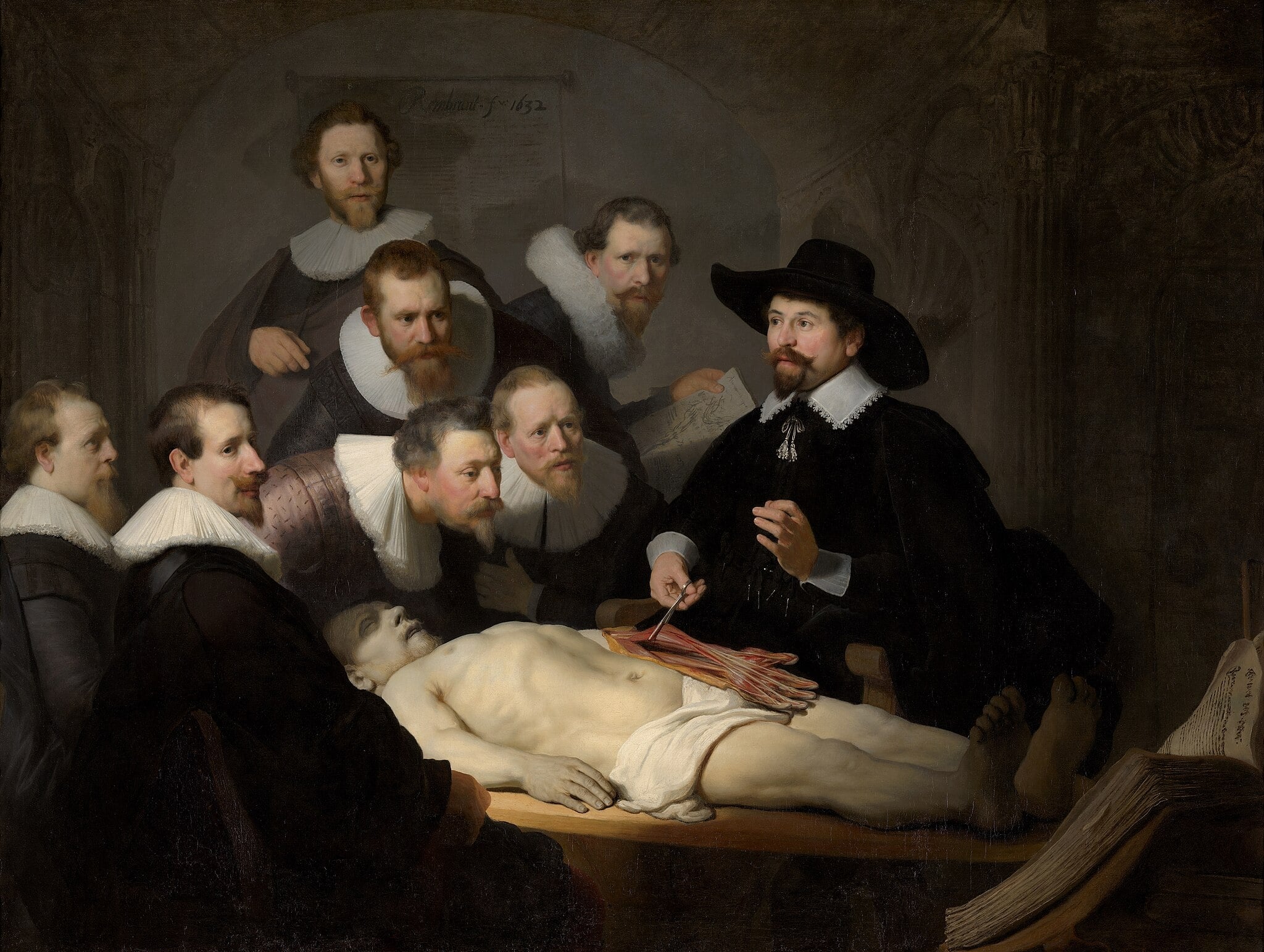
The Anatomy Lesson of Dr. Nicolaes Tulp by Rembrandt van Rijn

The Anatomy Lesson of Dr. Nicolaes Tulp

Rembrandt van Rijn (1632)

Rembrandt van Rijn turns a civic commission into a drama of <strong>knowledge made visible</strong>. A cone of light binds the ruff‑collared surgeons, the pale cadaver, and Dr. Tulp’s forceps as he raises the <strong>forearm tendons</strong> to explain the hand. Book and body face each other across the table, staging the tension—and alliance—between <strong>textual authority</strong> and <strong>empirical observation</strong> <sup>[1]</sup><sup>[2]</sup>.
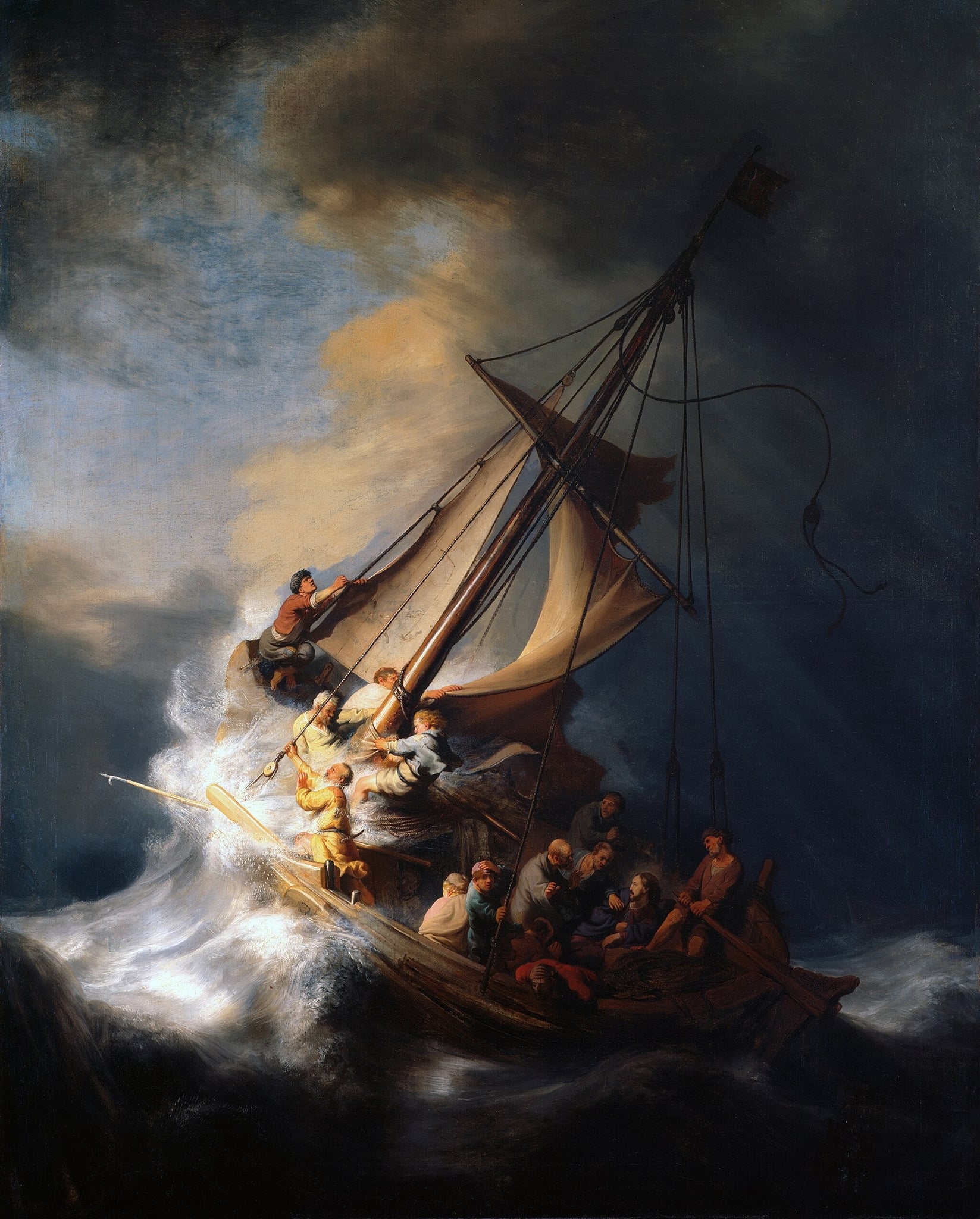
The Storm on the Sea of Galilee by Rembrandt van Rijn

The Storm on the Sea of Galilee

Rembrandt van Rijn (1633)

Rembrandt van Rijn’s The Storm on the Sea of Galilee stages a clash of <strong>human panic</strong> and <strong>divine composure</strong> at the instant before the miracle. A torn mainsail whips across a steeply tilted boat as terrified disciples scramble, while a <strong>serenely lit Christ</strong> anchors a pocket of calm—an image of faith holding within chaos <sup>[1]</sup><sup>[3]</sup>. It is Rembrandt’s only painted seascape, intensifying its dramatic singularity in his oeuvre <sup>[2]</sup>.
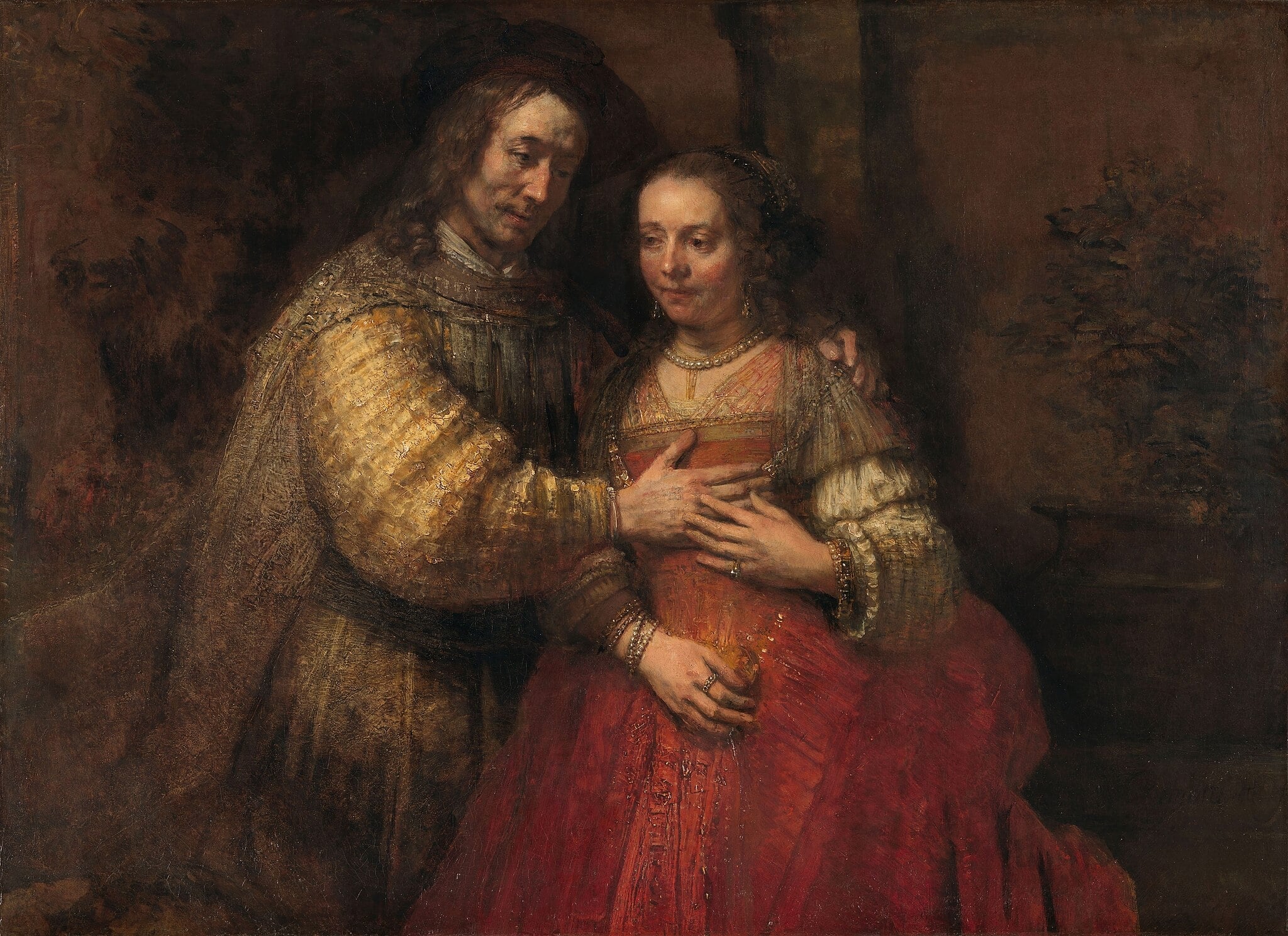
The Jewish Bride by Rembrandt van Rijn

The Jewish Bride

Rembrandt van Rijn (c. 1665–1669)

The Jewish Bride by Rembrandt van Rijn stages an intimate covenant: two figures, read today as <strong>Isaac and Rebecca</strong>, seal their union through touch rather than spectacle. Light concentrates on faces and hands, while the man’s glittering <strong>gold sleeve</strong> and the woman’s <strong>coral-red gown</strong> turn paint itself into a metaphor for fidelity and tenderness <sup>[1]</sup><sup>[3]</sup>. This late masterpiece embodies Rembrandt’s <strong>material eloquence</strong>—impasto as feeling—within a hushed, dark setting <sup>[1]</sup><sup>[2]</sup>.
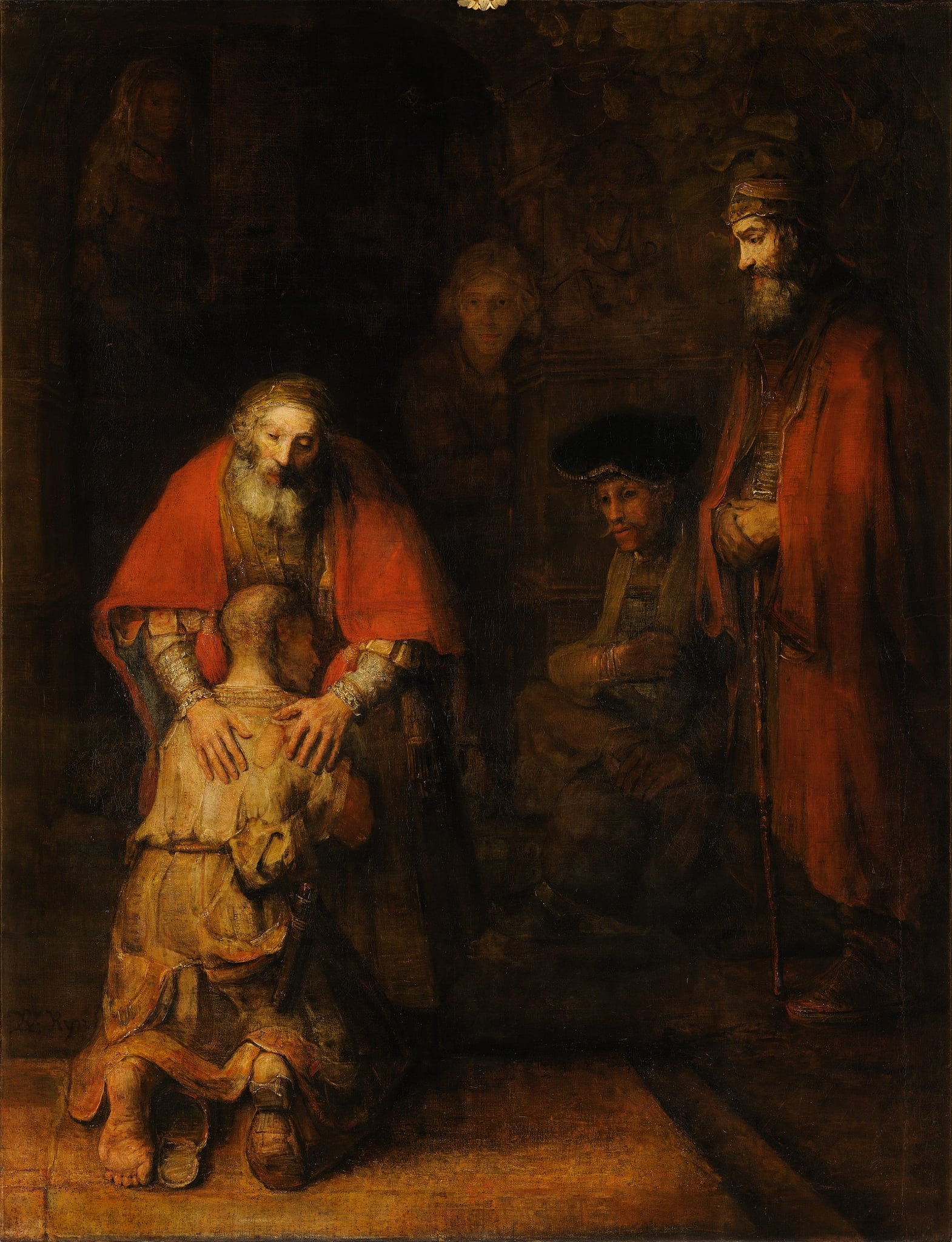
The Return of the Prodigal Son by Rembrandt van Rijn

The Return of the Prodigal Son

Rembrandt van Rijn (c. 1661–1669 (probably completed by 1669))

Rembrandt van Rijn’s The Return of the Prodigal Son is a late-life meditation on <strong>mercy</strong>, <strong>homecoming</strong>, and <strong>restored dignity</strong>. In a hush of dusk-like light, a ragged son kneels into his father’s <strong>embrace</strong>, while an upright elder brother holds back in shadow. The image concentrates meaning in illuminated <strong>faces, hands, and feet</strong>, turning a parable into a timeless human reckoning. <sup>[1]</sup><sup>[2]</sup>
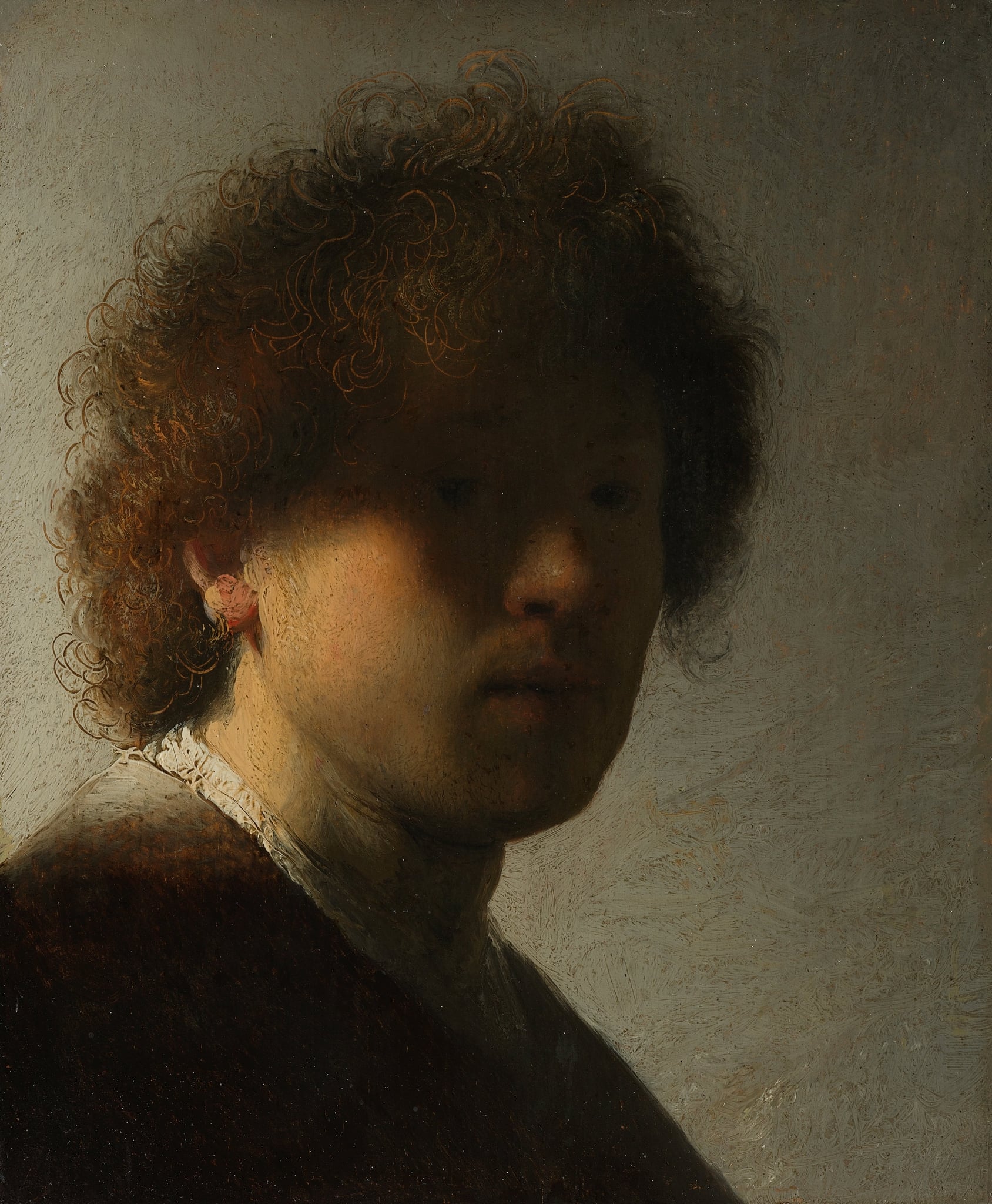
Self-portrait (with tousled hair) by Rembrandt van Rijn

Self-portrait (with tousled hair)

Rembrandt van Rijn (c. 1628)

A young Rembrandt van Rijn tests how <strong>light both reveals and withholds</strong> by letting his face emerge from darkness while his <strong>scratched, backlit curls</strong> flare like a rough halo. The small oak panel makes <strong>process itself the subject</strong>, turning hair, stubble, and a raking highlight into a statement of identity-in-formation <sup>[1]</sup><sup>[5]</sup>.
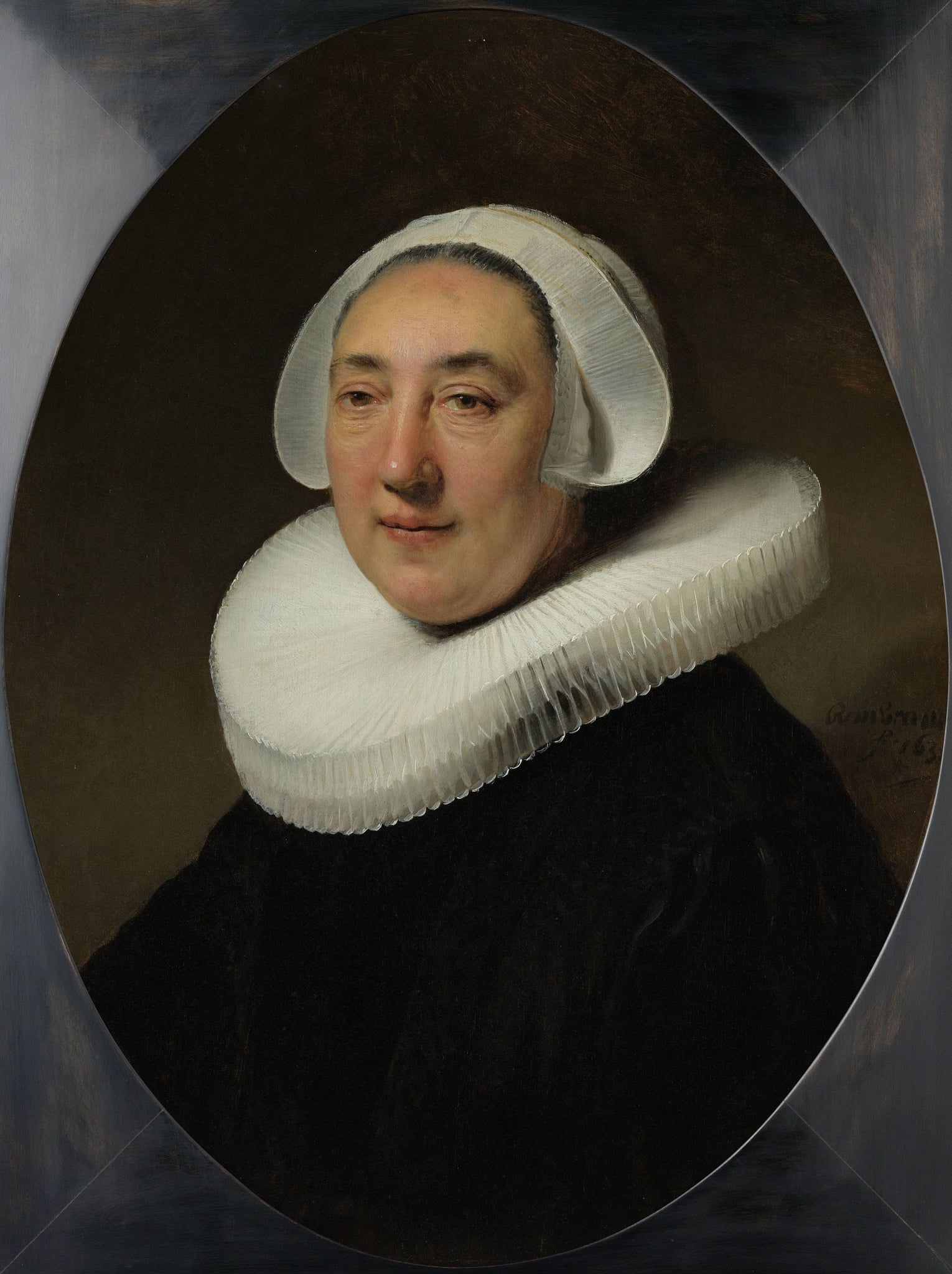
Portrait of Haesje Jacobsdr van Cleyburg by Rembrandt van Rijn

Portrait of Haesje Jacobsdr van Cleyburg

Rembrandt van Rijn (1634)

Rembrandt’s 1634 Portrait of Haesje Jacobsdr van Cleyburg stages a Dutch burgher within a feigned <strong>oval</strong> opening, illuminated by selective <strong>chiaroscuro</strong> that models warm skin against brilliant <strong>millstone ruff</strong> and sober black dress. The painting balances <strong>modesty and status</strong>, making virtue visible while quietly declaring prosperity through immaculate linen and craft <sup>[1]</sup><sup>[4]</sup>.