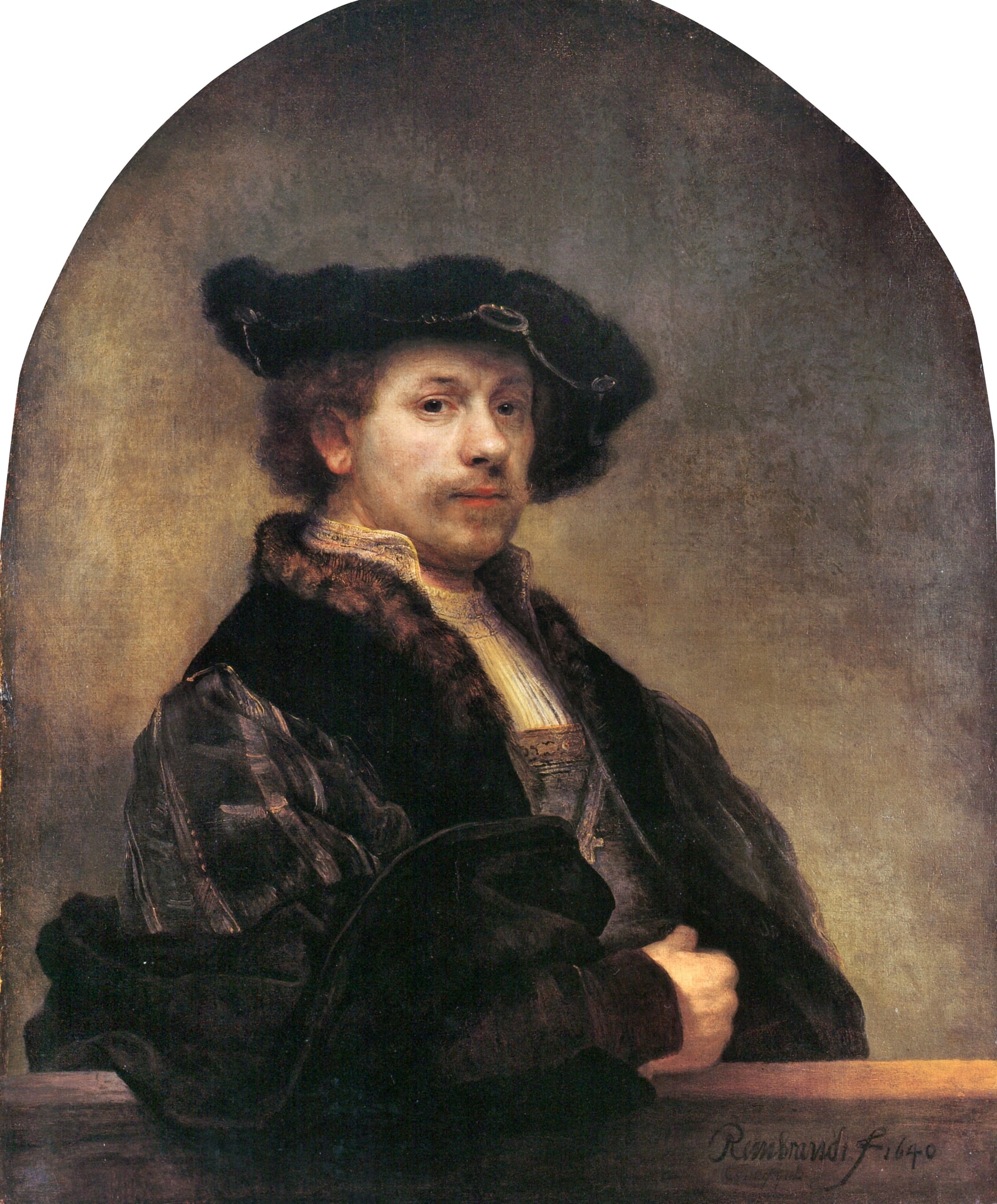
Self Portrait at the Age of 34

by Rembrandt van Rijn

Rembrandt van Rijn’s Self Portrait at the Age of 34 (1640) declares the painter’s authority by adopting the Renaissance gentleman pose, bathed in focused chiaroscuro and anchored by a projecting stone parapet. The sumptuous beret, fur-trimmed mantle, and steady hand assert social rank and artistic lineage while the softly parted lips keep the image searching and human [1][2].

Study Print Studio

Create a personal study print

Build a companion study sheet around the part of this painting that speaks to you most. Choose a detail, shape an interpretation, and walk away with something personal and display-worthy.

Fast Facts

Year
1640
Medium
Oil on canvas
Dimensions
91 x 75 cm
Location
National Gallery, London
See all Rembrandt van Rijn paintings in London
Self Portrait at the Age of 34 by Rembrandt van Rijn (1640) featuring Velvet beret with metal ornaments, Fur-trimmed mantle and satin doublet, Stone parapet (fictive ledge), Inscribed signature and date

Click on any numbered symbol to learn more about its meaning

Meaning & Symbolism

Rembrandt engineers a program of Renaissance emulation and personal promotion. The broad velvet beret ringed with metalwork, the fur-lined mantle, and the satin doublet are deliberately archaizing—attire closer to the 1520s than to Amsterdam in 1640—so that the artist appears as a cultivated courtier rather than a tradesman 1. The pose and three-quarter turn, lit from the left, cite Raphael’s Baldassare Castiglione, while the forearm engaging the stone parapet recalls Titian’s elite portrait convention; both sources were accessible in Amsterdam collections Rembrandt knew 12. By borrowing these markers of civility and learning, he converts costume into argument: the painter is not merely a maker of pictures but a gentleman of intellect and standing. The smoother, “classical” finish—especially across the face and the glossy sleeve—confirms mastery over multiple manners, even as flicks at the nape and cuff announce his trademark touch 1. The painting’s most daring device is the parapet-as-threshold. It functions as a fictive frame inscribed with his signature and date, a literal platform for authorship. The right hand, clenched but relaxed, stakes claim in our space, while the elbow’s weight and the cloak’s mass press against the stone to test painting’s capacity to convince. X‑rays show that Rembrandt initially rested the left hand on the ledge and then withdrew it, a calculated revision that heightens poise and a slight, courtly reserve 1. This orchestrated nearness and distance generates a performance of presence: the calm, appraising gaze meets us directly, yet the deep shadow swallows much of the body, granting the head and hand a sculptural authority and suggesting the discipline and judgment behind the image. The light chisels the cheek, nose bridge, and knuckles, proving his command of chiaroscuro as an instrument of gravitas rather than mere drama 1. Within Rembrandt’s career, the portrait crystallizes a moment of ambition. Fresh from purchasing an expensive house in 1639, he fashioned a public persona equal to his rising status 3. The painting refines the formula first tested in his 1639 etching Self-Portrait Leaning on a Stone Sill—same parapet conceit, same gentlemanly claim—now scaled up and polished to rival the prestige of Italian oil portraiture 42. Yet the image resists pure bravura. Slight asymmetries in the lips and mustache, the faint blanch of the lower eyelid, and the subtle sag at the glove’s edge temper grandeur with scrutiny. The result is a double assertion: an artist aligning himself with the greats of the past while asking how such models can be inhabited, not merely imitated. That duality—public elevation and private inquiry—explains why Self Portrait at the Age of 34 is important: it redefines the social and intellectual standing of the Northern painter even as it inaugurates the deeper self-examinations of Rembrandt’s later years 123.

Explore Deeper with AI

Ask questions about Self Portrait at the Age of 34

Popular questions:

Powered by AI • Get instant insights about this artwork

💬 Ask questions about this artwork!

Interpretations

Formal/Technical Analysis: The Choreography of Finish

The portrait stages a negotiation between classical finish and Rembrandt’s tactile signature. The face and sumptuous sleeve are fused with a refined, near-Raphaelesque surface, while micro-gestures—the scratched nape hairs, the enlivened cuff—retain the artist’s hallmark facture. Technical imaging shows he first rested the left hand on the parapet, then retracted it; this edit tightens decorum and shifts the composition’s weight to the projecting right arm and alert head, intensifying the work’s pictorial rhetoric of poise and presence. The combination of smooth passages and calligraphic incident demonstrates range rather than inconsistency: Rembrandt calibrates surface to meaning, deploying chiaroscuro not for spectacle but for sculptural authority and intellectual gravity 14.

Source: National Gallery, London; National Gallery Technical Bulletin

Social History/Economy: Branding the Gentleman-Artist

In 1640 Rembrandt had just secured an expensive Amsterdam townhouse (1639), a visible marker of ascent. This portrait functions as market-savvy self-branding: archaizing dress and a Titianic parapet recode the painter as a man of learning, suitable for elite patronage. The shift from the 1639 etching to this polished oil scales up the claim—from portable print to prestigious canvas—aligning his persona with Italian court portraiture and signaling parity with its status economy. The picture thus operates within Amsterdam’s competitive art market as a public relations instrument: the artist asserts not manual trade but cultivated judgment, inviting commissions that match his self-proclaimed rank. The result is a crafted identity at the juncture of taste, capital, and civility 123.

Source: National Gallery, London; National Gallery of Art (Washington); Rijksmuseum

Historiography/Emulation: Parity with Raphael and Titian

Rather than passive imitation, Rembrandt undertakes strategic emulation—a Renaissance practice of rivalrous learning—to test himself against Raphael’s Castiglione and Titian’s parapet portraits. The three-quarter turn and calm address are Castiglionesque, while the thrusting forearm cites Titian’s elite formula; but Rembrandt reframes these models through Northern light logic and psychological scrutiny. Scholarship has long read the 1639–1640 self-portraits as a considered response to Italian prestige, adapting emblematic markers to assert equivalence, even superiority, within oil portraiture’s highest register. By synthesizing and recalibrating canonical cues, he claims the inheritance of the Renaissance for a Dutch context—less court, more mercantile, but no less intellectually ambitious 21.

Source: National Gallery of Art (Washington); National Gallery, London

Medium Reflexivity: The Ledge as Liminal Device

The stone parapet is not mere furniture; it is a liminal engine. Doubled as an inscribed fictive frame, it both separates and fuses our space with his. The cloak’s mass and the angled elbow press against the ledge to materialize illusion, while the withdrawn left hand introduces a courtly reserve—near yet withheld. This calculated nearness/distance turns the image into a meditation on painting’s ontology: what does it mean for a picture to occupy the viewer’s world? Rembrandt answers through measured contact, calibrated light on knuckles and cheek, and a signature literally embedded at the threshold, converting border into declaration of authorship and proof-of-conviction for mimesis 1.

Source: National Gallery, London

Intermedial Translation: From Etching to Oil

The 1640 canvas refines a concept trialed in the 1639 Self-Portrait Leaning on a Stone Sill (etching): a gentleman-artist claiming space via a parapet. Moving from print to oil, Rembrandt retools scale, color, and surface—trading the etching’s graphic sparkle for chromatic gravitas and lustrous textures that compete with Italian oil portraiture’s cachet. The parapet remains the hinge of authorship, but the medium shift allows a denser play of velvet blacks, satin gleam, and fur pile, which serve the rhetoric of status and presence more potently than line alone. This is a conscious intermedial upgrade, using the authority of oil on canvas to transform a witty conceit into a full-fledged statement of professional identity 521.

Source: National Gallery of Art (Washington), Self-Portrait Leaning on a Stone Sill; National Gallery of Art (Washington); National Gallery, London

Related Themes

About Rembrandt van Rijn

Rembrandt van Rijn (1606–1669) was a leading Dutch Golden Age painter and printmaker whose Amsterdam years (from 1631) produced virtuosic portraits and ambitious history paintings. In the early 1630s he favored polished finishes, saturated color, and theatrical staging—qualities on display in this 1633 canvas. Although prolific, this is his only known painted seascape [2][4].
View all works by Rembrandt van Rijn

More by Rembrandt van Rijn
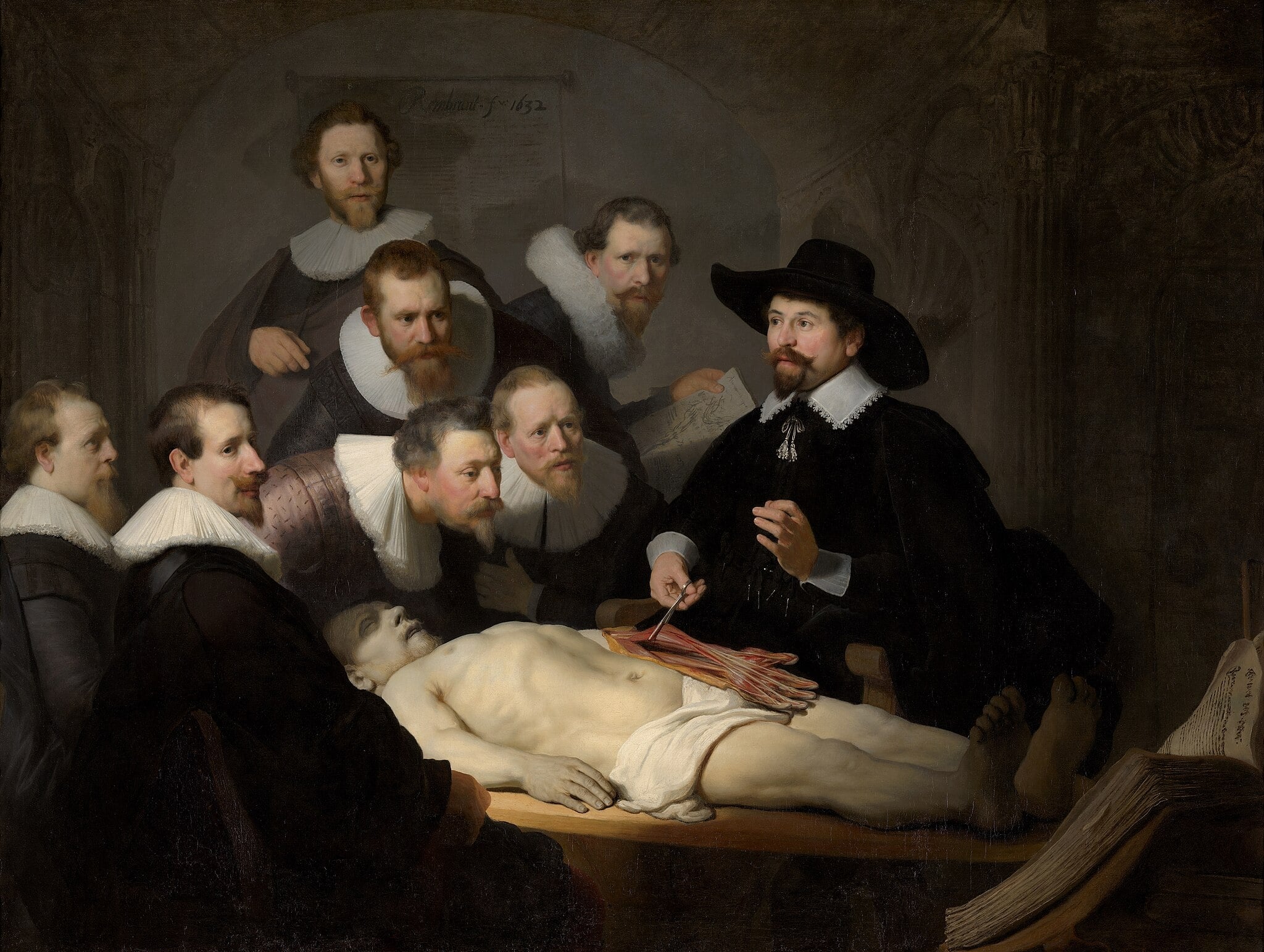
The Anatomy Lesson of Dr. Nicolaes Tulp by Rembrandt van Rijn

The Anatomy Lesson of Dr. Nicolaes Tulp

Rembrandt van Rijn (1632)

Rembrandt van Rijn turns a civic commission into a drama of <strong>knowledge made visible</strong>. A cone of light binds the ruff‑collared surgeons, the pale cadaver, and Dr. Tulp’s forceps as he raises the <strong>forearm tendons</strong> to explain the hand. Book and body face each other across the table, staging the tension—and alliance—between <strong>textual authority</strong> and <strong>empirical observation</strong> <sup>[1]</sup><sup>[2]</sup>.
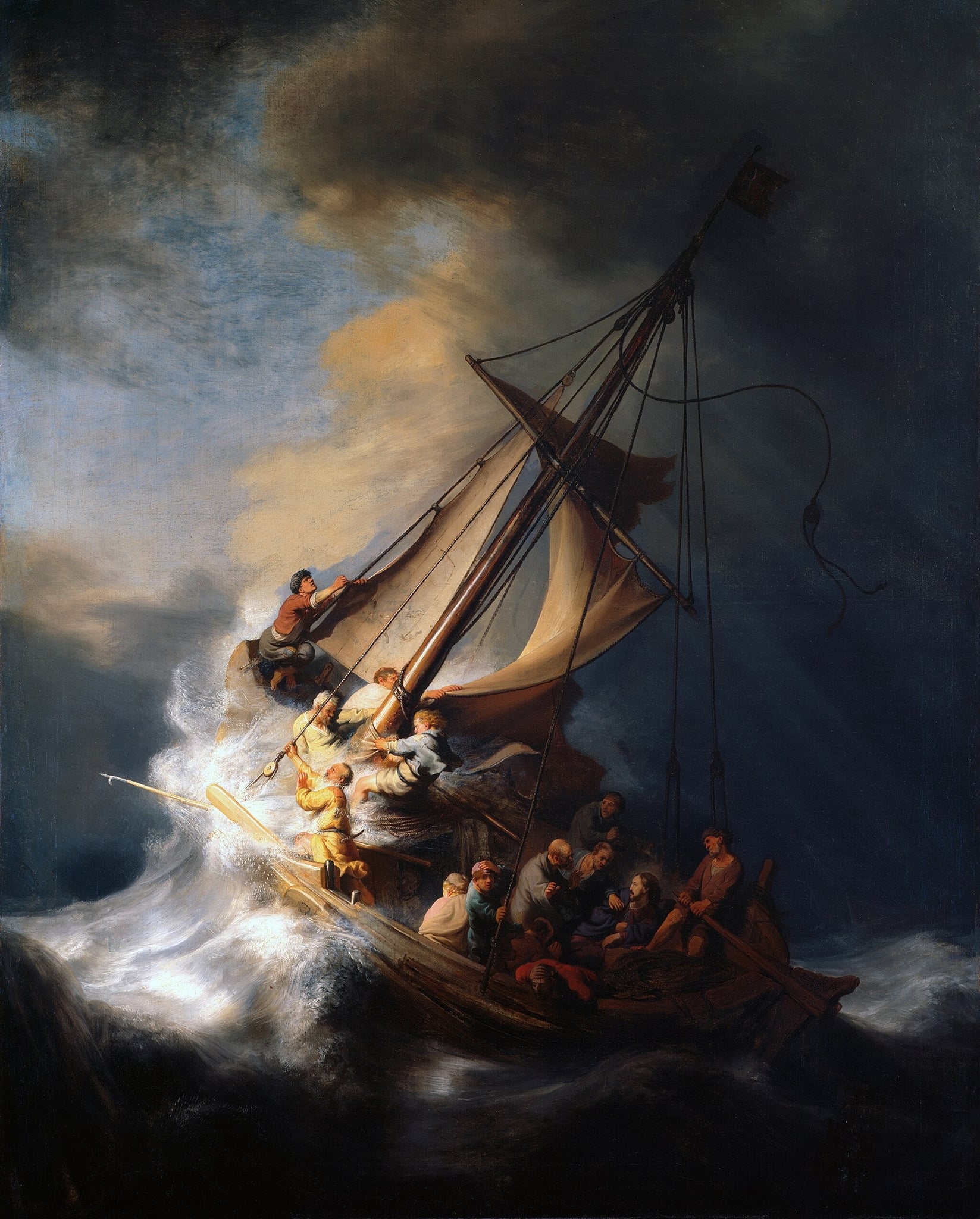
The Storm on the Sea of Galilee by Rembrandt van Rijn

The Storm on the Sea of Galilee

Rembrandt van Rijn (1633)

Rembrandt van Rijn’s The Storm on the Sea of Galilee stages a clash of <strong>human panic</strong> and <strong>divine composure</strong> at the instant before the miracle. A torn mainsail whips across a steeply tilted boat as terrified disciples scramble, while a <strong>serenely lit Christ</strong> anchors a pocket of calm—an image of faith holding within chaos <sup>[1]</sup><sup>[3]</sup>. It is Rembrandt’s only painted seascape, intensifying its dramatic singularity in his oeuvre <sup>[2]</sup>.
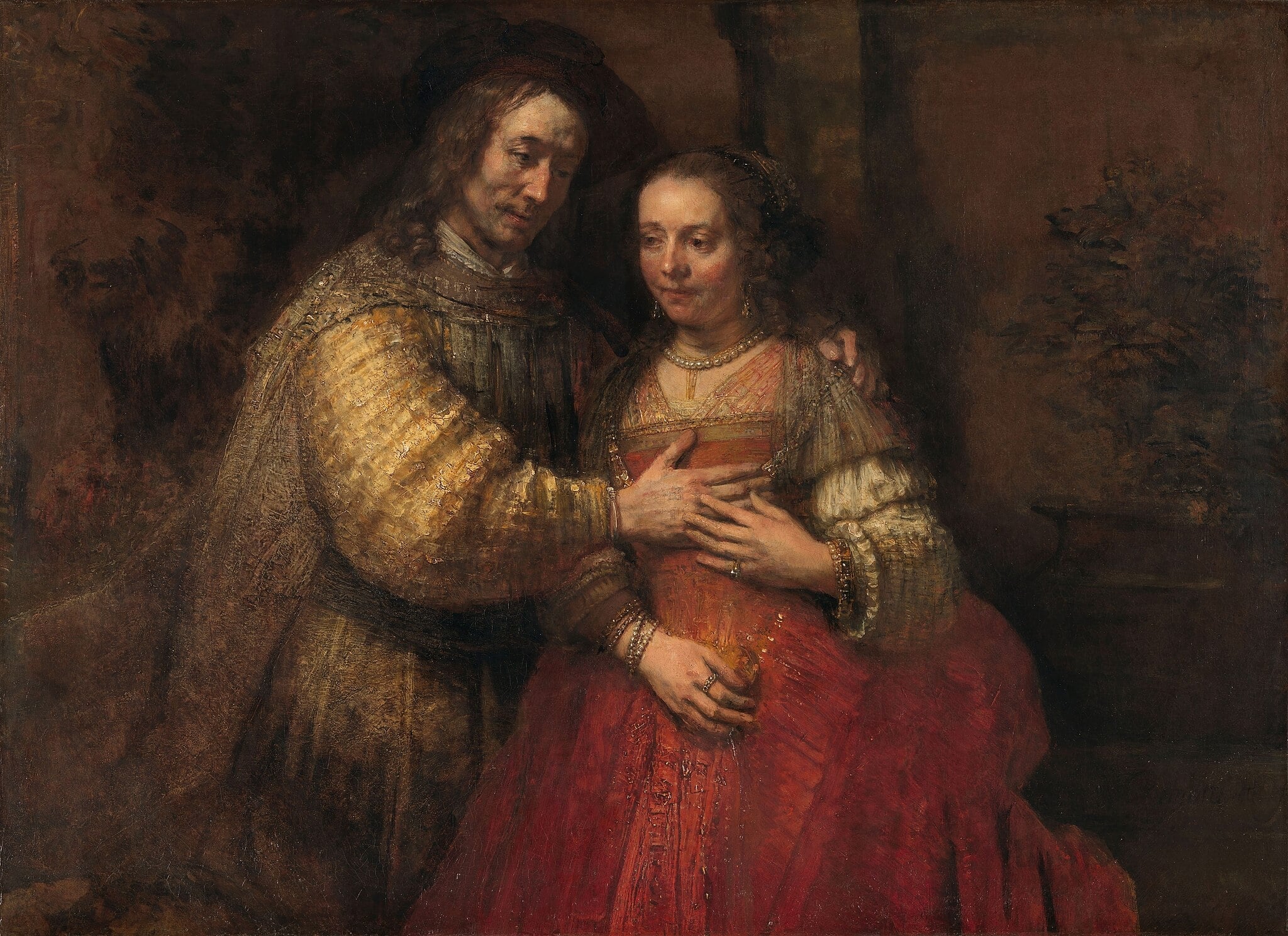
The Jewish Bride by Rembrandt van Rijn

The Jewish Bride

Rembrandt van Rijn (c. 1665–1669)

The Jewish Bride by Rembrandt van Rijn stages an intimate covenant: two figures, read today as <strong>Isaac and Rebecca</strong>, seal their union through touch rather than spectacle. Light concentrates on faces and hands, while the man’s glittering <strong>gold sleeve</strong> and the woman’s <strong>coral-red gown</strong> turn paint itself into a metaphor for fidelity and tenderness <sup>[1]</sup><sup>[3]</sup>. This late masterpiece embodies Rembrandt’s <strong>material eloquence</strong>—impasto as feeling—within a hushed, dark setting <sup>[1]</sup><sup>[2]</sup>.
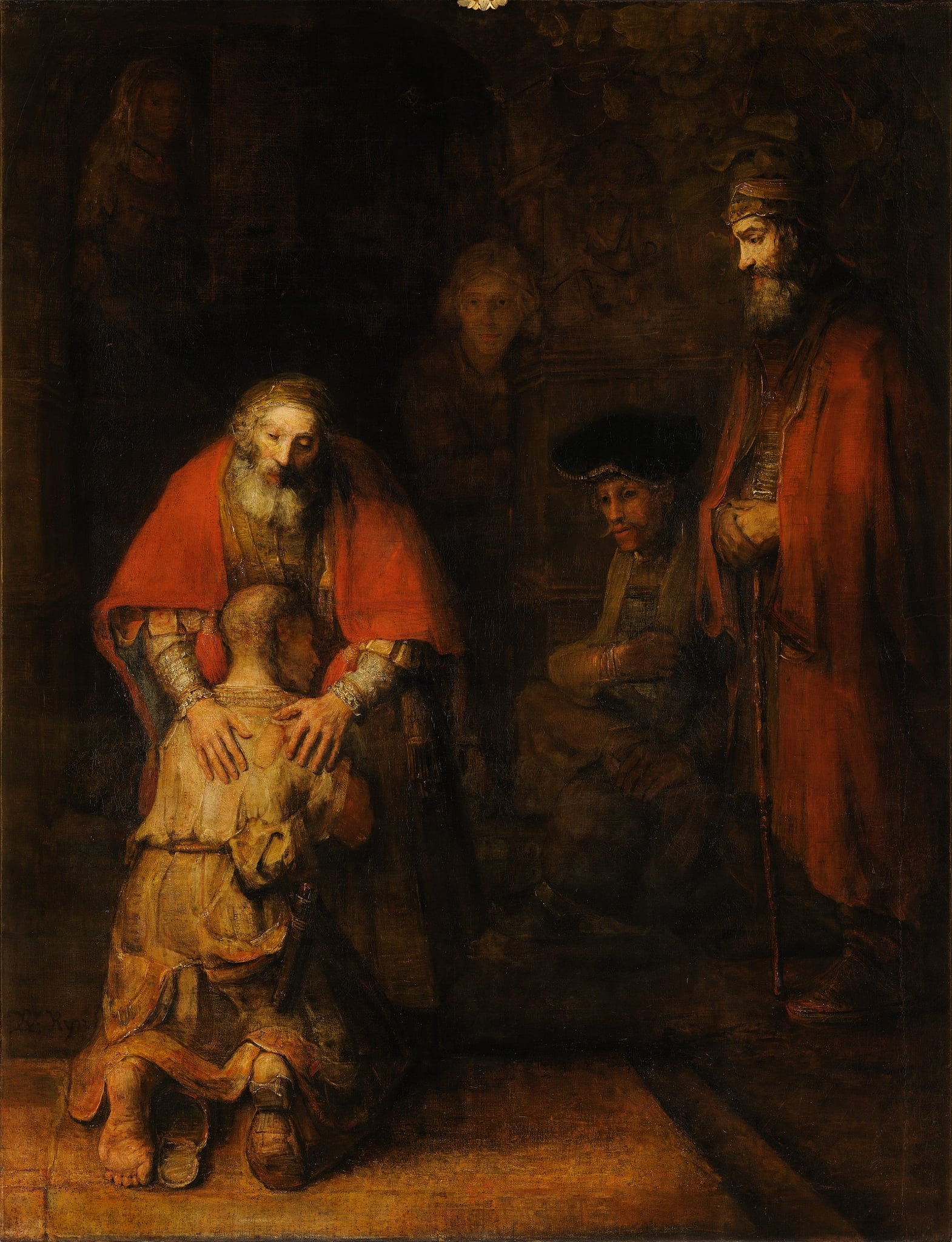
The Return of the Prodigal Son by Rembrandt van Rijn

The Return of the Prodigal Son

Rembrandt van Rijn (c. 1661–1669 (probably completed by 1669))

Rembrandt van Rijn’s The Return of the Prodigal Son is a late-life meditation on <strong>mercy</strong>, <strong>homecoming</strong>, and <strong>restored dignity</strong>. In a hush of dusk-like light, a ragged son kneels into his father’s <strong>embrace</strong>, while an upright elder brother holds back in shadow. The image concentrates meaning in illuminated <strong>faces, hands, and feet</strong>, turning a parable into a timeless human reckoning. <sup>[1]</sup><sup>[2]</sup>
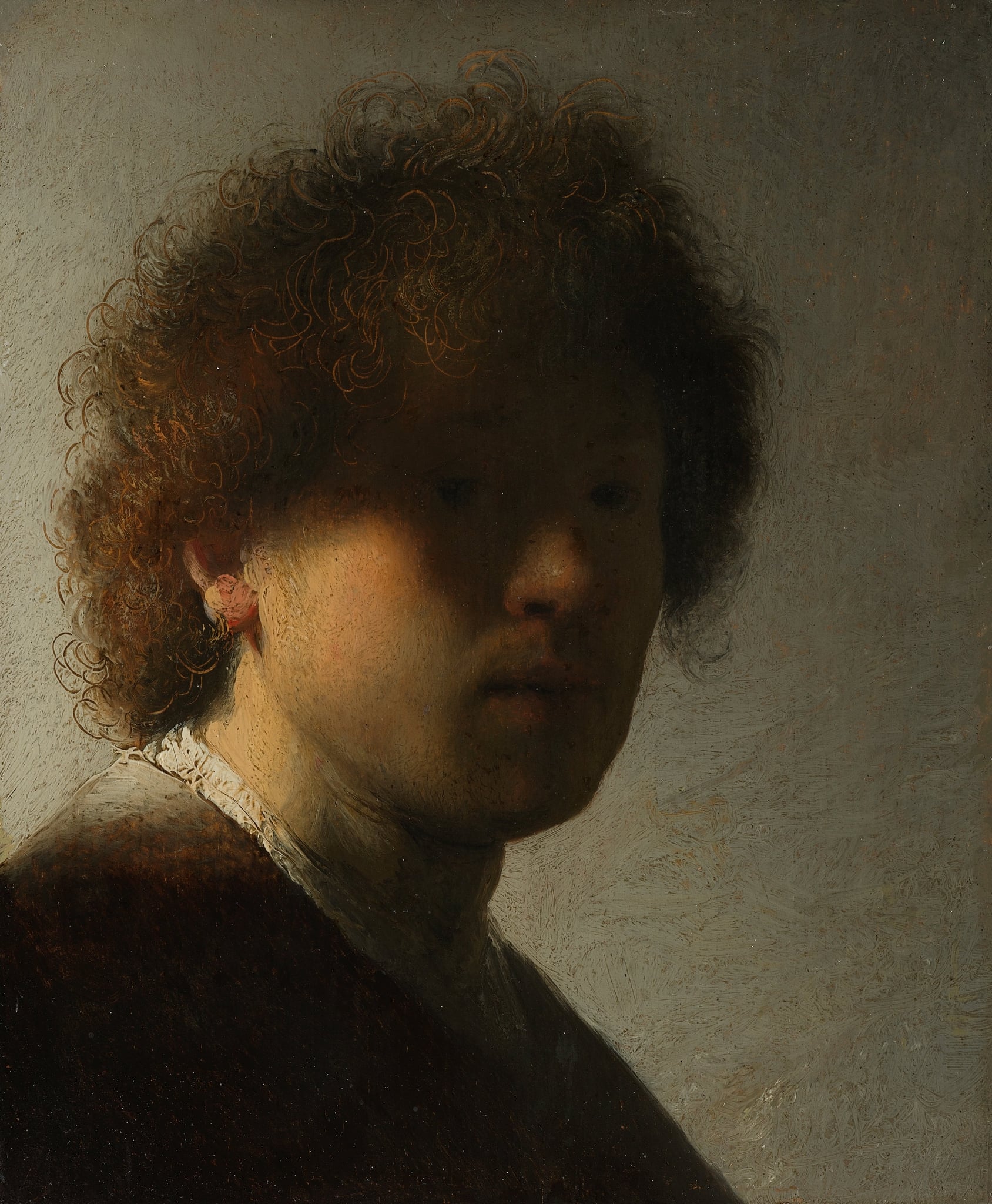
Self-portrait (with tousled hair) by Rembrandt van Rijn

Self-portrait (with tousled hair)

Rembrandt van Rijn (c. 1628)

A young Rembrandt van Rijn tests how <strong>light both reveals and withholds</strong> by letting his face emerge from darkness while his <strong>scratched, backlit curls</strong> flare like a rough halo. The small oak panel makes <strong>process itself the subject</strong>, turning hair, stubble, and a raking highlight into a statement of identity-in-formation <sup>[1]</sup><sup>[5]</sup>.
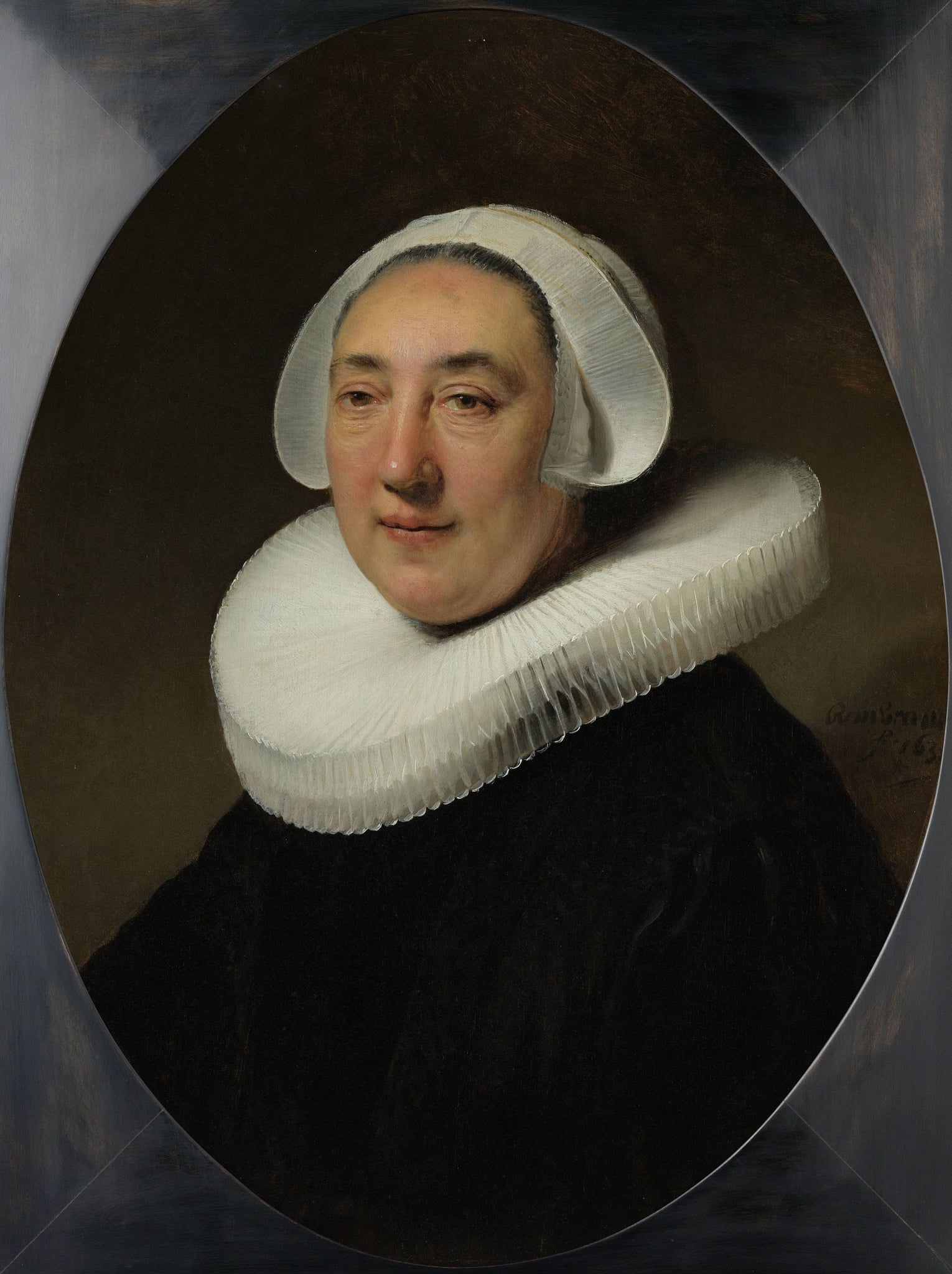
Portrait of Haesje Jacobsdr van Cleyburg by Rembrandt van Rijn

Portrait of Haesje Jacobsdr van Cleyburg

Rembrandt van Rijn (1634)

Rembrandt’s 1634 Portrait of Haesje Jacobsdr van Cleyburg stages a Dutch burgher within a feigned <strong>oval</strong> opening, illuminated by selective <strong>chiaroscuro</strong> that models warm skin against brilliant <strong>millstone ruff</strong> and sober black dress. The painting balances <strong>modesty and status</strong>, making virtue visible while quietly declaring prosperity through immaculate linen and craft <sup>[1]</sup><sup>[4]</sup>.