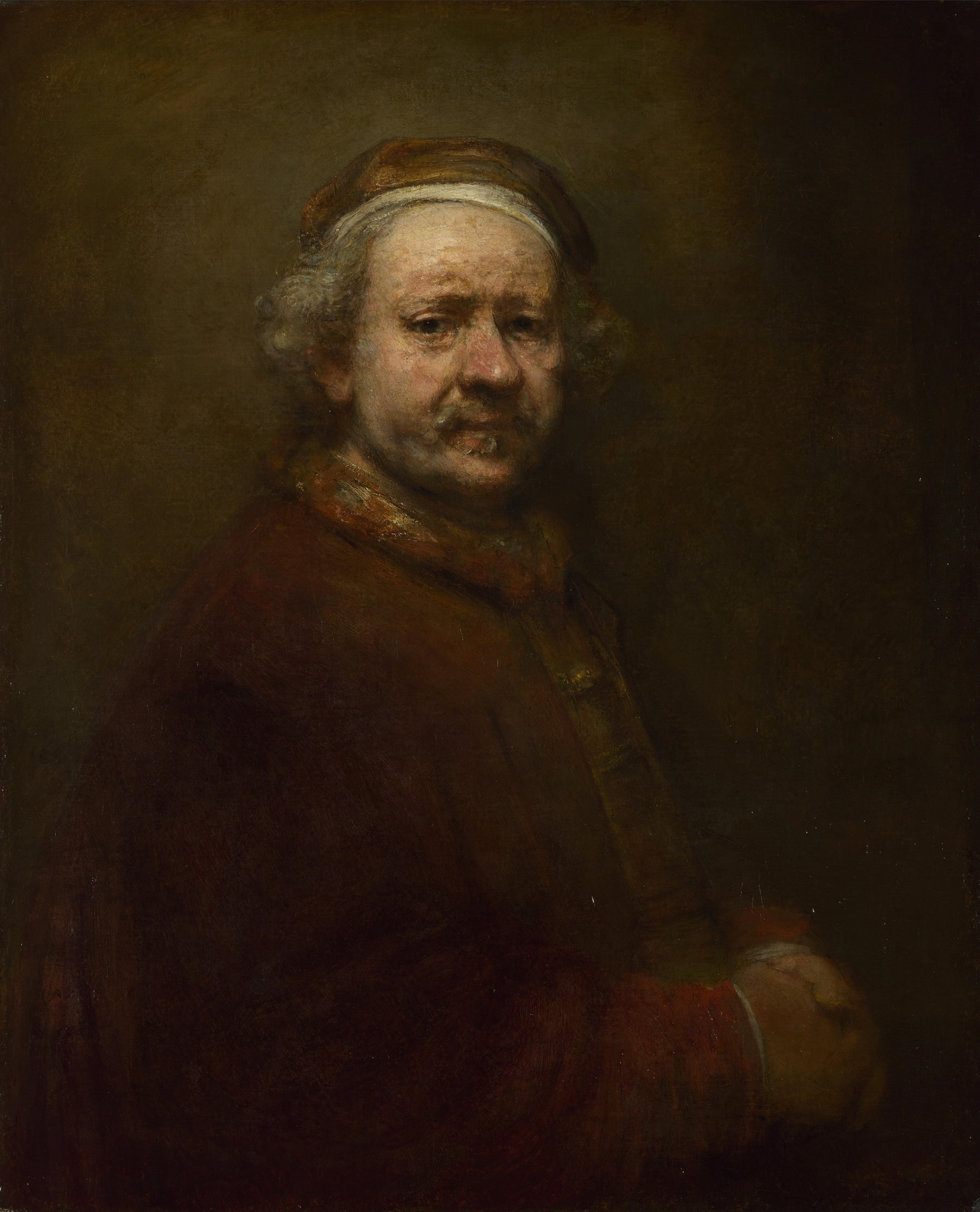
Self Portrait at the Age of 63

by Rembrandt van Rijn

Rembrandt van Rijn’s Self Portrait at the Age of 63 (1669) presents an aged painter held in a warm cone of light against an engulfing dark. Thick, tactile strokes carve the face while the clasped hands retreat into shadow, turning bodily presence into a meditation on endurance and the craft of looking [1][2].

Study Print Studio

Create a personal study print

Build a companion study sheet around the part of this painting that speaks to you most. Choose a detail, shape an interpretation, and walk away with something personal and display-worthy.

Fast Facts

Year
1669
Medium
Oil on canvas
Dimensions
86 × 70.5 cm
Location
National Gallery, London
See all Rembrandt van Rijn paintings in London
Self Portrait at the Age of 63 by Rembrandt van Rijn (1669) featuring Cone of light against deep shadow (tenebrism), Impastoed, time‑worn face, Direct, steady gaze, Modest painter’s cap

Click on any numbered symbol to learn more about its meaning

Meaning & Symbolism

The portrait is engineered to concentrate meaning where it counts: in the head and the gaze. Rembrandt builds the forehead, eyelids, and nose with heavy lead‑white impasto that physically protrudes from the canvas, so that the surface enacts the abrasion of years; the ridged paint catches the warm light and makes age itself legible as matter 2. The slightly reddened nose and puffed eyes are not softened, yet the direct, frontal look neither implores nor defies; it simply acknowledges. Around that center, everything withdraws. The small brown cap and fur‑edged mantle are broadly, even roughly, indicated; a faint glint along the chest reads as chain or trimming, a nod to professional dignity without flourish. Most telling is the treatment of the hands at lower right: folded, half‑eclipsed by shadow, their contours dissolve before the viewer’s eyes. Technical studies show that these hands were first painted open, likely holding a brush or mahlstick, and that the headgear was originally a larger, white painter’s cap; Rembrandt later painted both out 23. By erasing the explicit tools of his trade, he removes anecdote and leaves a distilled emblem of the artist as a thinking, seeing being. The dark, tenebrist ground sharpens this decision. Nothing in the background competes for attention; the world recedes so that the act of self‑regard can take the stage 13. This rethinking of self‑presentation belongs to the radical clarity of Rembrandt’s late manner. In the final year of his life, after reversals and bereavements, he favors a reduced palette of umbers and reds that yields somber resonance rather than spectacle; the harmony is grave, not mournful, and it anchors the unwavering look he casts at us. The material contrast between the highly worked face and the summarily brushed mantle and hands is not mere economy: it is a hierarchy of meaning that places consciousness over costume and craft over status 2. The change from “artist at work” to clasped, resting hands is especially potent because it reframes agency. Instead of catching him mid‑labor, we meet him at the pause where judgment happens—the inward moment when seeing becomes knowledge. That is why the cap remains yet is toned down: he keeps the sign of the painter’s calling but strips it of theatricality, aiming at a timeless rather than topical identity 23. Curators rightly stress self‑scrutiny in this late work, while scholars caution that Rembrandt’s self‑portraits served multiple functions beyond confession 39. Both insights apply here. The painting is not a diary entry; it is a crafted image for viewers and patrons that nonetheless convinces as truth because its means—light picking out the brow, paste‑thick strokes that refuse prettiness, hands retreating from claim—embody what it asserts. Thus, the canvas reads as a final testament to painting’s capacity to hold a human presence intact while acknowledging the encroaching dark. In Self Portrait at the Age of 63, Rembrandt makes the viewer witness not to biography but to endurance rendered as paint—a last, lucid defense of the value of looking 123.

Explore Deeper with AI

Ask questions about Self Portrait at the Age of 63

Popular questions:

Powered by AI • Get instant insights about this artwork

💬 Ask questions about this artwork!

Interpretations

Technical Art History: Materiality as Meaning

X‑radiography reveals that Rembrandt first conceived the figure with open hands holding a tool, then suppressed those markers and thickened the facial modeling with heavy lead‑white impasto. The change is not cosmetic: it reweights the composition toward the brow, eyelids, and nose, where paste‑rich ridges catch light to literalize age as matter. The brown ground—identified as containing silica and ochre—creates a low‑key register in which minute value shifts around the eyes read as thinking, not theatricality. By contrast, the mantle and hands are summarily brushed, their edges dissolving into the tenebrist field. This calibrated disparity of facture functions like a semantic hierarchy: consciousness is sculpted; status is sketched. The final surface, laid over revisions, lets viewers perceive process and judgment at once—medium and message fused in late Rembrandt’s studio practice 23.

Source: National Gallery, London (Scholarly Catalogue; 'Rembrandt in detail')

Function and Market: Beyond the ‘Diary’ Myth

Ernst van de Wetering argues that Rembrandt’s self‑portraits fulfilled multiple roles—pedagogical models, marketable images of authorship, and demonstrations of pictorial problem‑solving—rather than private confession. Read through this lens, the reduced cap and clasped hands are not simply signs of stoic introspection; they are strategic conventions that broadcast a timeless painter‑identity to connoisseurs while withholding anecdote. The removal of overt tools tempers self‑advertisement even as the commanding frontal look sustains authority. Such choices align with a late‑career bid for auctoritas grounded in mastery of light and substance, legible to the Amsterdam market and later collectors. The image persuades not by personal revelation, but by presenting the painter as the arbiter of seeing—an asset with clear market and studio utility in 1669 42.

Source: Ernst van de Wetering (Rembrandt Research Project)

Comparative Portraiture: Old Masters Reframed

Rembrandt’s late self‑portraits sustain the authoritative, half‑length formula associated with Raphael’s Castiglione and Titian’s aristocratic sitters—frontal presence, dark ground, controlled costume—yet they deflate courtly sheen in favor of material candor. In the 1669 canvas, the mantle’s broad handling recalls the grand manner but refuses its polish; the gaze holds court without brocade. Compared to his 1659 self‑portrait, the palette narrows, and the paint becomes more visibly worked, pushing the genre toward an introspective manifesto on seeing. By absorbing and then paring back Italianate models, Rembrandt asserts an authorship that is at once learned and singular: the old master’s pose reanimated as a study in surface truth, where facture and light carry the burden of eloquence 52.

Source: National Gallery of Art (Washington), Dutch Paintings Catalogue

Conservation and Historiography: The 1967 Reveal

The 1967 cleaning that uncovered the date “1669” and traces of the signature reset the painting’s historical stakes, confirming it as a work from Rembrandt’s final year. This intervention sharpened curatorial emphasis on late‑style reduction—the somber umbers, the tenebrist void, the thickened head—by anchoring them to the endgame of his practice. It also gave weight to the pentimenti in the cap and hands, moving interpretation from mere description to a documented rethinking of self‑presentation. The surviving stroke of the signature’s final “t,” trimmed by past interventions, became a poignant fragment of authorship. Conservation thus did double duty: stabilizing matter while reframing meaning for scholarship and the public, and demonstrating how technical study can recalibrate the chronology, function, and rhetoric of a canonical image 21.

Source: National Gallery, London (Scholarly Catalogue; Object Record)

Biography, Time, and the Ethics of Looking

Dated to 1669—Rembrandt’s last year, with burial recorded on 8 October—the portrait invites biographical readings: bankruptcies behind him, Hendrickje and Titus gone, he faces us with grave clarity. Yet the picture resists pathos; its reduced palette and stillness feel ethical rather than sentimental, insisting that looking be sober, sustained, and mutual. The clasped hands imply a pause where judgment forms; the small cap keeps vocation in play without show. In this balance, the work converts private loss into a public ethics of seeing: an image for patrons and posterity that models attention as a civic and artistic virtue. The life context sharpens our sense of risk and restraint, but the painting finally argues for presence—an endurance rendered as paint, not confession 631.

Source: National Gallery (Artist Overview); Stadsarchief Amsterdam; National Gallery 'Rembrandt in detail'

Related Themes

About Rembrandt van Rijn

Rembrandt van Rijn (1606–1669) was a leading Dutch Golden Age painter and printmaker whose Amsterdam years (from 1631) produced virtuosic portraits and ambitious history paintings. In the early 1630s he favored polished finishes, saturated color, and theatrical staging—qualities on display in this 1633 canvas. Although prolific, this is his only known painted seascape [2][4].
View all works by Rembrandt van Rijn

More by Rembrandt van Rijn
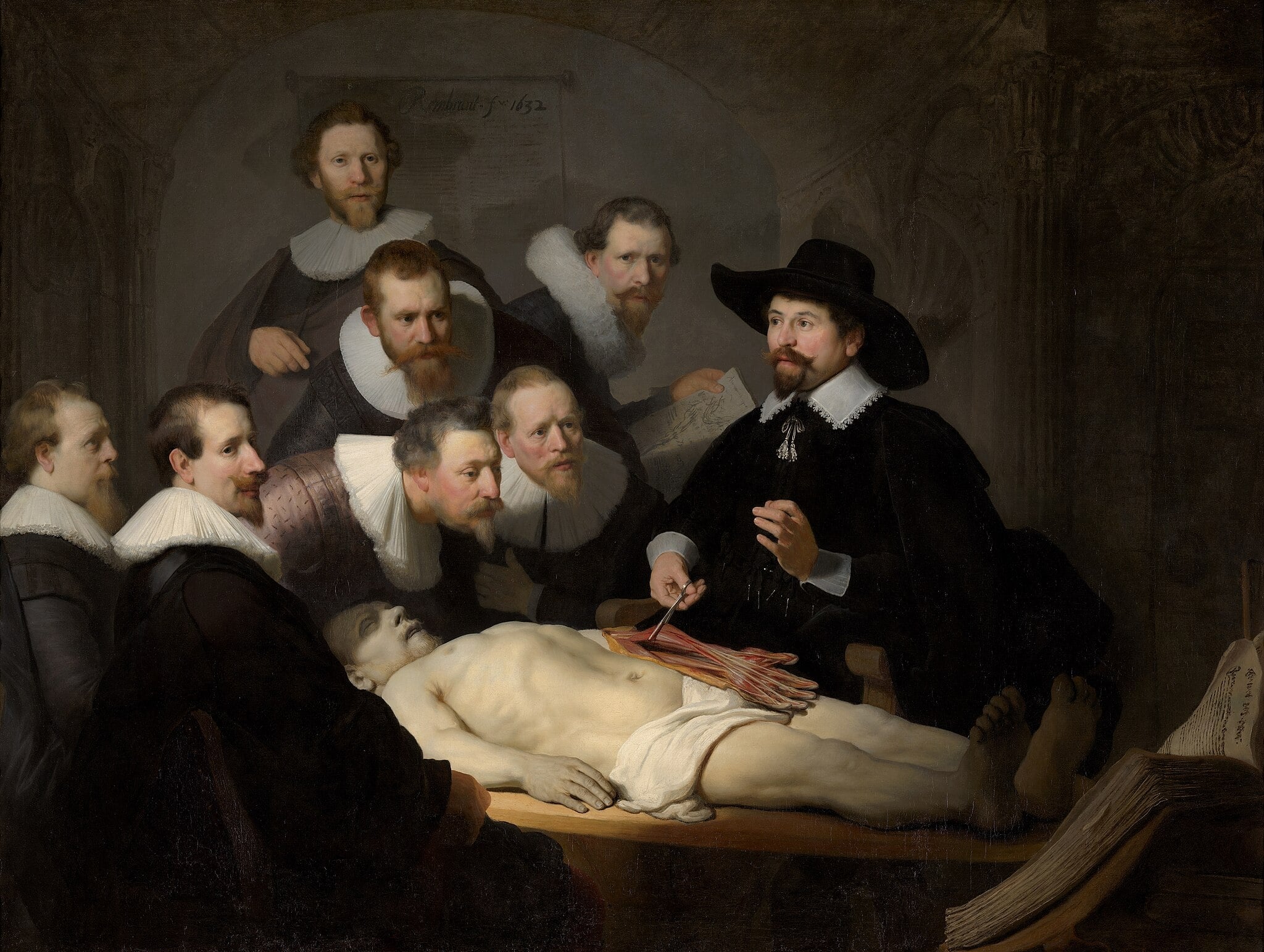
The Anatomy Lesson of Dr. Nicolaes Tulp by Rembrandt van Rijn

The Anatomy Lesson of Dr. Nicolaes Tulp

Rembrandt van Rijn (1632)

Rembrandt van Rijn turns a civic commission into a drama of <strong>knowledge made visible</strong>. A cone of light binds the ruff‑collared surgeons, the pale cadaver, and Dr. Tulp’s forceps as he raises the <strong>forearm tendons</strong> to explain the hand. Book and body face each other across the table, staging the tension—and alliance—between <strong>textual authority</strong> and <strong>empirical observation</strong> <sup>[1]</sup><sup>[2]</sup>.
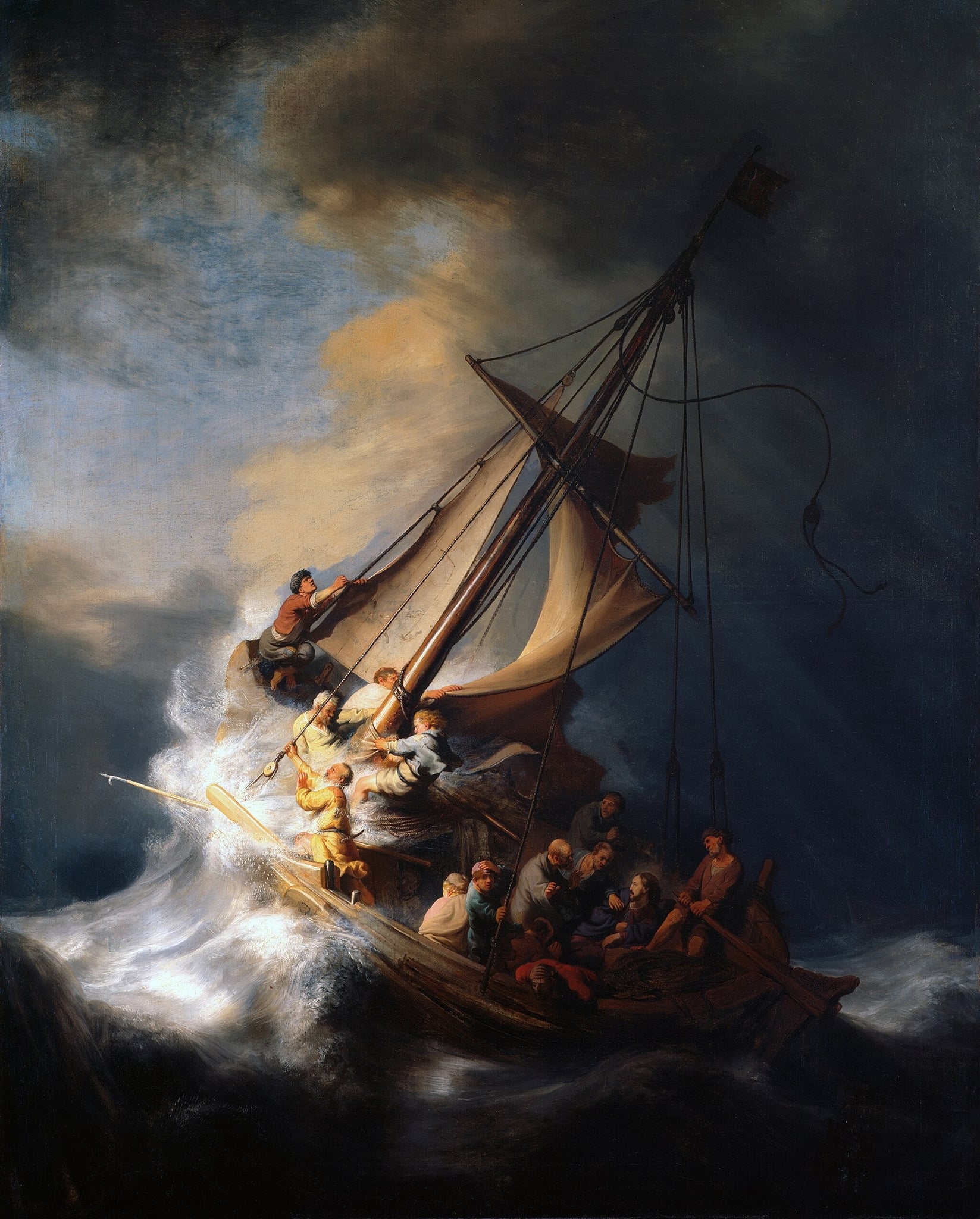
The Storm on the Sea of Galilee by Rembrandt van Rijn

The Storm on the Sea of Galilee

Rembrandt van Rijn (1633)

Rembrandt van Rijn’s The Storm on the Sea of Galilee stages a clash of <strong>human panic</strong> and <strong>divine composure</strong> at the instant before the miracle. A torn mainsail whips across a steeply tilted boat as terrified disciples scramble, while a <strong>serenely lit Christ</strong> anchors a pocket of calm—an image of faith holding within chaos <sup>[1]</sup><sup>[3]</sup>. It is Rembrandt’s only painted seascape, intensifying its dramatic singularity in his oeuvre <sup>[2]</sup>.
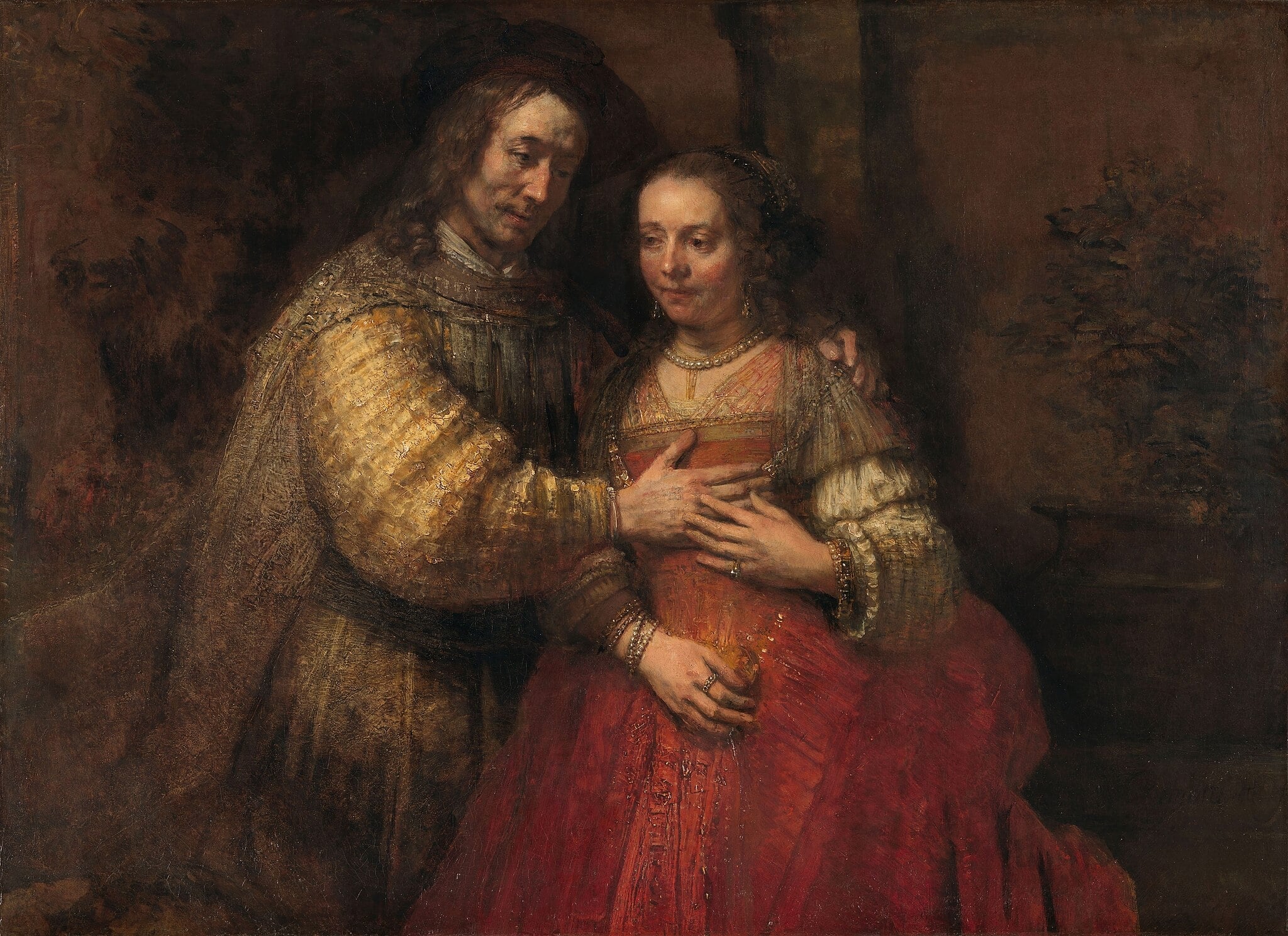
The Jewish Bride by Rembrandt van Rijn

The Jewish Bride

Rembrandt van Rijn (c. 1665–1669)

The Jewish Bride by Rembrandt van Rijn stages an intimate covenant: two figures, read today as <strong>Isaac and Rebecca</strong>, seal their union through touch rather than spectacle. Light concentrates on faces and hands, while the man’s glittering <strong>gold sleeve</strong> and the woman’s <strong>coral-red gown</strong> turn paint itself into a metaphor for fidelity and tenderness <sup>[1]</sup><sup>[3]</sup>. This late masterpiece embodies Rembrandt’s <strong>material eloquence</strong>—impasto as feeling—within a hushed, dark setting <sup>[1]</sup><sup>[2]</sup>.
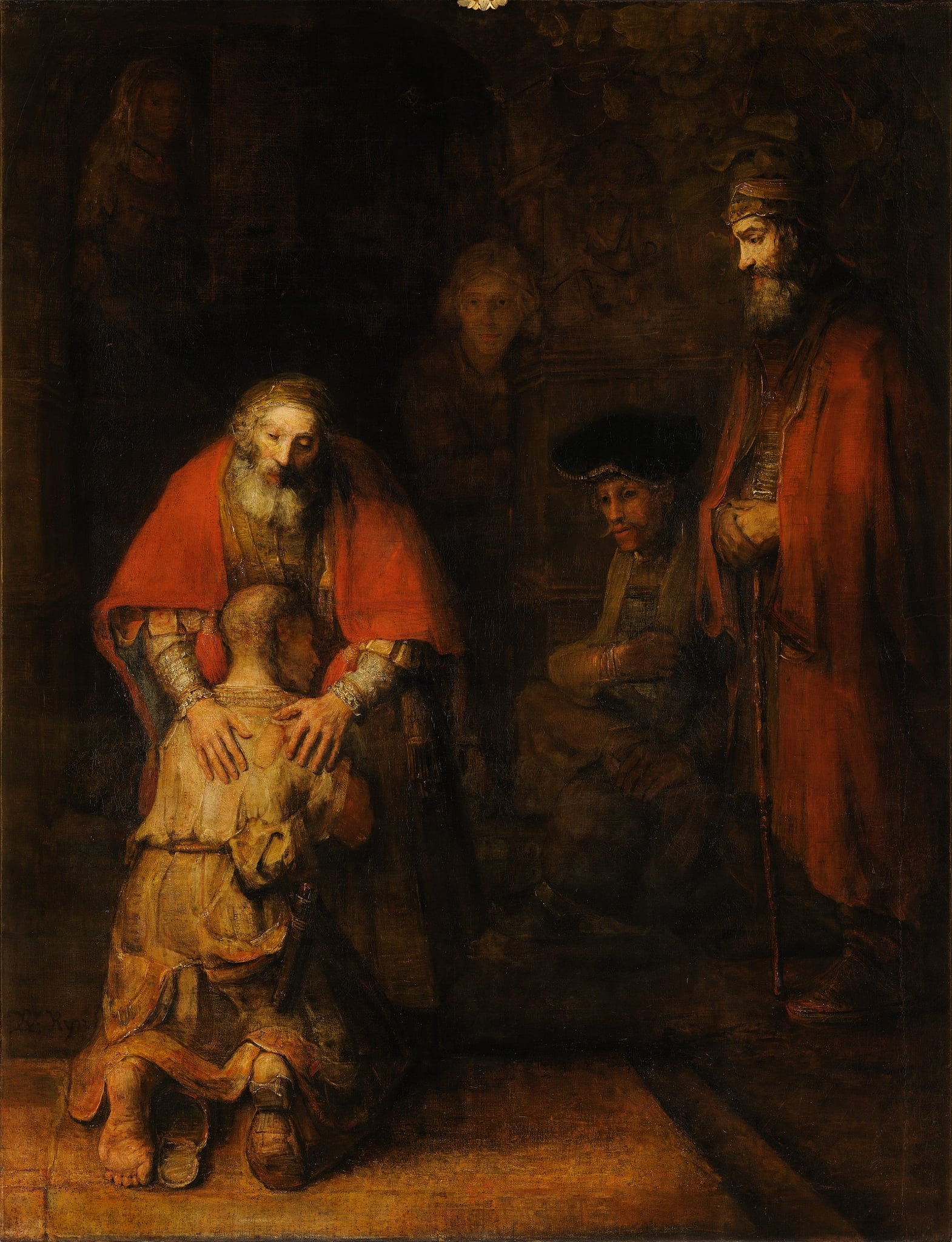
The Return of the Prodigal Son by Rembrandt van Rijn

The Return of the Prodigal Son

Rembrandt van Rijn (c. 1661–1669 (probably completed by 1669))

Rembrandt van Rijn’s The Return of the Prodigal Son is a late-life meditation on <strong>mercy</strong>, <strong>homecoming</strong>, and <strong>restored dignity</strong>. In a hush of dusk-like light, a ragged son kneels into his father’s <strong>embrace</strong>, while an upright elder brother holds back in shadow. The image concentrates meaning in illuminated <strong>faces, hands, and feet</strong>, turning a parable into a timeless human reckoning. <sup>[1]</sup><sup>[2]</sup>
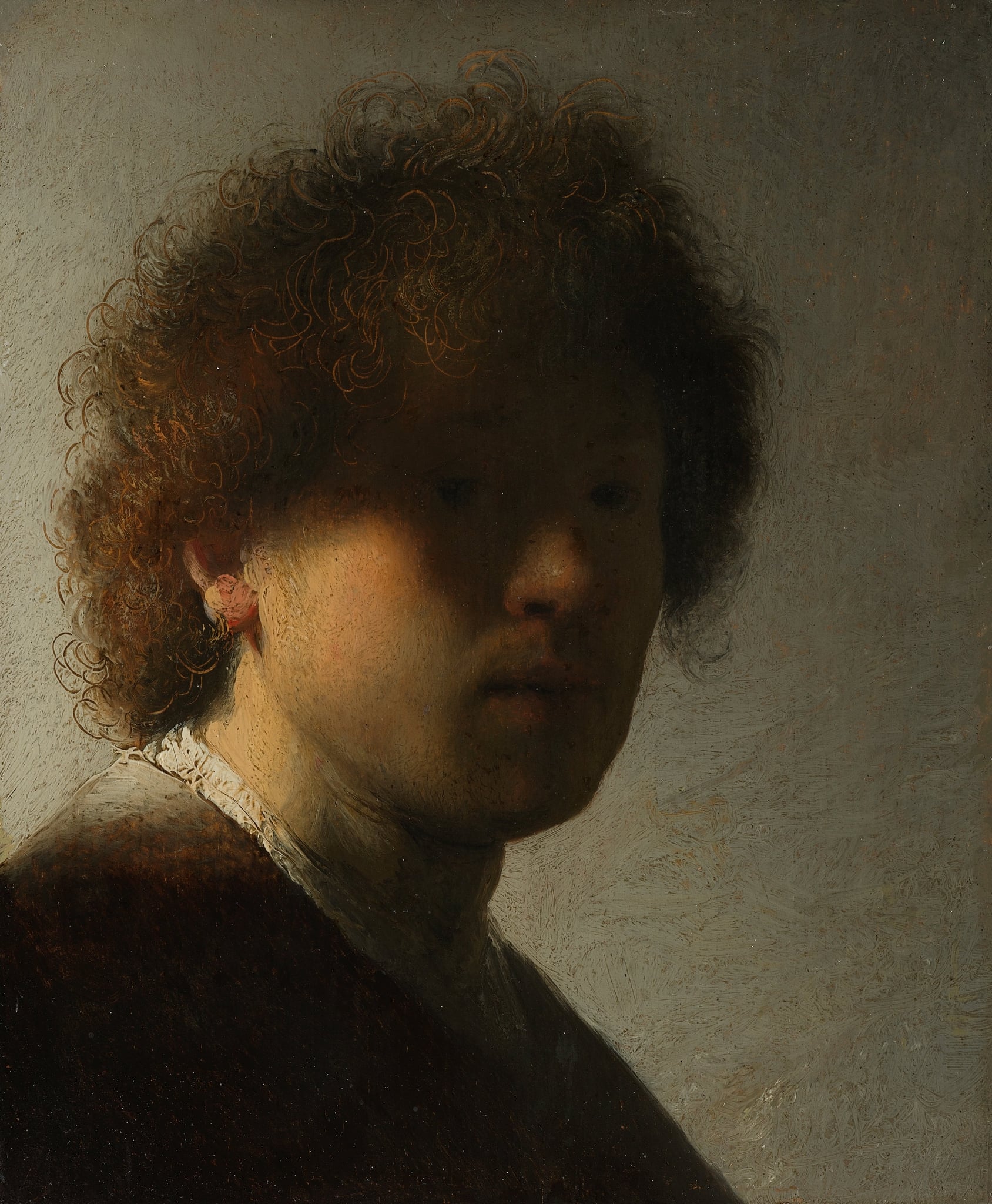
Self-portrait (with tousled hair) by Rembrandt van Rijn

Self-portrait (with tousled hair)

Rembrandt van Rijn (c. 1628)

A young Rembrandt van Rijn tests how <strong>light both reveals and withholds</strong> by letting his face emerge from darkness while his <strong>scratched, backlit curls</strong> flare like a rough halo. The small oak panel makes <strong>process itself the subject</strong>, turning hair, stubble, and a raking highlight into a statement of identity-in-formation <sup>[1]</sup><sup>[5]</sup>.
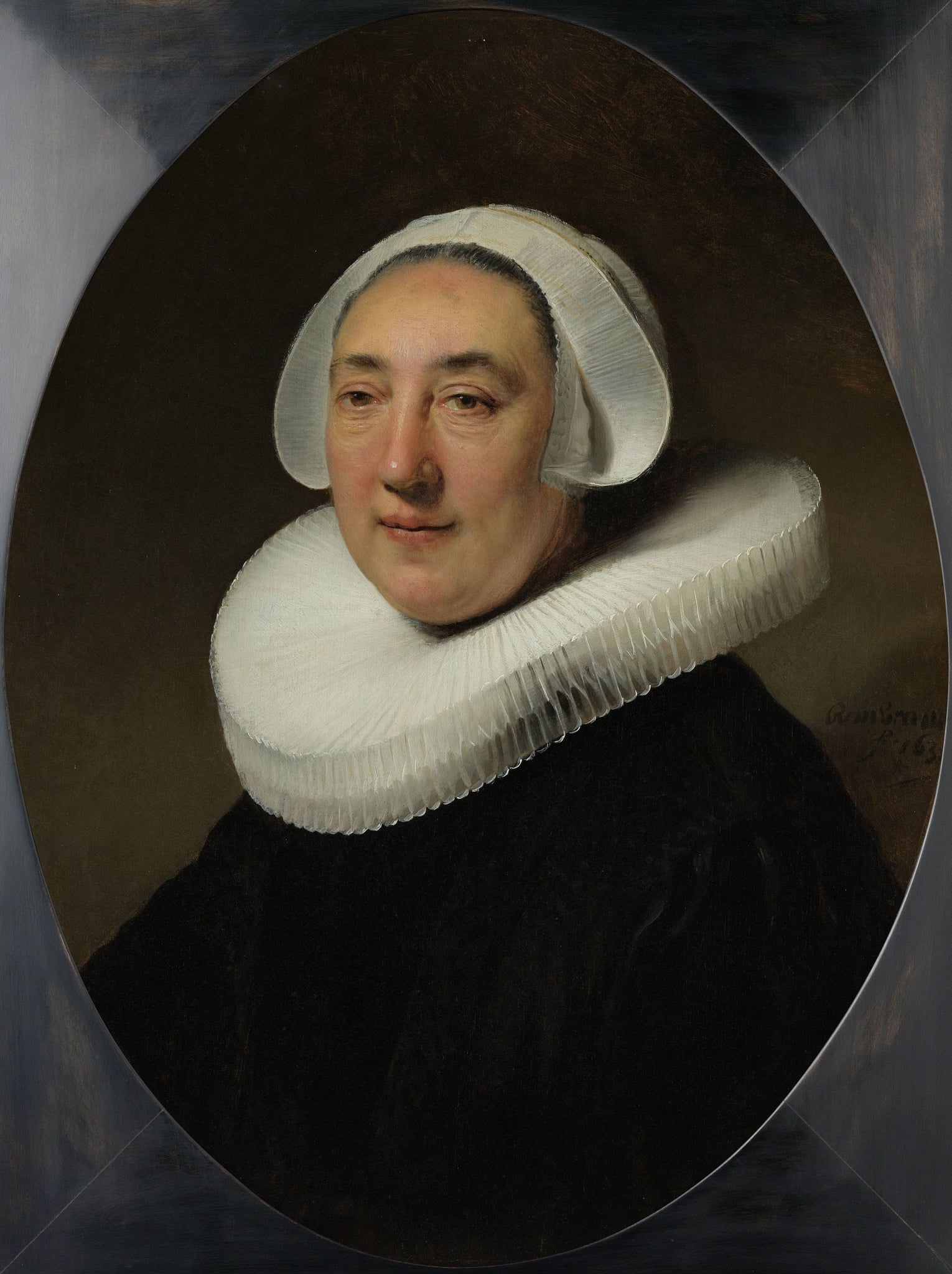
Portrait of Haesje Jacobsdr van Cleyburg by Rembrandt van Rijn

Portrait of Haesje Jacobsdr van Cleyburg

Rembrandt van Rijn (1634)

Rembrandt’s 1634 Portrait of Haesje Jacobsdr van Cleyburg stages a Dutch burgher within a feigned <strong>oval</strong> opening, illuminated by selective <strong>chiaroscuro</strong> that models warm skin against brilliant <strong>millstone ruff</strong> and sober black dress. The painting balances <strong>modesty and status</strong>, making virtue visible while quietly declaring prosperity through immaculate linen and craft <sup>[1]</sup><sup>[4]</sup>.