Color
Color symbolism in late nineteenth‑century painting shifts from fixed allegorical codes to dynamic chromatic structures, in which hues and their contrasts model perception, social experience, and ethical temperature as much as they denote specific ideas.
Member Symbols
Featured Artworks
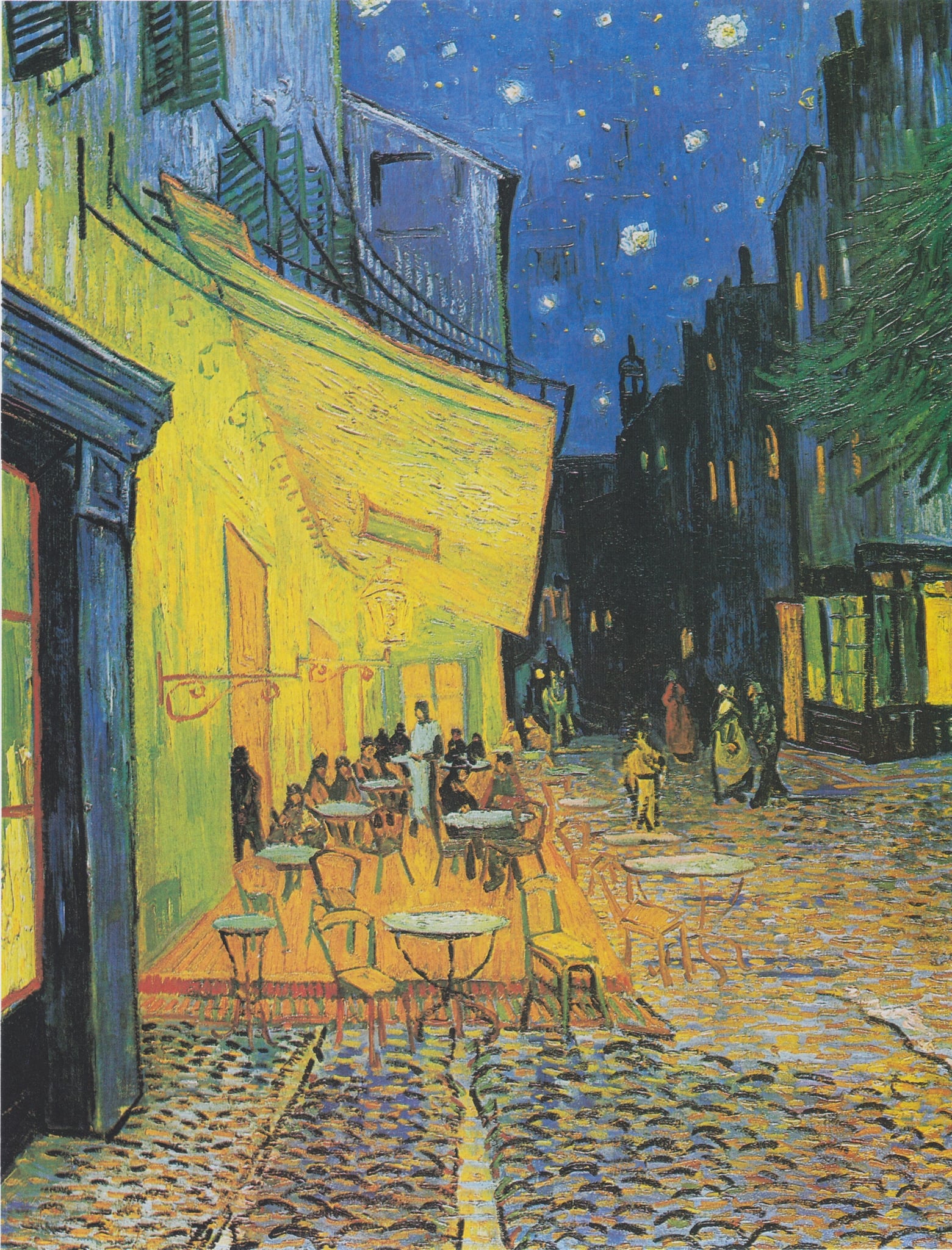
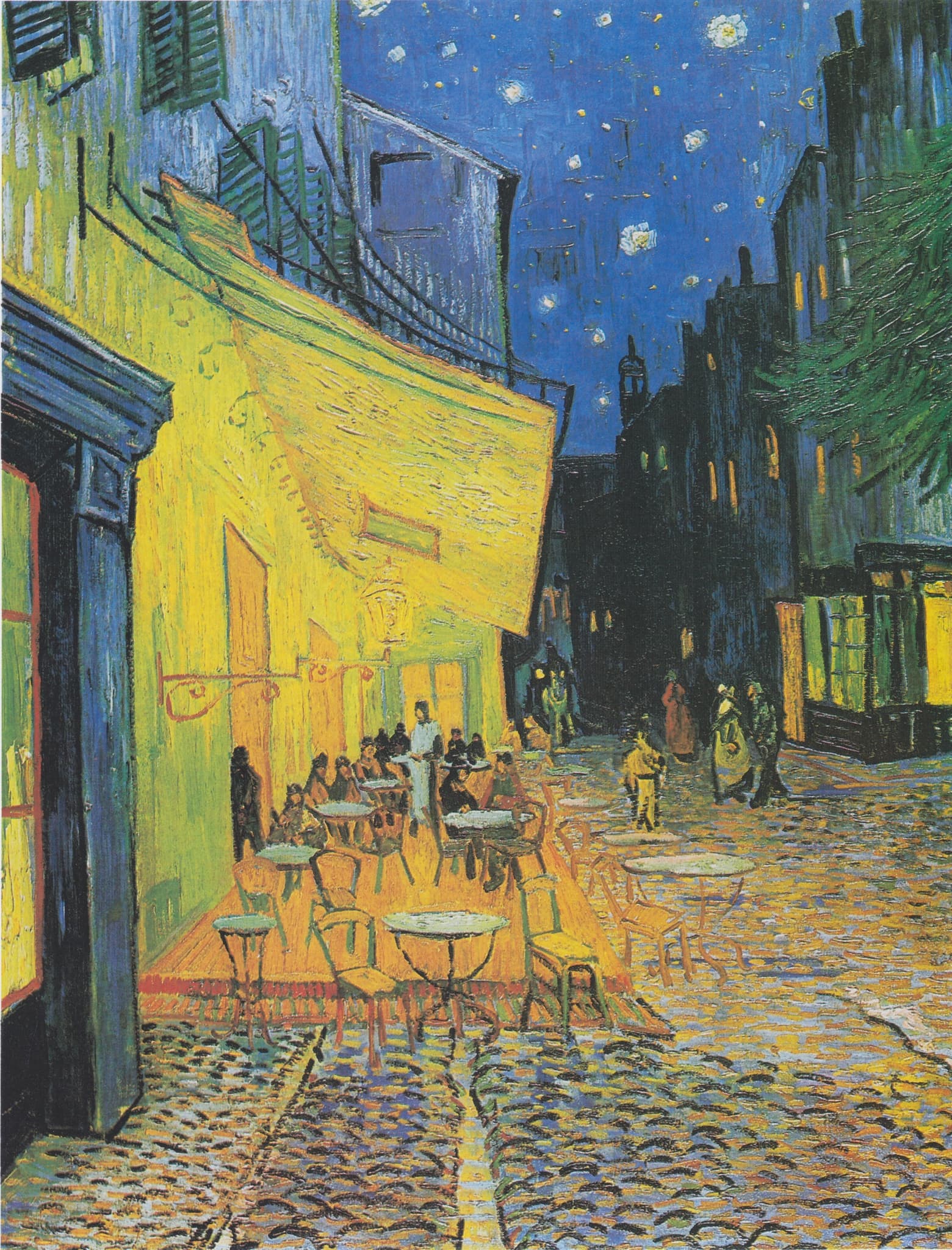
Café Terrace at Night
Vincent van Gogh (1888)
In Café Terrace at Night, Vincent van Gogh turns nocturne into <strong>luminous color</strong>: a gas‑lit terrace glows in yellows and oranges against a deep <strong>ultramarine sky</strong> pricked with stars. By building night “<strong>without black</strong>,” he stages a vivid encounter between human sociability and the vastness overhead <sup>[1]</sup><sup>[2]</sup>.
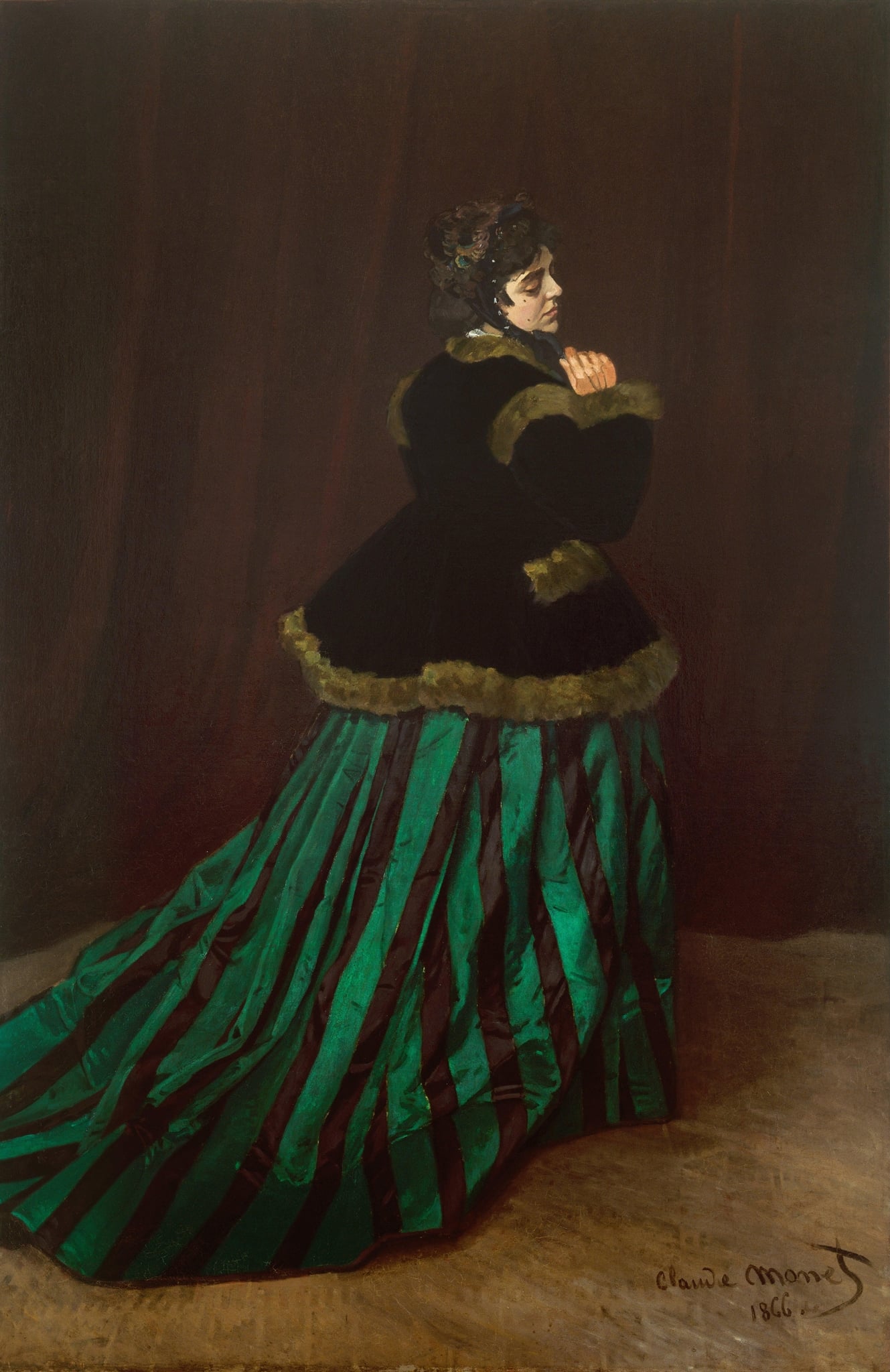
Camille (The Woman in the Green Dress)
Claude Monet (1866)
Monet’s Camille (The Woman in the Green Dress) turns a full-length portrait into a study of <strong>modern spectacle</strong>. The spotlit emerald-and-black skirt, set against a near-black curtain, makes <strong>fashion</strong> the engine of meaning and the vehicle of status.
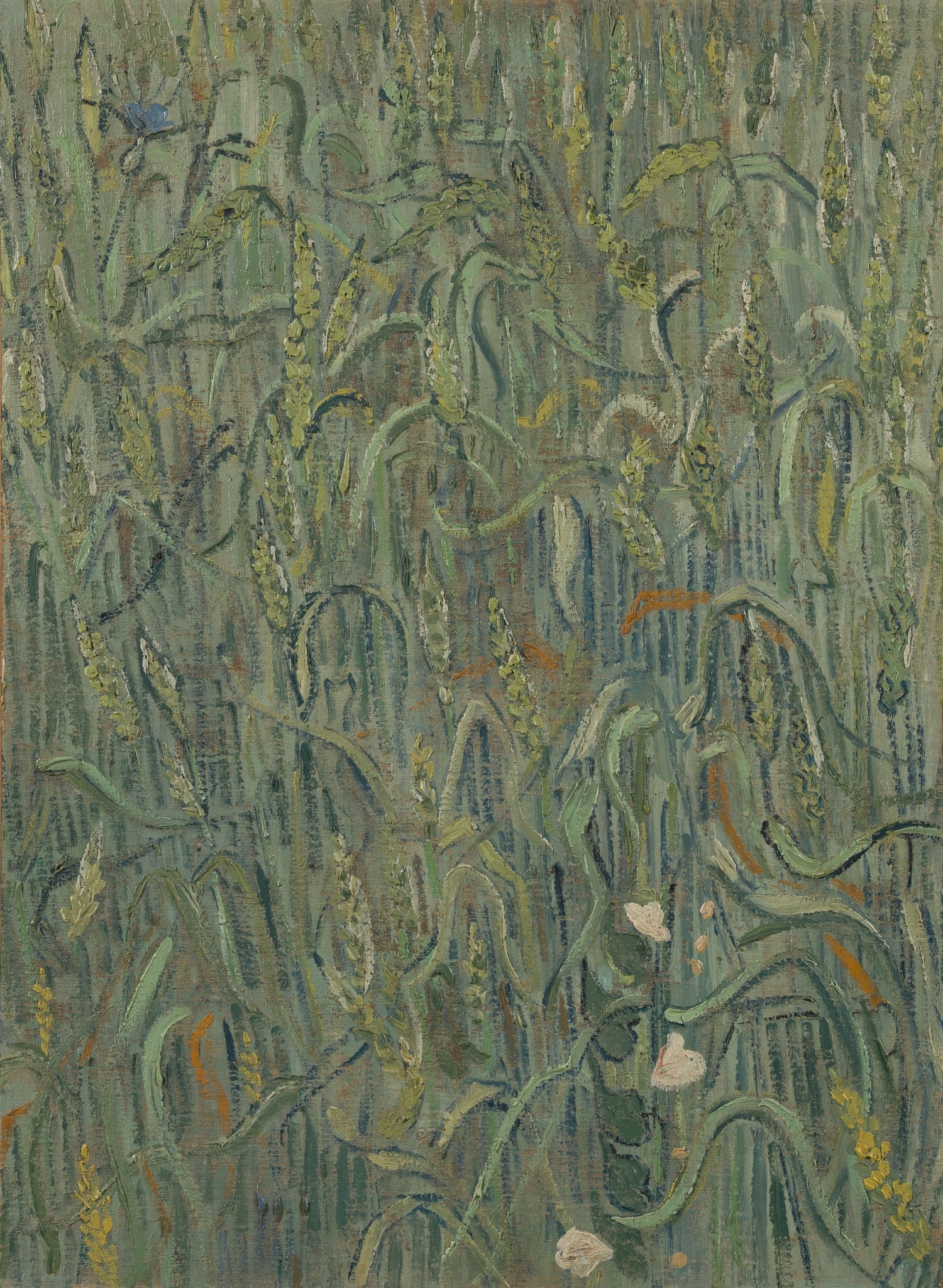
Ears of Wheat
Vincent van Gogh (1890)
Ears of Wheat plunges the viewer into a close, horizonless tangle of grain, rendering a living field as an all‑over surface of <strong>vibrating strokes</strong> and <strong>looping leaves</strong>. Cool greens and blue‑grays are pricked by ocher and rusty orange, while a blue <strong>cornflower</strong> at upper left and pale <strong>bindweed</strong> at lower right anchor the scene’s ecology <sup>[1]</sup><sup>[2]</sup>. Van Gogh turns a humble crop into a <strong>meditation on resilience and life’s cycles</strong>.
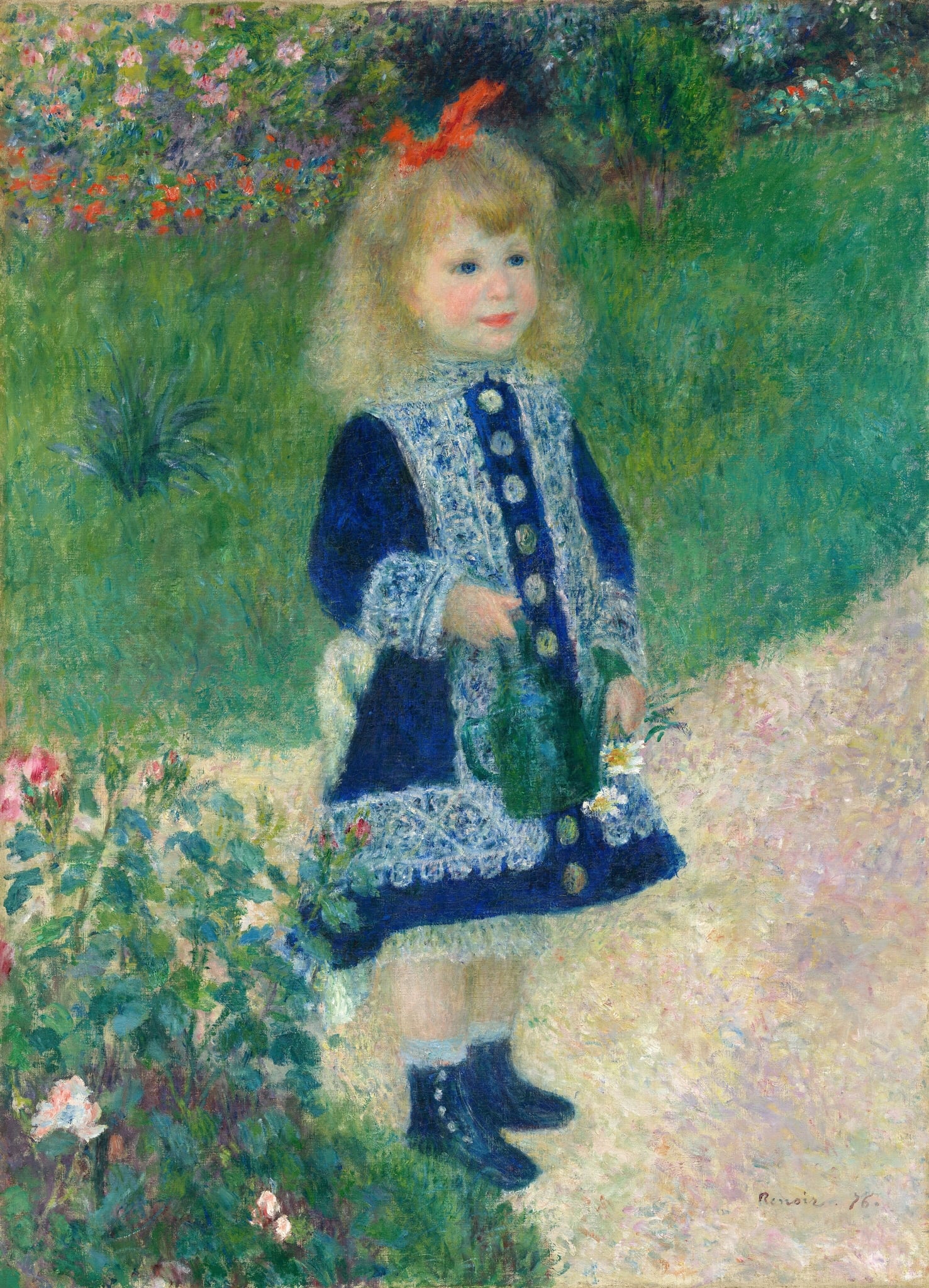
Girl with a Watering Can
Pierre-Auguste Renoir (1876)
Renoir’s 1876 Girl with a Watering Can fuses a crisply perceived child with a dissolving garden atmosphere, using <strong>prismatic color</strong> and <strong>controlled facial modeling</strong> to stage innocence within modern leisure <sup>[1]</sup>. The cobalt dress, red bow, and green can punctuate a haze of pinks and greens, making nurture and growth the scene’s quiet thesis.
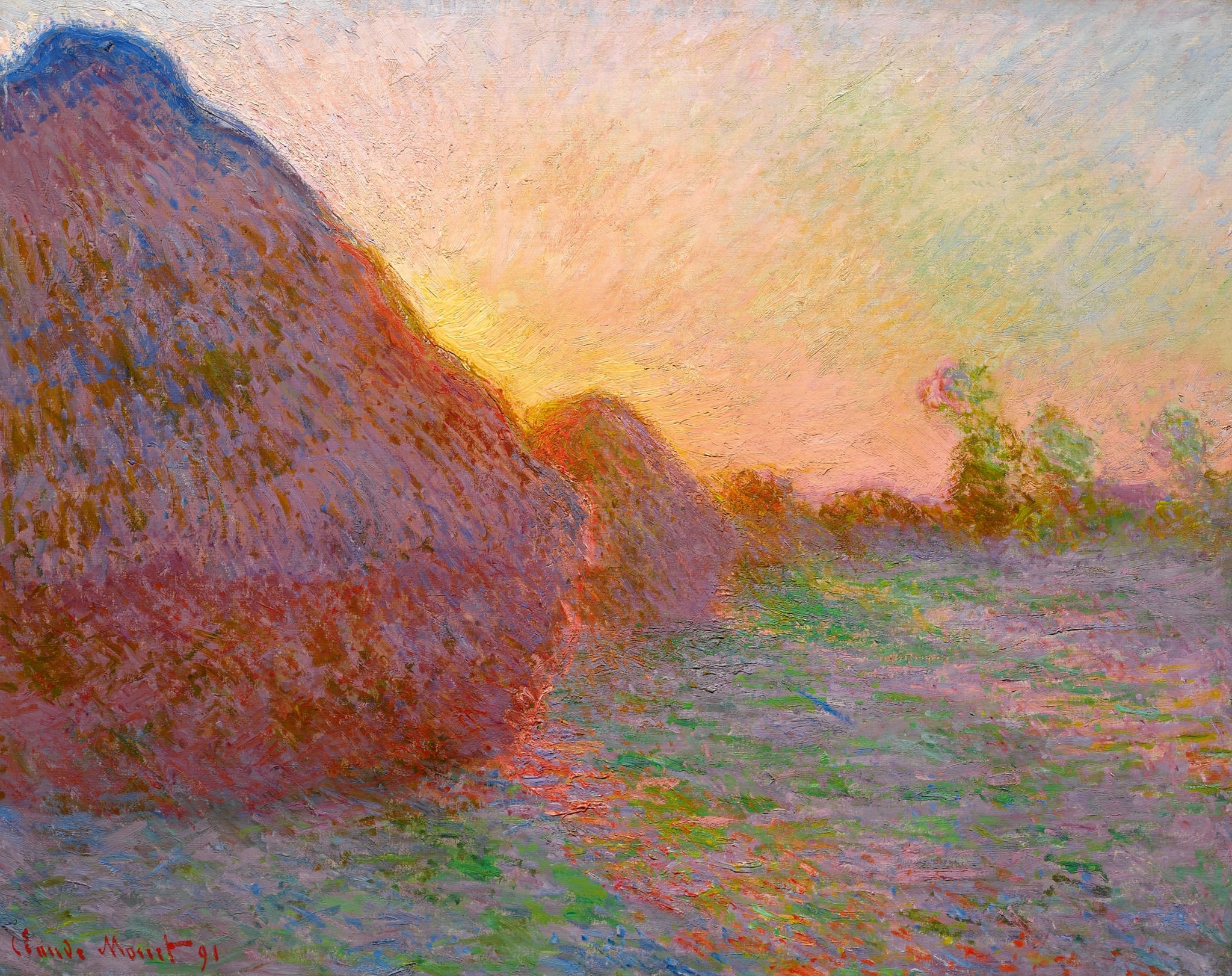
Haystacks Series by Claude Monet | Light, Time & Atmosphere
Claude Monet
Claude Monet’s <strong>Haystacks Series</strong> transforms a routine rural subject into an inquiry into <strong>light, time, and perception</strong>. In this sunset view, the stacks swell at the left while the sun burns through the gap, making the field shimmer with <strong>apricot, lilac, and blue</strong> vibrations.
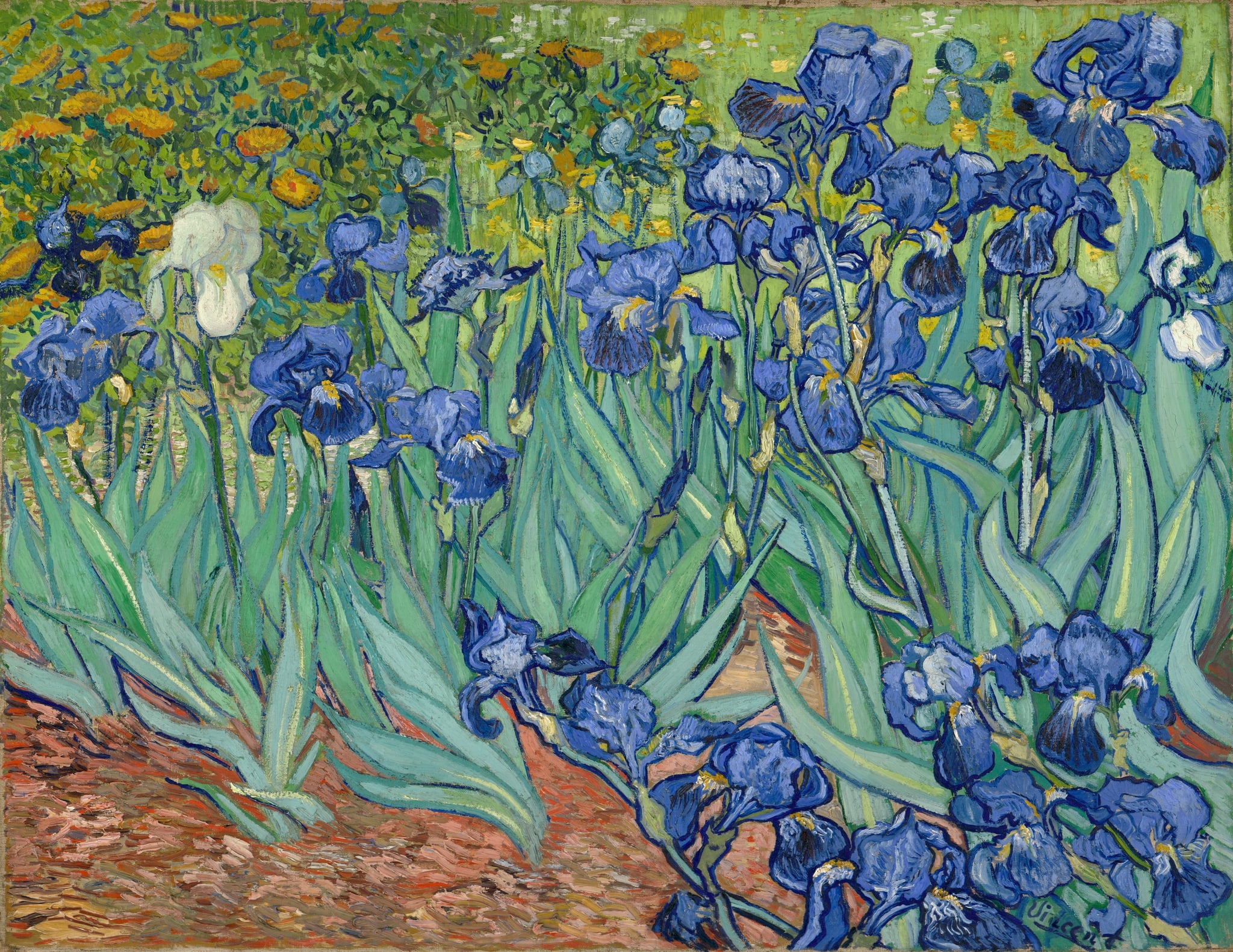
Irises
Vincent van Gogh (1889)
Painted in May 1889 at the Saint-Rémy asylum garden, Vincent van Gogh’s <strong>Irises</strong> turns close observation into an act of repair. Dark contours, a cropped, print-like vantage, and vibrating complements—violet/blue blossoms against <strong>yellow-green</strong> ground—stage a living frieze whose lone <strong>white iris</strong> punctuates the field with arresting clarity <sup>[1]</sup><sup>[2]</sup>.
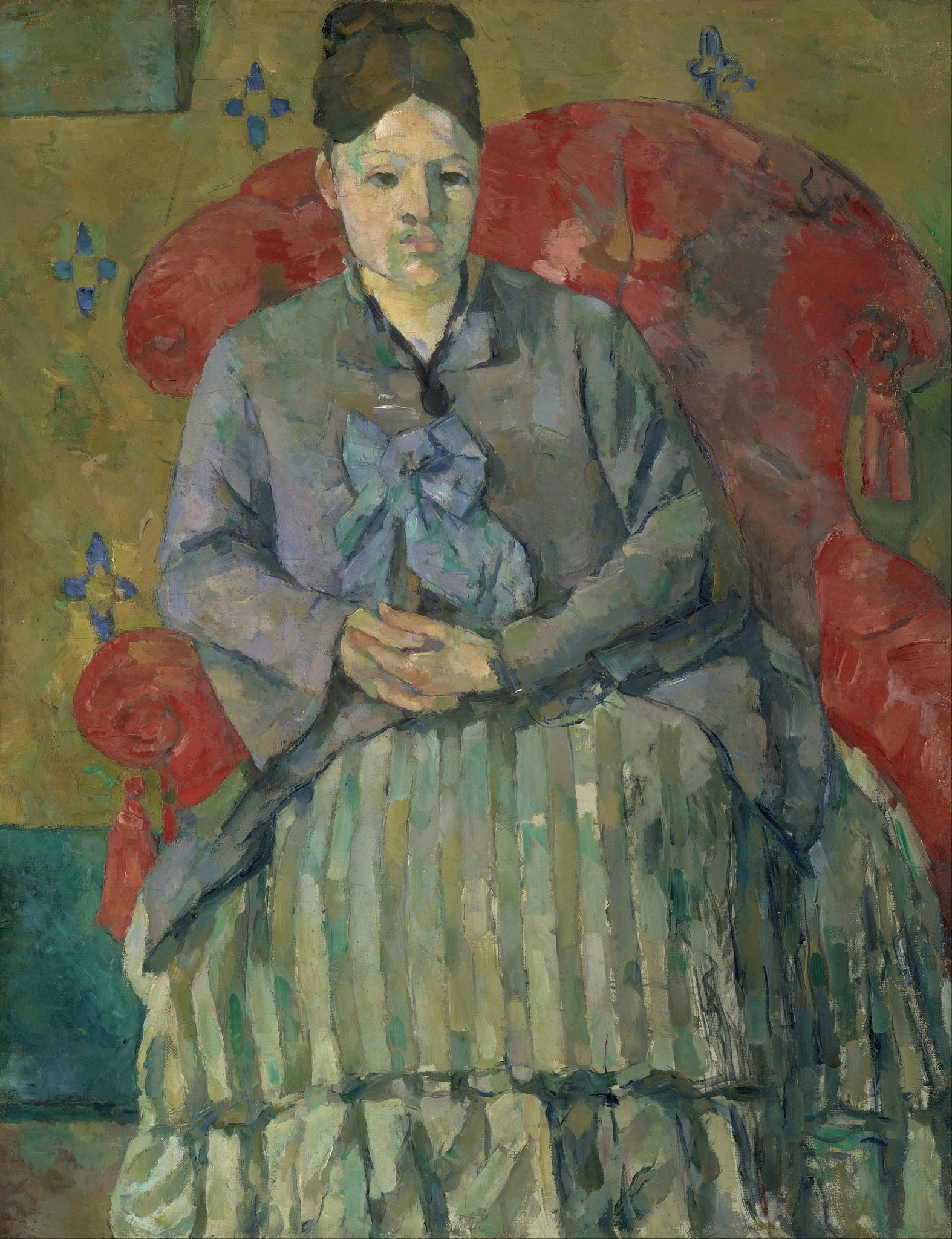
Madame Cézanne in a Red Armchair
Paul Cézanne (about 1877)
Paul Cézanne’s Madame Cézanne in a Red Armchair (about 1877) turns a domestic sit into a study of <strong>color-built structure</strong> and <strong>compressed space</strong>. Cool blue-greens of dress and skin lock against the saturated <strong>crimson armchair</strong>, converting likeness into an inquiry about how painting makes stability visible <sup>[1]</sup><sup>[3]</sup>.
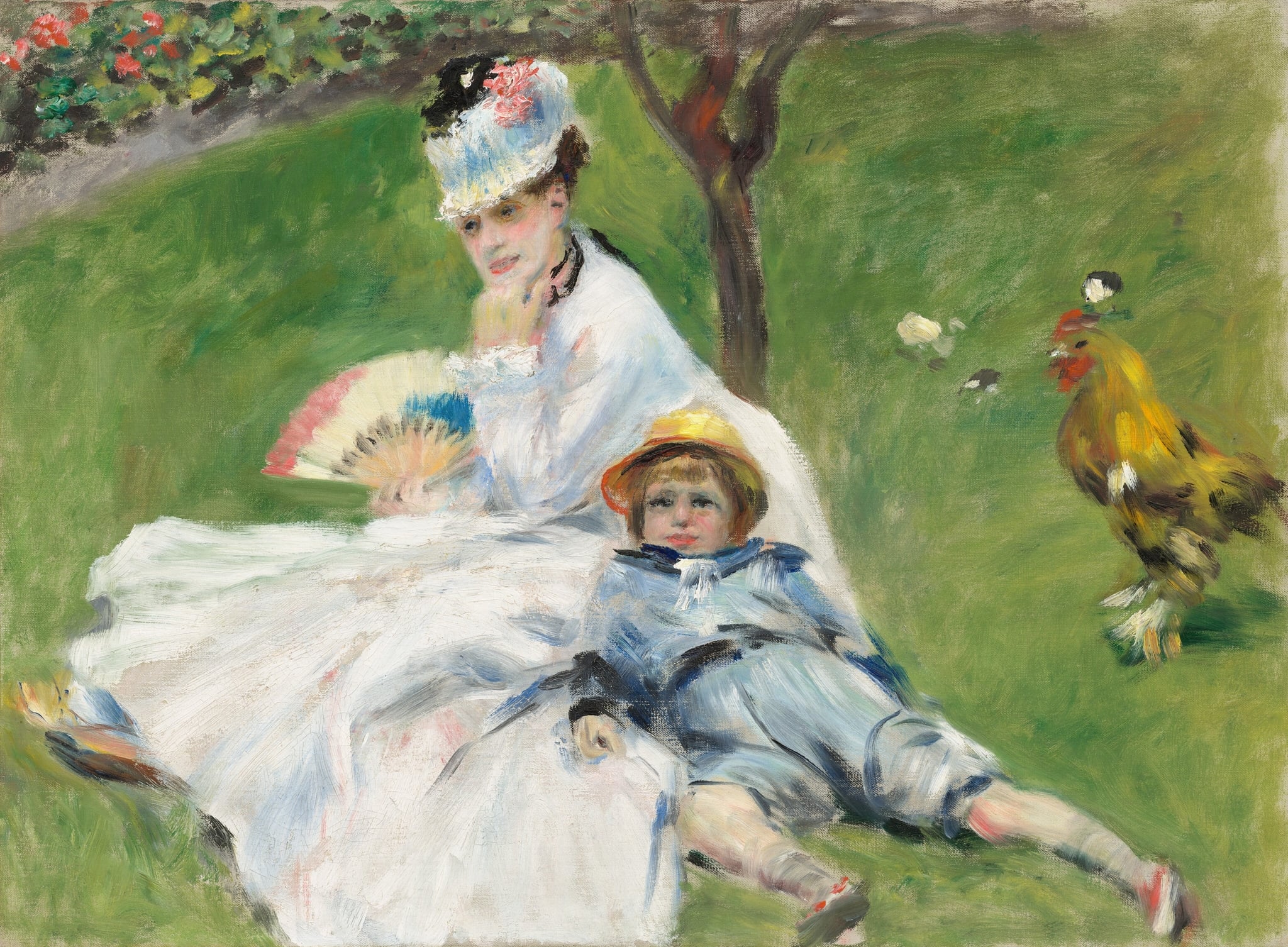
Madame Monet and Her Son
Pierre-Auguste Renoir (1874)
Renoir’s 1874 canvas Madame Monet and Her Son crystallizes <strong>modern domestic leisure</strong> and <strong>plein‑air immediacy</strong> in Argenteuil. A luminous white dress pools into light while a child in a pale‑blue sailor suit reclines diagonally; a strutting rooster punctuates the greens with warm color. The brushwork fuses figure and garden so the moment reads as <strong>lived, not staged</strong> <sup>[1]</sup><sup>[2]</sup><sup>[5]</sup>.
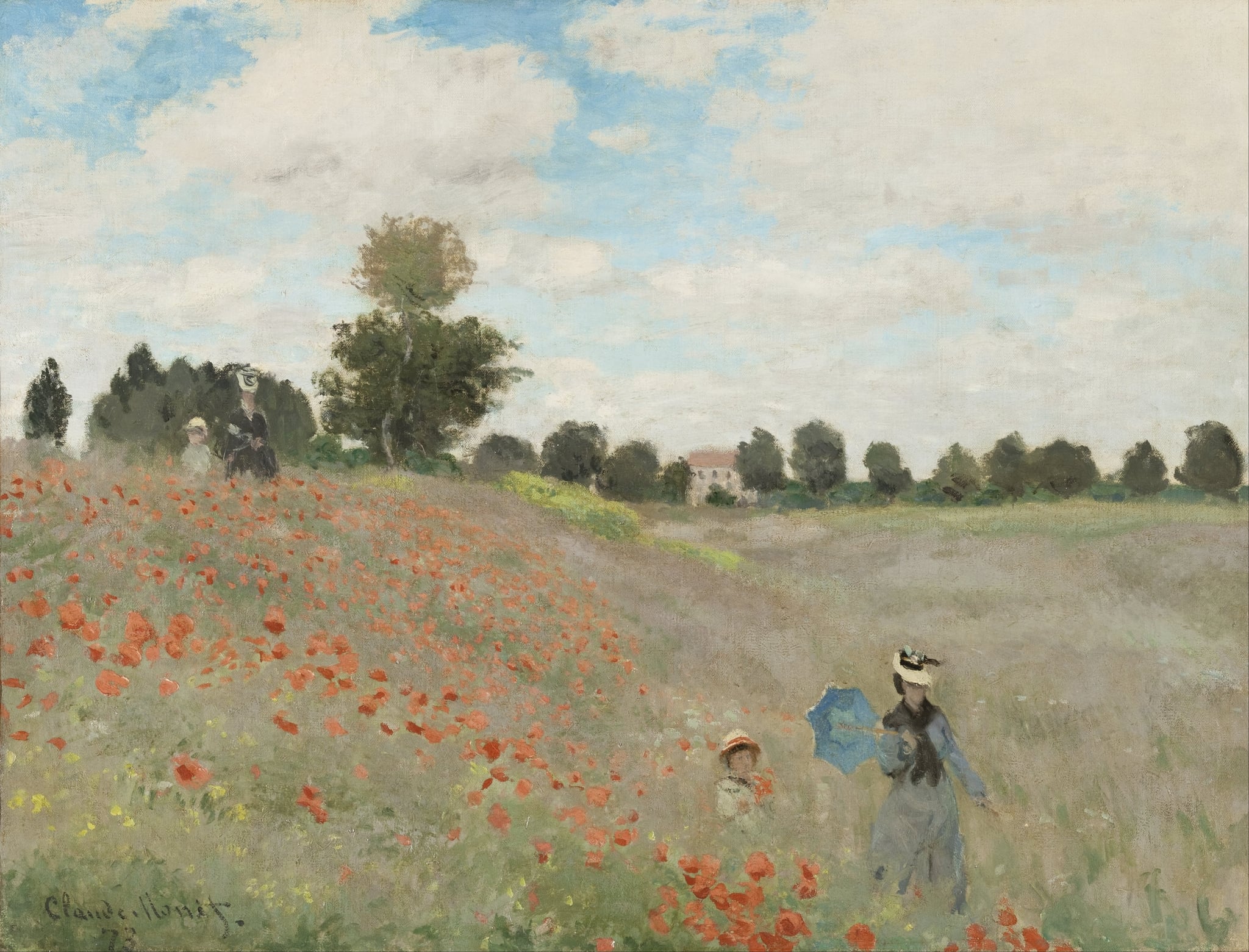
Poppies
Claude Monet (1873)
Claude Monet’s Poppies (1873) turns a suburban hillside into a theater of <strong>light, time, and modern leisure</strong>. A red diagonal of poppies counters cool fields and sky, while a woman with a <strong>blue parasol</strong> and a child appear twice along the slope, staging a gentle <strong>echo of moments</strong> rather than a single event <sup>[1]</sup>. The painting asserts sensation over contour, letting broken touches make the day itself the subject.
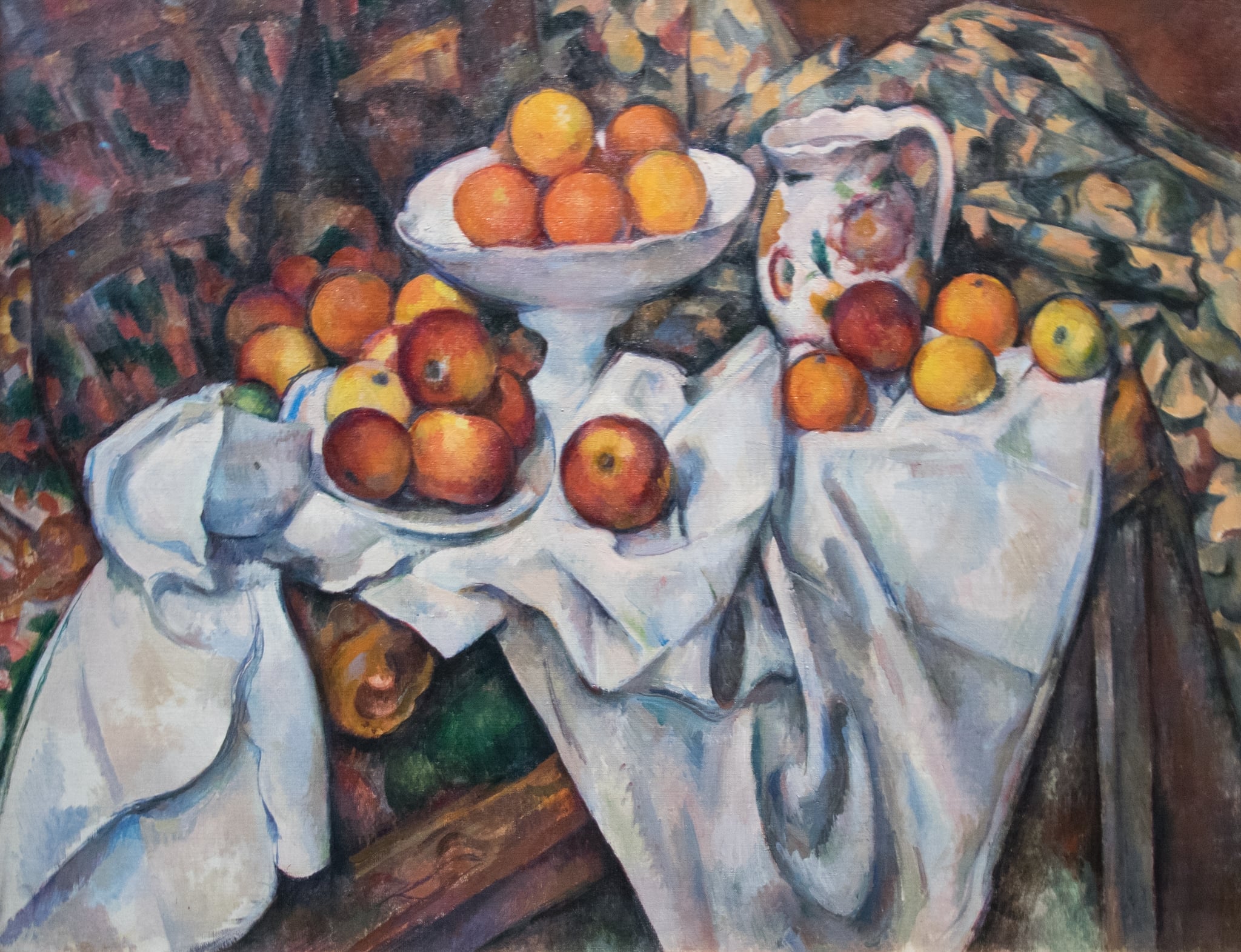
Still Life with Apples and Oranges
Paul Cézanne (c. 1899)
Paul Cézanne’s Still Life with Apples and Oranges builds a quietly monumental world from domestic things. A tilting table, a heaped white compote, a flowered jug, and cascading cloths turn fruit into <strong>durable forms</strong> stabilized by <strong>color relationships</strong> rather than single‑point perspective <sup>[1]</sup><sup>[2]</sup>. The result is a still life that feels both solid and subtly <strong>unstable</strong>, a meditation on how we construct vision.
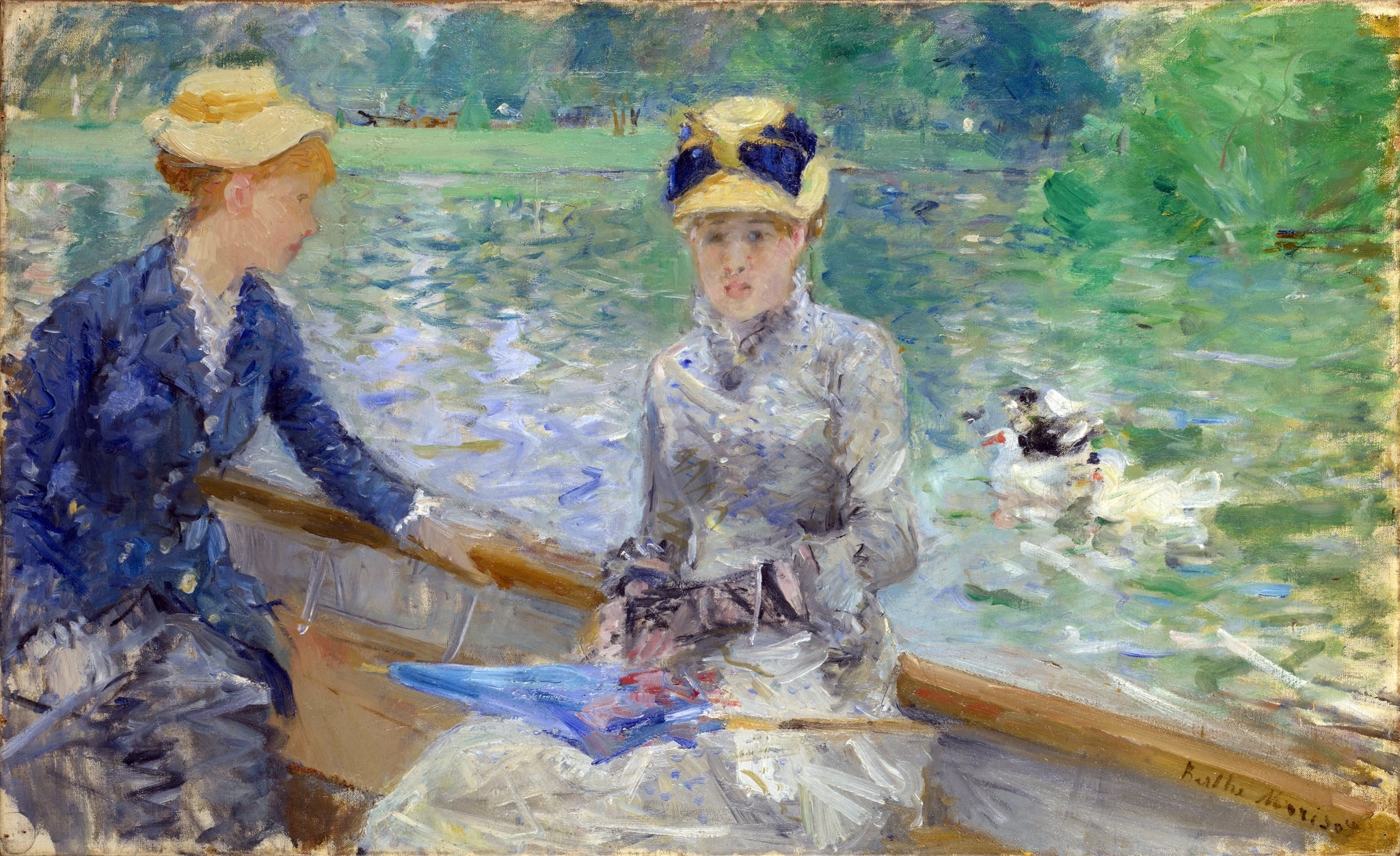
Summer's Day
Berthe Morisot (about 1879)
Two women drift on a boat in the Bois de Boulogne, their dresses, hats, and a bright blue parasol fused with the lake’s flicker by Morisot’s swift, <strong>zig‑zag brushwork</strong>. The scene turns a brief outing into a poised study of <strong>modern leisure</strong> and <strong>female companionship</strong> in public space <sup>[1]</sup>.
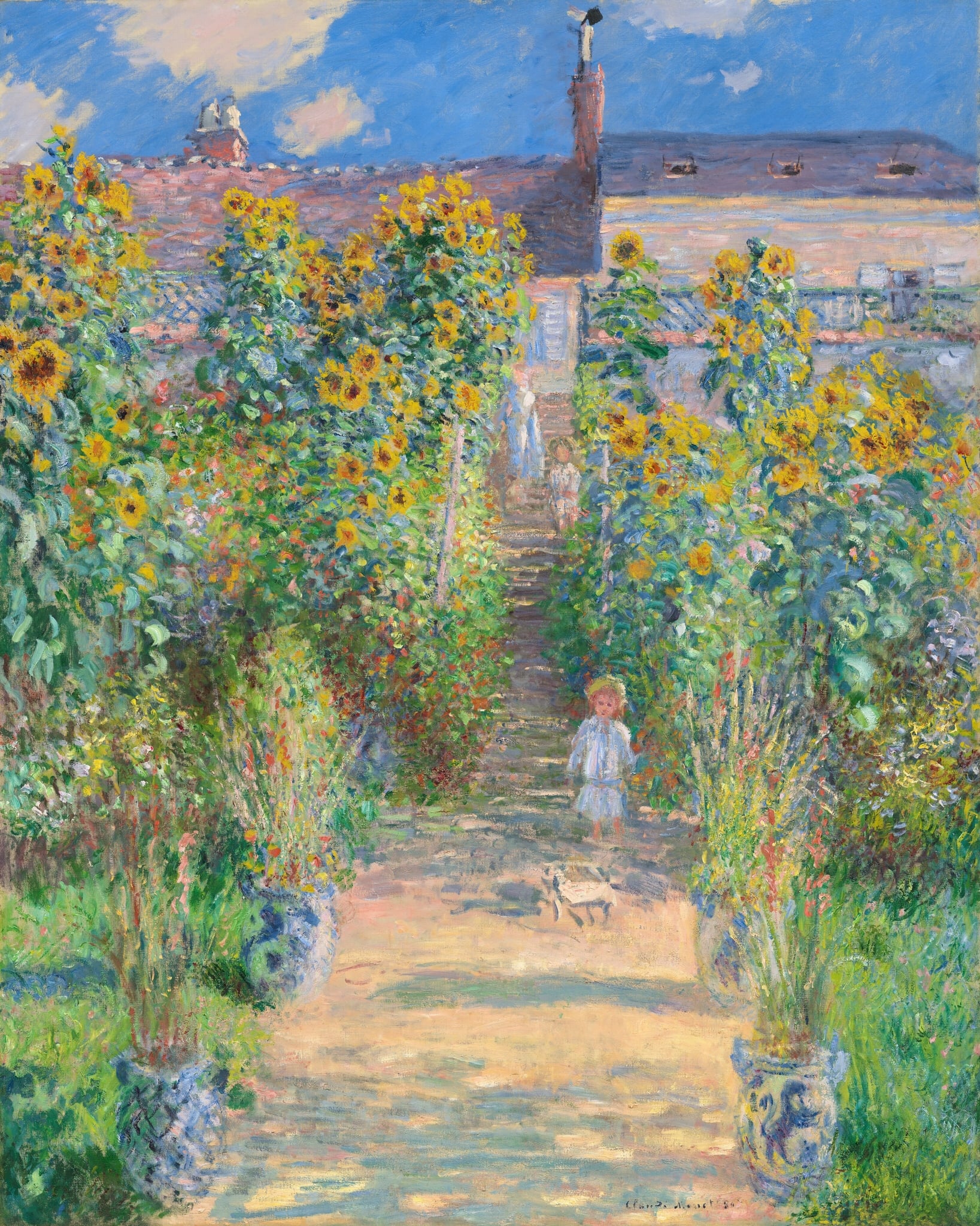
The Artist's Garden at Vétheuil
Claude Monet (1881)
Claude Monet’s The Artist’s Garden at Vétheuil stages a sunlit ascent through a corridor of towering sunflowers toward a modest house, where everyday life meets cultivated nature. Quick, broken strokes make leaves and shadows tremble, asserting <strong>light</strong> and <strong>painterly surface</strong> over linear contour. Blue‑and‑white <strong>jardinieres</strong> anchor the foreground, while a child and dog briefly pause on the path, turning the garden into a <strong>domestic sanctuary</strong> <sup>[1]</sup><sup>[2]</sup>.
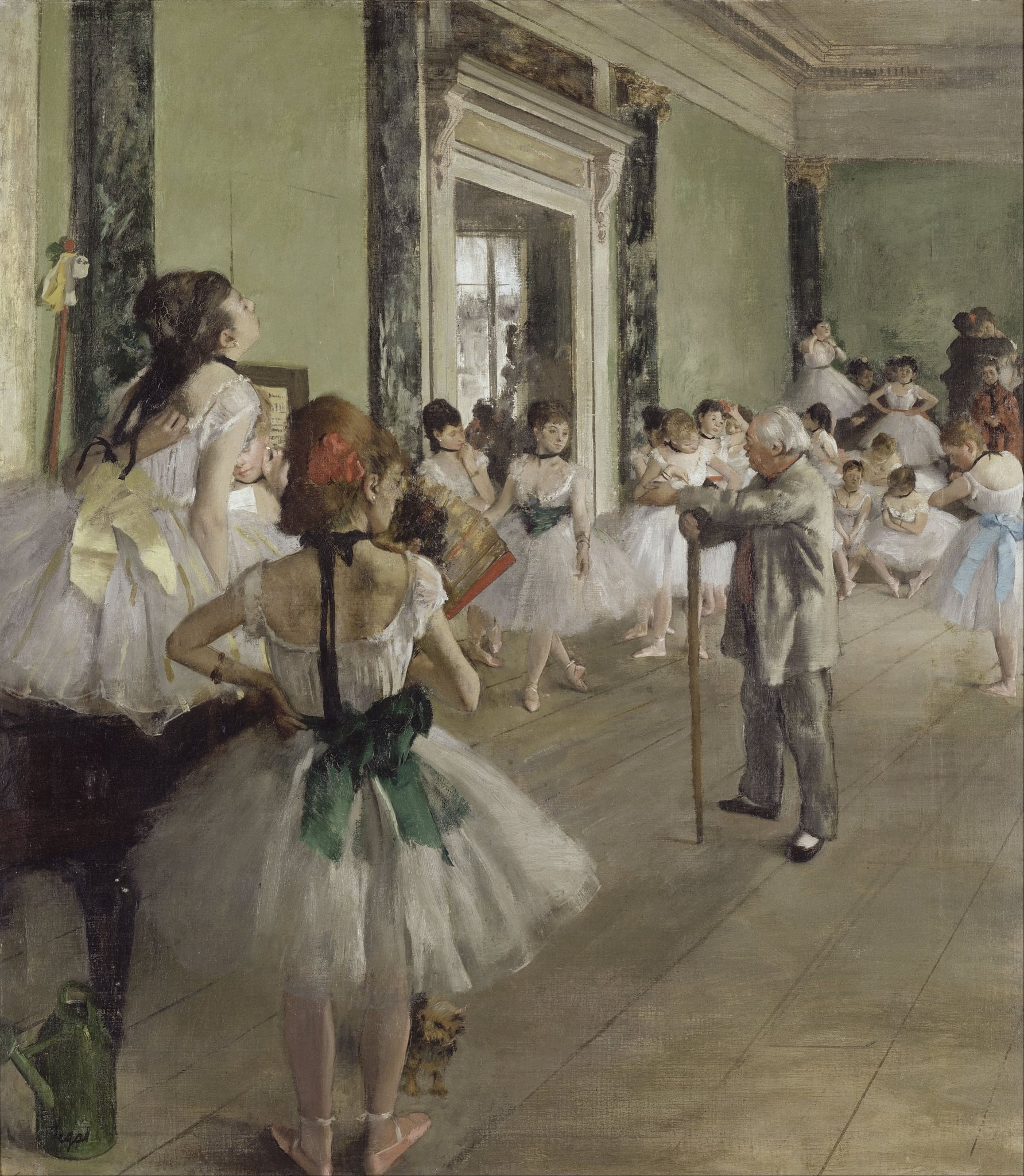
The Ballet Class
Edgar Degas (1873–1876)
<strong>The Ballet Class</strong> shows the work behind grace: a green-walled studio where young dancers in white tutus rest, fidget, and stretch while the gray-suited master stands with his cane. Degas’s diagonal floorboards, cropped viewpoints, and scattered props—a watering can, a music stand, even a tiny dog—stage a candid vision of routine rather than spectacle. The result is a modern image of discipline, hierarchy, and fleeting poise.
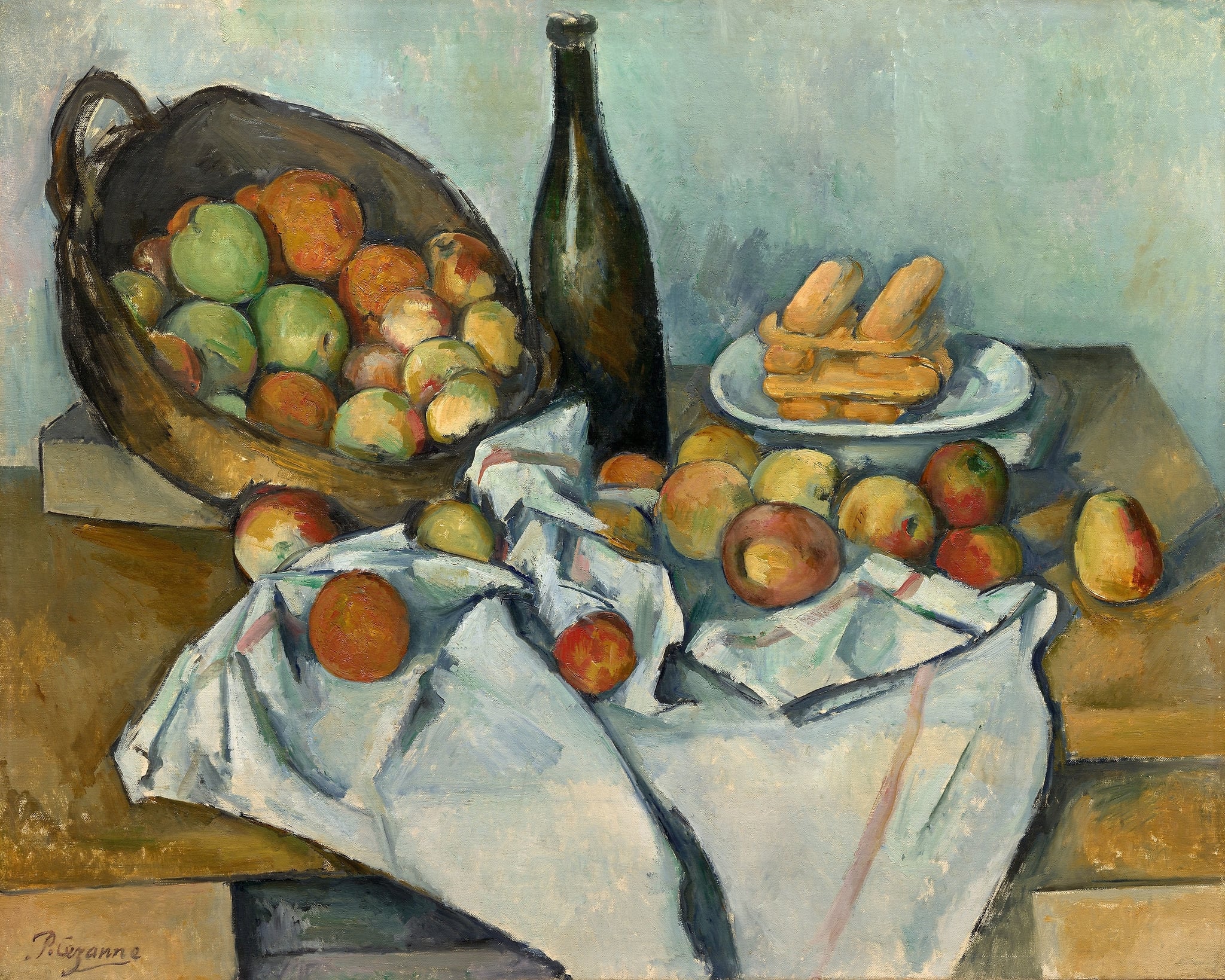
The Basket of Apples
Paul Cézanne (c. 1893)
Paul Cézanne’s The Basket of Apples stages a quiet drama of <strong>balance and perception</strong>. A tilted basket spills apples across a <strong>rumpled white cloth</strong> toward a <strong>dark vertical bottle</strong> and a plate of <strong>biscuits</strong>, while the tabletop’s edges refuse to align—an intentional play of <strong>multiple viewpoints</strong> <sup>[1]</sup><sup>[2]</sup><sup>[3]</sup>.
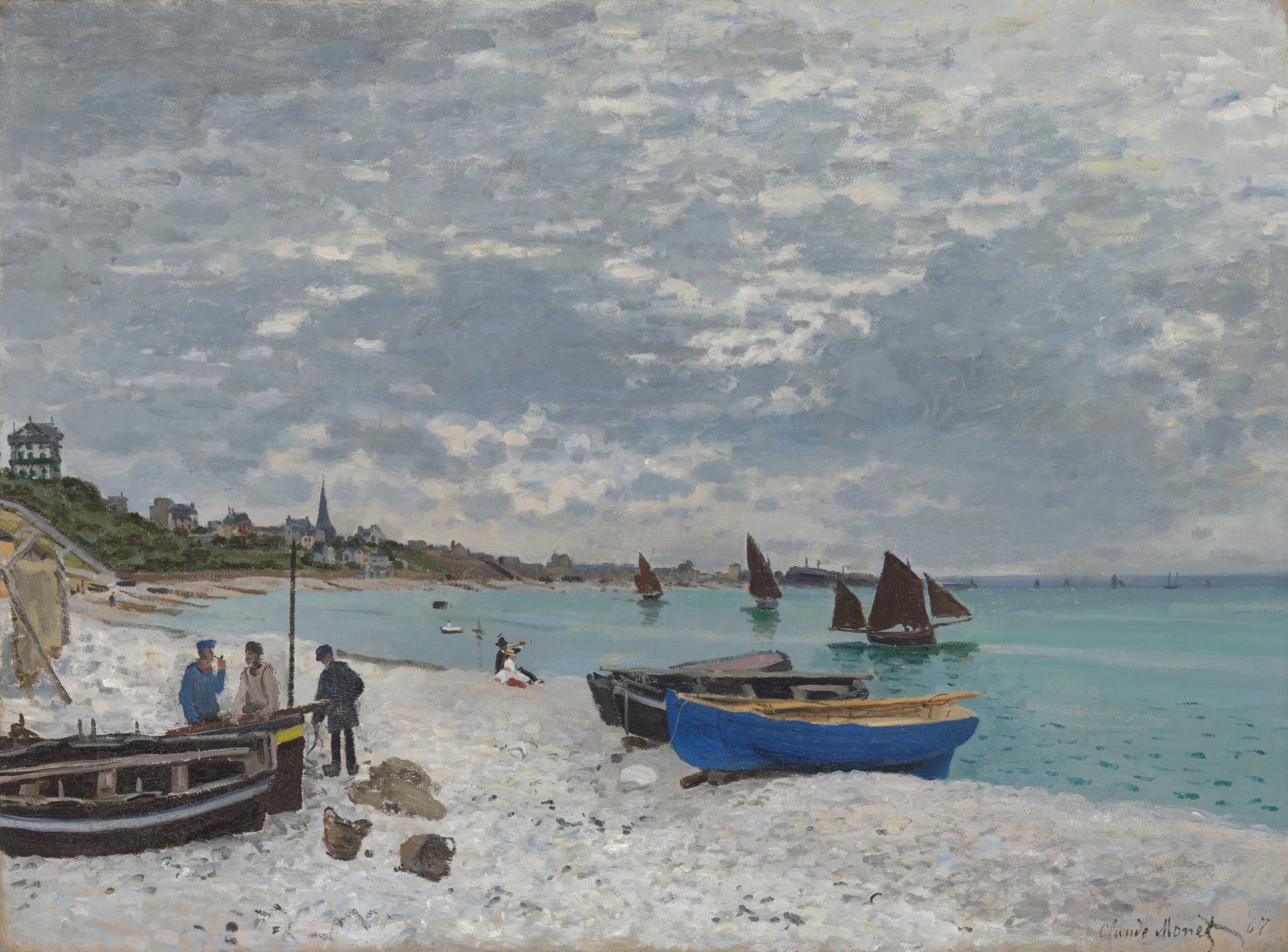
The Beach at Sainte-Adresse
Claude Monet (1867)
In The Beach at Sainte-Adresse, Claude Monet stages a modern shore where <strong>labor and leisure intersect</strong> under a broad, changeable sky. The bright <strong>blue beached boat</strong> and the flotilla of <strong>rust-brown working sails</strong> punctuate a turquoise channel, while a fashionably dressed pair sits mid-beach, spectators to the traffic of the port. Monet’s brisk, broken strokes make the scene feel <strong>caught between tides and weather</strong>, a momentary balance of work, tourism, and atmosphere <sup>[1]</sup><sup>[2]</sup>.
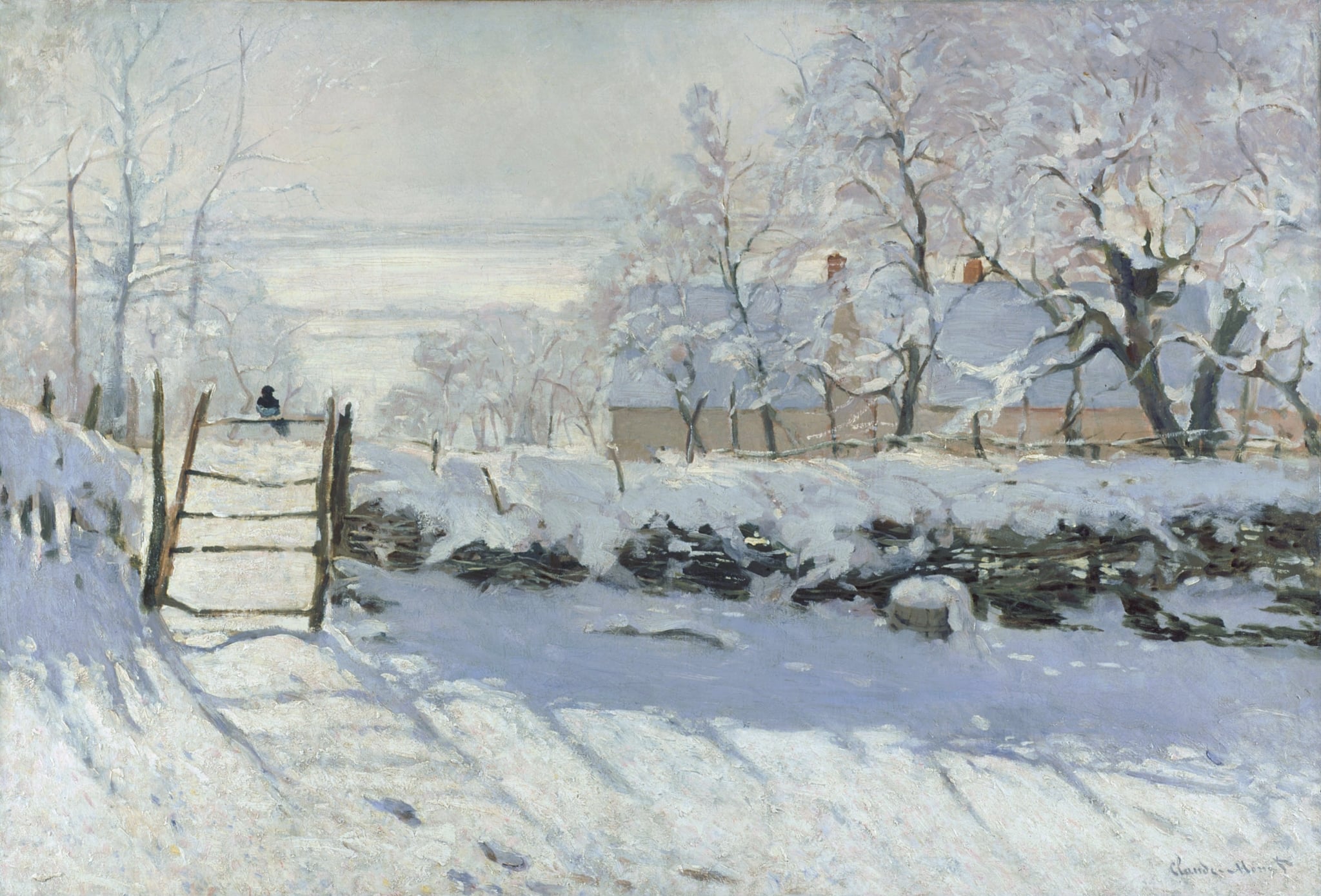
The Magpie
Claude Monet (1868–1869)
Claude Monet’s The Magpie turns a winter field into a study of <strong>luminous perception</strong>, where blue-violet shadows articulate snow’s light. A lone <strong>magpie</strong> perched on a wooden gate punctuates the silence, anchoring a scene that balances homestead and open countryside <sup>[1]</sup>.
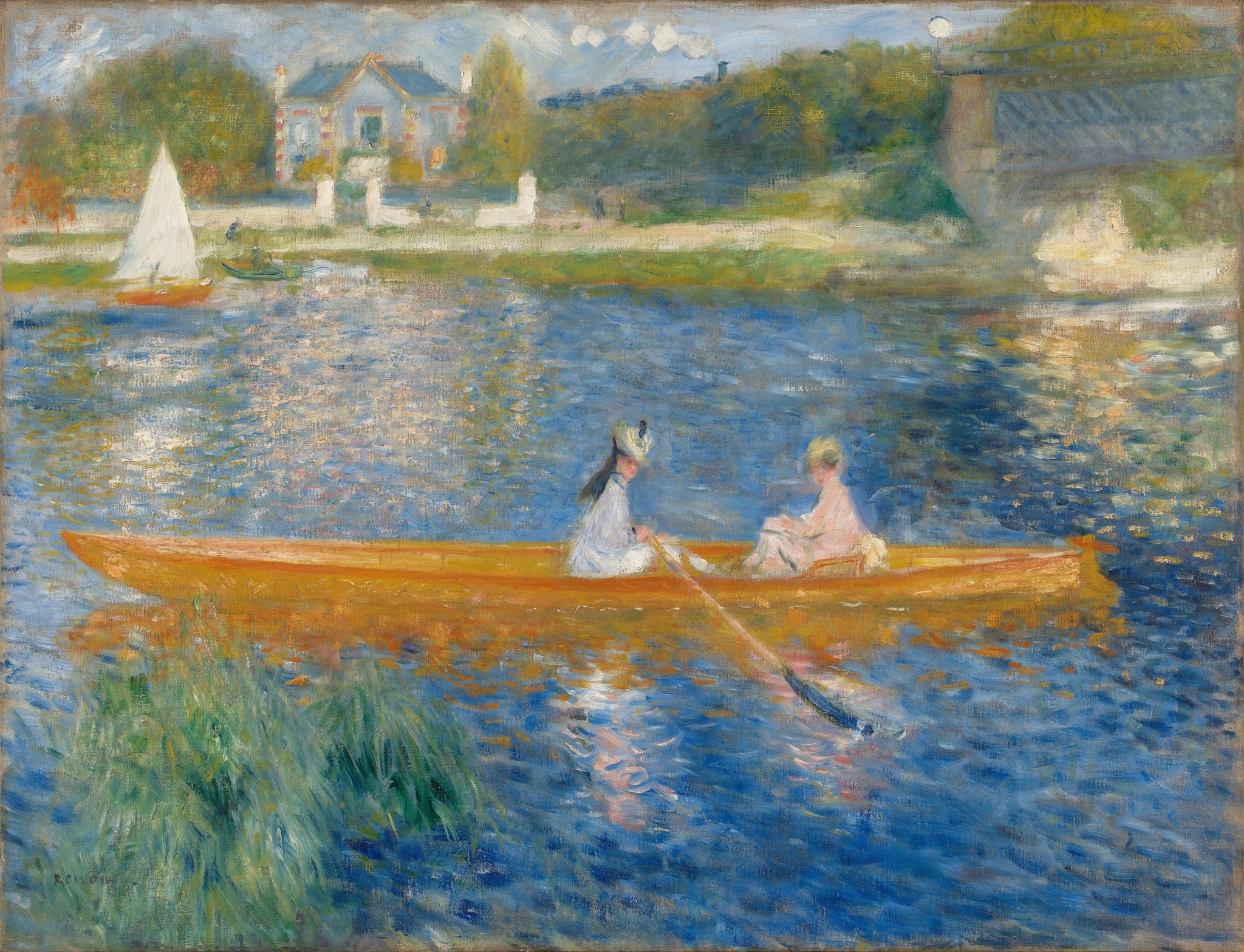
The Skiff (La Yole)
Pierre-Auguste Renoir (1875)
In The Skiff (La Yole), Pierre-Auguste Renoir stages a moment of modern leisure on a broad, vibrating river, where a slender, <strong>orange skiff</strong> cuts across a field of <strong>cool blues</strong>. Two women ride diagonally through the shimmer; an <strong>oar’s sweep</strong> spins a vortex of color as a sailboat, villa, and distant bridge settle the scene on the Seine’s suburban edge <sup>[1]</sup>. Renoir turns motion and light into a single sensation, using a high‑chroma, complementary palette to fuse human pastime with nature’s flux <sup>[1]</sup><sup>[2]</sup>.
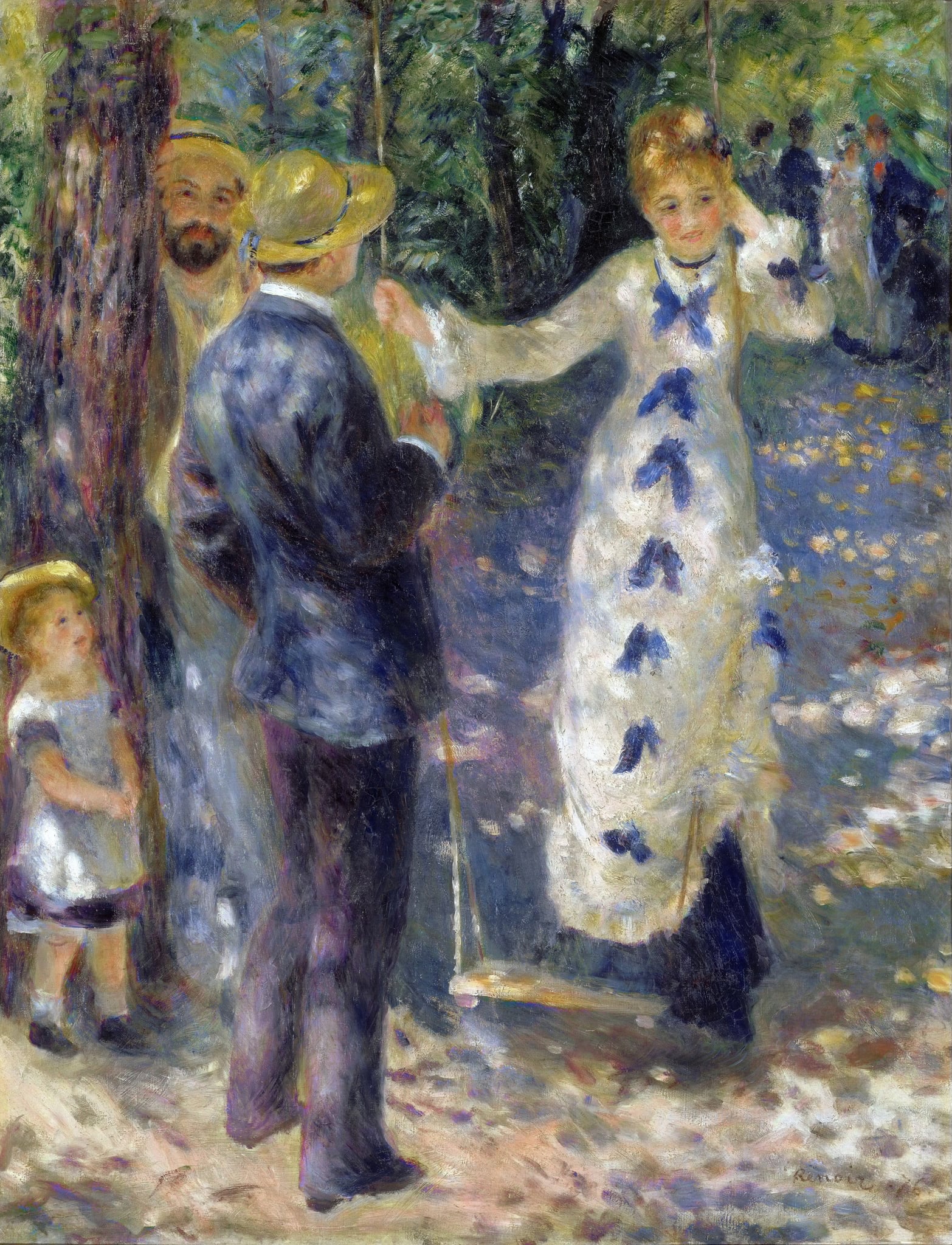
The Swing
Pierre-Auguste Renoir (1876)
Renoir’s The Swing fixes a fleeting, sun-dappled exchange in a Montmartre garden, where a woman in a white dress with blue bows steadies herself on a swing while a man in a blue jacket addresses her. The scene crystallizes <strong>modern leisure</strong>, <strong>flirtation</strong>, and <strong>optical shimmer</strong>, as broken strokes scatter light over faces, fabric, and ground <sup>[1]</sup><sup>[4]</sup>.
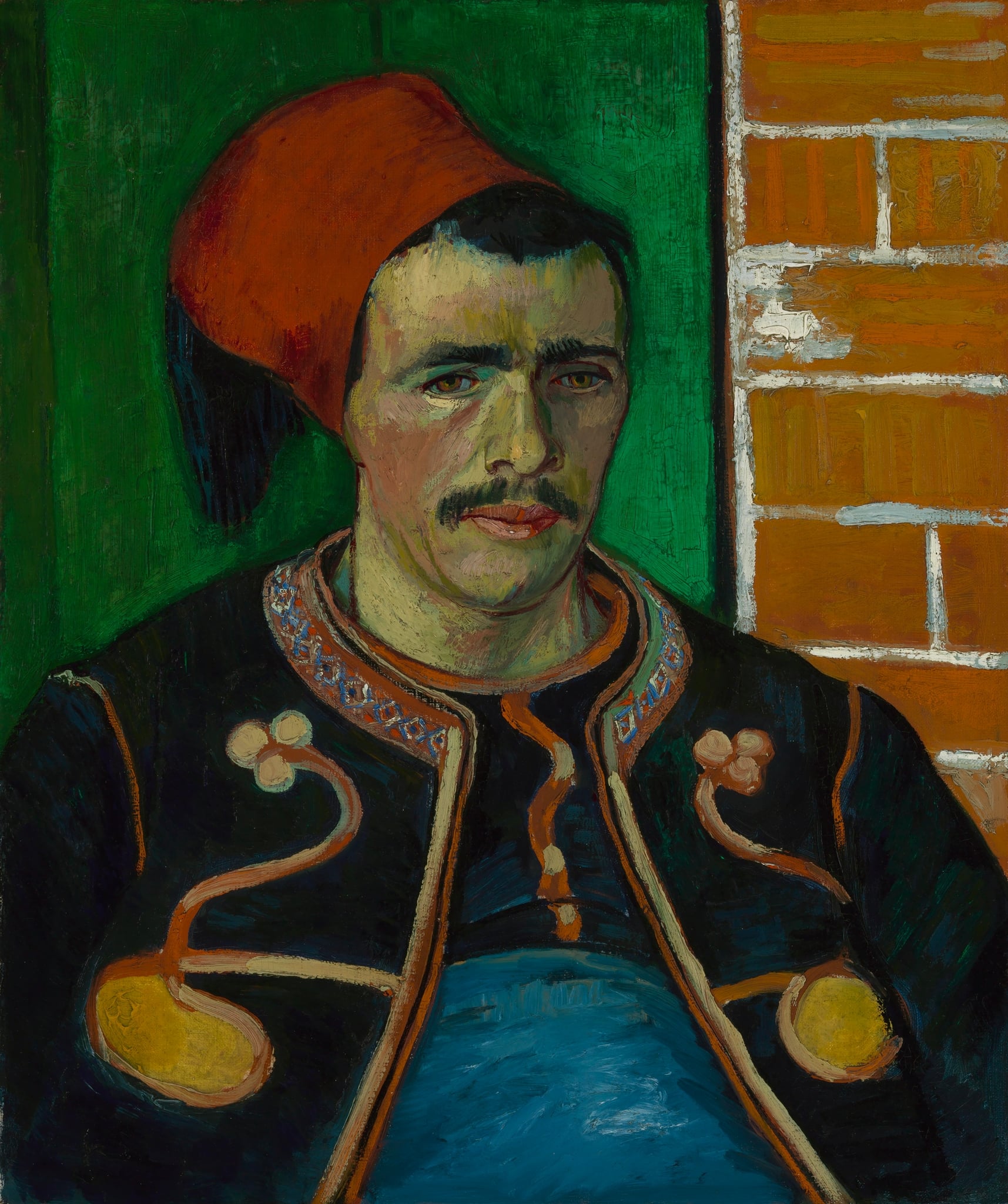
The Zouave
Vincent van Gogh (1888)
<strong>The Zouave</strong> crystallizes Van Gogh’s Arles project: a half-length soldier thrust forward by clashing complements—red, green, orange, blue—so color carries character. The flame-like <strong>fez</strong> ignites against a flat <strong>green door</strong> and a sliver of <strong>orange brick wall</strong>, while heavy outlines and simplified planes turn uniform into emblem. The work inaugurates his pursuit of the <strong>modern “character portrait,”</strong> where chromatic force outweighs likeness <sup>[1]</sup><sup>[2]</sup>.
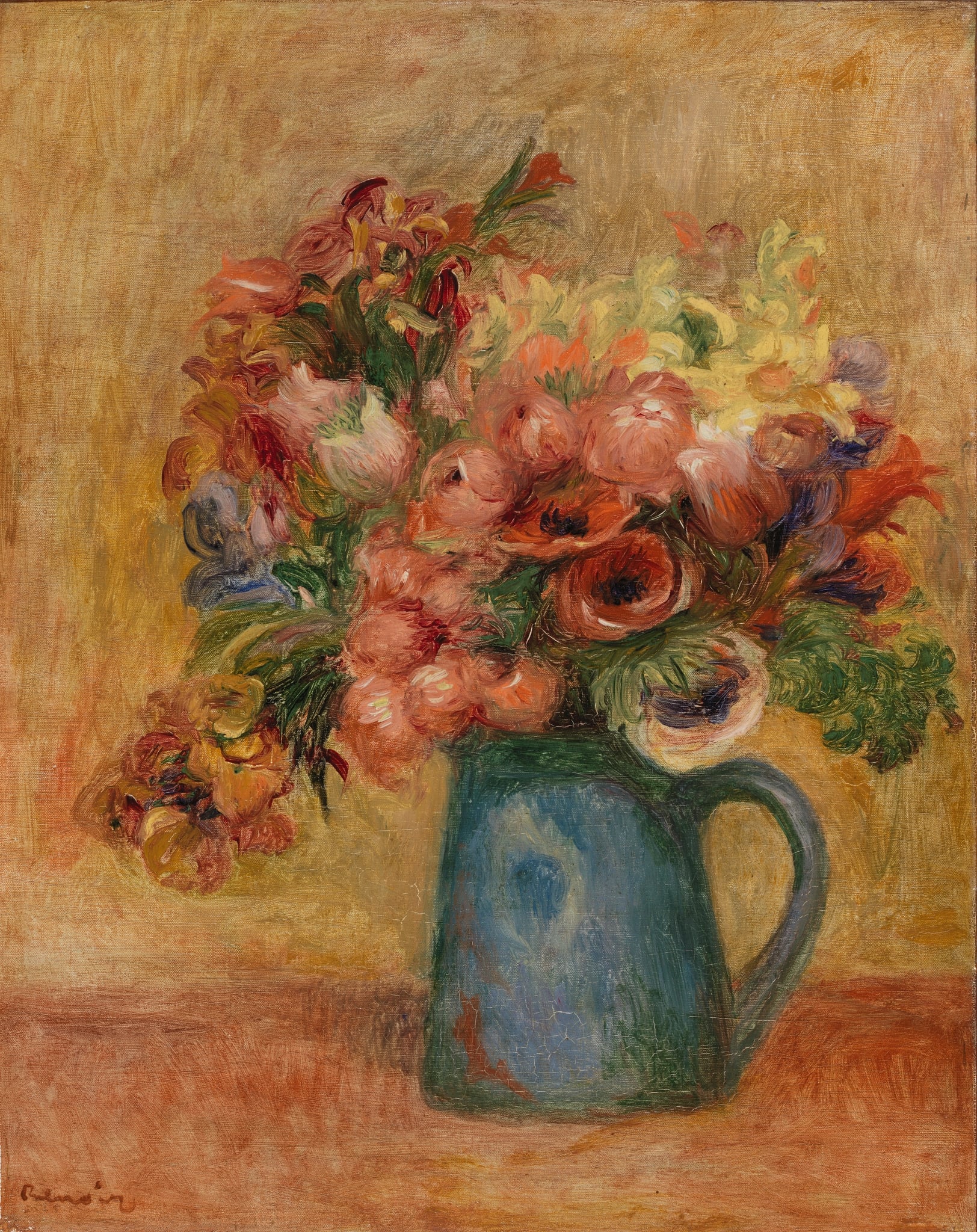
Vase of Flowers
Pierre-Auguste Renoir (c. 1889)
Vase of Flowers is a late‑1880s still life in which Pierre-Auguste Renoir turns a humble blue‑green jug and a tumbling bouquet into a <strong>laboratory of color and touch</strong>. Against a warm ocher wall and reddish tabletop, coral and vermilion blossoms flare while cool greens and violets anchor the mass, letting <strong>color function as drawing</strong> <sup>[1]</sup><sup>[4]</sup>. The work affirms Renoir’s belief that flower painting was a space for bold experimentation that fed his figure art.
Related Themes
Related Symbolism Categories
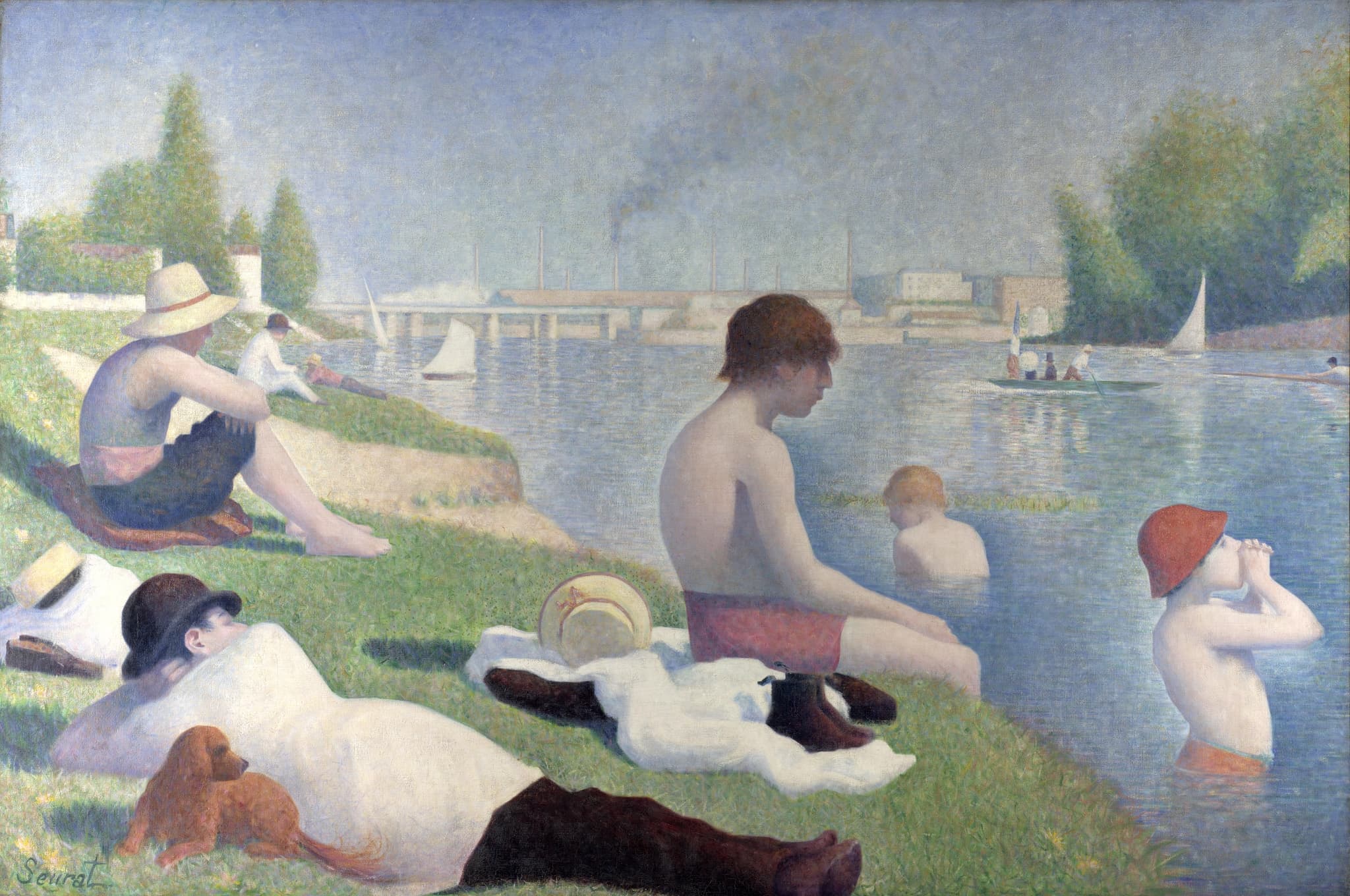
Landscape
Landscape symbolism in modern painting transforms rivers, trees, bridges, and distant horizons into active sign-systems for labor, leisure, perception, and cyclical time, reworking inherited Arcadian and religious motifs under industrial and Impressionist conditions.
Nature
In modern and contemporary painting, natural motifs operate less as fixed emblems than as dynamic structures through which artists negotiate perception, temporality, class, and the sacred, reworking an older iconography of nature into a self-conscious language of light, labor, and psychological atmosphere.
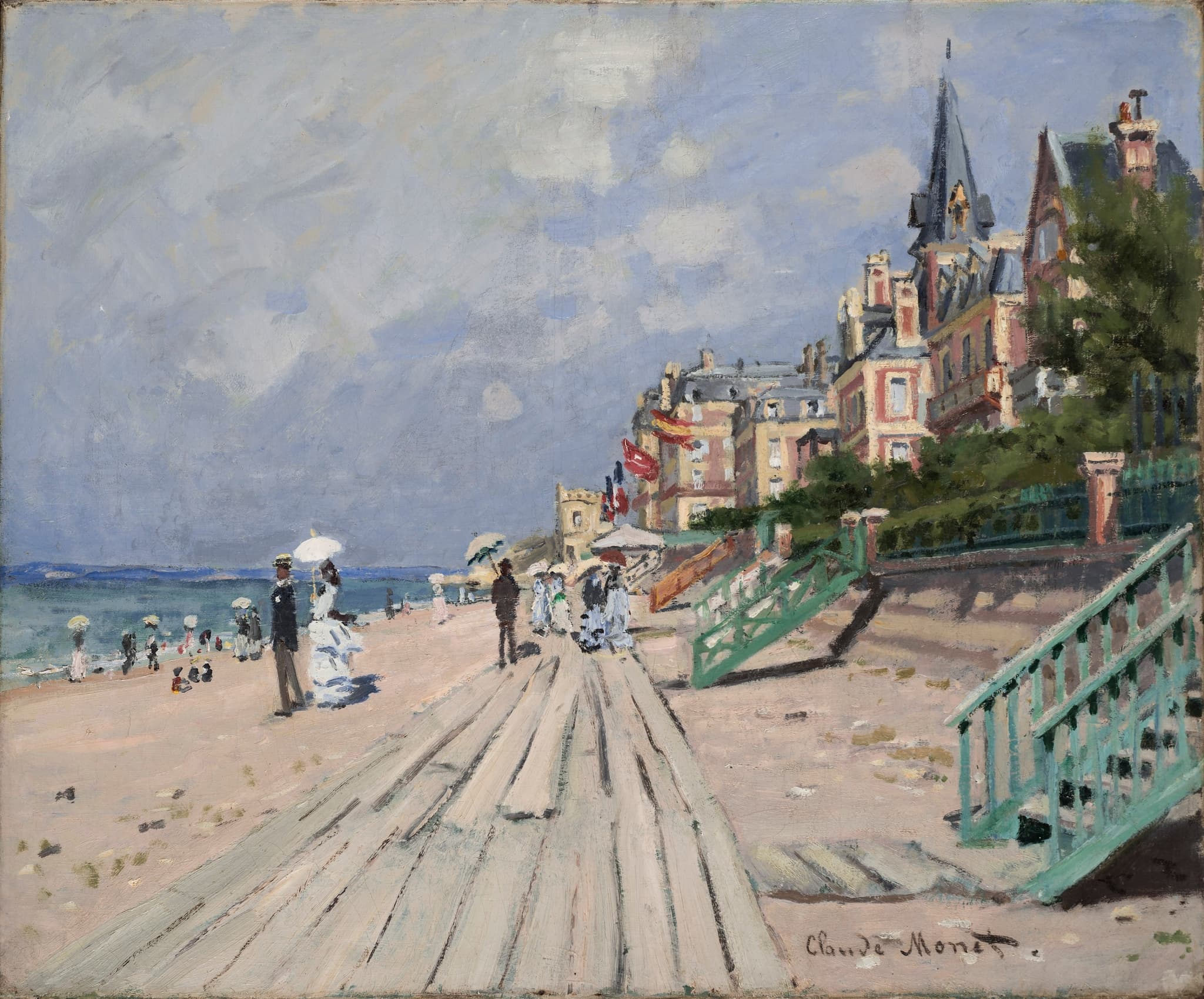
Fashion
In Impressionist and related modern painting, fashion functions as a coded system of class, gender, and spectatorship, translating older allegorical and mythic meanings into the language of couture, accessories, and regulated bodily comportment.
Within Western art history, color has long carried symbolic weight, but in the later nineteenth century it increasingly becomes both subject and sign system. Rather than merely clothing pre‑existing allegories—blue for the Virgin’s humility, gold for divinity—color itself is theorized as a perceptual and ethical force. The artists represented here, above all Monet, Renoir, Van Gogh, and Cézanne, deploy intensely calibrated palettes in which hues, temperatures, and complements function semiotically: they mark labor and leisure, intimacy and risk, transience and endurance. Color ceases to be a subordinate attribute and becomes an autonomous register of meaning, structuring experience as much as depicting it.
Many of the symbols in this category hinge on complementary contrast as an engine of signification. In Van Gogh’s Café Terrace at Night (1888), the opposition between the sulphur and citron yellows of the gas‑lit café and the ultramarine and blue‑green of the street and sky exemplifies what the glossary names both blue–orange complement and blue–yellow chromatic counterpoint. Semiotic force resides in the very clash: warm yellows crystallize hospitality, sociability, and the “promise” of the café, while the deep blue avenue is construed in the object text as freedom and risk, the unknown beyond the circle of light. The same chromatic grammar that color theory describes as optical vibration here underwrites an ethical polarity. Darkness, famously rendered “without black,” is recoded as a presence of layered blues and violets, a decision that transforms nocturne from negation into saturated, legible experience.
Claude Monet’s work in this group makes an even more explicit argument for color as temporal structure. In the Haystacks series, a Cobalt Rim crowns haystacks whose flanks glow with rose, lilac, and ember orange. That cool blue band stabilizes the form while also signalling what the glossary terms Blue–ochre color modules: masonry‑like, interlocking patches that translate atmosphere into structure. The small “cobalt rim” is not decorative trim, but an atmospheric envelope that reads time—the moment when the upper contour absorbs the last cool of the sky even as the lower masses smoulder with residual warmth. Likewise, the ground below is described as a Chromatic Field Mosaic, a unity where shadow becomes color; lilacs, greens, and peaches tessellate into a field in which there is no neutral zone, only temporally inflected passages. Monet’s method of painting several canvases in succession, following light, is here literalized as color itself becoming a metronome of changing hours.
In Poppies (1873), Monet again yokes color to temporality and social experience. The hillside is organized by a diagonal rhythm of scarlet blooms that cuts across cool greens and the pale sky. The woman’s blue parasol punctuates this red diagonal with a cool accent; according to the glossary, that object simultaneously marks “modern suburban leisure” and serves as a tool to test outdoor color contrasts. The parasol’s hue ties it to the cooler sky and shadows even as its function binds it to modern bourgeois recreation. Here color semiotics thus work on two registers: iconographically, the parasol aligns with leisure; chromatically, its blue produces a complementary clash with the poppies that vivifies the very idea of a summer walk as a weave of warmth and relief, effort and repose.
Renoir’s portraits take this chromatic semiotics into the domestic sphere. In Girl with a Watering Can (1876), the cobalt blue of the child’s dress, named in the glossary as a sign of refinement and tenderness in related contexts, operates as the picture’s tonal anchor. The dress, the red hair bow, and the green watering can form a primary triad of blue, red, and green that holds against the dissolving garden atmosphere. The surrounding lawn and shrubbery break into pinks and greens, but the saturated dress and precise facial modeling assert a core of clarity amid shimmer. Chromatically, the dress is a cool, dense mass; iconographically, it encodes middle‑class care and fashionable childhood. The watering can, while not given a separate entry, is activated by this palette as an emblem of nurture and growth, its green echoing the foliage that surrounds the child. Color, in other words, mediates between social identity (bourgeois childhood, domestic gardening) and an Impressionist ontology of perception.
Madame Monet and Her Son (1874) elaborates this domestic chromatic ethics. The mother’s luminous white dress becomes a field in which “Colored Shadows on White Dress” register Impressionist optical doctrine—that shadow is colored, not gray. Veins of blues, violets, and reflected greens model the folds, turning the garment into a responsive sensor of light. Simultaneously, the child’s blue sailor suit signals, per the symbol glossary, “a healthy, active bourgeois childhood” and contemporary fashion. Here blue is doubly coded: as cool, recessive hue, it visually binds the child to the green lawn and shaded zones; as cultural sign, it marks modernity and a new, mobile ideal of childhood. The rooster’s warm plumage and the scattered garden reds act almost as crimson blooms in the Monetian sense: small flare‑ups of warmth that interrupt and animate a largely cool, contemplative field.
Where Monet and Renoir probe the play of warm and cool across open air and social leisure, Cézanne turns color into a quasi‑architectural system. In Madame Cézanne in a Red Armchair (c. 1877), the Crimson Armchair is explicitly defined as a “warm, enveloping mass” that conveys structural stability and pressure. Opposed to it are the sitter’s blue‑green garments and pallid skin, which the glossary groups under Blue‑green Dress and Bow: a cool, tempered mass that counters the warm field. The encounter of these two chromatic blocs—red and blue‑green—produces not only the illusion of space but also a felt sense of poise, interiority, and resistance. The wallpaper’s Cobalt Wallpaper Florets echo the jacket’s cool tones while resisting depth; they keep the surface emphatically present even as the armchair seems to press forward. Here color functions less as symbol in an allegorical sense than as what one might call a structural sign: each patch “knows” the others, as Rilke observed, and their mutual adjustments enact a conception of equilibrium and endurance.
Van Gogh’s Ears of Wheat (1890) and Irises (1889) extend this structural understanding of color into an expressive, even therapeutic register. In Ears of Wheat, a blue cornflower appears as a small, fiercely saturated accent within a tangle of blue‑greens and blue‑grays. The glossary reads this motif as “wildfield vitality and clarity” inserted into cultivated grain; semiotically, it marks the persistence of spontaneous life within systems of agricultural order. Paired with a pale bindweed blossom, it anchors the viewer’s sense of location and depth within an otherwise all‑over Chromatic Field Mosaic. The palette’s coolness, pricked by ocher and rusty orange seed heads, articulates ripeness and the approach of harvest without recourse to anecdote.
In Irises, color contrast becomes almost didactic. The bed of blue‑violet irises against a yellow‑green ground is a textbook deployment of complementary chords, but the glossary insists on their symbolic freight as “collective vitality and rhythmic variation.” The crop‑like frieze of blossoms, outlined in darker contour, reads as life expressed through repeating forms; iconographically, the planting in an asylum garden layers connotations of care, constraint, and hope. The lone white iris, set among the blue‑violet cohort, functions as a chromatic exception that sharpens the perception of the whole—almost a visual allegory of singularity within community. In both works, chroma and contour together construct a world in which difference and repetition, coolness and warmth, are the terms in which vitality is perceived and valued.
Across these examples, certain color oppositions—blue/orange, blue/yellow, red/green, warm/cool—recur as flexible yet legible codes. They mark moral temperature (the warm café versus the cool night), social type (the blue sailor suit of bourgeois childhood), psychological register (Cézanne’s cool reserve framed by crimson pressure), and ontological stance (Monet’s insistence that shadows be colored events). Over the course of the late nineteenth century, such symbols evolve away from fixed, inherited iconographies toward what might be termed chromatic structures of thought. The same hue can signify refuge in one work (Blue‑white cottage walls elsewhere in the corpus) and risk in another (blue street/avenue in Van Gogh’s night scene), with context and contrast determining its valence. Color becomes less a dictionary of one‑to‑one equivalences and more a grammar of relations, in which meaning arises from how tones meet, clash, and modulate across the surface. This shift marks a crucial modernist reorientation: to understand a painting’s color is not simply to decode a set of symbols, but to engage a dynamic field where perception, emotion, and cultural signification are inseparably woven.