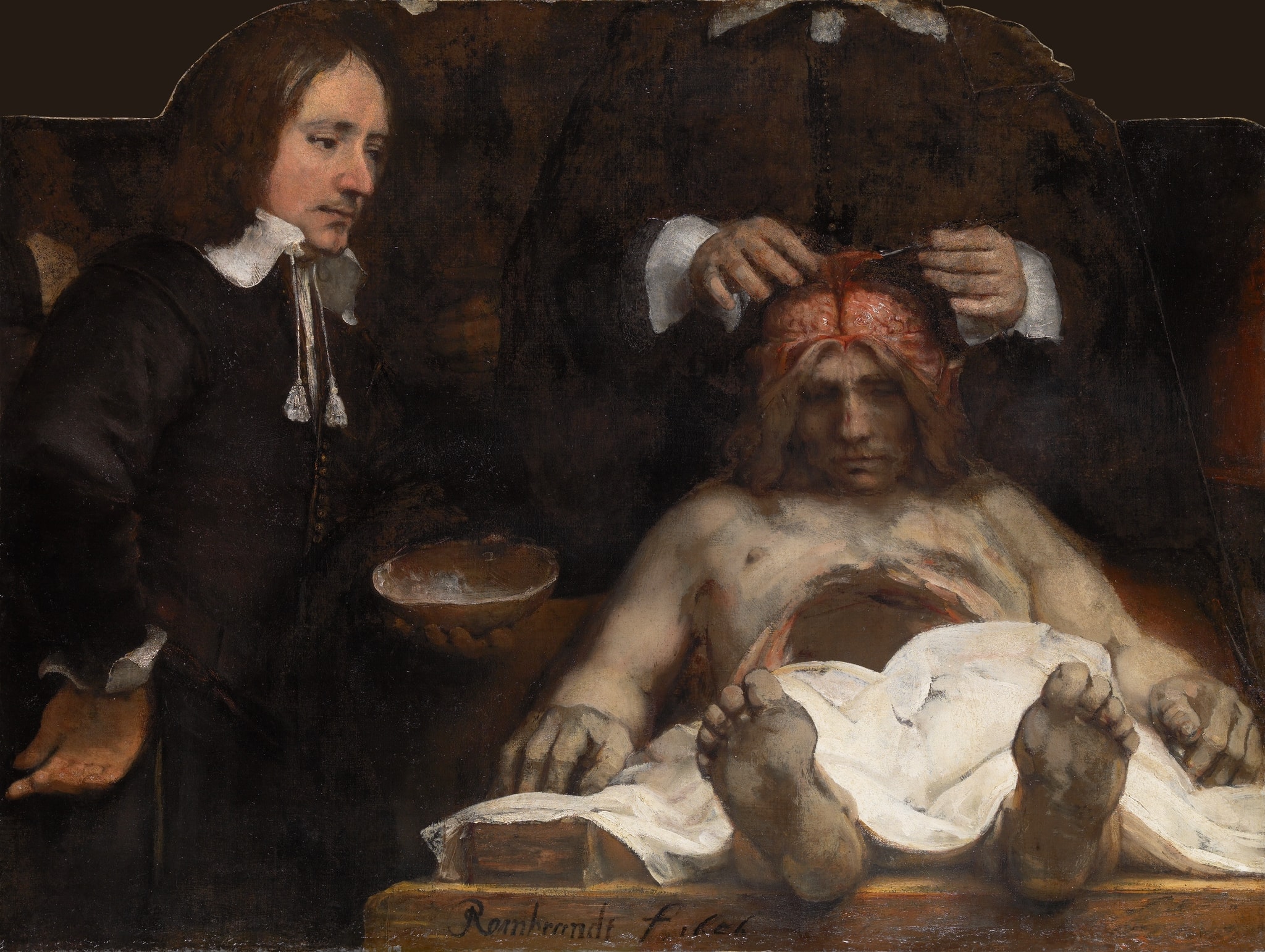
The Anatomy Lesson of Dr. Jan Deijman

by Rembrandt van Rijn

Rembrandt van Rijn’s The Anatomy Lesson of Dr. Jan Deijman (1656) stages a public dissection in which the surgeon exposes the falx cerebri while a foreshortened corpse thrusts its feet toward us. The white sheet blazes under Rembrandt’s chiaroscuro, making inquiry itself the drama as instruments and cuffs emerge from shadow. What survives—now a fragment—is a riveting meditation on knowledge practiced at the edge of mortality [1][3][5].

Study Print Studio

Create a personal study print

Build a companion study sheet around the part of this painting that speaks to you most. Choose a detail, shape an interpretation, and walk away with something personal and display-worthy.

Fast Facts

Year
1656
Medium
Oil on canvas
Dimensions
100 x 134 cm
Location
Amsterdam Museum, Amsterdam
See all Rembrandt van Rijn paintings in Amsterdam
The Anatomy Lesson of Dr. Jan Deijman by Rembrandt van Rijn (1656) featuring Falx cerebri, White sheet, Foreshortened soles of the feet, Surgical instruments and cuffed hands

Click on any numbered symbol to learn more about its meaning

Meaning & Symbolism

Rembrandt organizes the fragment so the viewer must cross a threshold of flesh before entering the space of knowledge. The corpse’s soles, dirty and emphatically present, act as a barricade while the abdomen gapes beneath a luminous sheet that gathers the strongest light. That sheet is not mere drapery: its brightness concentrates attention around the action at the head, where cuffed hands and slender instruments hover in a brown, receding atmosphere. The assistant presents the removed skullcap; above it, Deijman’s hands delicately lift the sickle‑shaped falx cerebri, the membranous fold dividing the hemispheres. Medical historians confirm this as a precise neuroanatomical demonstration, likely drawn from the body of the executed criminal Joris Fonteijn, the legally sanctioned source for public lessons in Amsterdam 34. Rembrandt’s decision to frontally foreshorten the corpse—rather than stage a conversational oblique as in his 1632 Tulp—drives the eye along a strict axis from death’s blunt fact to the brain as the newly privileged object of inquiry 57. This compositional gamble reframes the group portrait into a drama of cognition. By bathing the sheet, the hands, and the instruments in light, Rembrandt renders observation the subject: the painting narrates a method as much as an event. The falx, raised like a small internal banner, functions dually—clinically exact and symbolically charged. Its “sickle” profile, singled out by scholars, invites a vanitas echo: knowledge is harvested under the sign of time’s scythe, and every incision is also a reminder of finitude 34. The cadaver’s face, downcast and nearly serene, with the skin of the scalp peeled back, refuses sensationalism; it keeps the tone grave, not theatrical. Around this argent center, figures retreat into velvety shadow so that individuality yields to collective purpose—an image of civic medicine sponsored by the Surgeons’ Guild and intended to codify the authority of its praelector anatomiae, Dr. Deijman 15. Why The Anatomy Lesson of Dr. Jan Deijman is important is that it marks a pivot in how art visualizes science and how science imagines itself. Painted the year Rembrandt entered insolvency, its stripped‑down eloquence mirrors a late style preoccupied with essentials: form, light, and the ethics of looking 2. The work converts a public spectacle into a meditation on the conditions of knowledge—fragile, communal, and wrested from darkness. Even its status as a surviving fragment after the 1723 fire sharpens the theme: what remains is the core of the lesson—the brain, the hands, the shining cloth—so that posterity keeps precisely the passage from ignorance to insight that Rembrandt staged 1. In concert with the earlier Tulp, Deijman expands the anatomy-lesson genre from manual know‑how to the geography of thought, making this fragment one of the most consequential images in the intertwined histories of art and neuroanatomy 37.

Explore Deeper with AI

Ask questions about The Anatomy Lesson of Dr. Jan Deijman

Popular questions:

Powered by AI • Get instant insights about this artwork

💬 Ask questions about this artwork!

Interpretations

Historical Context: Guild Power and Public Knowledge

Commissioned by the Amsterdam Surgeons’ Guild, the work visualizes how civic bodies converted anatomy into public pedagogy and prestige. Deijman, as praelector anatomiae, performs authority through demonstration rather than oratory, shifting the genre from celebratory portrait to institutional legitimation 5. The preparatory drawing (Rijksprentenkabinet) shows a broader assembly now lost, indicating that the extant fragment once anchored a larger choreography of spectatorship 8. This was painted in 1656, the year of Rembrandt’s insolvency, yet the canvas carries the guild’s stability rather than the artist’s precarity: a sober, procedural image of urban expertise 2. The later display history—long at the Rijksmuseum and now with the Amsterdam Museum—confirms its status as a civic touchstone, repeatedly mobilized to articulate Amsterdam’s narrative of enlightened urban medicine 19.

Source: Amsterdam Museum (Norbert Middelkoop); National Gallery (London)

Medical-Historical Lens: The Brain as Pedagogical Object

Unlike Tulp’s tendon lesson, Deijman’s session isolates the falx cerebri, the dural partition between hemispheres, making neuroanatomy the pedagogic core 3. The assistant elevates the calvarium while Deijman lifts the falx with forceps-like delicacy, a procedure corroborated by modern neurosurgical readings that praise the anatomical exactitude of the depiction 34. Identifying the cadaver as the executed Joris Fonteijn situates the event in a juridical-medical pipeline where justice supplied bodies for science 3. The luminous sheet is not mere decor; it is a didactic device concentrating the visual field to the cranial vault, the new seat of inquiry. In medical historiography, this painting is frequently cited as among the most consequential early images of cerebral anatomy in art, aligning baroque spectacle with emergent neuroscientific curiosity 34.

Source: University of Groningen (Neurosurgery); Amsterdam UMC

Formal Analysis: Foreshortening, Cloth, and the Axis of Looking

Rembrandt’s radical frontal foreshortening drives the viewer along a strict axis from soiled soles to illuminated cranium, orchestrating a passage from matter to mind 5. The argent sheet, saturated with the strongest light, functions as a reflective plane that collects eyes, hands, and instruments into a single optical node, a baroque solution to focus and hierarchy. Figures recede into velvety chiaroscuro, letting individuality yield to a collective process of observation—an inversion of the chatty sociability of the 1632 Tulp 6. The composition acts like a funnel: darkness to cloth, cloth to hand, hand to falx. In doing so, Rembrandt transposes the painter’s craft—selection, emphasis, and revelation—into a visual allegory of empirical method, where seeing is both subject and structure 52.

Source: Städel Museum (Middelkoop); Mauritshuis (for Tulp comparison)

Social Ethics: Justice, Class, and the Politics of the Body

The practice of dissecting the bodies of the executed reveals an economy in which marginalized lives subsidized elite knowledge and civic self-fashioning 3. Fonteijn’s corpse becomes a site where punishment, pedagogy, and portraiture converge; the law confers bodies to the guild, and the guild translates them into cultural capital via the group portrait 45. The painting’s non-sensational tone—downcast face, meticulous handling—does not negate this asymmetry; it ritualizes it, framing extraction of knowledge as morally contained within civic procedure. In this sense, the work is a key image for the ethics of looking in early modern science: who may see, what may be seen, and at whose bodily expense that seeing proceeds 45.

Source: Amsterdam UMC; Amsterdam Museum (Norbert Middelkoop)

Reception & Fragment: Meaning After the 1723 Fire

The painting survives as a fragment after a 1723 fire, a contingency that sharpens its theme: what endured is the exact corridor from feet to brain, cloth to falx 1. Modern reconstructions using Rembrandt’s preparatory drawing suggest lost spectators and context 8, but the fragment’s tight focus has arguably intensified its reception as a meditation on knowledge wrested from darkness. Display itineraries—from 19th‑century Rijksmuseum showings to present Amsterdam Museum stewardship and the Rembrandt House exhibition—have continually framed the work as a cornerstone of Rembrandt’s late, essentializing style 279. The material loss thus created an interpretive gain: posterity encounters a distilled lesson where clinical precision, vanitas inflection, and civic purpose remain in a compact, luminous core 12.

Source: Amsterdam Museum; Rembrandt House Museum; National Gallery (London)

Related Themes

About Rembrandt van Rijn

Rembrandt van Rijn (1606–1669) was a leading Dutch Golden Age painter and printmaker whose Amsterdam years (from 1631) produced virtuosic portraits and ambitious history paintings. In the early 1630s he favored polished finishes, saturated color, and theatrical staging—qualities on display in this 1633 canvas. Although prolific, this is his only known painted seascape [2][4].
View all works by Rembrandt van Rijn

More by Rembrandt van Rijn
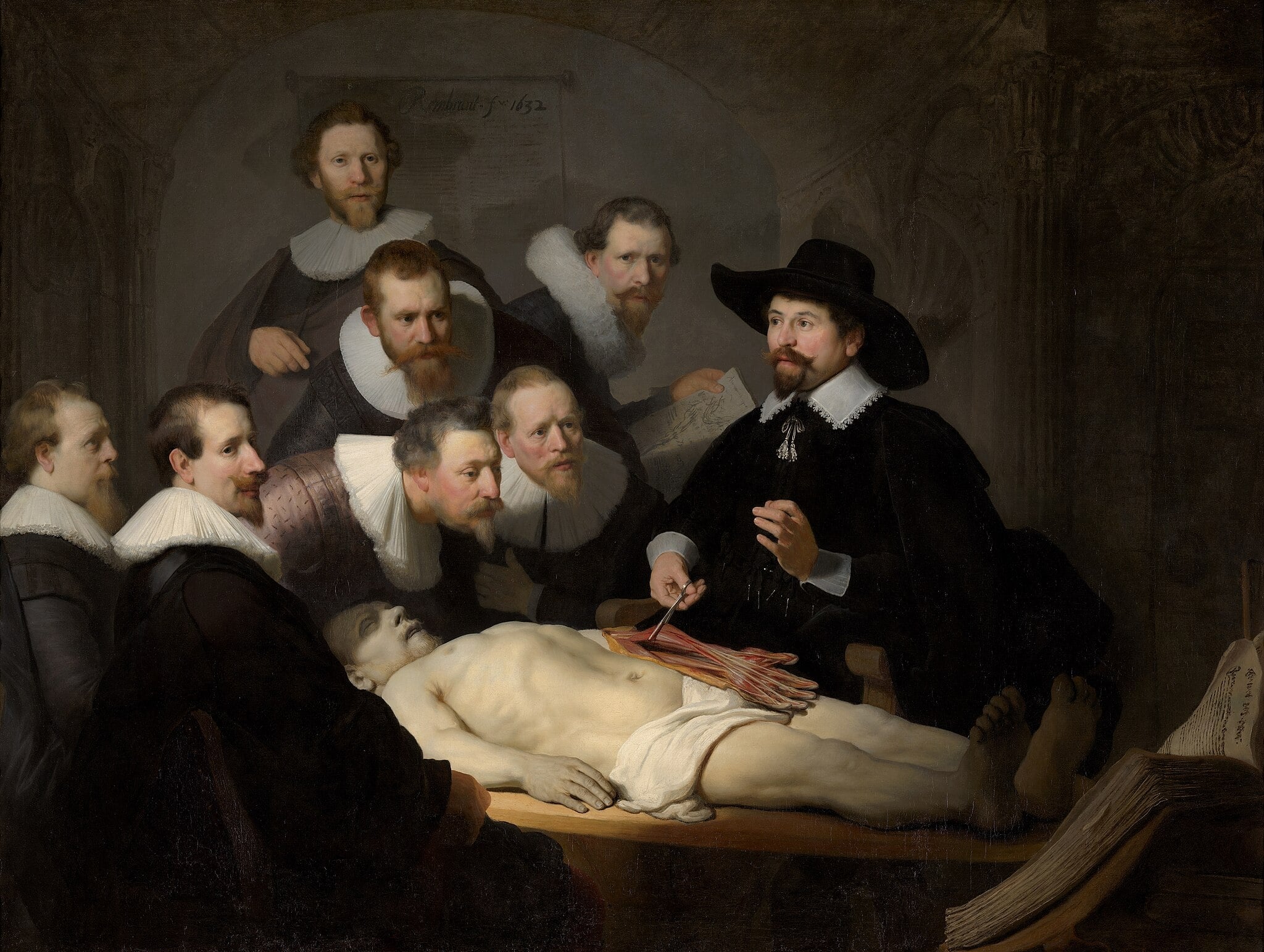
The Anatomy Lesson of Dr. Nicolaes Tulp by Rembrandt van Rijn

The Anatomy Lesson of Dr. Nicolaes Tulp

Rembrandt van Rijn (1632)

Rembrandt van Rijn turns a civic commission into a drama of <strong>knowledge made visible</strong>. A cone of light binds the ruff‑collared surgeons, the pale cadaver, and Dr. Tulp’s forceps as he raises the <strong>forearm tendons</strong> to explain the hand. Book and body face each other across the table, staging the tension—and alliance—between <strong>textual authority</strong> and <strong>empirical observation</strong> <sup>[1]</sup><sup>[2]</sup>.
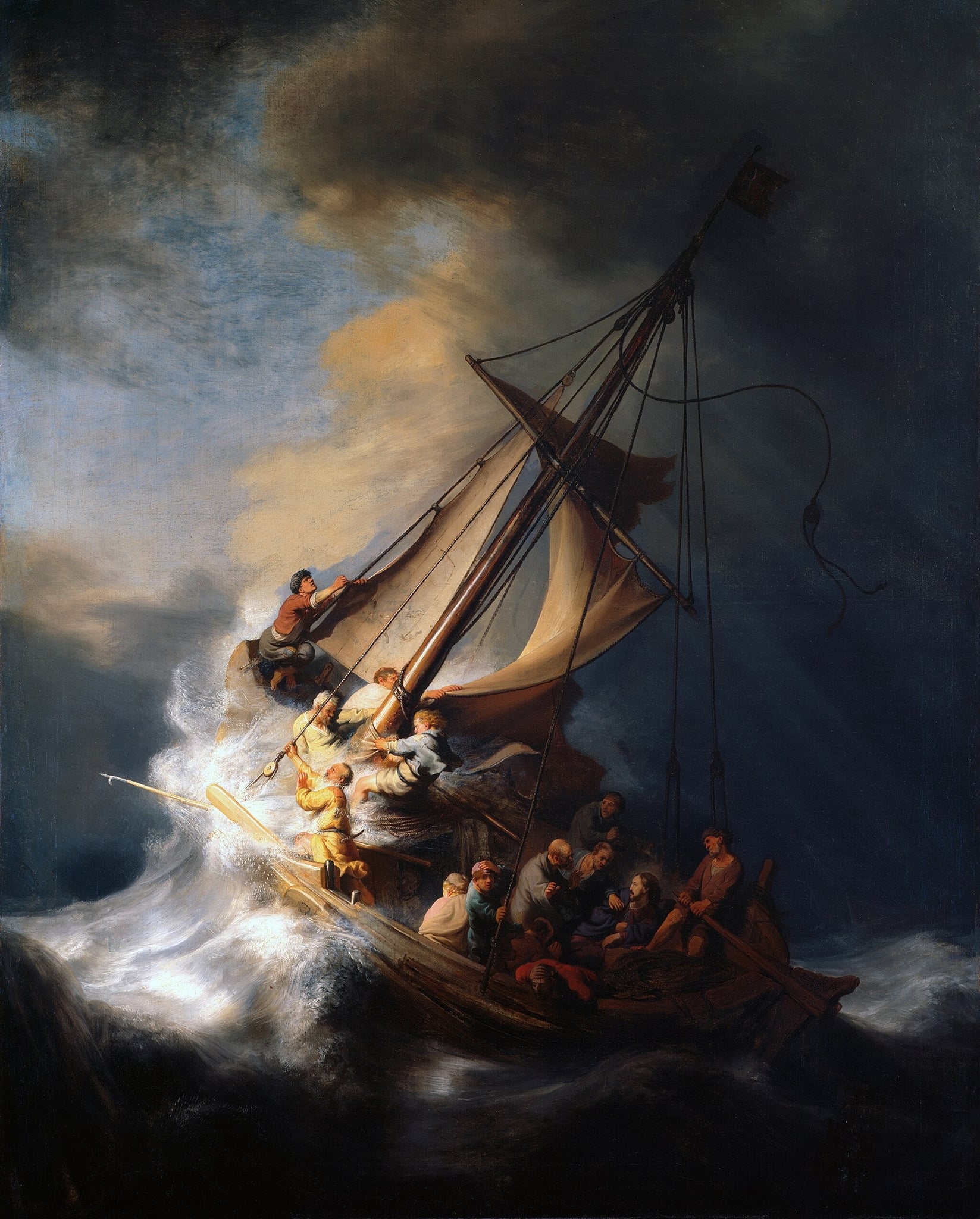
The Storm on the Sea of Galilee by Rembrandt van Rijn

The Storm on the Sea of Galilee

Rembrandt van Rijn (1633)

Rembrandt van Rijn’s The Storm on the Sea of Galilee stages a clash of <strong>human panic</strong> and <strong>divine composure</strong> at the instant before the miracle. A torn mainsail whips across a steeply tilted boat as terrified disciples scramble, while a <strong>serenely lit Christ</strong> anchors a pocket of calm—an image of faith holding within chaos <sup>[1]</sup><sup>[3]</sup>. It is Rembrandt’s only painted seascape, intensifying its dramatic singularity in his oeuvre <sup>[2]</sup>.
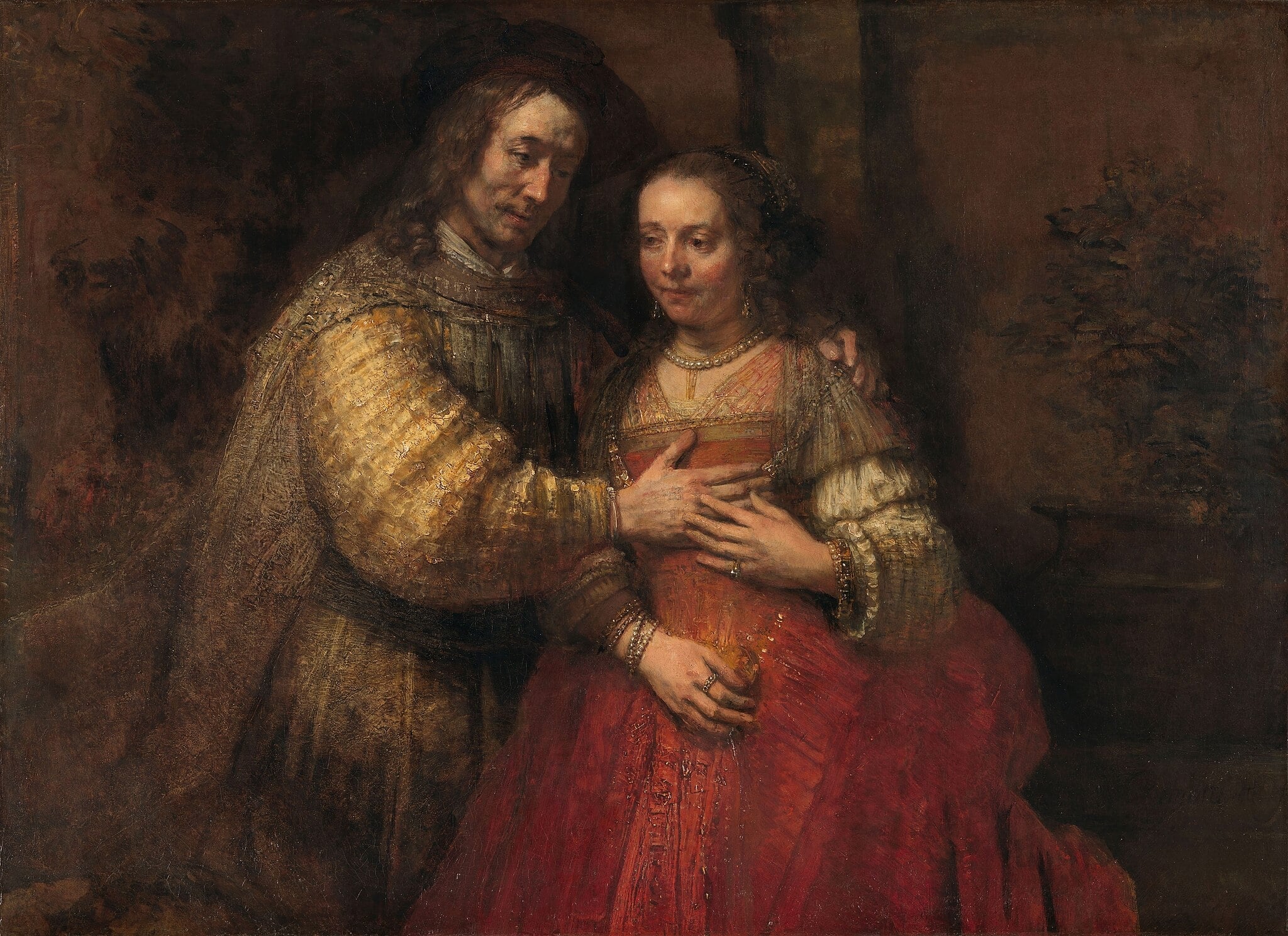
The Jewish Bride by Rembrandt van Rijn

The Jewish Bride

Rembrandt van Rijn (c. 1665–1669)

The Jewish Bride by Rembrandt van Rijn stages an intimate covenant: two figures, read today as <strong>Isaac and Rebecca</strong>, seal their union through touch rather than spectacle. Light concentrates on faces and hands, while the man’s glittering <strong>gold sleeve</strong> and the woman’s <strong>coral-red gown</strong> turn paint itself into a metaphor for fidelity and tenderness <sup>[1]</sup><sup>[3]</sup>. This late masterpiece embodies Rembrandt’s <strong>material eloquence</strong>—impasto as feeling—within a hushed, dark setting <sup>[1]</sup><sup>[2]</sup>.
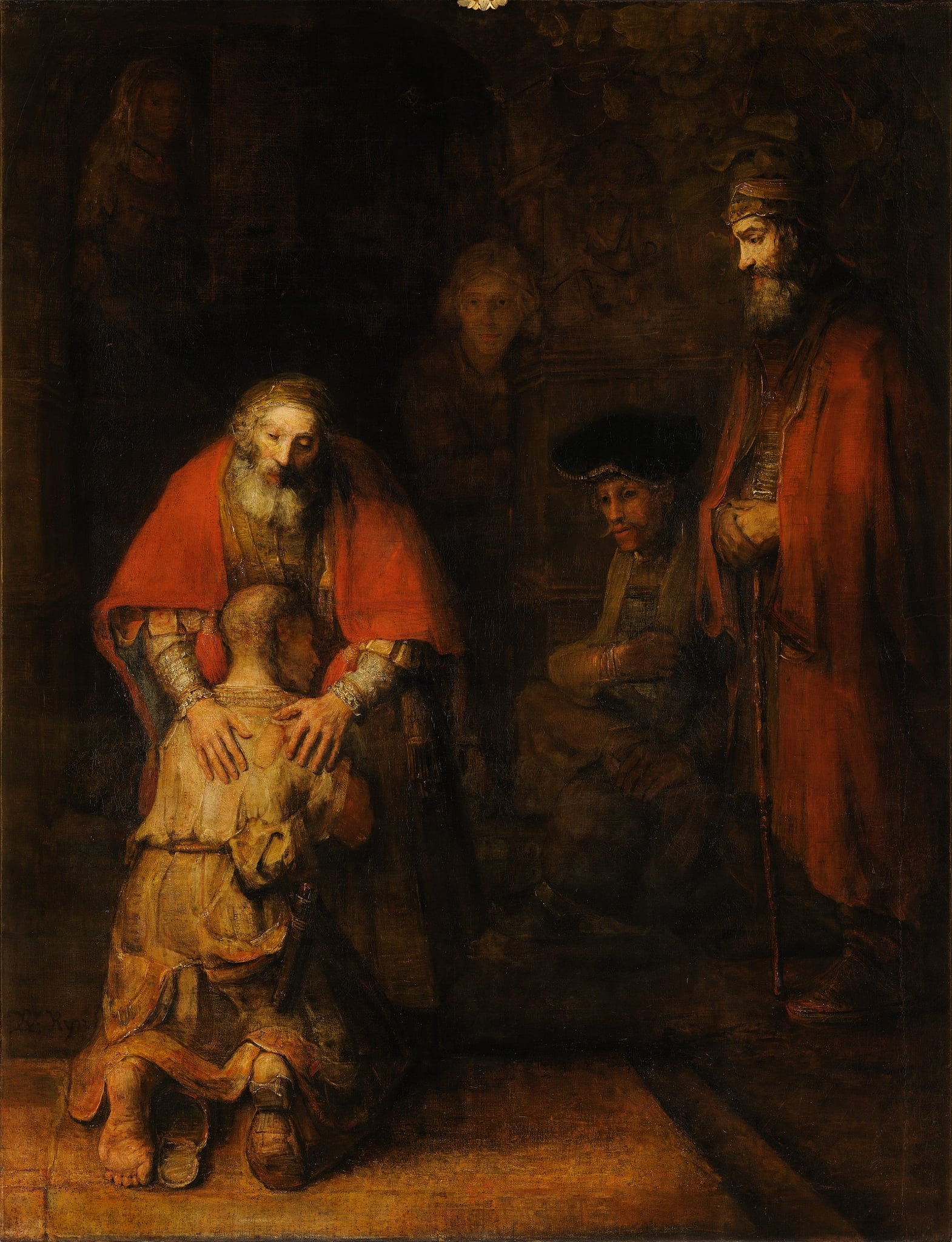
The Return of the Prodigal Son by Rembrandt van Rijn

The Return of the Prodigal Son

Rembrandt van Rijn (c. 1661–1669 (probably completed by 1669))

Rembrandt van Rijn’s The Return of the Prodigal Son is a late-life meditation on <strong>mercy</strong>, <strong>homecoming</strong>, and <strong>restored dignity</strong>. In a hush of dusk-like light, a ragged son kneels into his father’s <strong>embrace</strong>, while an upright elder brother holds back in shadow. The image concentrates meaning in illuminated <strong>faces, hands, and feet</strong>, turning a parable into a timeless human reckoning. <sup>[1]</sup><sup>[2]</sup>
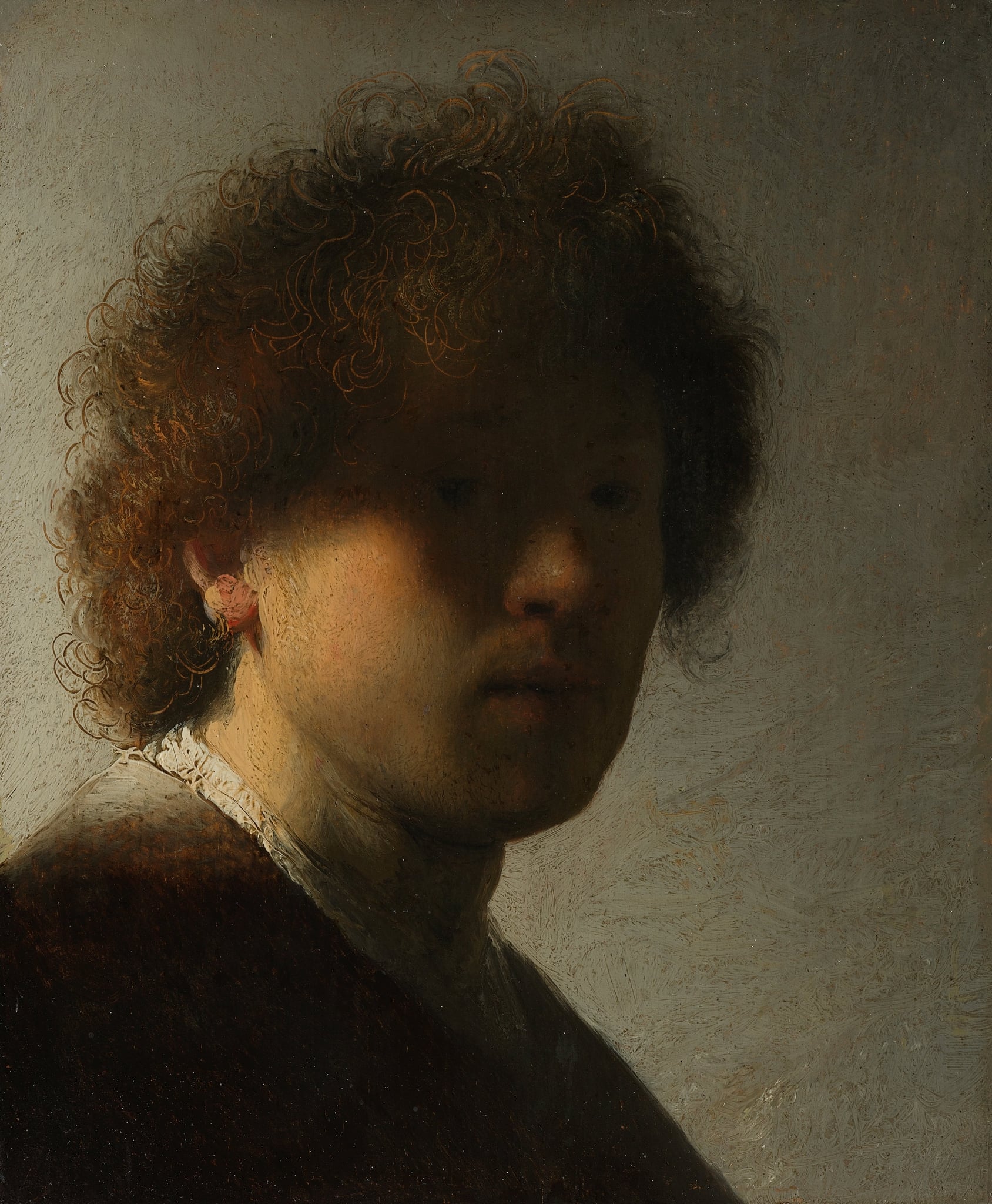
Self-portrait (with tousled hair) by Rembrandt van Rijn

Self-portrait (with tousled hair)

Rembrandt van Rijn (c. 1628)

A young Rembrandt van Rijn tests how <strong>light both reveals and withholds</strong> by letting his face emerge from darkness while his <strong>scratched, backlit curls</strong> flare like a rough halo. The small oak panel makes <strong>process itself the subject</strong>, turning hair, stubble, and a raking highlight into a statement of identity-in-formation <sup>[1]</sup><sup>[5]</sup>.
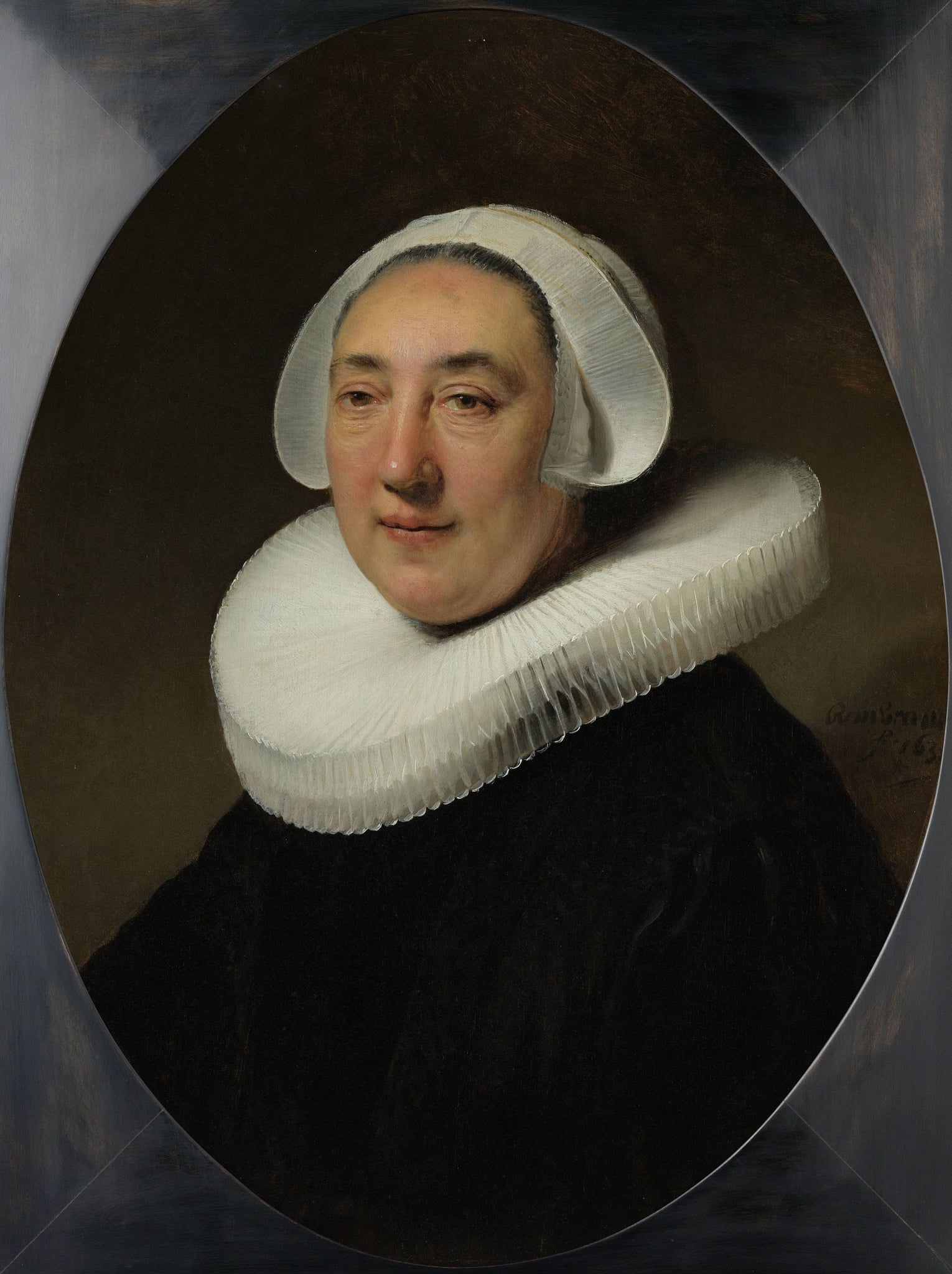
Portrait of Haesje Jacobsdr van Cleyburg by Rembrandt van Rijn

Portrait of Haesje Jacobsdr van Cleyburg

Rembrandt van Rijn (1634)

Rembrandt’s 1634 Portrait of Haesje Jacobsdr van Cleyburg stages a Dutch burgher within a feigned <strong>oval</strong> opening, illuminated by selective <strong>chiaroscuro</strong> that models warm skin against brilliant <strong>millstone ruff</strong> and sober black dress. The painting balances <strong>modesty and status</strong>, making virtue visible while quietly declaring prosperity through immaculate linen and craft <sup>[1]</sup><sup>[4]</sup>.