Identity
The Identity symbolism category traces how modern painters repurpose attributes, poses, and fashions as semiotic devices that construct, fracture, or contest social selves within regimes of spectatorship and exchange.
Member Symbols
Featured Artworks
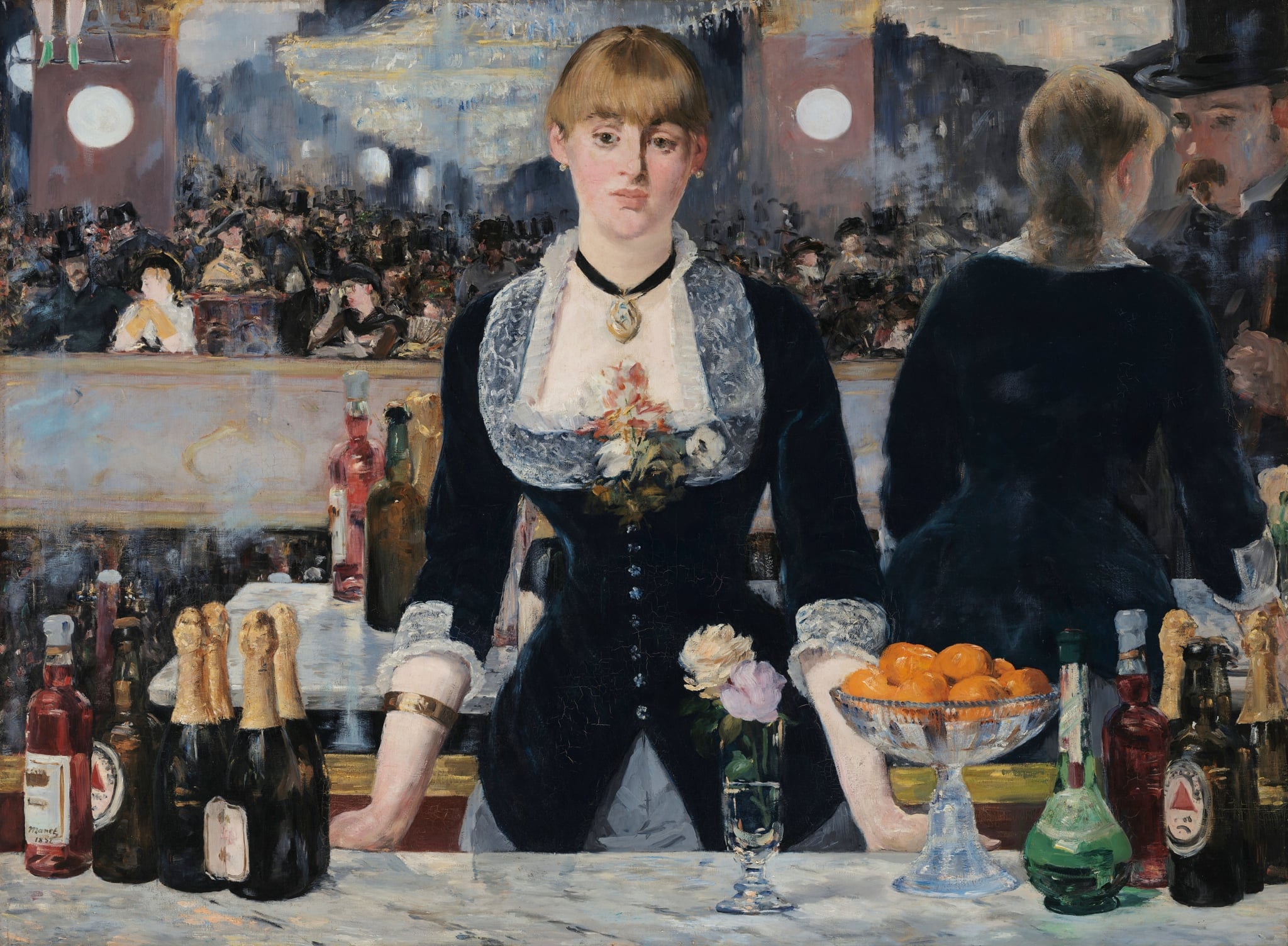
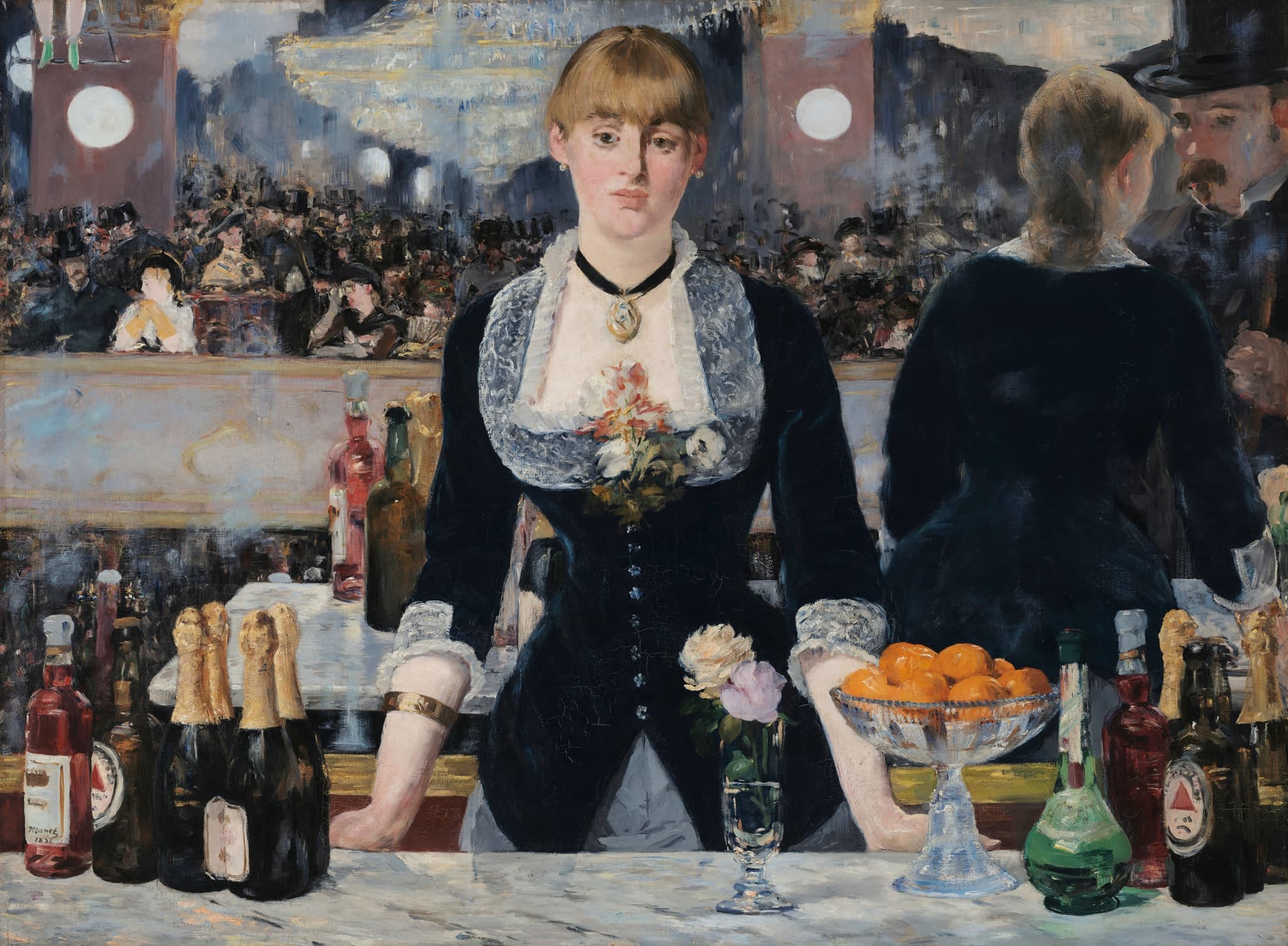
A Bar at the Folies-Bergère
Édouard Manet (1882)
Édouard Manet’s A Bar at the Folies-Bergère stages a face-to-face encounter with modern Paris, where <strong>commerce</strong>, <strong>spectacle</strong>, and <strong>alienation</strong> converge. A composed barmaid fronts a marble counter loaded with branded bottles, flowers, and a brimming bowl of oranges, while a disjunctive <strong>mirror</strong> unravels stable viewing and certainty <sup>[1]</sup><sup>[2]</sup>.
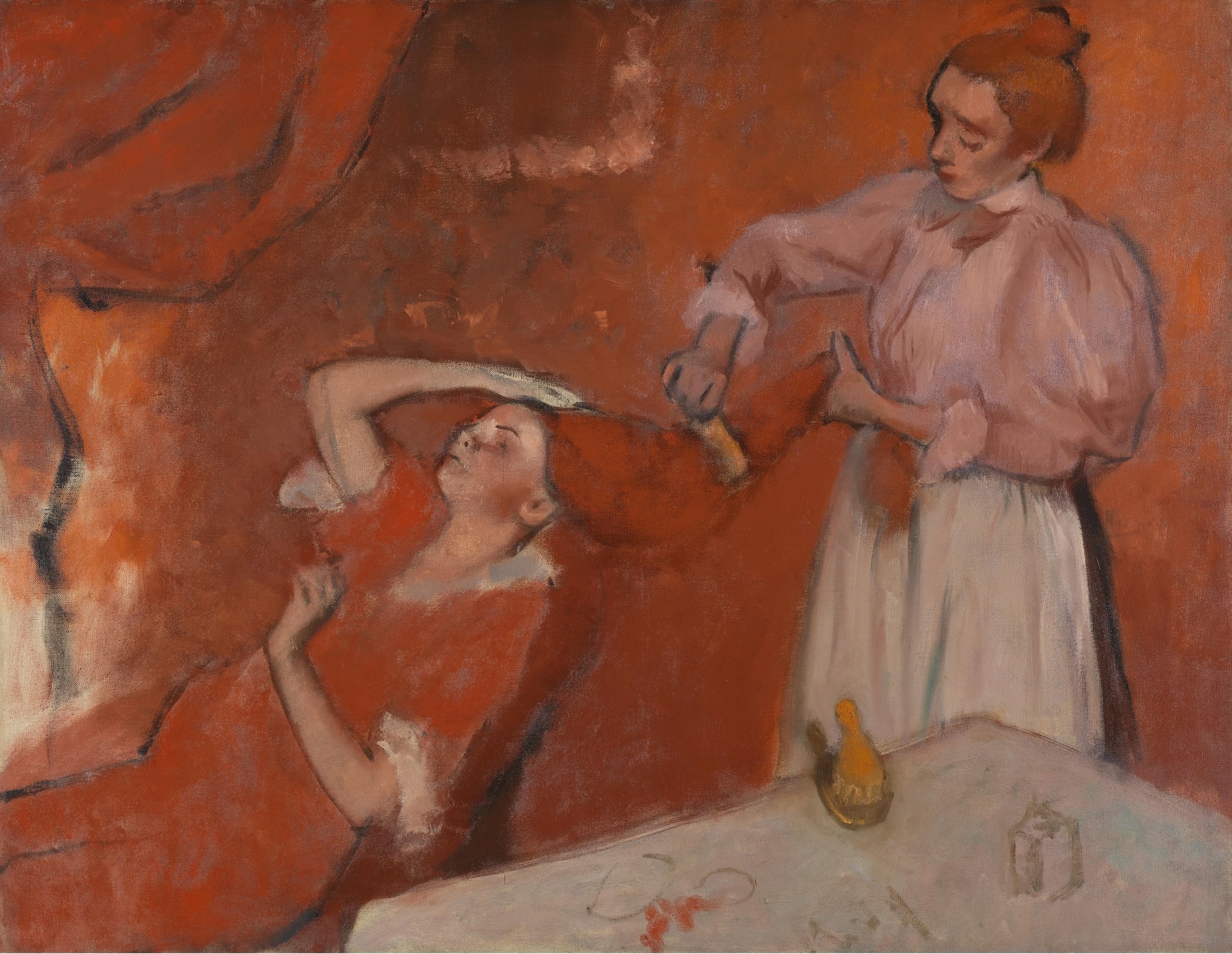
Combing the Hair
Edgar Degas (c.1896)
Edgar Degas’s Combing the Hair crystallizes a private ritual into a scene of <strong>compressed intimacy</strong> and <strong>classed labor</strong>. The incandescent field of red fuses figure and room, turning the hair into a <strong>binding ribbon</strong> between attendant and sitter <sup>[1]</sup>.
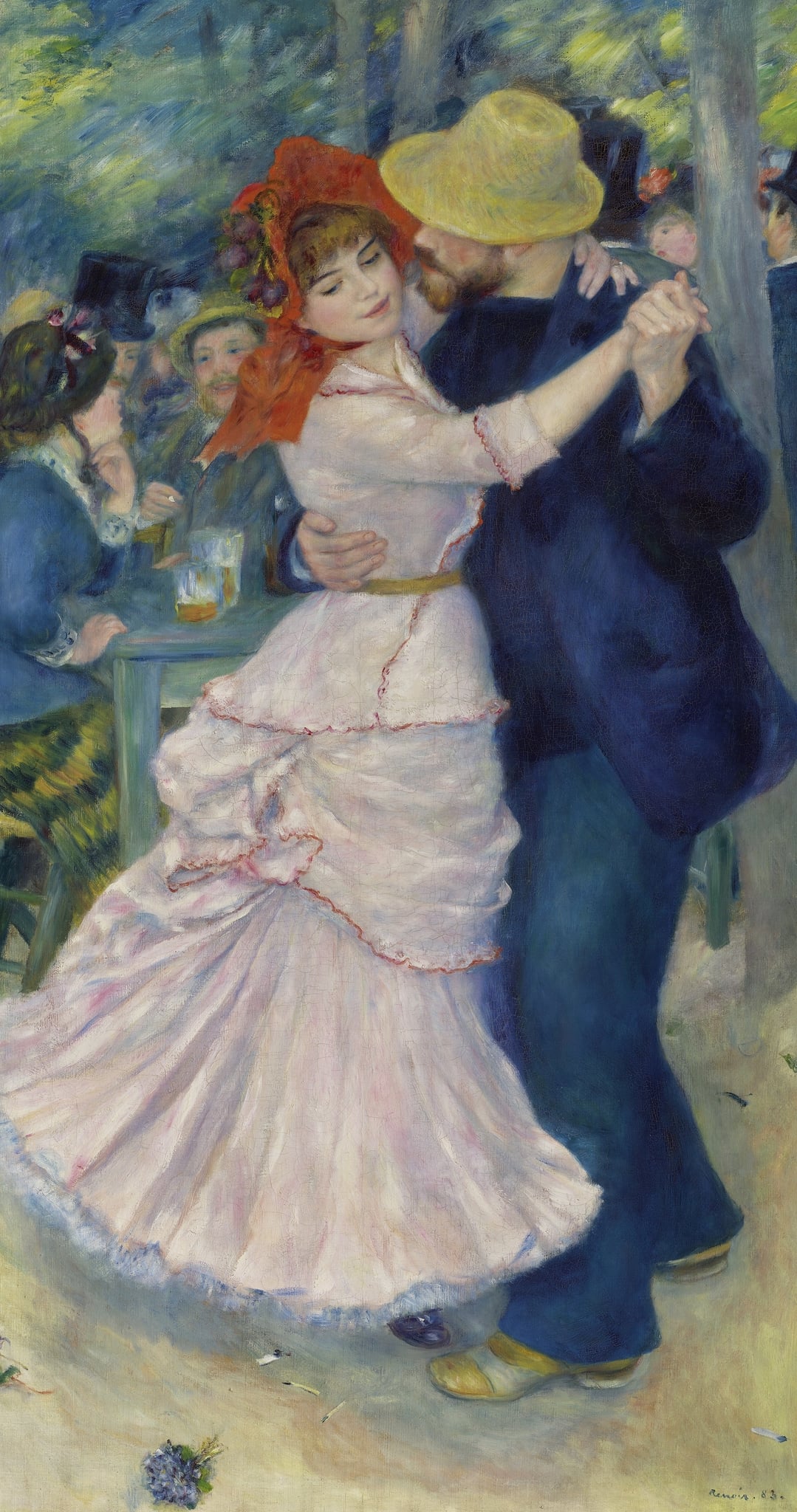
Dance at Bougival
Pierre-Auguste Renoir (1883)
In Dance at Bougival, Pierre-Auguste Renoir turns a crowded suburban dance into a <strong>private vortex of intimacy</strong>. Rose against ultramarine, skin against shade, and a flare of the woman’s <strong>scarlet bonnet</strong> concentrate the scene’s energy into a single turning moment—modern leisure made palpable as <strong>touch, motion, and light</strong> <sup>[1]</sup><sup>[2]</sup>.
Dance in the City
Pierre-Auguste Renoir (1883)
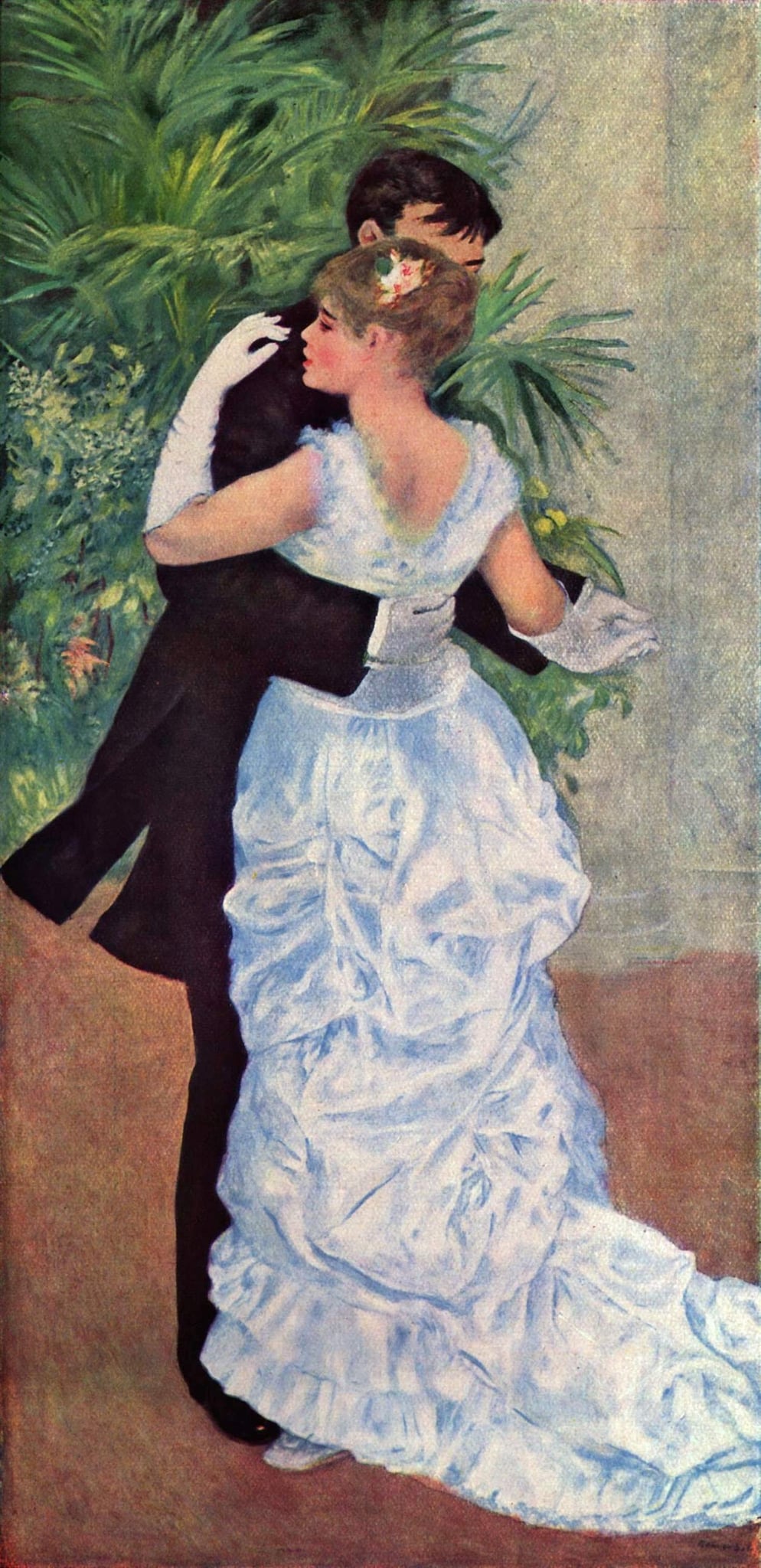
Pierre-Auguste Renoir’s Dance in the City stages an urban waltz where decorum and desire briefly coincide. A couple’s close embrace—his black tailcoat enclosing her luminous white satin gown—creates a <strong>cool, elegant</strong> harmony against potted palms and marble. Renoir’s refined, post‑Impressionist touch turns social ritual into <strong>sensual modernity</strong> <sup>[1]</sup><sup>[2]</sup>.
In the Garden
Pierre-Auguste Renoir (1885)
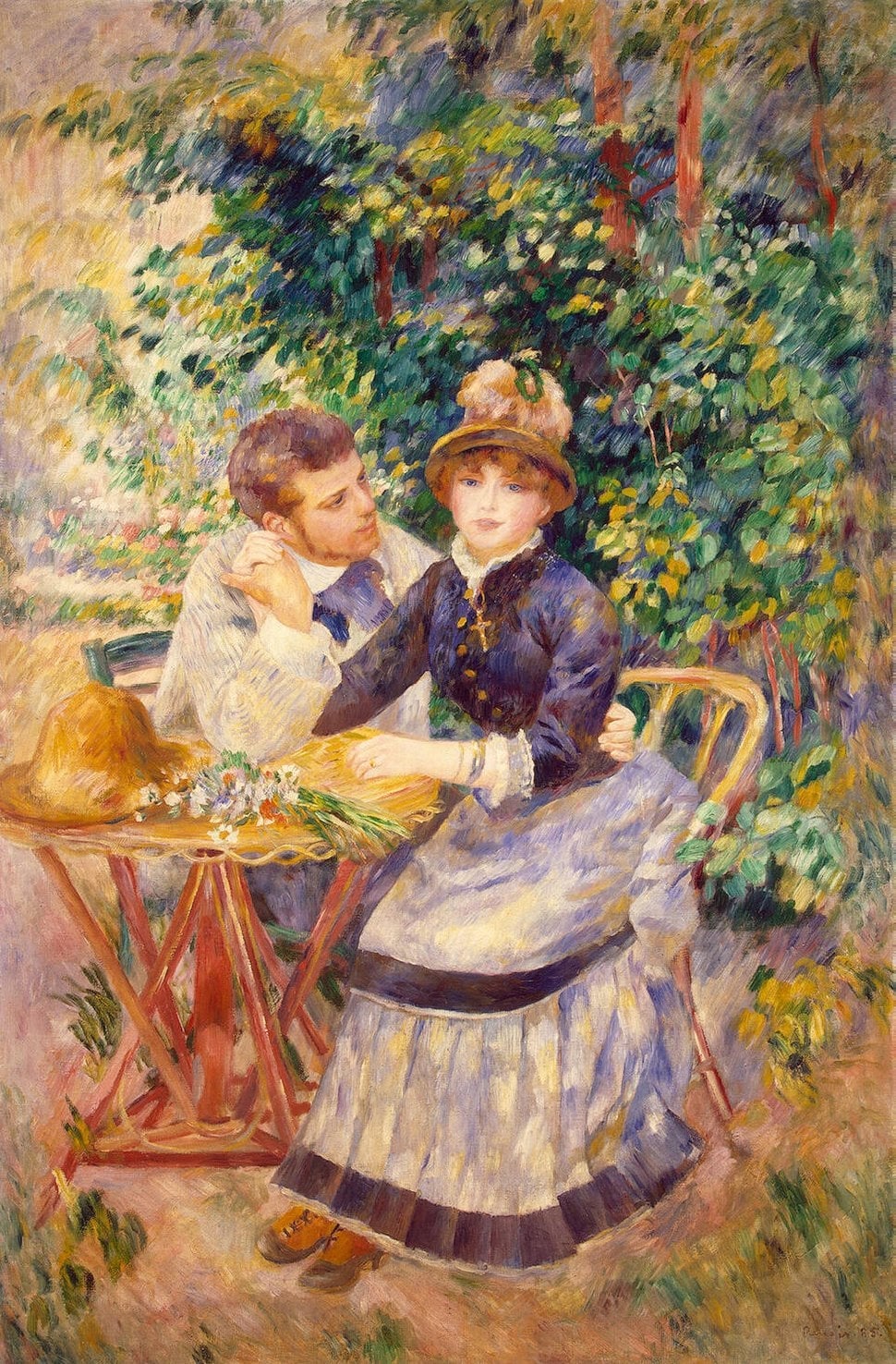
In the Garden presents a charged pause in modern leisure: a young couple at a café table under a living arbor of leaves. Their lightly clasped hands and the bouquet on the tabletop signal courtship, while her calm, front-facing gaze checks his lean. Renoir’s flickering brushwork fuses figures and foliage, rendering love as a <strong>transitory, luminous sensation</strong> <sup>[1]</sup><sup>[3]</sup>.
Jeanne (Spring)
Édouard Manet (1881)
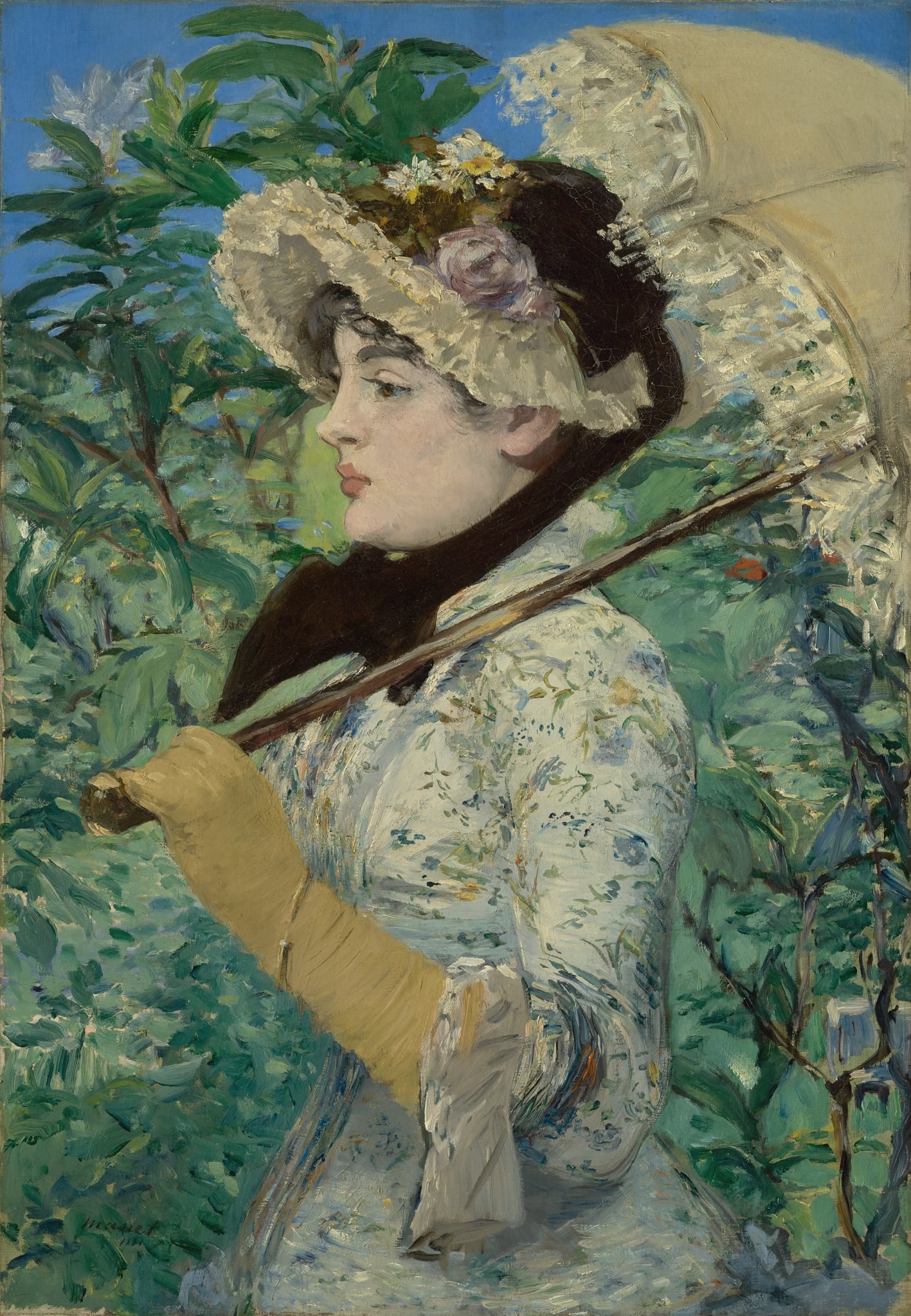
Édouard Manet’s Jeanne (Spring) fuses a time-honored allegory with <strong>modern Parisian fashion</strong>: a crisp profile beneath a cream parasol, set against <strong>luminous, leafy greens</strong>. Manet turns couture—hat, glove, parasol—into the language of <strong>renewal and youth</strong>, making spring feel both perennial and up-to-the-minute <sup>[1]</sup><sup>[2]</sup>.
Luncheon on the Grass
Édouard Manet (1863)
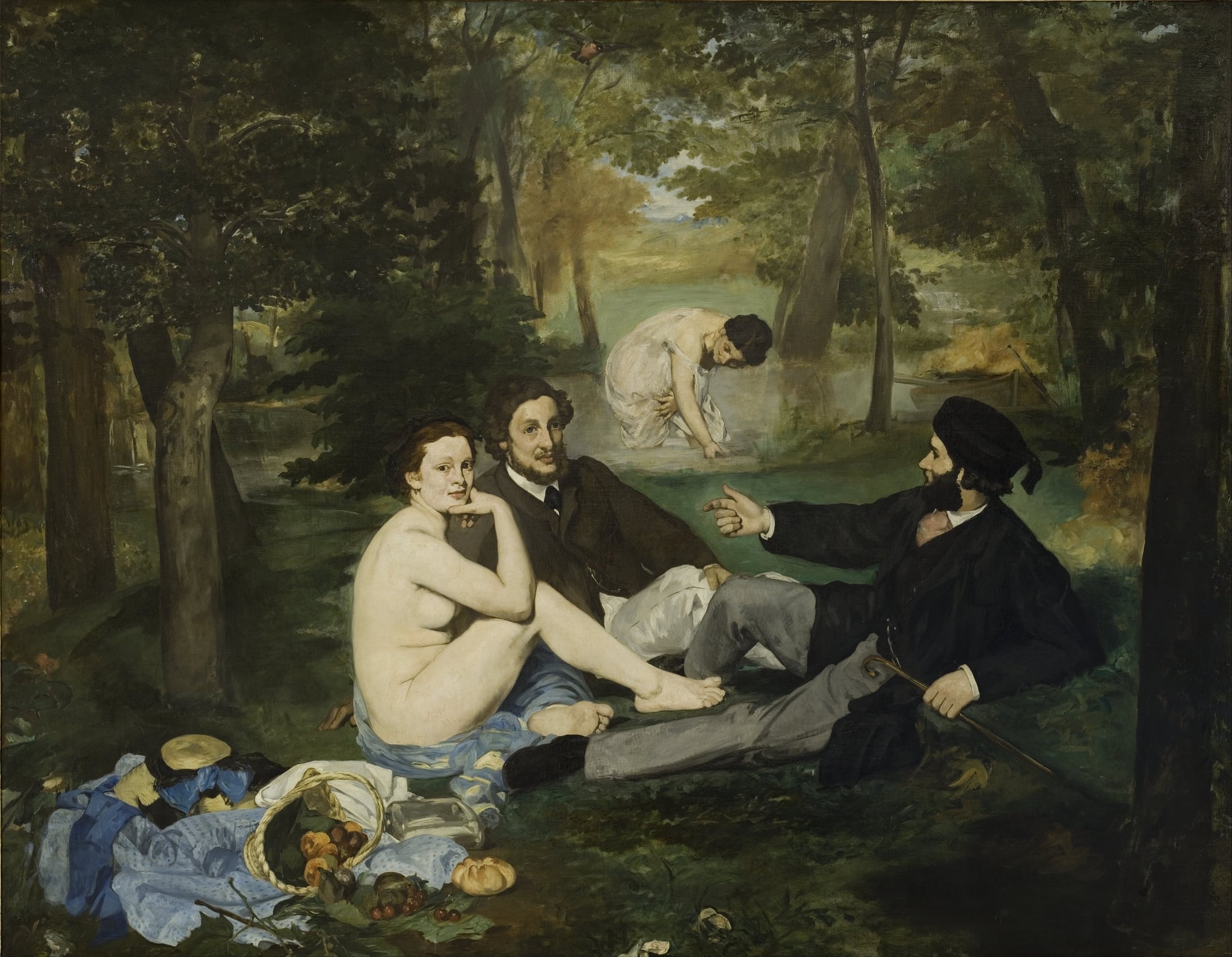
Luncheon on the Grass stages a confrontation between <strong>modern Parisian leisure</strong> and <strong>classical precedent</strong>. A nude woman meets our gaze beside two clothed men, while a distant bather and an overturned picnic puncture naturalistic illusion. Manet’s scale and flat, studio-like light convert a park picnic into a manifesto of <strong>modern painting</strong> <sup>[1]</sup><sup>[2]</sup>.
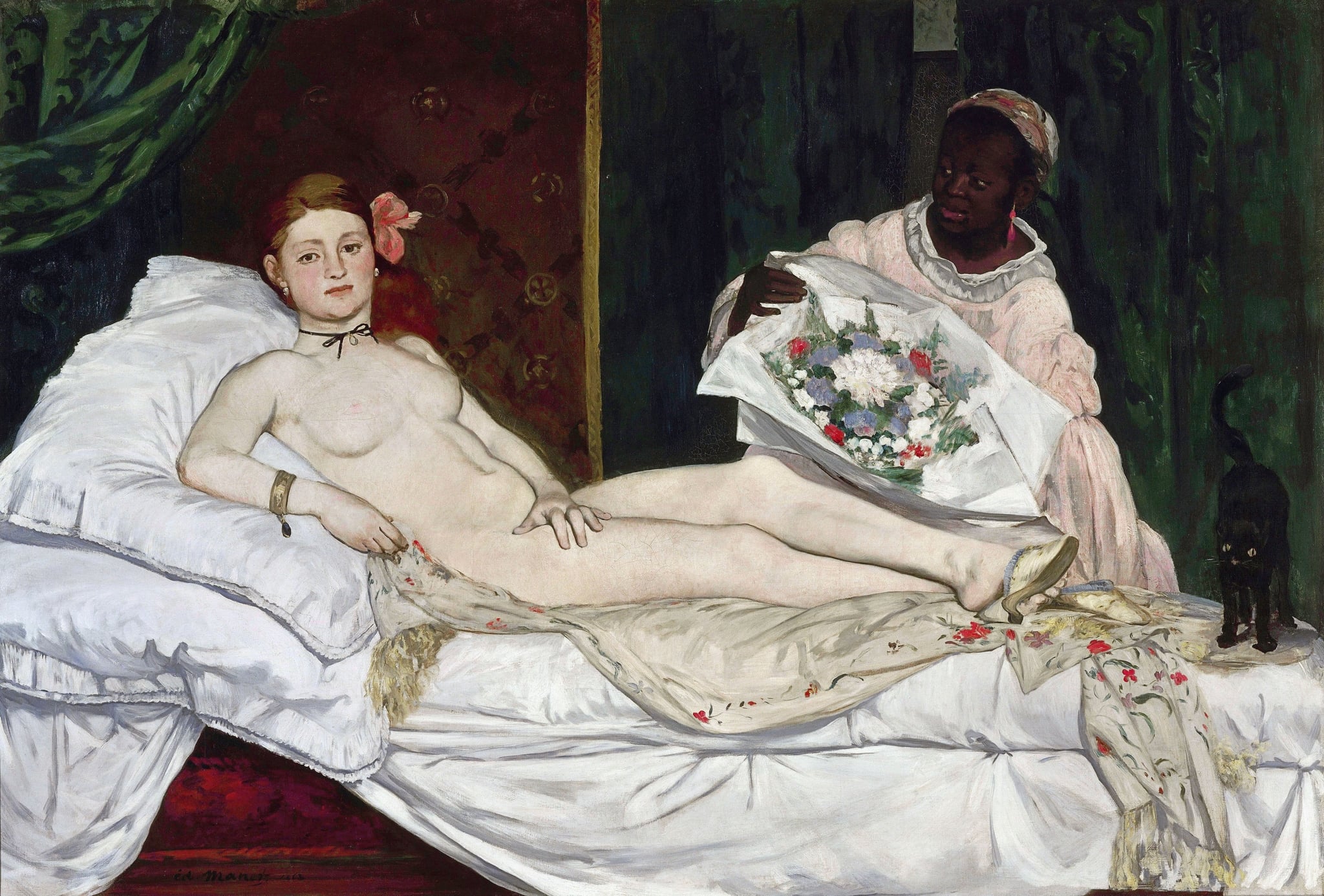
Olympia
Édouard Manet (1863 (Salon 1865))
A defiantly contemporary nude confronts the viewer with a steady gaze and a guarded pose, framed by crisp light and luxury trappings. In Olympia, <strong>Édouard Manet</strong> strips myth from the female nude to expose the <strong>modern economy of desire</strong>, power, and looking <sup>[1]</sup><sup>[3]</sup>.
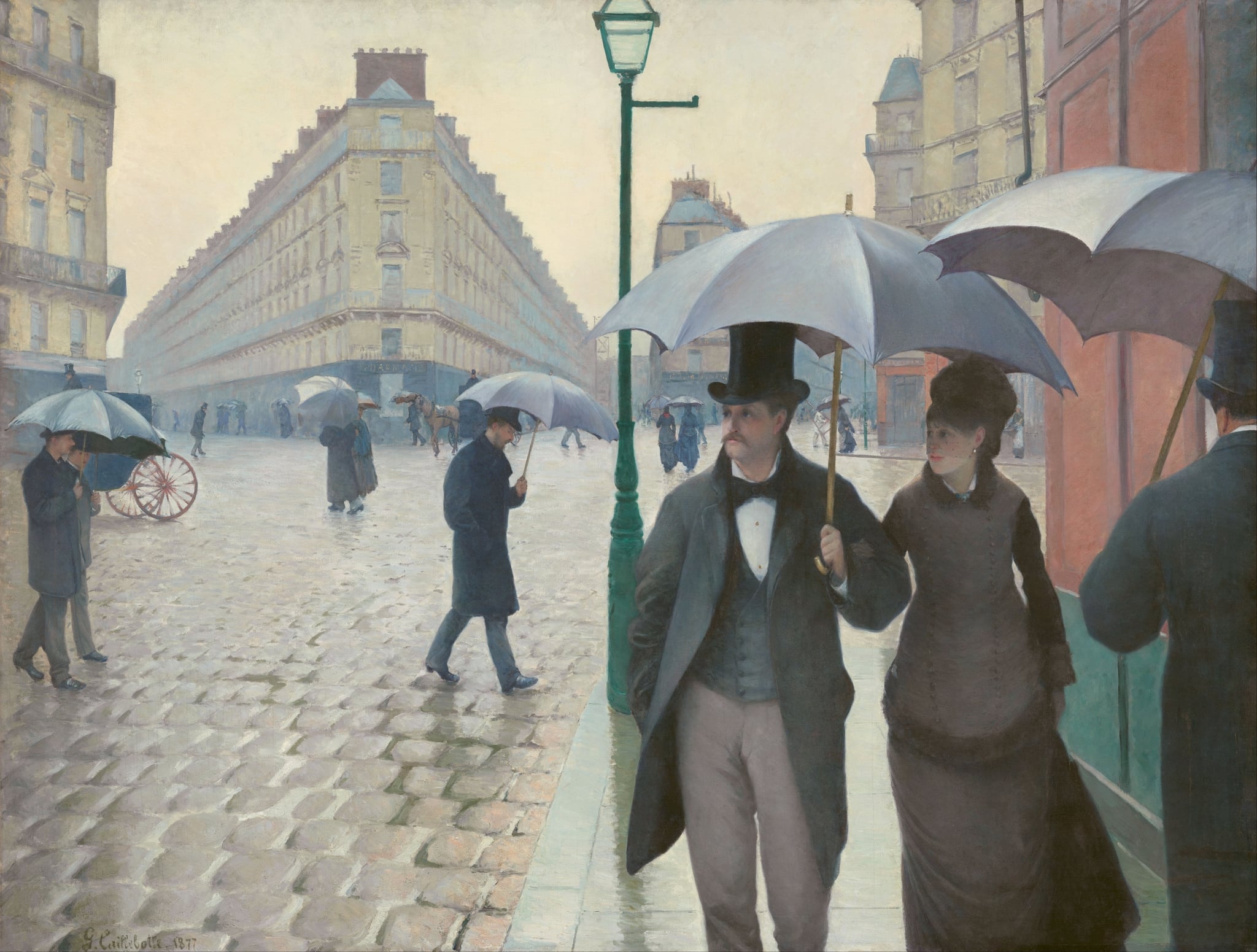
Paris Street; Rainy Day
Gustave Caillebotte (1877)
Gustave Caillebotte’s Paris Street; Rainy Day renders a newly modern Paris where <strong>Haussmann’s geometry</strong> meets the <strong>anonymity of urban life</strong>. Umbrellas punctuate a silvery atmosphere as a <strong>central gas lamp</strong> and knife-sharp façades organize the space into measured planes <sup>[1]</sup><sup>[2]</sup>.
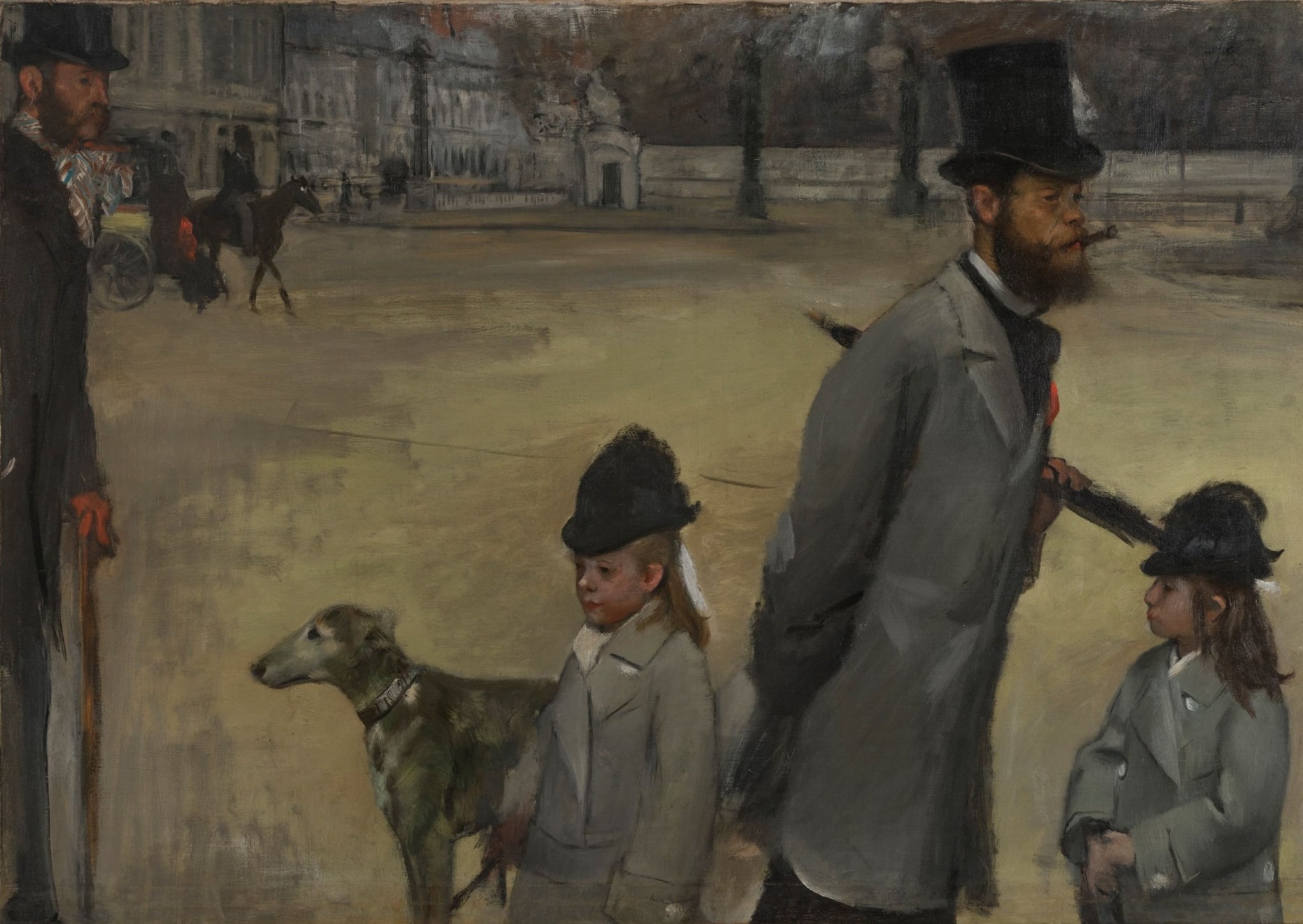
Place de la Concorde
Edgar Degas (1875)
Degas’s Place de la Concorde turns a famous Paris square into a study of <strong>modern isolation</strong> and <strong>instantaneous vision</strong>. Figures stride past one another without contact, their bodies abruptly <strong>cropped</strong> and adrift in a wide, airless plaza—an urban stage where elegance masks estrangement <sup>[1]</sup><sup>[2]</sup>.
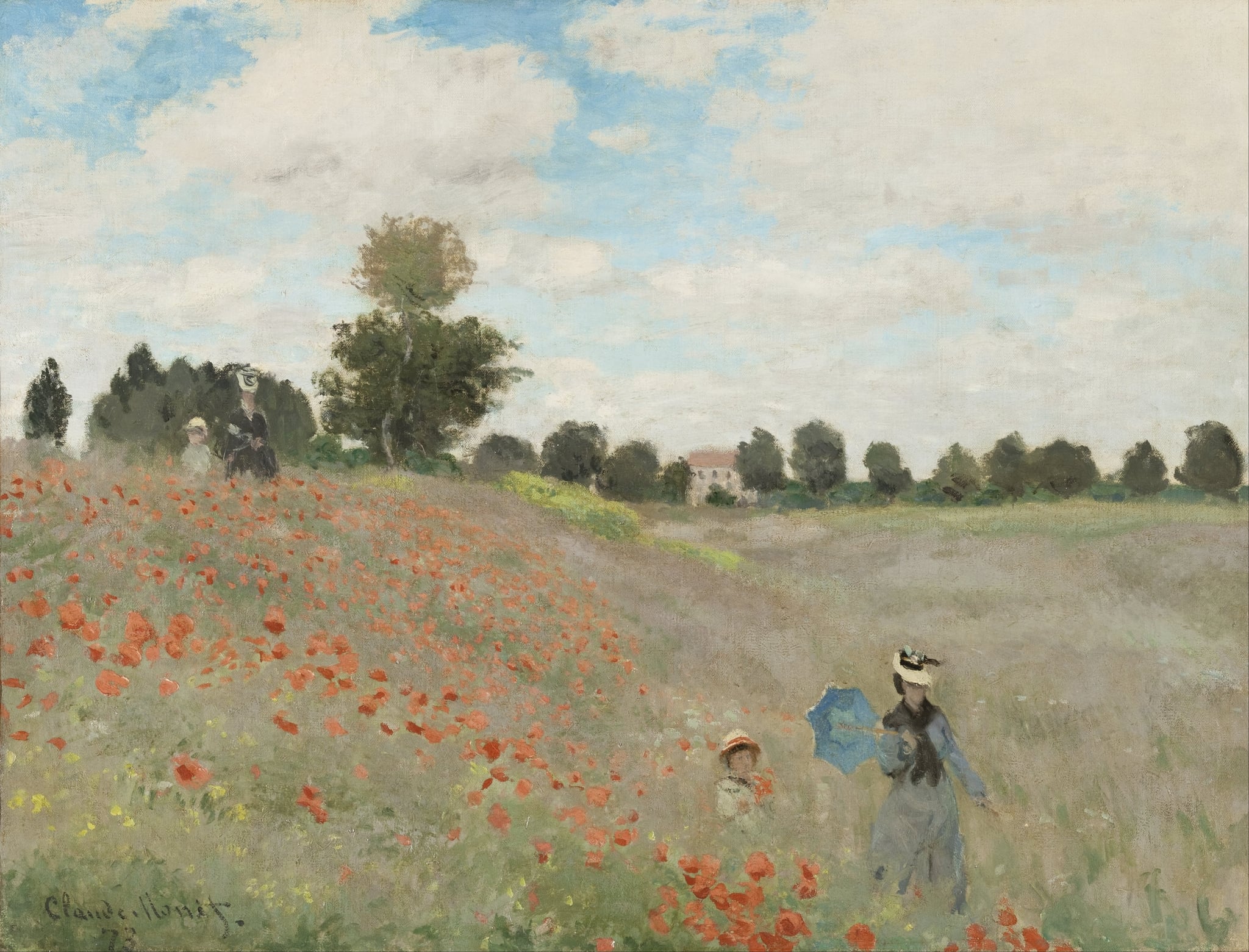
Poppies
Claude Monet (1873)
Claude Monet’s Poppies (1873) turns a suburban hillside into a theater of <strong>light, time, and modern leisure</strong>. A red diagonal of poppies counters cool fields and sky, while a woman with a <strong>blue parasol</strong> and a child appear twice along the slope, staging a gentle <strong>echo of moments</strong> rather than a single event <sup>[1]</sup>. The painting asserts sensation over contour, letting broken touches make the day itself the subject.
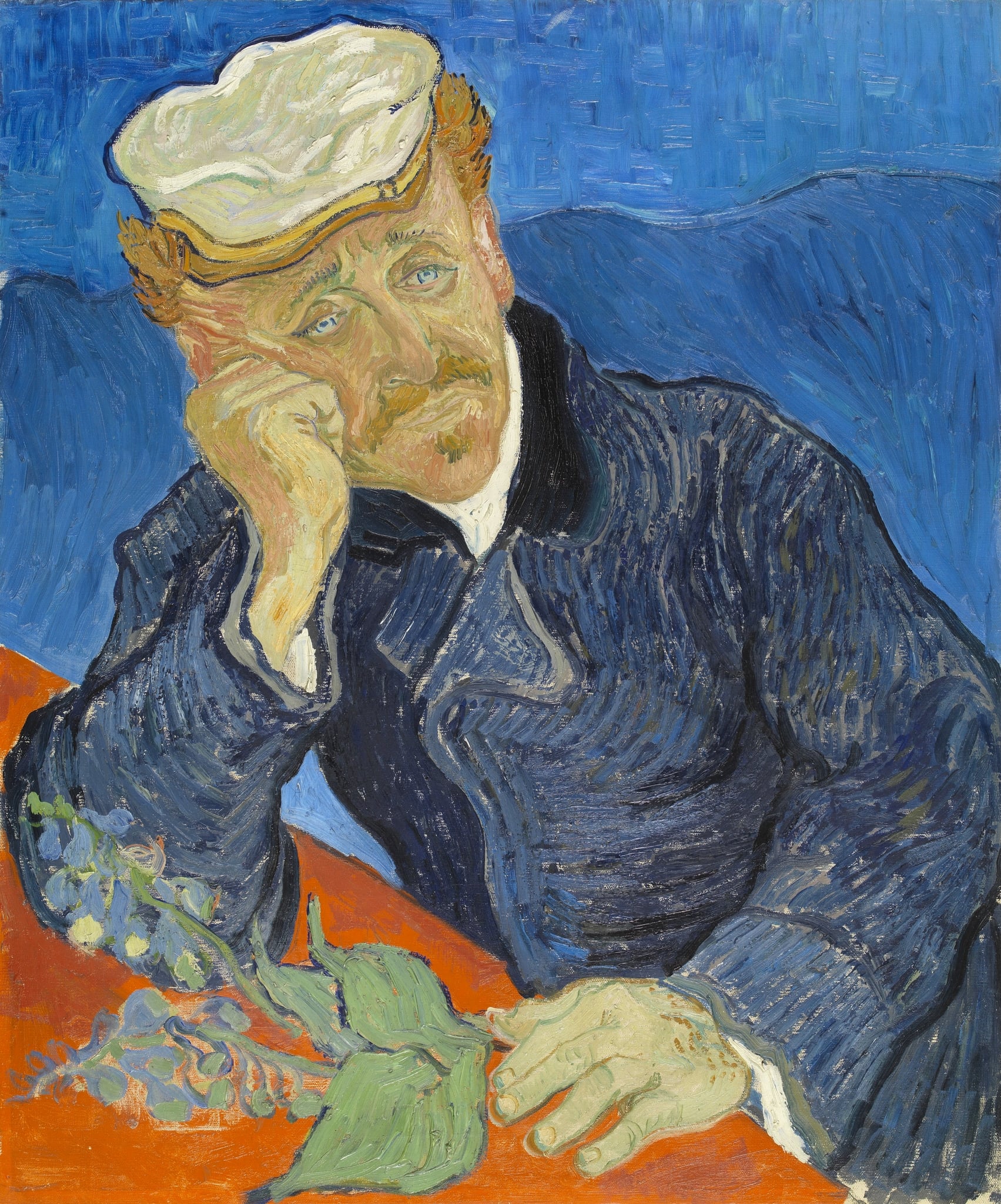
Portrait of Dr. Gachet
Vincent van Gogh (1890)
Portrait of Dr. Gachet distills Van Gogh’s late ambition for a <strong>modern, psychological portrait</strong> into vibrating color and touch. The sitter’s head sinks into a greenish hand above a <strong>blazing orange-red table</strong>, foxglove sprig nearby, while waves of <strong>cobalt and ultramarine</strong> churn through coat and background. The chromatic clash turns a quiet pose into an <strong>empathic image of fragility and care</strong> <sup>[1]</sup><sup>[2]</sup>.
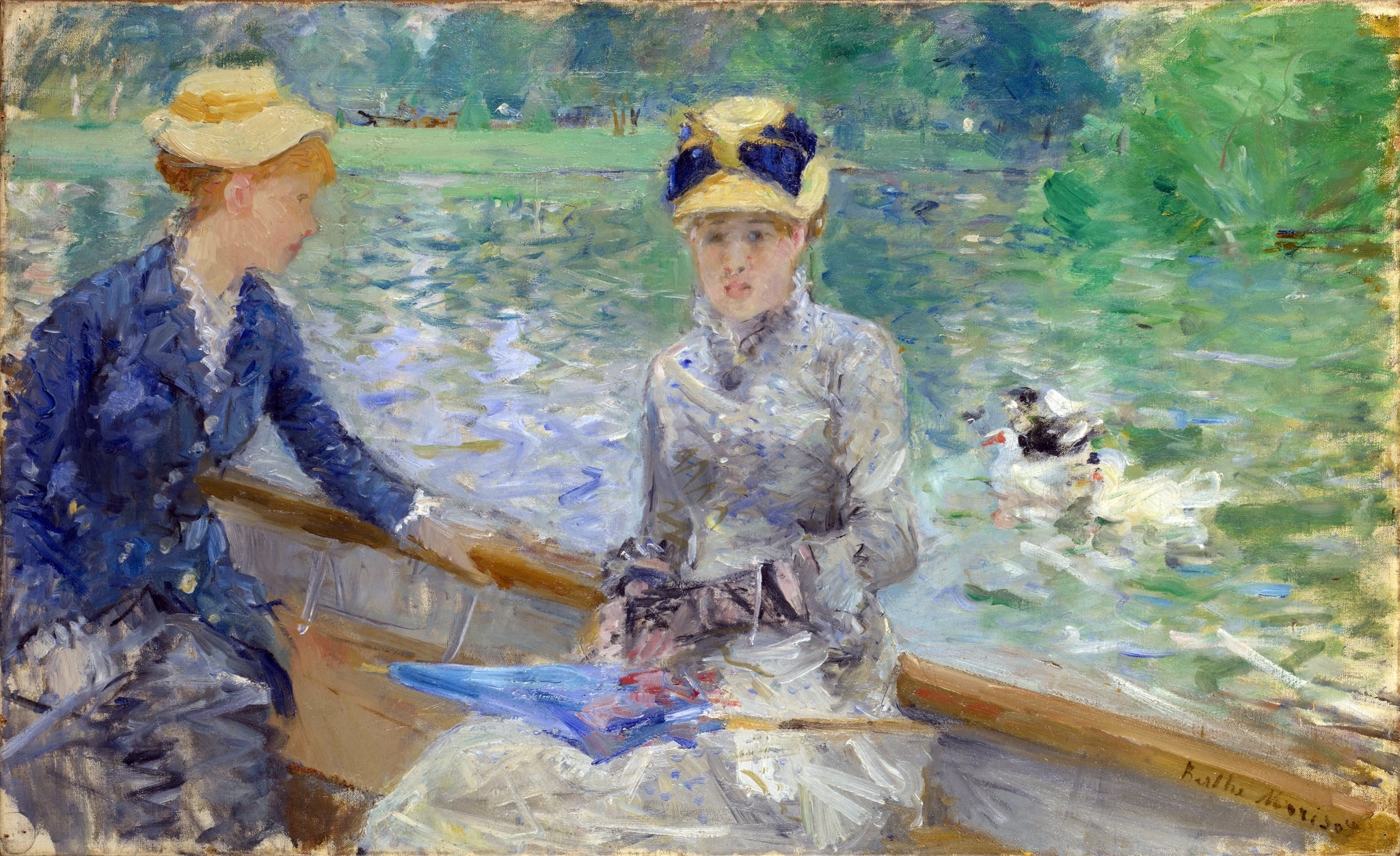
Summer's Day
Berthe Morisot (about 1879)
Two women drift on a boat in the Bois de Boulogne, their dresses, hats, and a bright blue parasol fused with the lake’s flicker by Morisot’s swift, <strong>zig‑zag brushwork</strong>. The scene turns a brief outing into a poised study of <strong>modern leisure</strong> and <strong>female companionship</strong> in public space <sup>[1]</sup>.
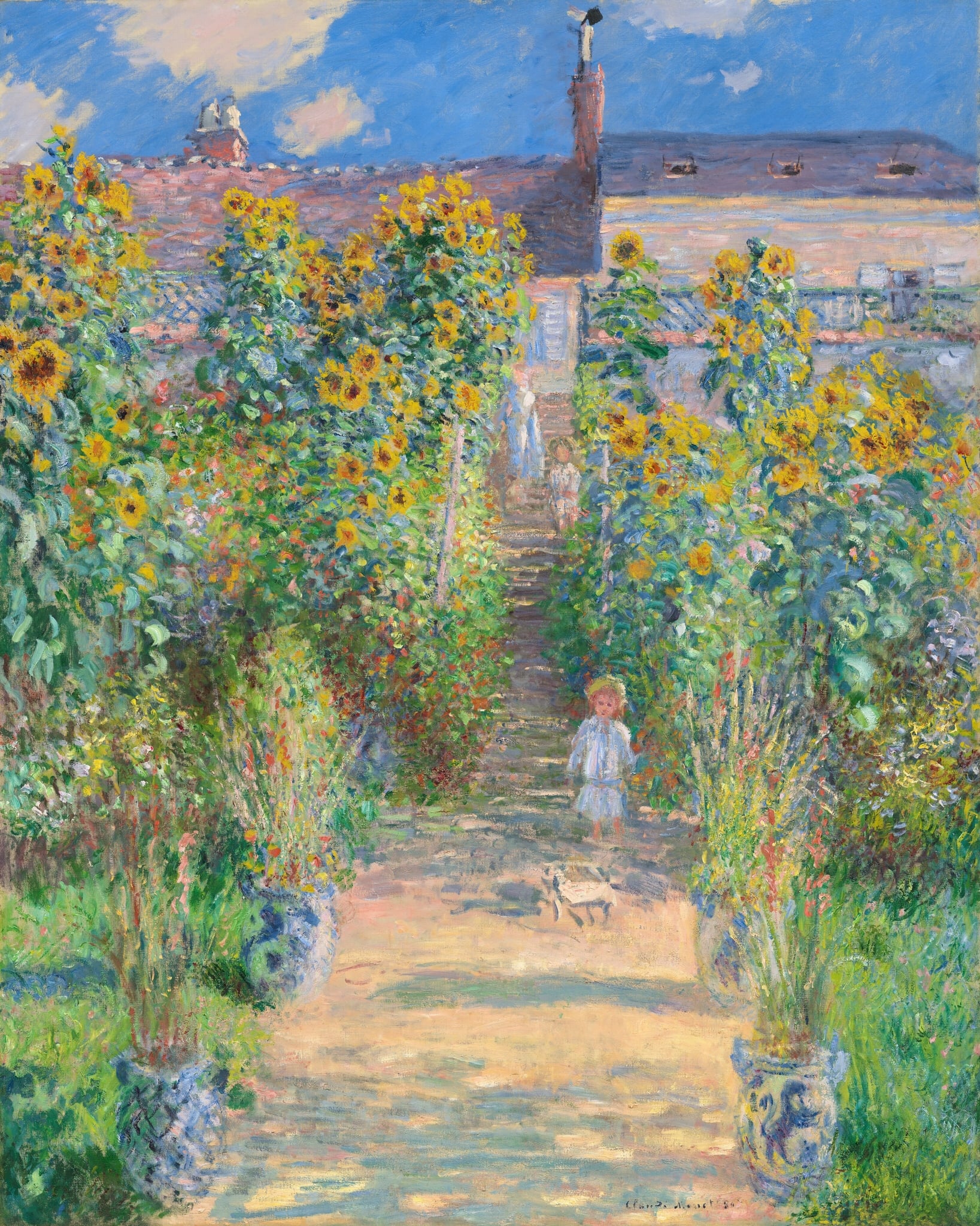
The Artist's Garden at Vétheuil
Claude Monet (1881)
Claude Monet’s The Artist’s Garden at Vétheuil stages a sunlit ascent through a corridor of towering sunflowers toward a modest house, where everyday life meets cultivated nature. Quick, broken strokes make leaves and shadows tremble, asserting <strong>light</strong> and <strong>painterly surface</strong> over linear contour. Blue‑and‑white <strong>jardinieres</strong> anchor the foreground, while a child and dog briefly pause on the path, turning the garden into a <strong>domestic sanctuary</strong> <sup>[1]</sup><sup>[2]</sup>.
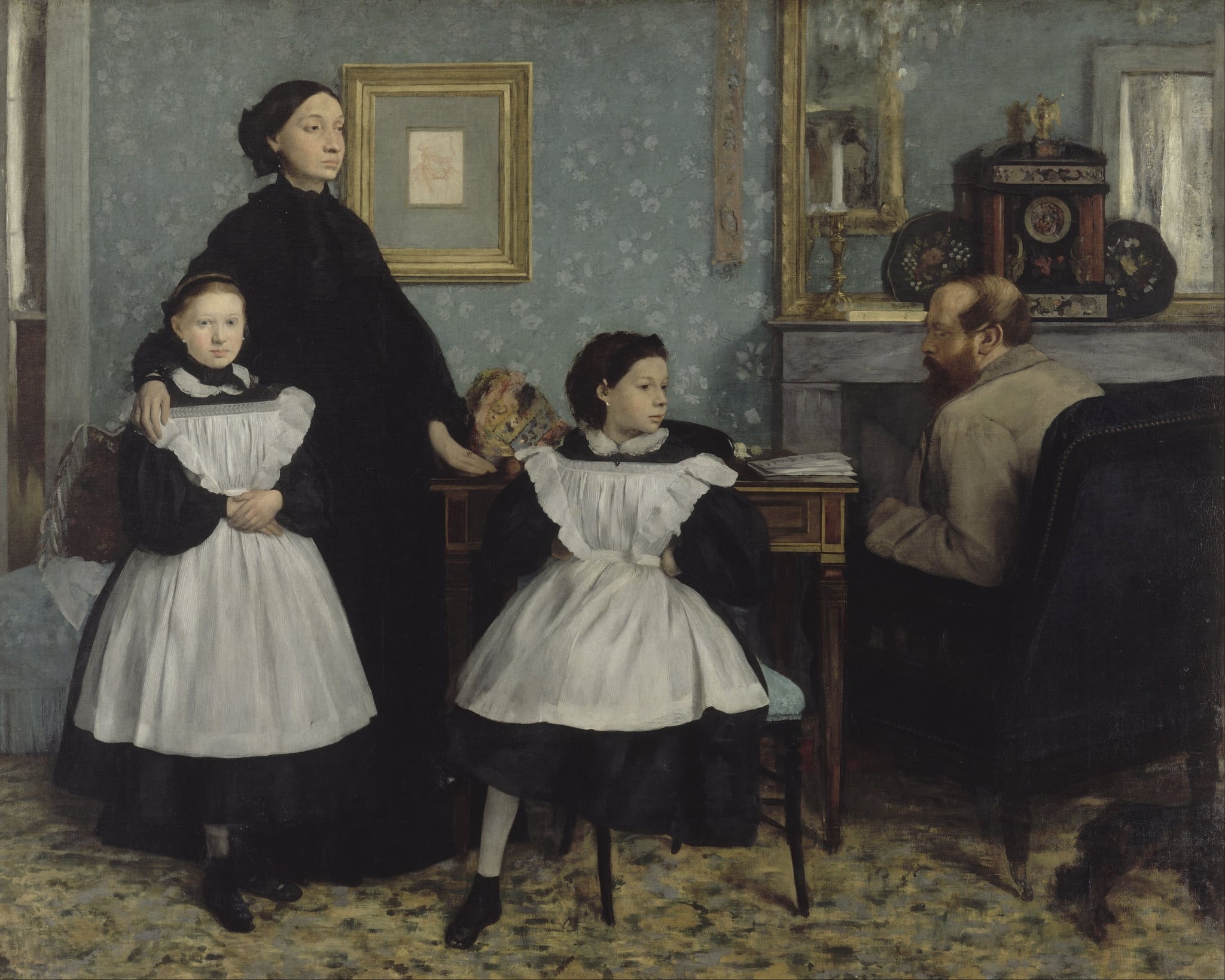
The Bellelli Family
Edgar Degas (1858–1869)
In The Bellelli Family, Edgar Degas orchestrates a poised domestic standoff, using the mother’s column of <strong>mourning black</strong>, the daughters’ <strong>mediating whiteness</strong>, and the father’s turned-away profile to script roles and distance. Rigid furniture lines, a gilt <strong>clock</strong>, and the ancestor’s red-chalk portrait create a stage where time, duty, and inheritance press on a family held in uneasy equilibrium.
The Boating Party
Mary Cassatt (1893–1894)
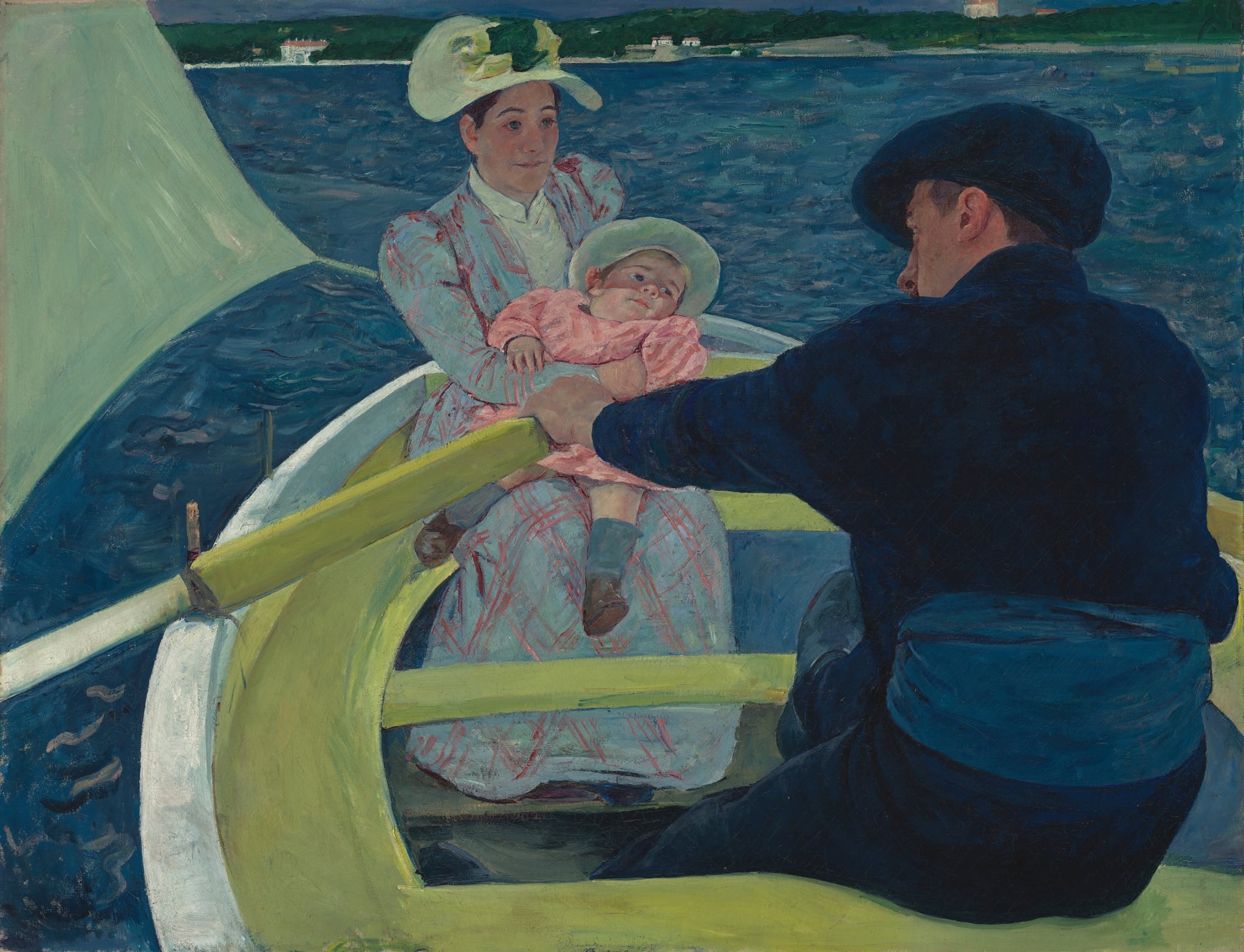
In The Boating Party, Mary Cassatt fuses <strong>intimate caregiving</strong> with <strong>modern mobility</strong>, compressing mother, child, and rower inside a skiff that cuts diagonals across ultramarine water. Bold arcs of citron paint and a high, flattened horizon reveal a deliberate <strong>Japonisme</strong> logic that stabilizes the scene even as motion surges around it <sup>[1]</sup>. The painting asserts domestic life as a public, modern subject while testing the limits of Impressionist space and color.
The Hermitage at Pontoise
Camille Pissarro (ca. 1867)
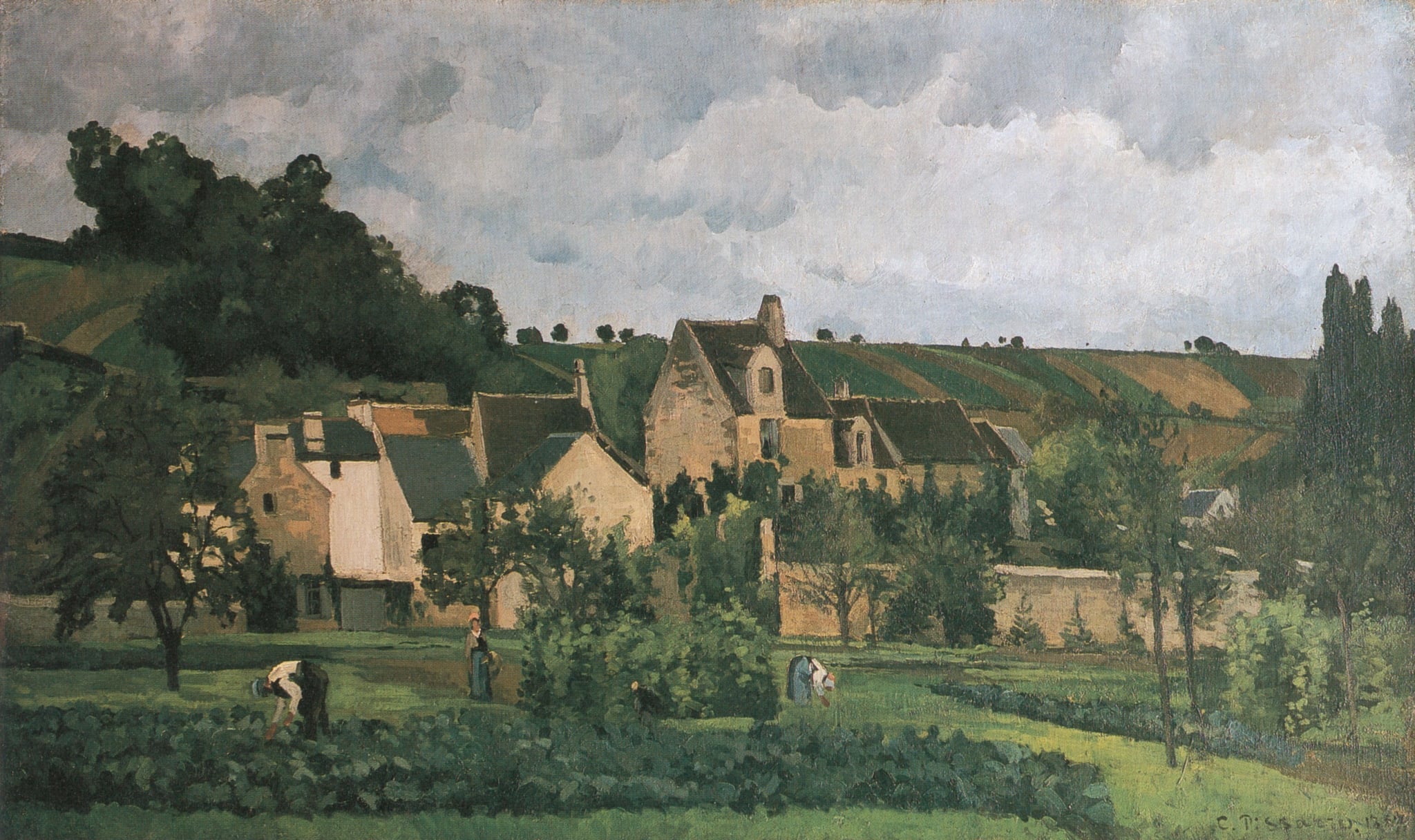
Camille Pissarro’s The Hermitage at Pontoise shows a hillside village interlaced with <strong>kitchen gardens</strong>, stone houses, and workers bent to their tasks under a <strong>low, cloud-laden sky</strong>. The painting binds human labor to place, staging a quiet counterpoint between <strong>architectural permanence</strong> and the <strong>seasonal flux</strong> of fields and weather <sup>[1]</sup><sup>[3]</sup>.
The Tub
Edgar Degas (1886)
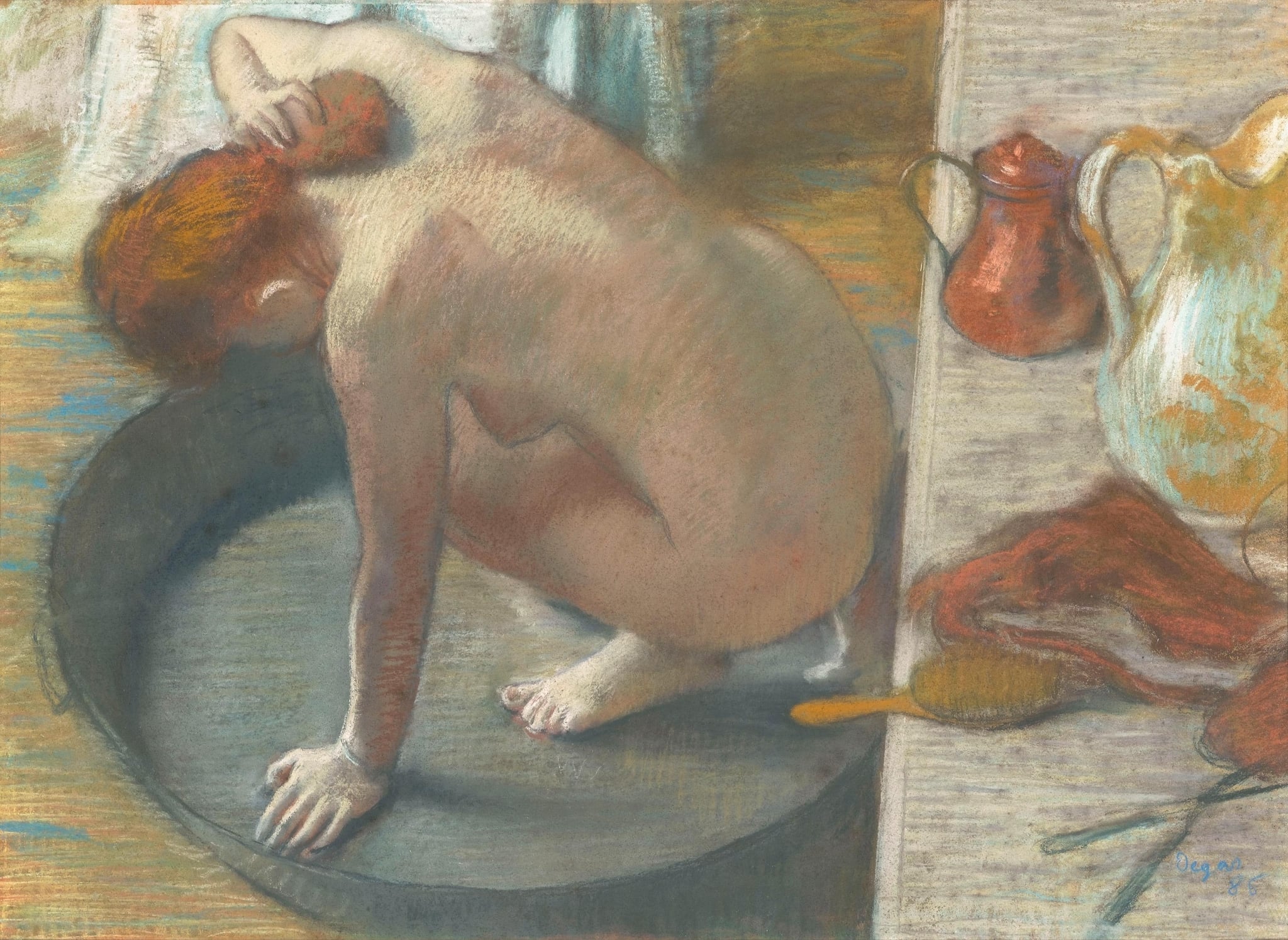
In The Tub (1886), Edgar Degas turns a routine bath into a study of <strong>modern solitude</strong> and <strong>embodied labor</strong>. From a steep, overhead angle, a woman kneels within a circular basin, one hand braced on the rim while the other gathers her hair; to the right, a tabletop packs a ewer, copper pot, comb/brush, and cloth. Degas’s layered pastel binds skin, water, and objects into a single, breathing field of <strong>warm flesh tones</strong> and blue‑greys, collapsing distance between body and still life <sup>[1]</sup>.
Woman at Her Toilette
Berthe Morisot (1875–1880)
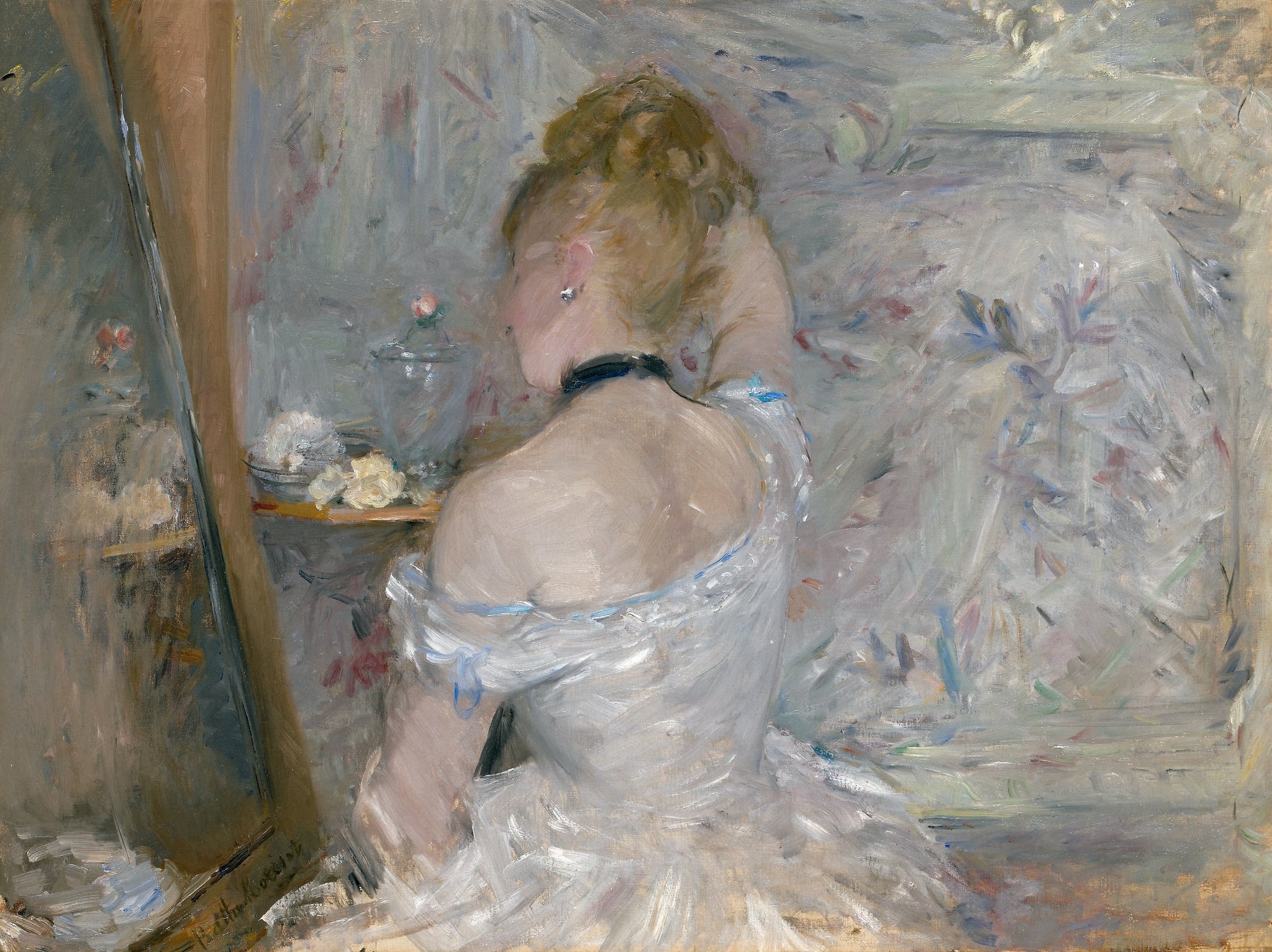
Woman at Her Toilette stages a private ritual of self-fashioning, not a spectacle of vanity. A woman, seen from behind, lifts her arm to adjust her hair as a <strong>black velvet choker</strong> punctuates Morisot’s silvery-violet haze; the <strong>mirror’s blurred reflection</strong> with powders, jars, and a white flower refuses a clear face. Morisot’s <strong>feathery facture</strong> turns a fleeting toilette into modern subjectivity made visible <sup>[1]</sup>.
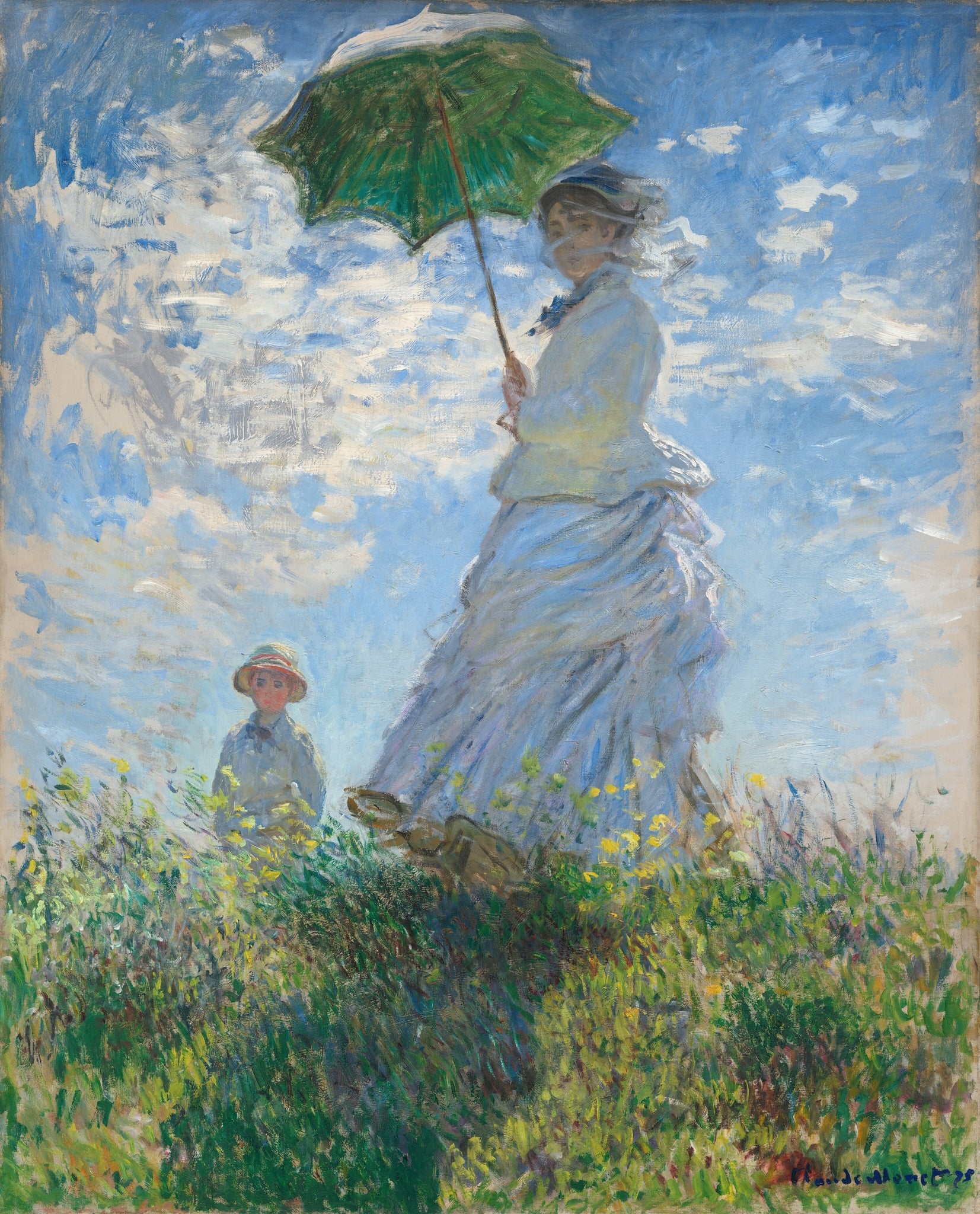
Woman with a Parasol
Claude Monet (1875)
Claude Monet’s Woman with a Parasol fixes a breezy hillside instant in high, shifting light, setting a figure beneath a <strong>green parasol</strong> against a vast, vibrating sky. The low vantage and <strong>broken brushwork</strong> merge dress, clouds, and grasses into one atmosphere, while a child at the rise anchors depth and intimacy <sup>[1]</sup>. It is a manifesto of <strong>plein-air</strong> perception—painting the sensation of air in motion rather than the contours of things <sup>[2]</sup>.
Related Themes
Related Symbolism Categories
Fashion
In Impressionist and related modern painting, fashion functions as a coded system of class, gender, and spectatorship, translating older allegorical and mythic meanings into the language of couture, accessories, and regulated bodily comportment.
Objects
Object symbols in modern and early modern painting transform everyday things—vessels, tools, clocks, mirrors, and branded goods—into compact arguments about labor, desire, time, and spectatorship, updating long iconographic traditions for a modern economy of signs.
Femininity
In late nineteenth‑century painting, femininity is articulated not as an essence but as a mutable ensemble of fashion, gesture, and setting, through which modern artists probe women’s visibility, labor, and agency within emerging urban and suburban worlds.
Within Western art, identity has long been mediated through attributes: crowns and miters, armor and instruments, coats of arms and genealogical emblems. By the nineteenth century, however, this inherited iconographic repertoire is progressively displaced by a more provisional, secular code of clothing, gesture, and setting. In modern painting, the self is no longer guaranteed by lineage or stable role; it is staged, negotiated, and often fractured in public. The symbols in this category—gloves and chokers, interlaced hands and backward glances, uniforms and masks—operate as semiotic markers of such constructed personae. They do not merely describe individuals; they dramatize identity as something performed under the conditions of commodity culture, surveillance, and urban sociability.
Semiotically, these motifs function less as fixed emblems than as indices of social scripts. A black ribbon choker, for instance, has no inherent meaning outside its historical context; yet in Manet’s Olympia (1863), it condenses the painting’s challenge to both classical nudity and bourgeois propriety. The choker encircles the model’s neck with a sharp, modern line, linking her to the world of purchasable fashion and contemporary sexuality rather than timeless myth. It sits amid other identity-markers—the orchid in her hair, the bracelet, the silk slippers and shawl—that read as commodities, while her direct gaze and guarded hand insist on agency. Identity here is a contract between appearance and power: the accessories brand her as a courtesan within Parisian visual culture even as her stare reverses the direction of objectification. The symbol thus operates on two registers, signaling a classed and sexual role while exposing that role as performed.
Manet’s A Bar at the Folies-Bergère (1882) radicalizes this dynamic by multiplying the axes of looking. The barmaid Suzon stands as the “human face of urban commerce”—a living mediator between viewer and marketplace—framed by branded bottles and a brimming bowl of oranges that code her simultaneously as vendor and potential commodity. Her mask-like, cool face with direct gaze reads as a studied, professional surface: sociability without confession. Yet the mirror behind her scrambles identity through a disjunctive reflection. The man who addresses her appears only in the mirror; her reflected body shifts to the right, her expression altered. The barmaid’s persona is thus doubled and destabilized: frontally, she presents the impassive, serviceable self required by the establishment; in reflection, she is absorbed into the circuitry of desire, exchange, and male address. All-seeing eyes are not depicted literally, but the entire back wall functions as an ocular field, a surface of surveillance in which every subject is both watcher and watched. The work becomes a treatise on how modern identities are constructed in and through reflective surfaces—glass, labels, the painter’s own pictorial mirror.
In Renoir’s figure paintings of the 1880s, identity is organized more directly around touch and relational gesture than around institutional settings. Dance at Bougival (1883) anchors the couple in their interlaced, ungloved hands, a motif of public intimacy and mutual consent. The woman’s flushed face and absorbed, slightly downcast gaze suggest the inwardness of feeling, while the man’s enclosing blue jacket and the swirl of her scarlet-topped bonnet define a vortex of shared presence set against the looser crowd. Their identities, though generically coded as working- or lower-middle-class leisure types, are less individuated than relational: they are the dancing pair, a modern couple temporarily constituted through rhythm and clasped hands. The fallen bouquet and scattered cigarette butts on the ground hint at the ephemerality of this moment; identity here is a transient configuration of desire and circumstance rather than a fixed social role.
By contrast, Dance in the City (also 1883) presents identity as an effect of decorum and hierarchy. The man’s black tailcoat, a symbol of masculine formality and restraint, encloses the woman’s luminous white satin gown, which carries connotations of respectability and feminine display. Her opera-length gloves are not mere descriptions of attire; they are social instruments that regulate and authorize touch. As her gloved hand rests with calculated pressure on his shoulder, intimacy becomes legible only because etiquette sanctions it. Both faces are partially withheld; the painting relocates identity from psychology to costume and posture. Renoir thus stages a double identity: the pair as refined participants in urban high society, and the woman as a subject whose inward life is delicately veiled by the very codes that permit her visibility.
Renoir’s In the Garden (1885) further complicates this relational paradigm. At a café table under an arbor, a young man leans in, his fingers folding over the woman’s hand; she meets the viewer with a calm, front-facing gaze, shoulders squared, forearm braced along the red table. The lightly clasped hands form a tentative bond, yet the table’s diagonal acts as a polite barrier, keeping the gesture provisional. Her floral dress and hat feather suggest fashioned femininity and modest decorum; his parted lips and incline signal petition. Here, identity is triangulated between self-presentation to the partner, to the viewer, and to the codes of courtship. The woman’s direct, composed gaze interrupts the fantasy of her being wholly defined by the man’s desire: she is not only an object of courtship but an observing subject who addresses us as well. The symbol of the clasped hands, then, does not simply affirm union; it stages negotiation, making visible the work of consent and reserve that underwrites modern romantic identities.
Across these works, certain symbols recur and shift meaning as they migrate between contexts. Gloves, for instance, index public self-containment in Manet’s Jeanne (Spring) (1881), where the long camel glove and floral bonnet turn the sitter into an allegorical yet utterly contemporary embodiment of seasonal renewal. Her profile, sharp against luminous foliage, fuses classical ideals of beauty with the latest couture, signaling identity as an elegant synthesis of tradition and fashion. In Renoir’s ballroom scene, gloves manage sanctioned intimacy; in Manet’s bar and brothel interiors, their absence or presence shades distinctions between labor, leisure, and sexual transaction. Similarly, direct versus averted gazes function as a syntax of interiority and social address: Olympia’s frontal stare weaponizes self-consciousness; Suzon’s cool, masklike gaze registers professional detachment; Renoir’s downcast or sideways glances signal feeling folded back into the self even within public space.
Over the later nineteenth century, these identity symbols evolve from relatively stable markers of class and propriety into instruments for questioning the coherence of the self. Manet’s strategic use of chokers, jewelry, and commodities underscores the manufactured nature of feminine personae under capitalist spectacle, while his fractured mirrors and confrontational frontality expose the tensions between image and subject. Renoir, less polemical, explores how identities are formed in the interstices of touch, etiquette, and environment: interlaced hands, floral dresses, and hats become means of visualizing the fragile negotiations that give modern relationships their shape. In each case, the iconography of identity shifts from heraldic certainty to performative ambivalence, signaling a broader modern recognition that who one “is” in painting depends on how—and by whom—one is seen.