Landscape
Landscape symbolism in modern painting transforms rivers, trees, bridges, and distant horizons into active sign-systems for labor, leisure, perception, and cyclical time, reworking inherited Arcadian and religious motifs under industrial and Impressionist conditions.
Member Symbols
Featured Artworks
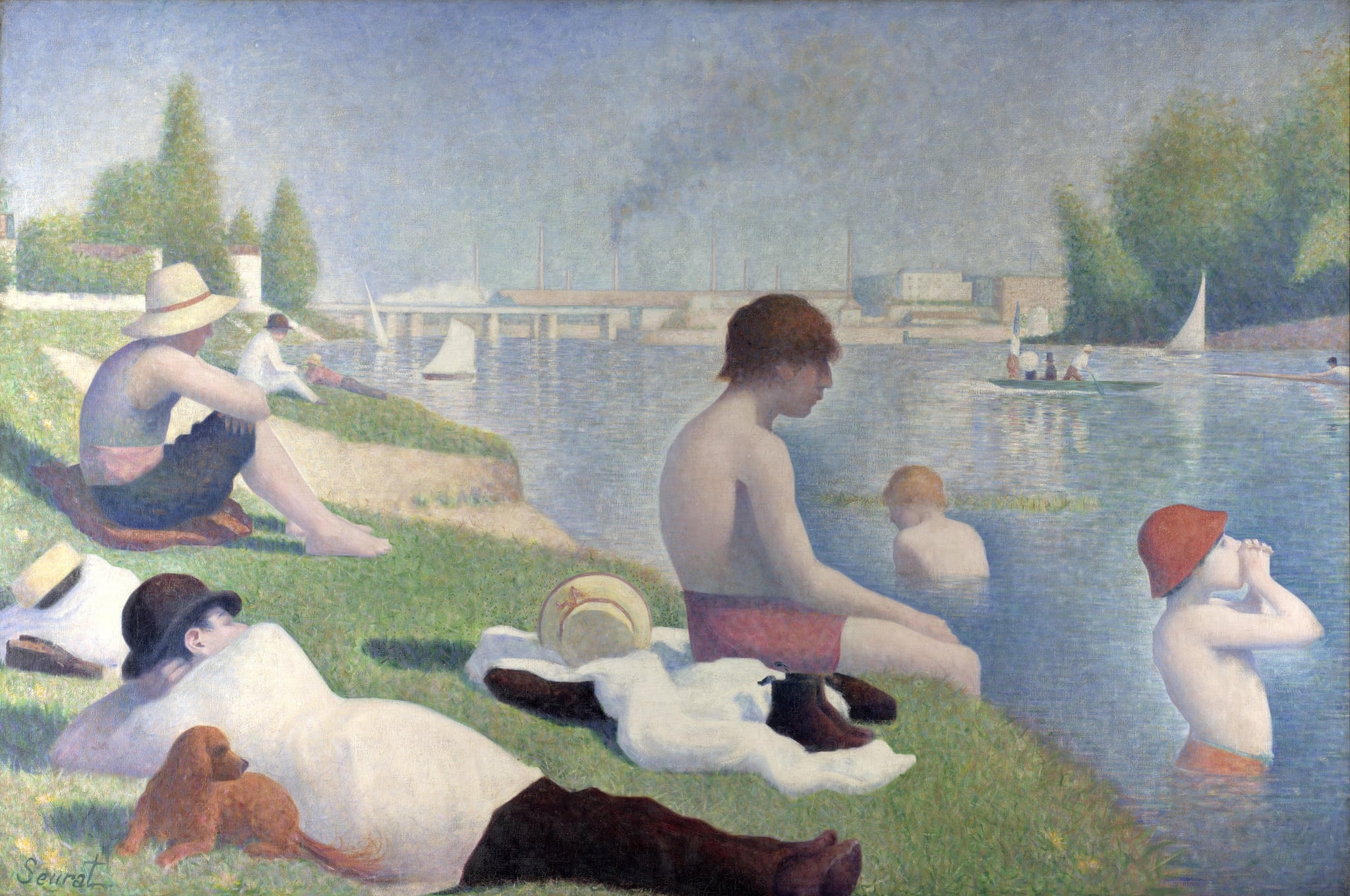
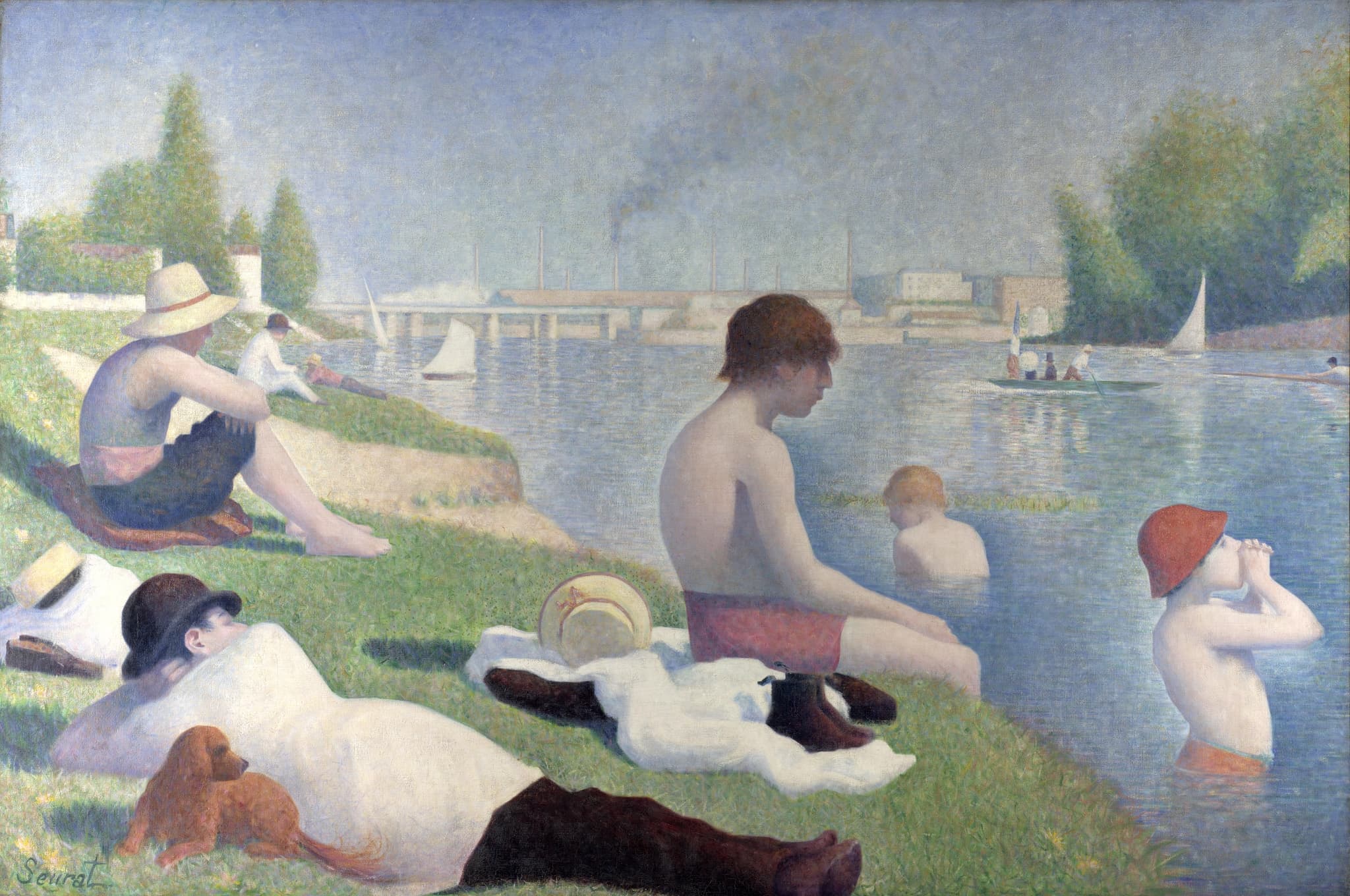
Bathers at Asnières
Georges Seurat (1884)
Bathers at Asnières stages a scene of <strong>modern leisure</strong> on the Seine, where workers recline and wade beneath a hazy, unified light. Seurat fuses <strong>classicizing stillness</strong> with an <strong>industrial backdrop</strong> of chimneys, bridges, and boats, turning ordinary rest into a monumental, ordered image of urban life <sup>[1]</sup><sup>[3]</sup>. The canvas balances soft greens and blues with geometric structures, producing a calm yet charged harmony.
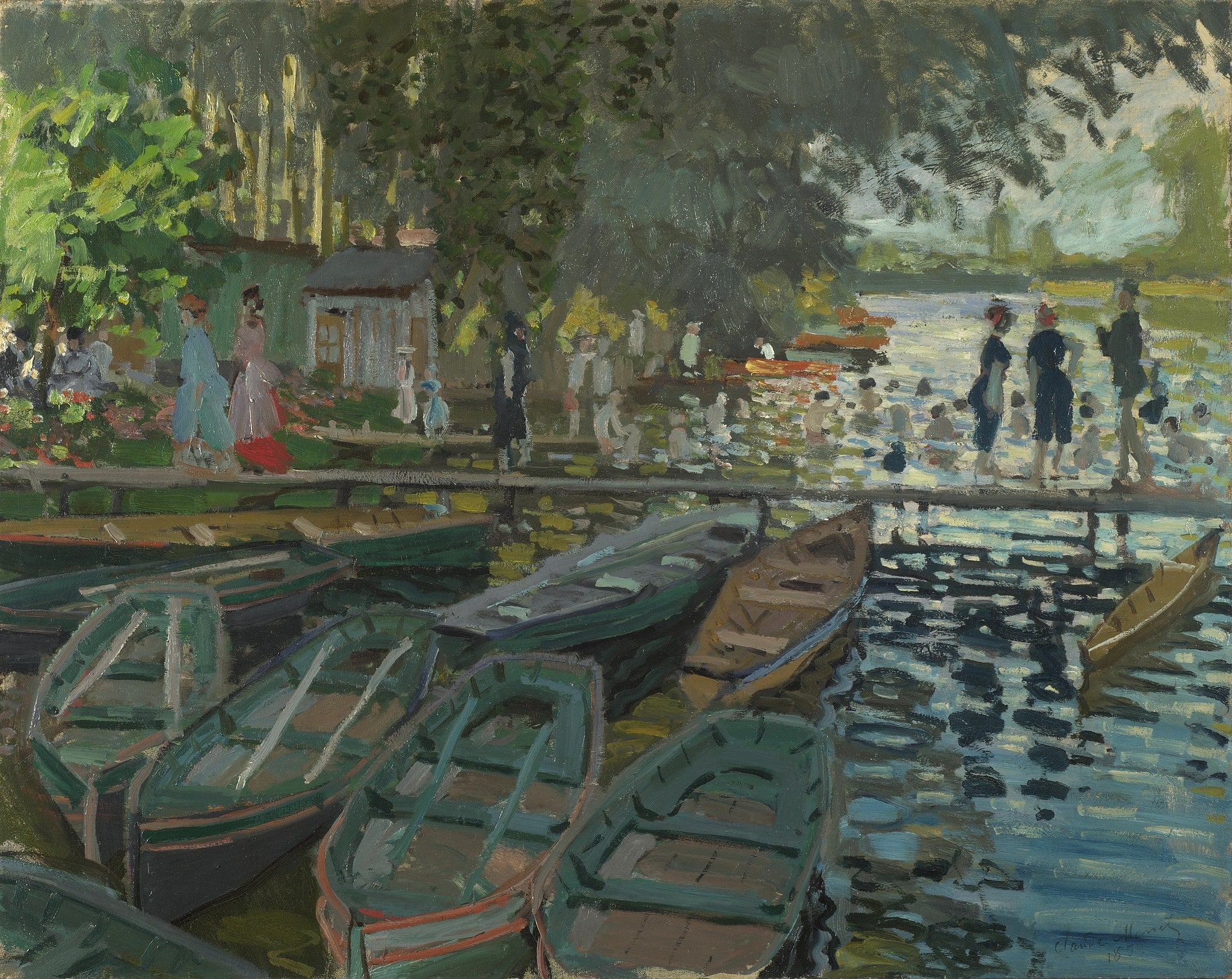
Bathers at La Grenouillère
Claude Monet (1869)
Claude Monet’s Bathers at La Grenouillère stages modern leisure on the Seine as a theater of <strong>light, motion, and sociability</strong>. Foregrounded green rowboats, a narrow footbridge, and clustered bathers turn the resort’s engineered setting into a manifesto for <strong>on‑the‑spot vision</strong> and the fleeting present <sup>[1]</sup>. Painted outdoors in 1869 with rapid strokes, it crystallizes the emergence of <strong>Impressionism</strong> <sup>[1]</sup>.
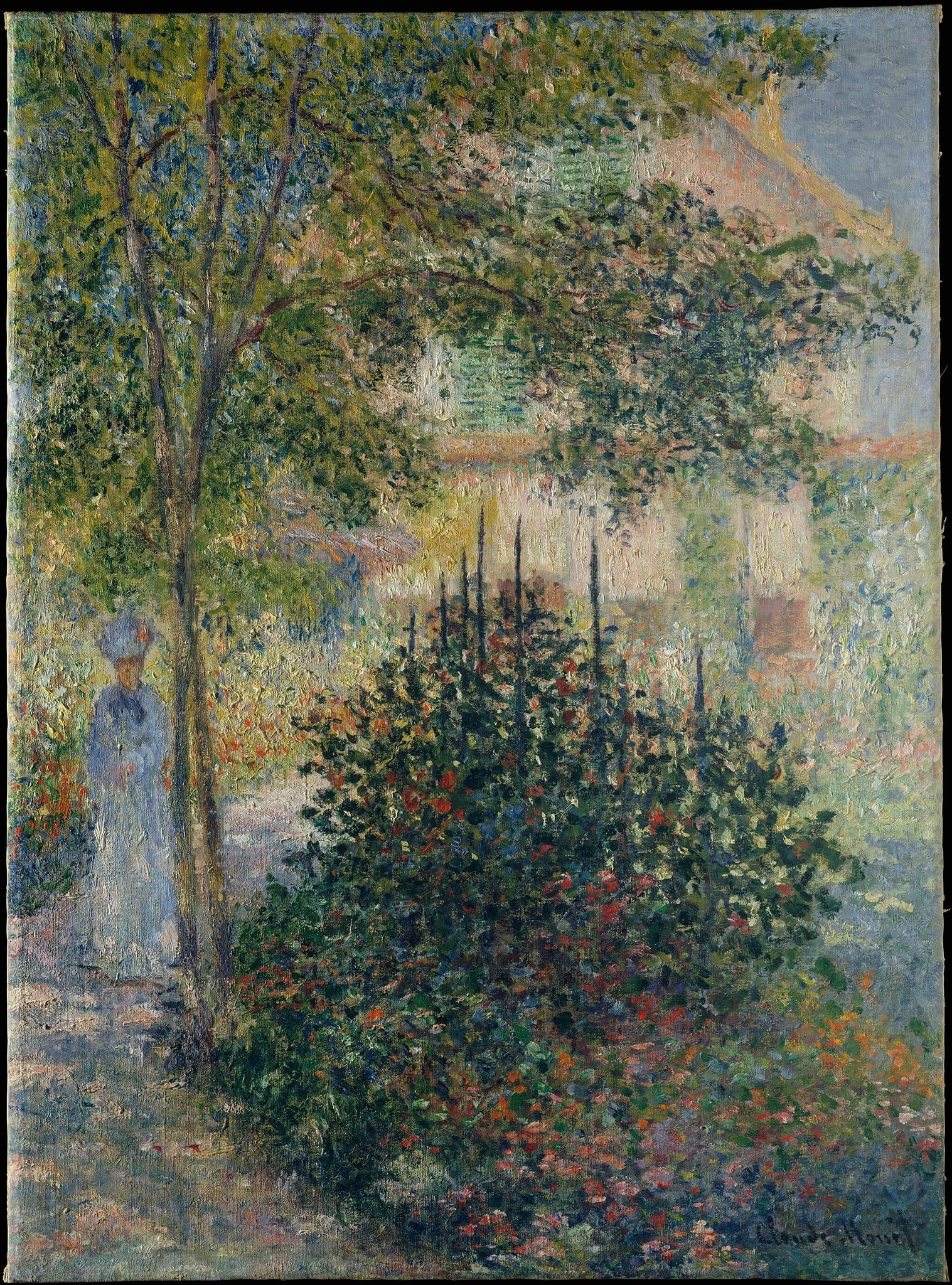
Camille Monet (1847–1879) in the Garden at Argenteuil
Claude Monet (1876)
Claude Monet’s Camille Monet (1847–1879) in the Garden at Argenteuil captures a fleeting, sunstruck interval where a blue‑clad figure hovers at the shaded path while a <strong>corbeille</strong> of spiked flowers ignites the foreground. The pink house with <strong>green shutters</strong> flickers through a veil of leaves, its surfaces dissolved into vibrating strokes of light. Monet subordinates likeness to the <strong>sensation of air and color</strong>, turning the garden into a living field of time and perception <sup>[1]</sup><sup>[2]</sup>.
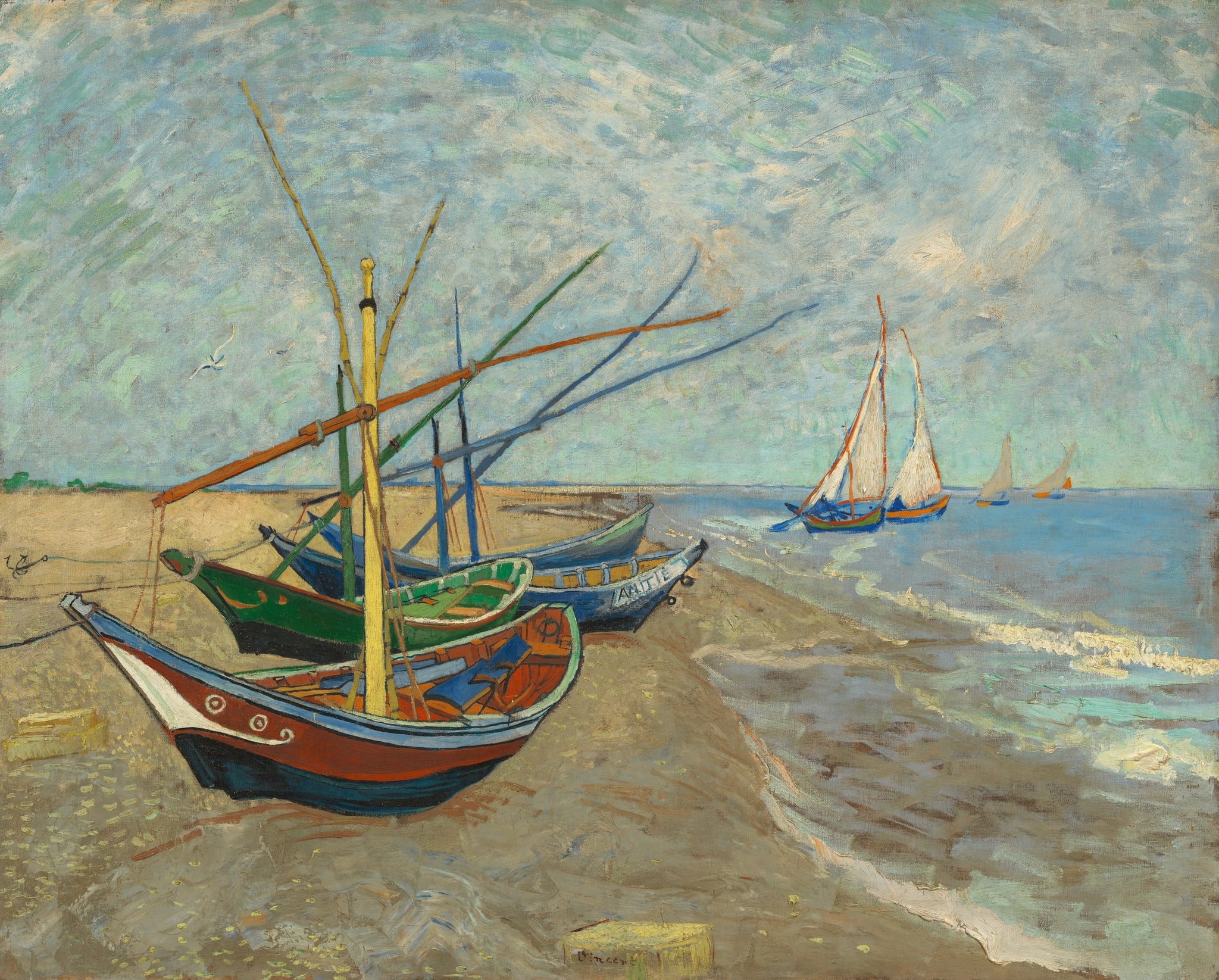
Fishing Boats on the Beach at Les Saintes-Maries-de-la-Mer
Vincent van Gogh (1888)
Vincent van Gogh lines up a file of beached craft like actors awaiting their cue, turning working boats into <strong>emblems of readiness and risk</strong>. Bold contours, flattened color, and the wind‑tossed sea and sky translate Mediterranean luminosity into a <strong>Japonisme/Cloisonnism</strong> idiom that clarifies form and heightens feeling. The scene suspends time at the edge of departure, where labor, hope, and the sea’s pull meet.
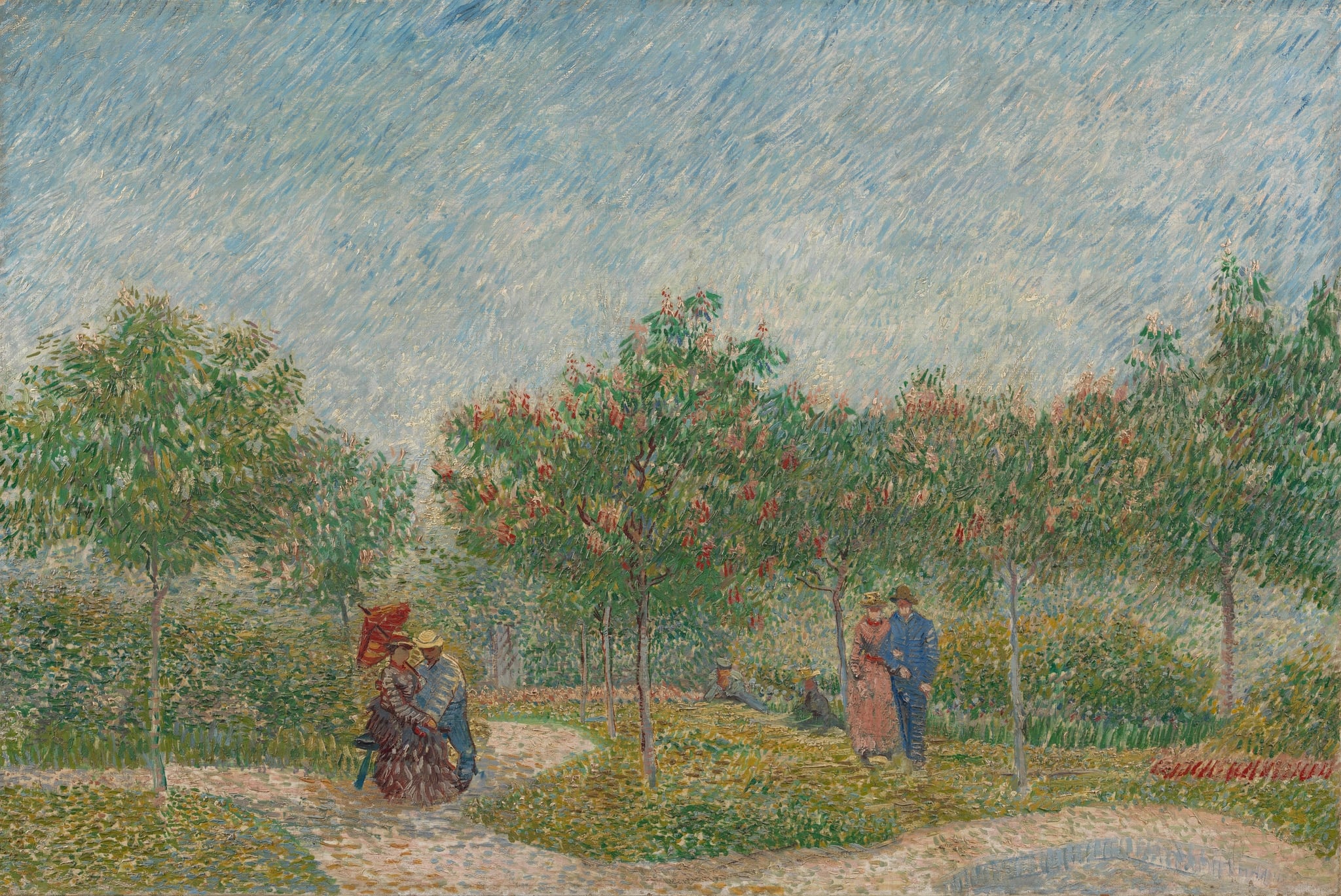
Garden with Courting Couples: Square Saint-Pierre
Vincent van Gogh (1887)
In Garden with Courting Couples: Square Saint-Pierre, Vincent van Gogh turns a small Montmartre park into a stage where <strong>spring</strong>, <strong>intimacy</strong>, and <strong>urban leisure</strong> converge. Short, shimmering strokes fuse pink chestnut blossoms, curving paths, and paired figures into one pulse of <strong>renewal</strong> and <strong>togetherness</strong> <sup>[1]</sup><sup>[2]</sup>.
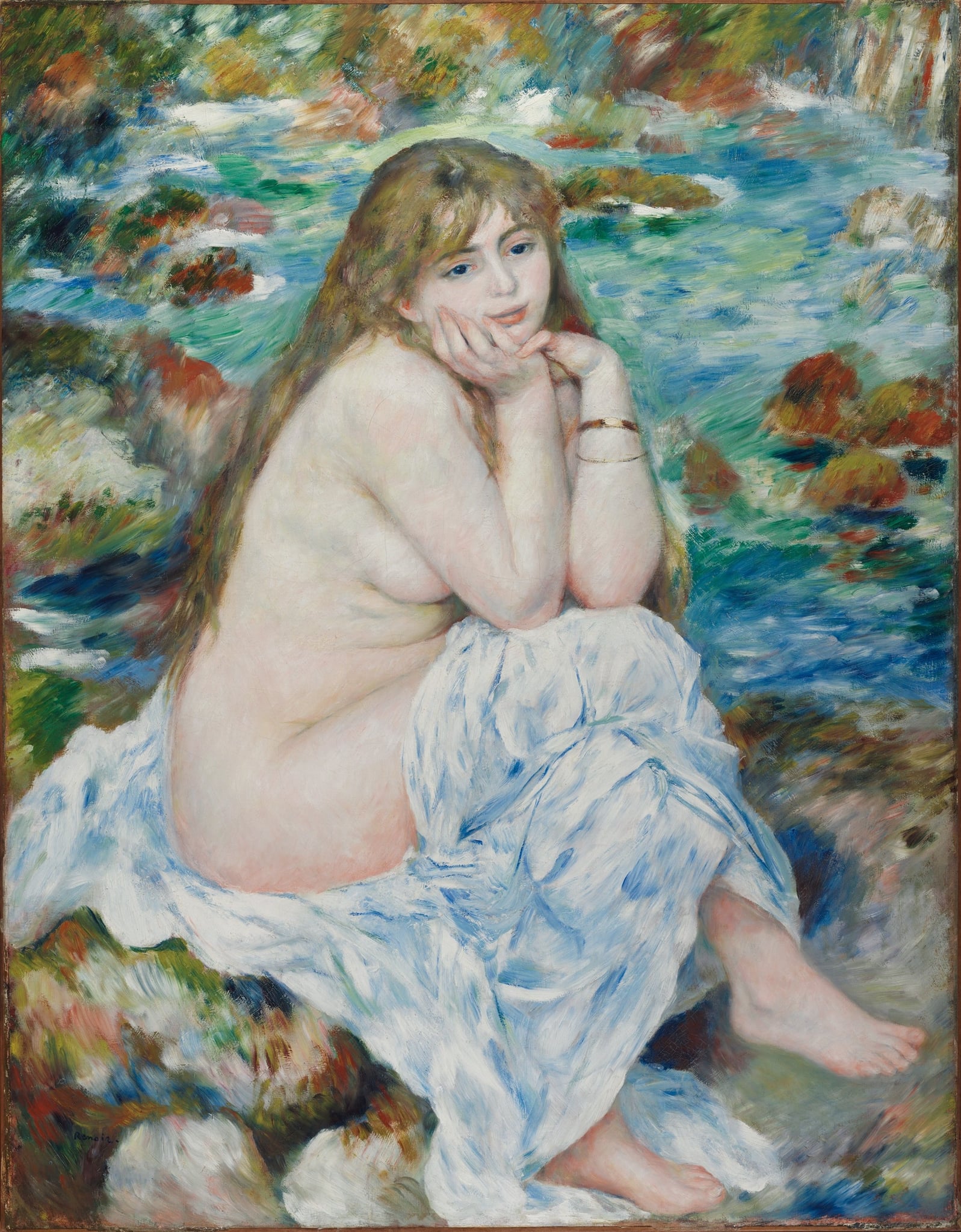
Seated Bather
Pierre-Auguste Renoir
Renoir’s Seated Bather stages a quiet pause between bathing and reverie, fusing the model’s pearly flesh with the flicker of stream and stone. The white drapery pooled around her hips and the soft, frontal gaze convert a simple toilette into a <strong>modern Arcadia</strong> where body and landscape dissolve into light. In this late-Impressionist idiom, Renoir refines the nude as a <strong>timeless ideal</strong> felt through color and touch <sup>[1]</sup><sup>[2]</sup>.
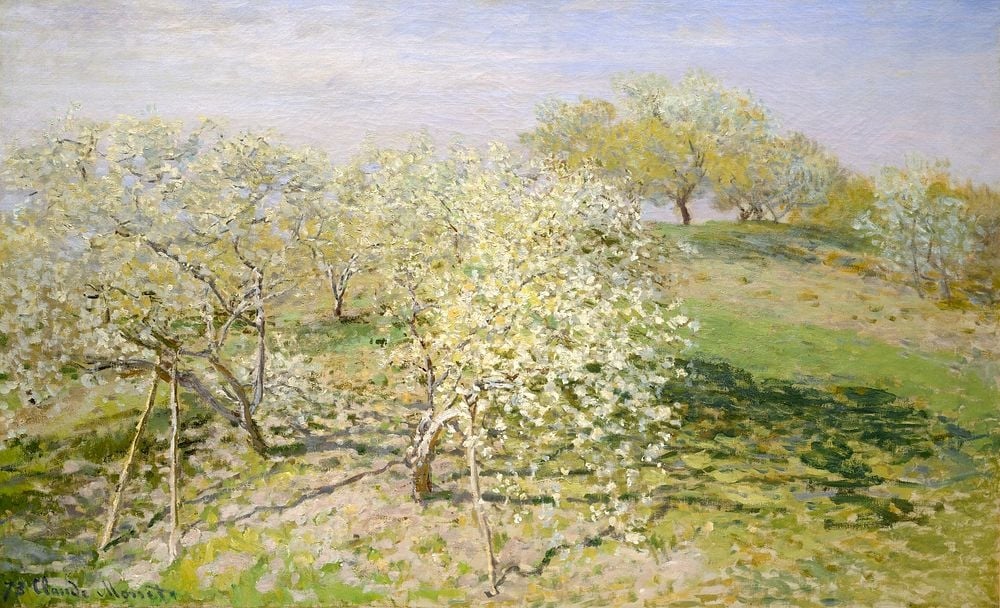
Spring (Fruit Trees in Bloom)
Claude Monet (1873)
Claude Monet’s Spring (Fruit Trees in Bloom) captures a hillside orchard at Argenteuil where pale blossoms flicker across a diagonal slope under a <strong>pearly, breathable sky</strong>. The canvas privileges <strong>light over contour</strong>, letting trunks, stakes, and petal-clusters resolve through vibrating touches of color that register passing air and sun <sup>[1]</sup><sup>[2]</sup>. The scene fixes a <strong>radiant instant</strong> while acknowledging its fragility.
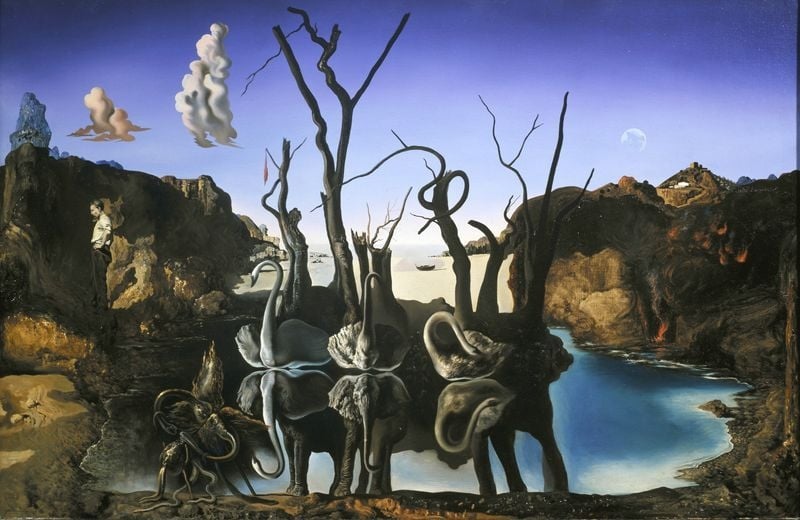
Swans Reflecting Elephants
Salvador Dali (1937)
Swans Reflecting Elephants stages a calm Catalan lagoon where three swans and a thicket of bare trees flip into monumental <strong>elephants</strong> in the mirror of water. Salvador Dali crystallizes his <strong>paranoiac-critical</strong> method: a meticulously painted illusion that makes perception generate its own doubles <sup>[1]</sup><sup>[2]</sup>. The work locks grace to gravity, surface to depth, turning the lake into a theater of <strong>metamorphosis</strong>.
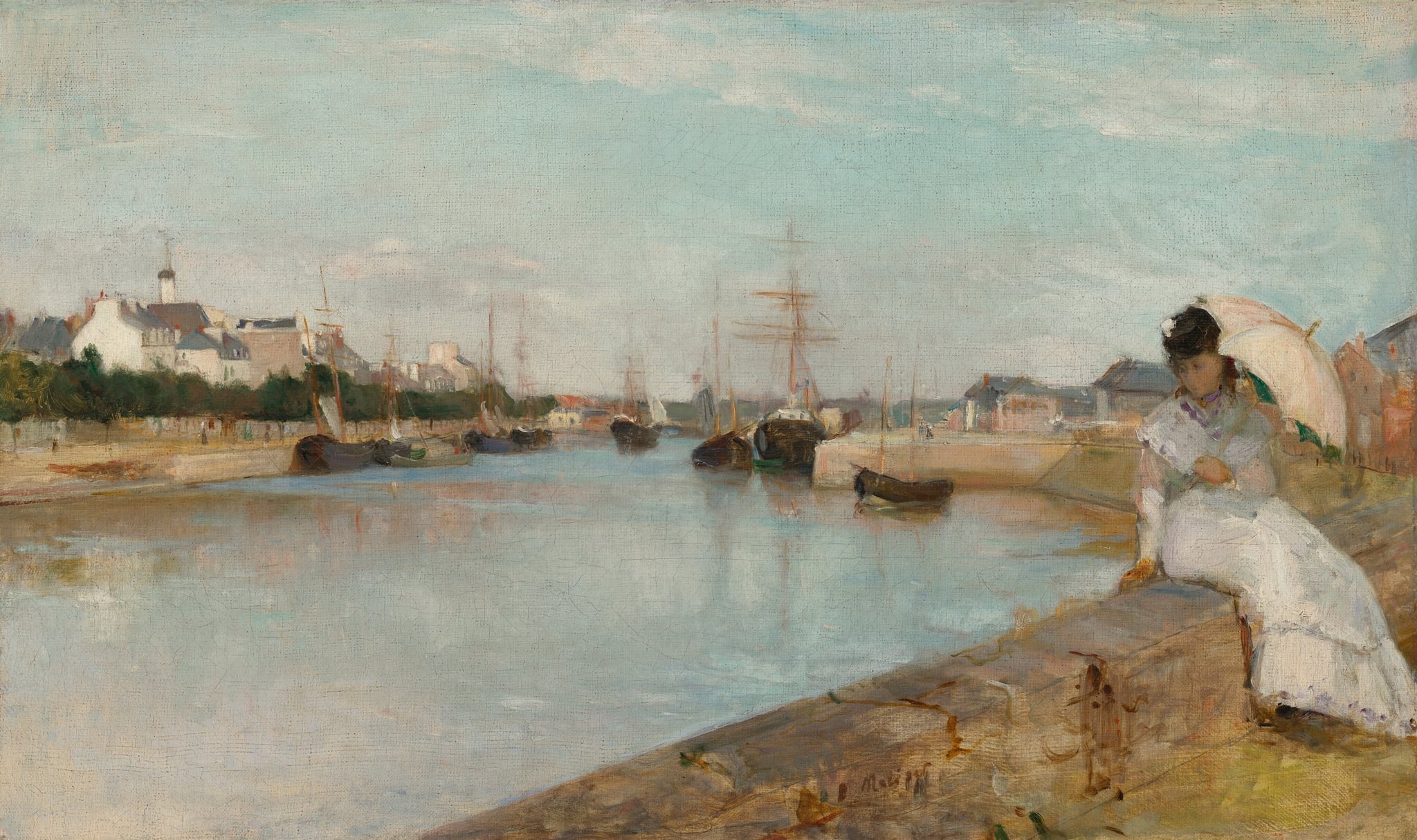
The Harbour at Lorient
Berthe Morisot (1869)
Berthe Morisot’s The Harbour at Lorient stages a quiet tension between <strong>private reverie</strong> and <strong>public movement</strong>. A woman under a pale parasol sits on the quay’s stone lip while a flotilla of masted boats idles across a silvery basin, their reflections dissolving into light. Morisot’s <strong>pearly palette</strong> and brisk brushwork make the water read as time itself, holding stillness and departure in the same breath <sup>[1]</sup>.
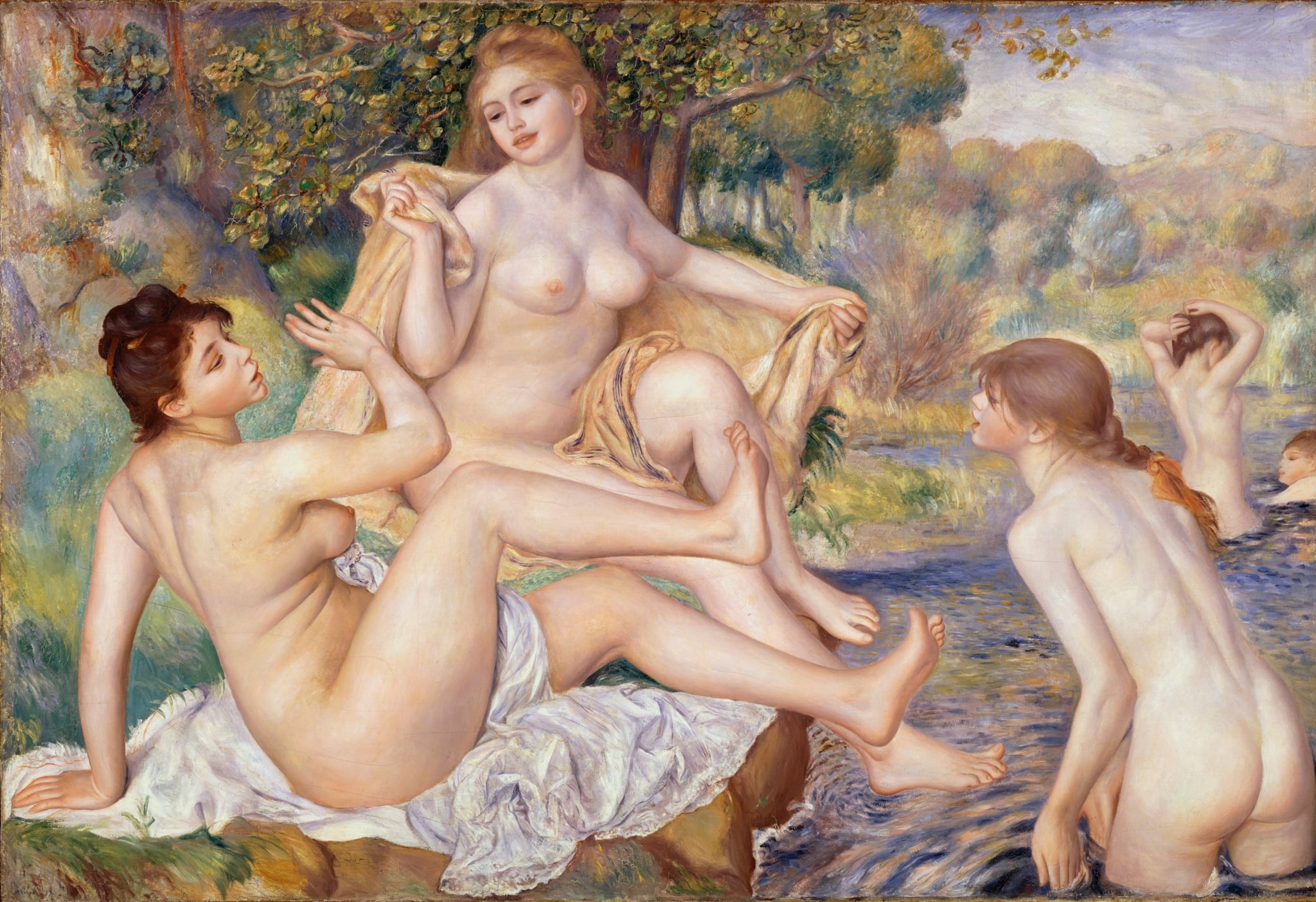
The Large Bathers
Pierre-Auguste Renoir (1884–1887)
Pierre-Auguste Renoir’s The Large Bathers unites modern bodies with a pastoral grove to stage an <strong>Arcadian ideal</strong>. Three monumental nudes form interlocking curves and triangles while two background figures splash and groom, fusing <strong>sensual warmth</strong> with <strong>classical order</strong> <sup>[1]</sup><sup>[2]</sup>.
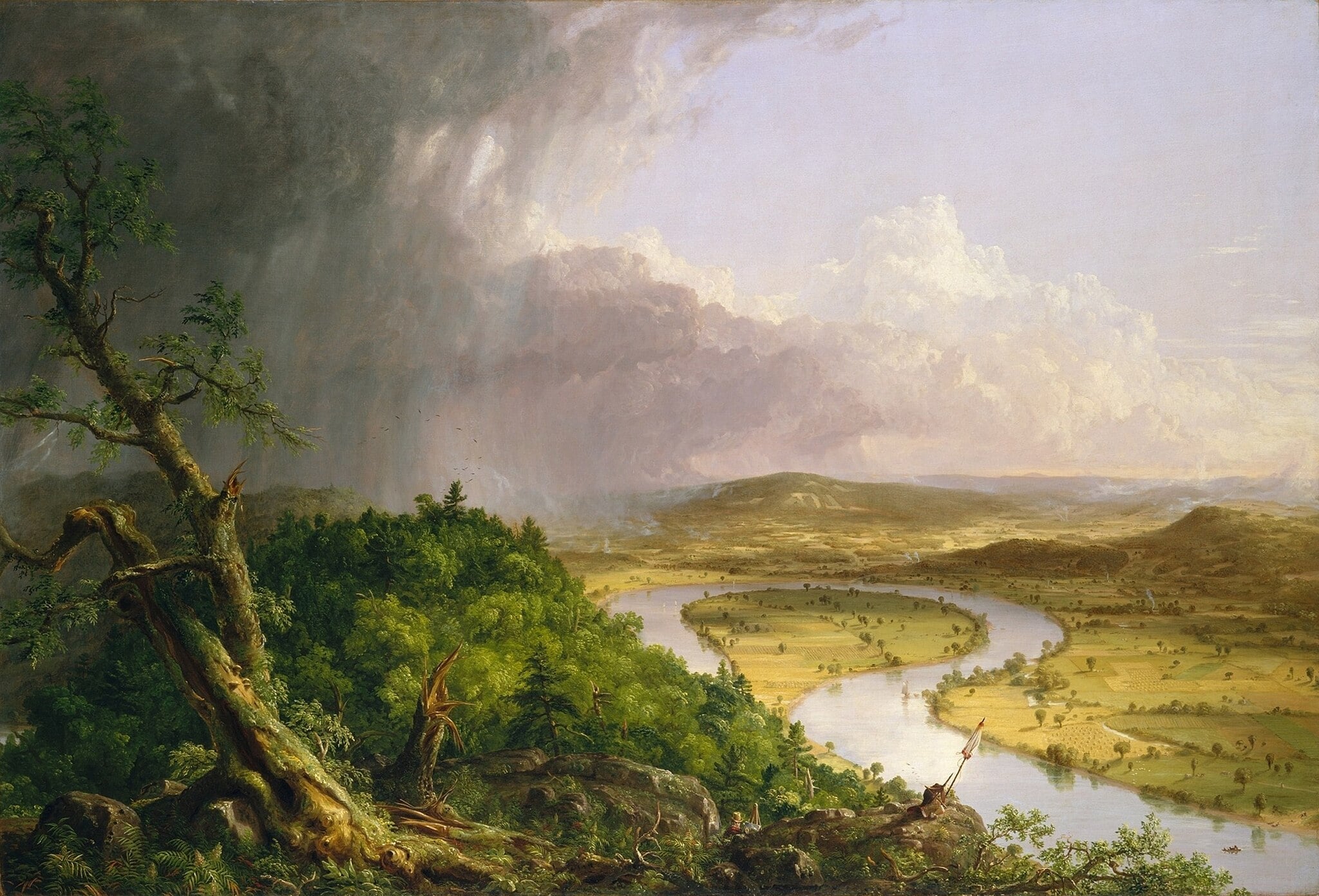
The Oxbow (View from Mount Holyoke)
Thomas Cole (1836)
Thomas Cole’s The Oxbow (View from Mount Holyoke) juxtaposes <strong>storm-lashed wilderness</strong> at left with <strong>sunlit, cultivated farmland</strong> at right, using a panoramic sweep of the Connecticut River’s curve. A tiny figure with an easel—Cole’s self-insertion—stands between realms, turning sight into judgment. The painting frames America’s landscape as both <strong>sublime</strong> and <strong>pastoral</strong>, a place of awe, promise, and warning.
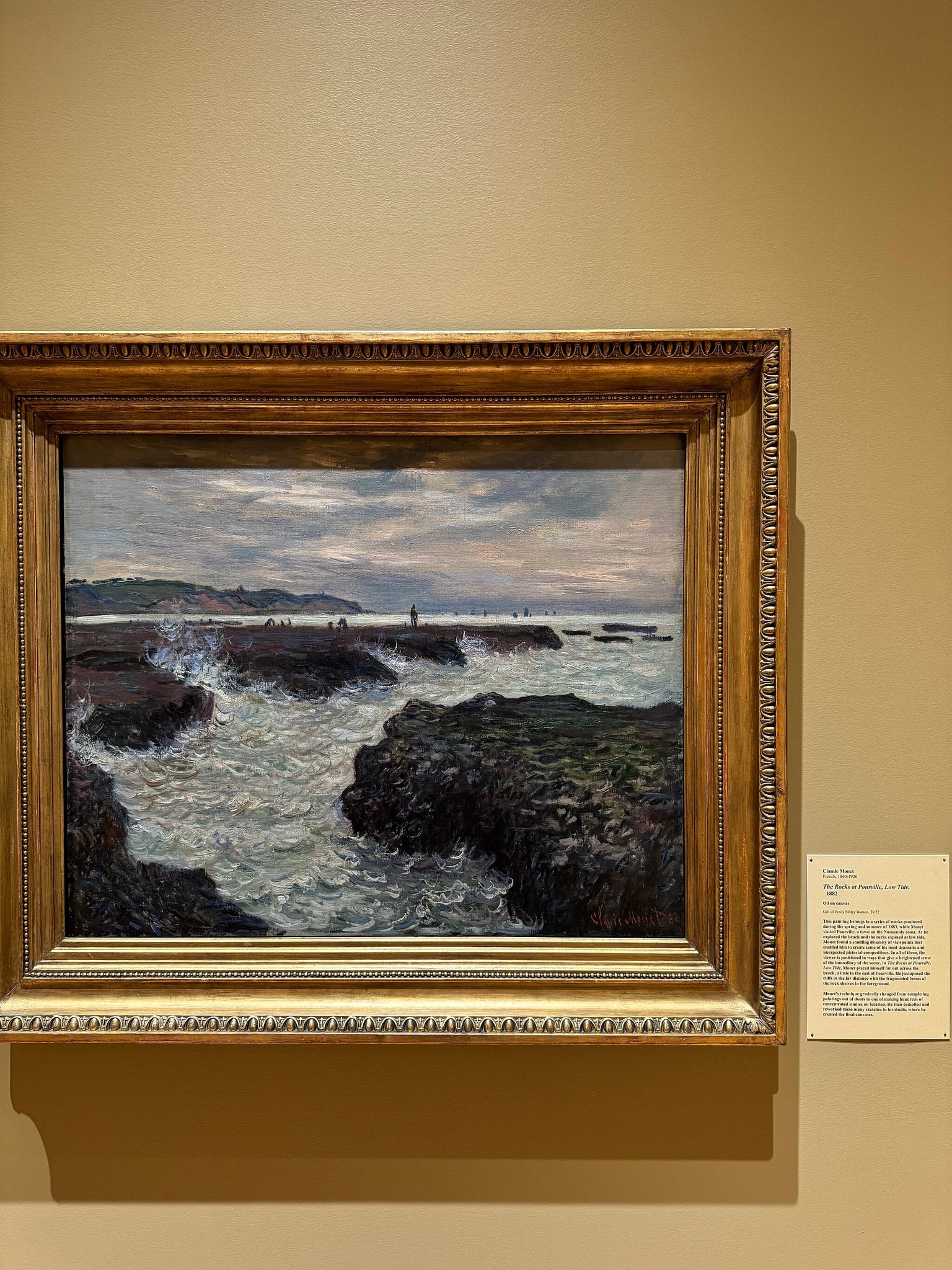
The Rocks at Pourville, Low Tide
Claude Monet (1882)
Claude Monet’s The Rocks at Pourville, Low Tide renders the Normandy foreshore as a meeting of <strong>endurance and flux</strong>—dark, seaweed-laden rocks cleave through <strong>foaming, mobile surf</strong> beneath a cool, <strong>pewter sky</strong>. Tiny silhouettes along the horizon reduce human presence to scale and rhythm, centering nature’s <strong>temporal pulse</strong>.
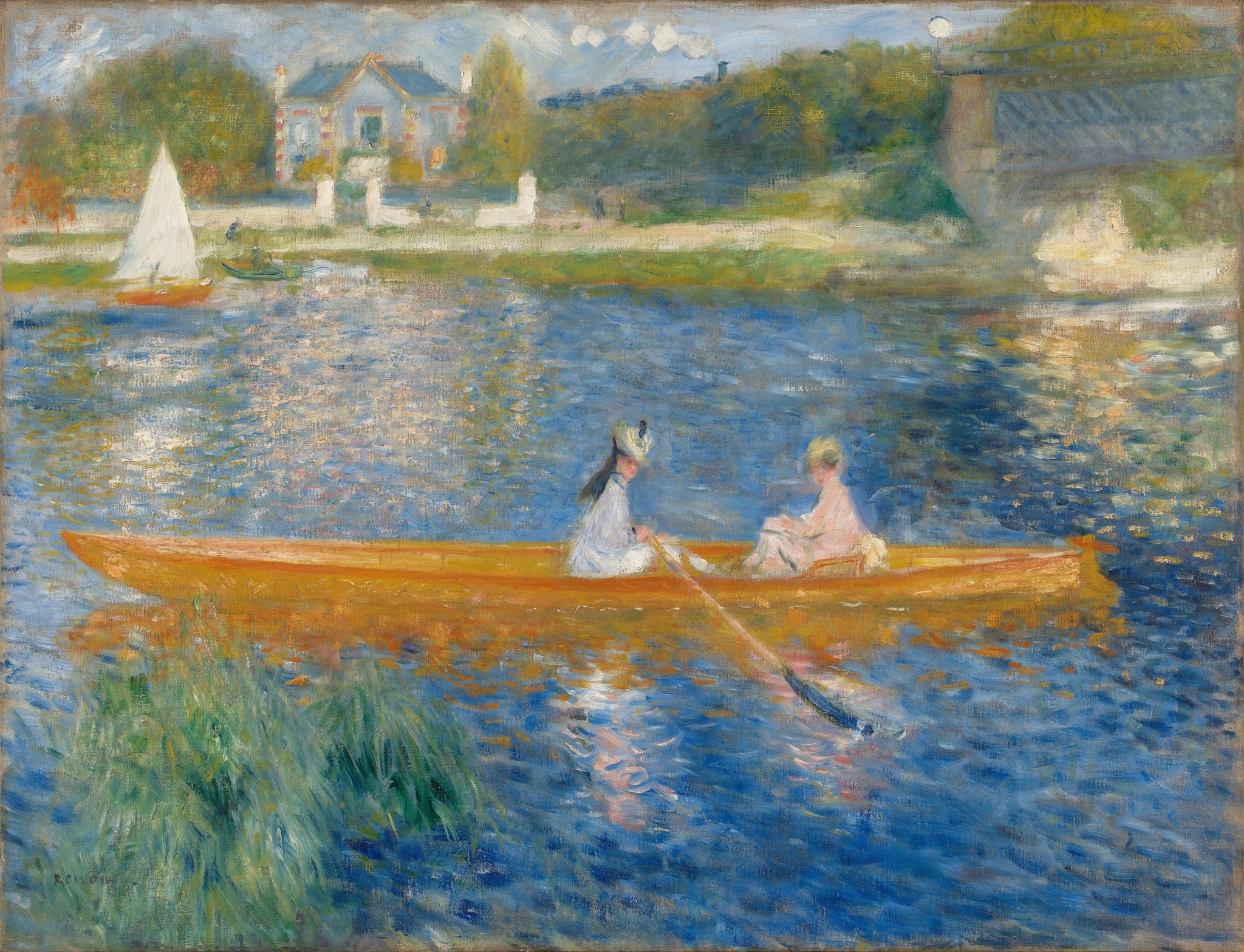
The Skiff (La Yole)
Pierre-Auguste Renoir (1875)
In The Skiff (La Yole), Pierre-Auguste Renoir stages a moment of modern leisure on a broad, vibrating river, where a slender, <strong>orange skiff</strong> cuts across a field of <strong>cool blues</strong>. Two women ride diagonally through the shimmer; an <strong>oar’s sweep</strong> spins a vortex of color as a sailboat, villa, and distant bridge settle the scene on the Seine’s suburban edge <sup>[1]</sup>. Renoir turns motion and light into a single sensation, using a high‑chroma, complementary palette to fuse human pastime with nature’s flux <sup>[1]</sup><sup>[2]</sup>.
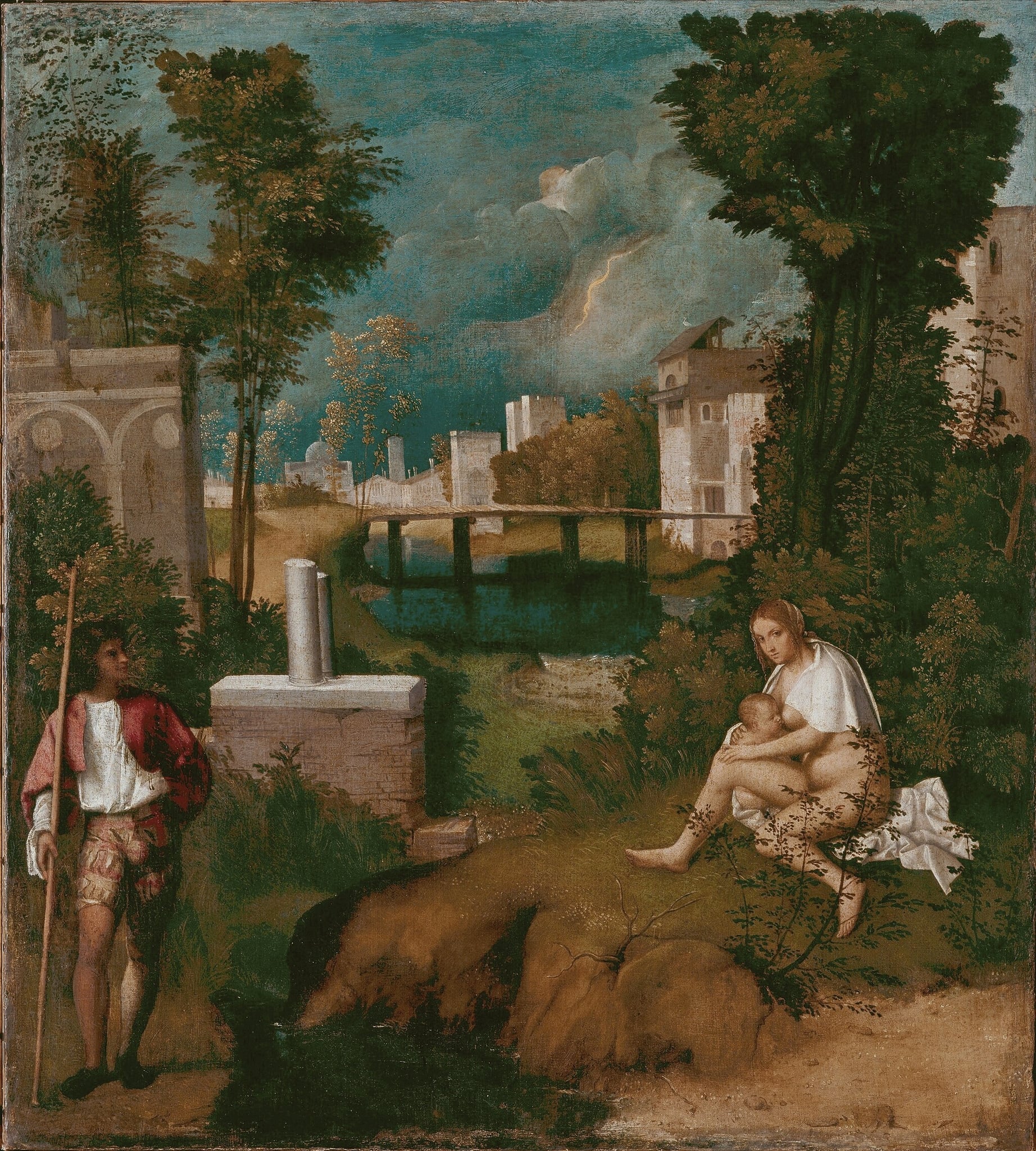
The Storm
Giorgione (c. 1505–1508)
Giorgione’s The Storm stages human life on the brink of change, fusing <strong>pastoral calm</strong> with <strong>sudden rupture</strong>. A watchful youth and a nursing mother face each other across a stream as lightning splits the blue‑green sky, while ruins and a narrow bridge signal fragile passage. The landscape itself becomes the protagonist, turning everyday figures into a <strong>poetic allegory</strong> of vulnerability and fate <sup>[1]</sup><sup>[2]</sup>.
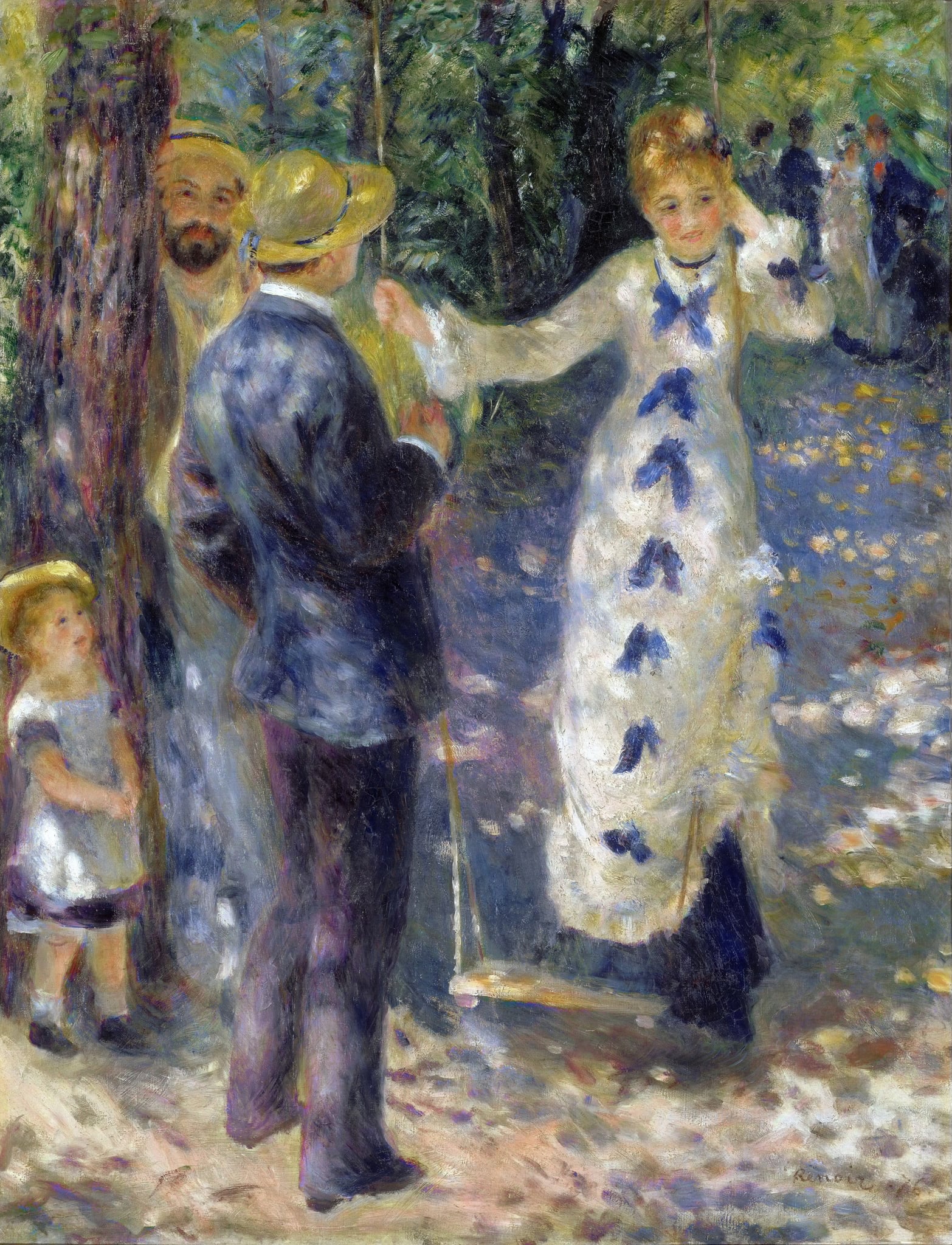
The Swing
Pierre-Auguste Renoir (1876)
Renoir’s The Swing fixes a fleeting, sun-dappled exchange in a Montmartre garden, where a woman in a white dress with blue bows steadies herself on a swing while a man in a blue jacket addresses her. The scene crystallizes <strong>modern leisure</strong>, <strong>flirtation</strong>, and <strong>optical shimmer</strong>, as broken strokes scatter light over faces, fabric, and ground <sup>[1]</sup><sup>[4]</sup>.
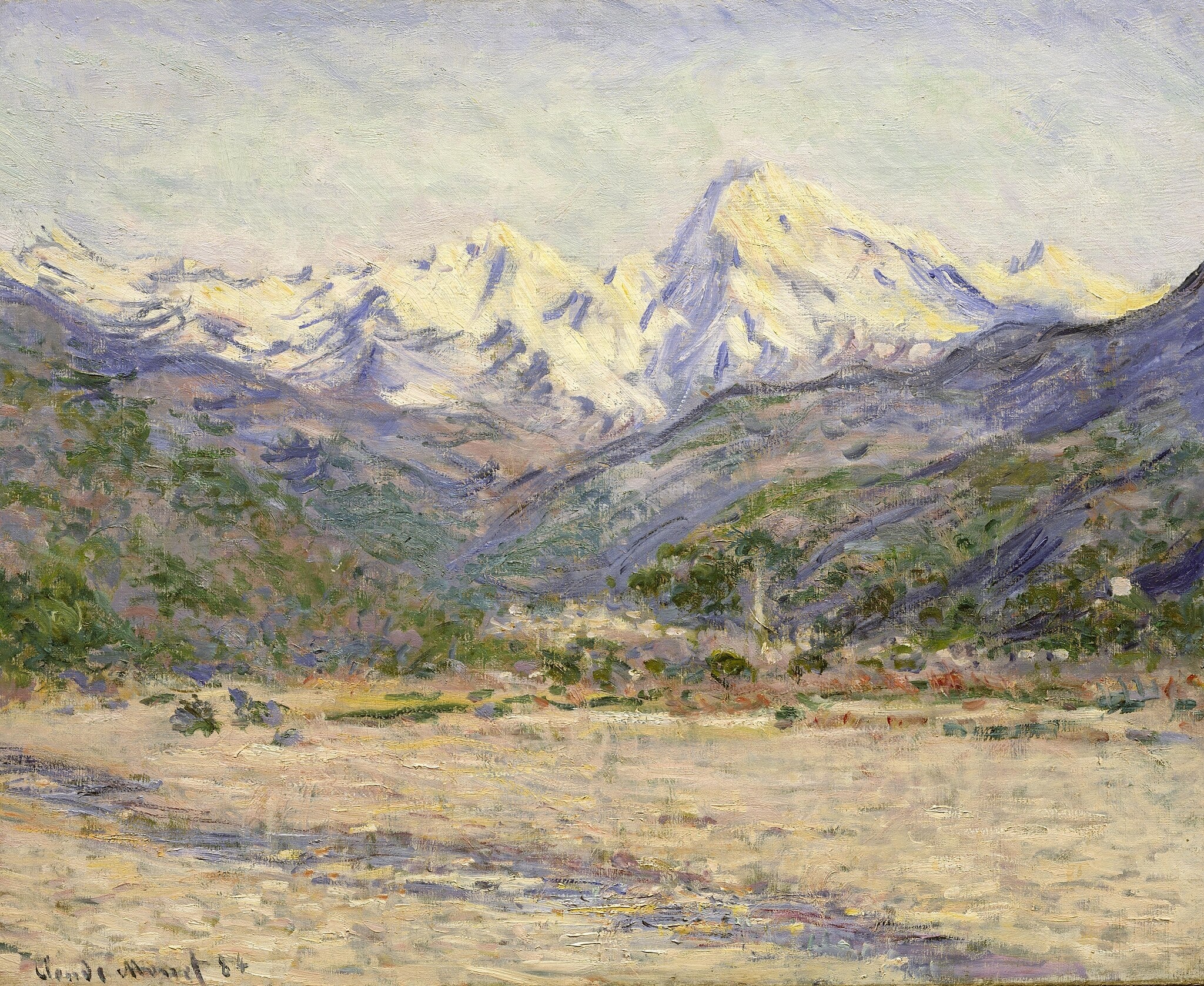
The Valley of the Nervia
Claude Monet (1884)
Claude Monet’s The Valley of the Nervia is a high‑key meditation on <strong>atmosphere as structure</strong>: snow‑lit Maritime Alps rise above a pale, stony riverbed, their mass defined by air and light rather than contour. Through quick, broken strokes of <strong>violet, blue, and lemon</strong>, Monet fuses fleeting afternoon shimmer with the valley’s geologic permanence <sup>[1]</sup><sup>[2]</sup>.
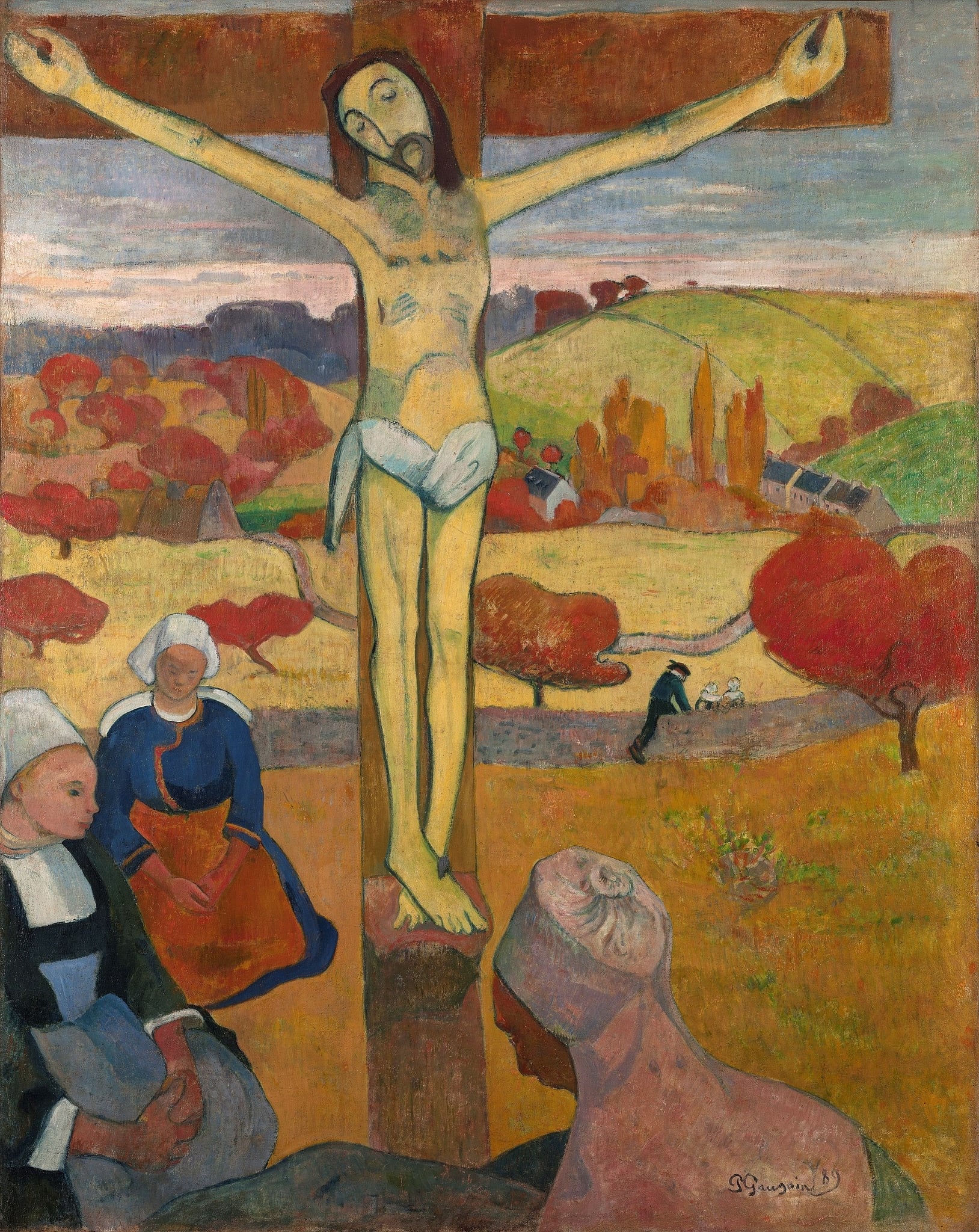
The Yellow Christ
Paul Gauguin (1889)
Paul Gauguin’s The Yellow Christ (1889) fuses sacred narrative with everyday Brittany, rendering a lemon‑<strong>yellow</strong> Christ in a rural autumn landscape. Through <strong>Synthetist</strong> color and <strong>Cloisonnist</strong> contours, the work declares spiritual meaning over naturalism, placing devotion among kneeling Breton women beneath a banded, hope‑tinged sky <sup>[1]</sup><sup>[3]</sup>.
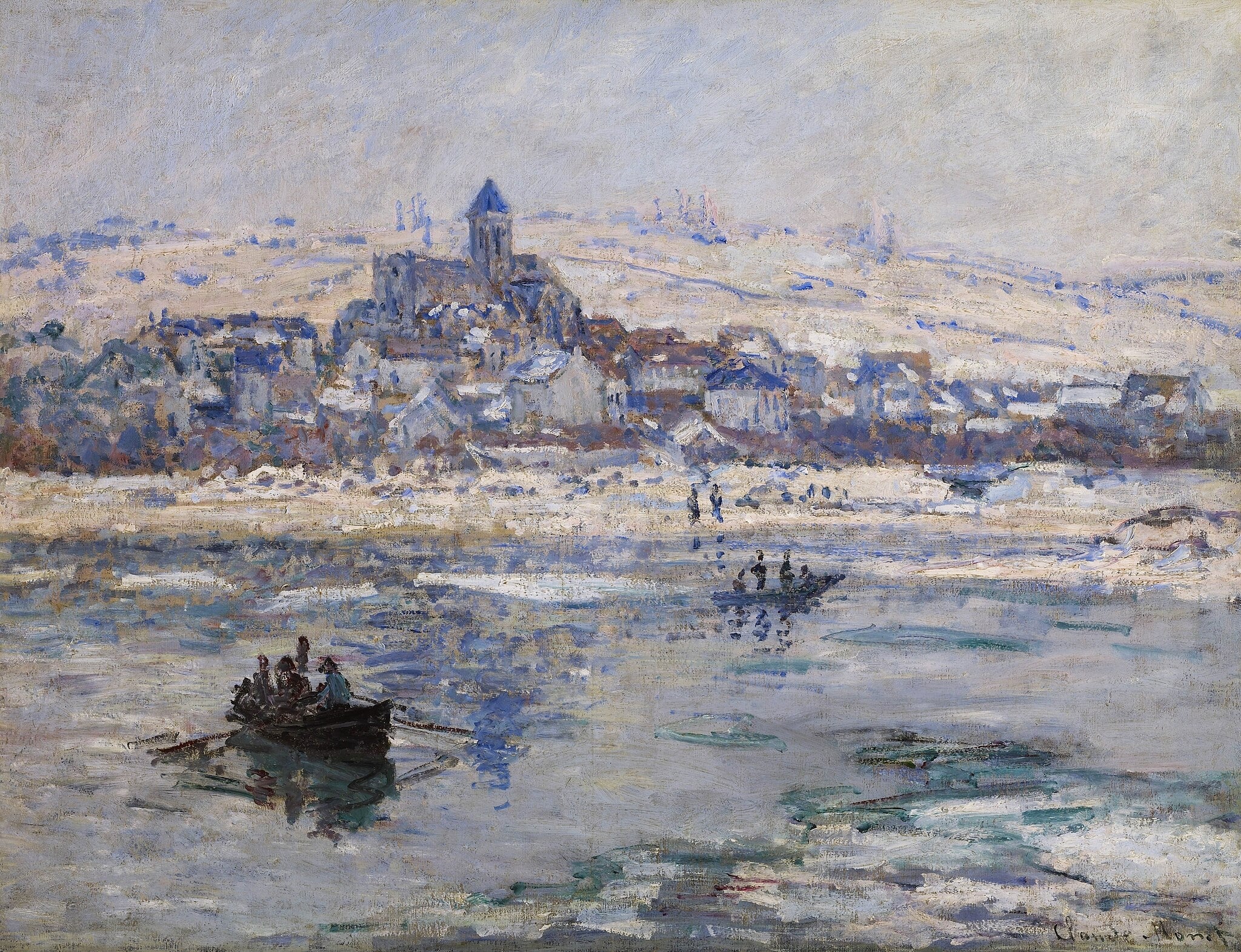
Vétheuil in Winter
Claude Monet (1878–79)
Claude Monet’s Vétheuil in Winter renders a riverside village in a <strong>silvery, frost-laden light</strong>, where the Seine carries <strong>broken ice</strong> past clustered houses and the tall church tower. The scene’s <strong>granular blue-green palette</strong> and softened edges make the town appear to crystallize out of air and water, while small boats and figures signal quiet persistence.
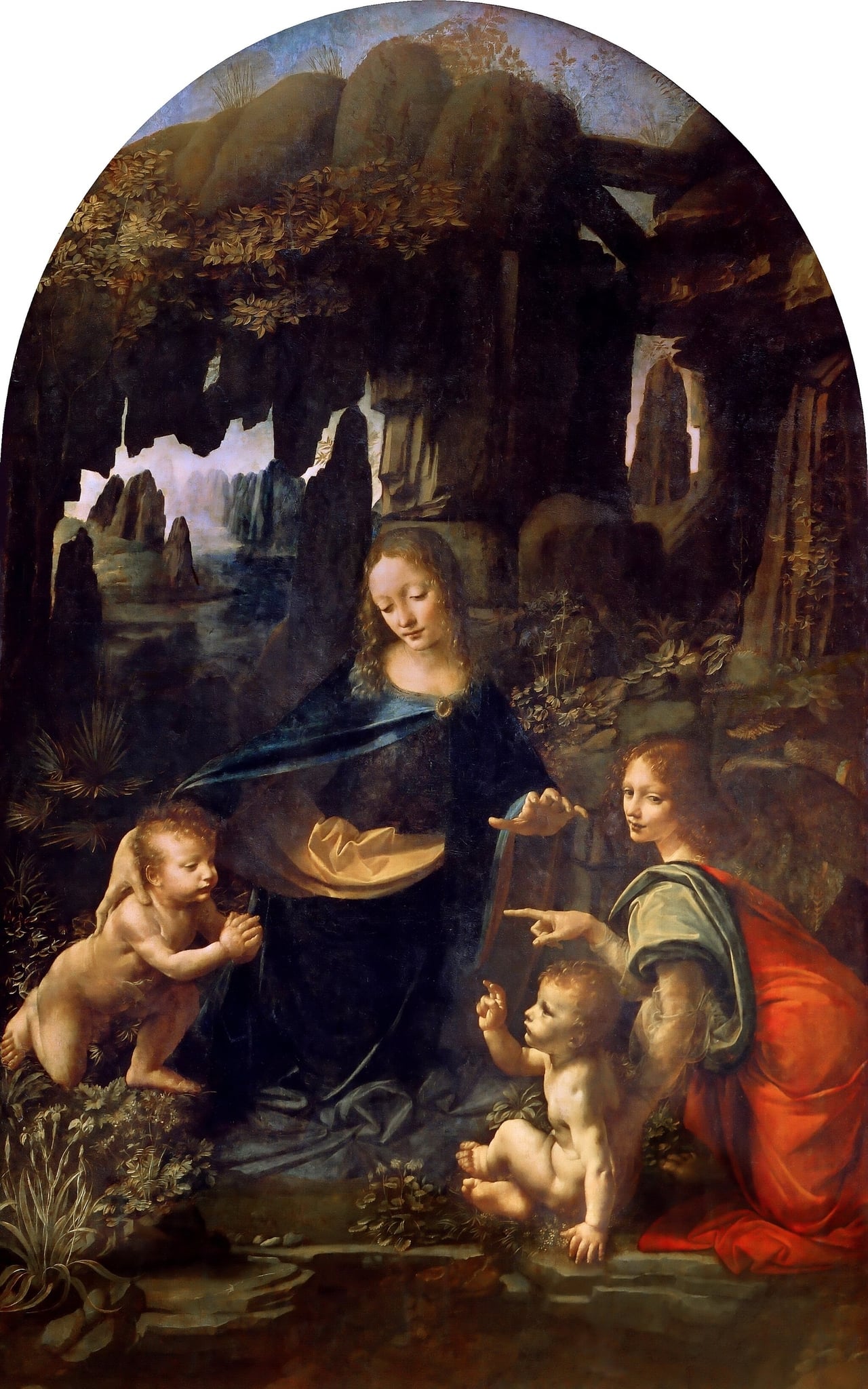
Virgin of the Rocks
Leonardo da Vinci (c. 1483–1494)
In Virgin of the Rocks, Leonardo da Vinci fuses sacred narrative with the natural world, staging the Holy Family and an angel inside a cavern where rock, water, and foliage form a living chapel. The angel’s pointing hand and outward gaze guide the viewer to the kneeling infant John as Mary shelters him and blesses the <strong>Christ Child</strong>, binding the group in a pyramidal, breath-like <strong>sfumato</strong>. By omitting overt markers like halos, Leonardo makes <strong>grace</strong> feel immanent within creation itself <sup>[1]</sup><sup>[2]</sup>.
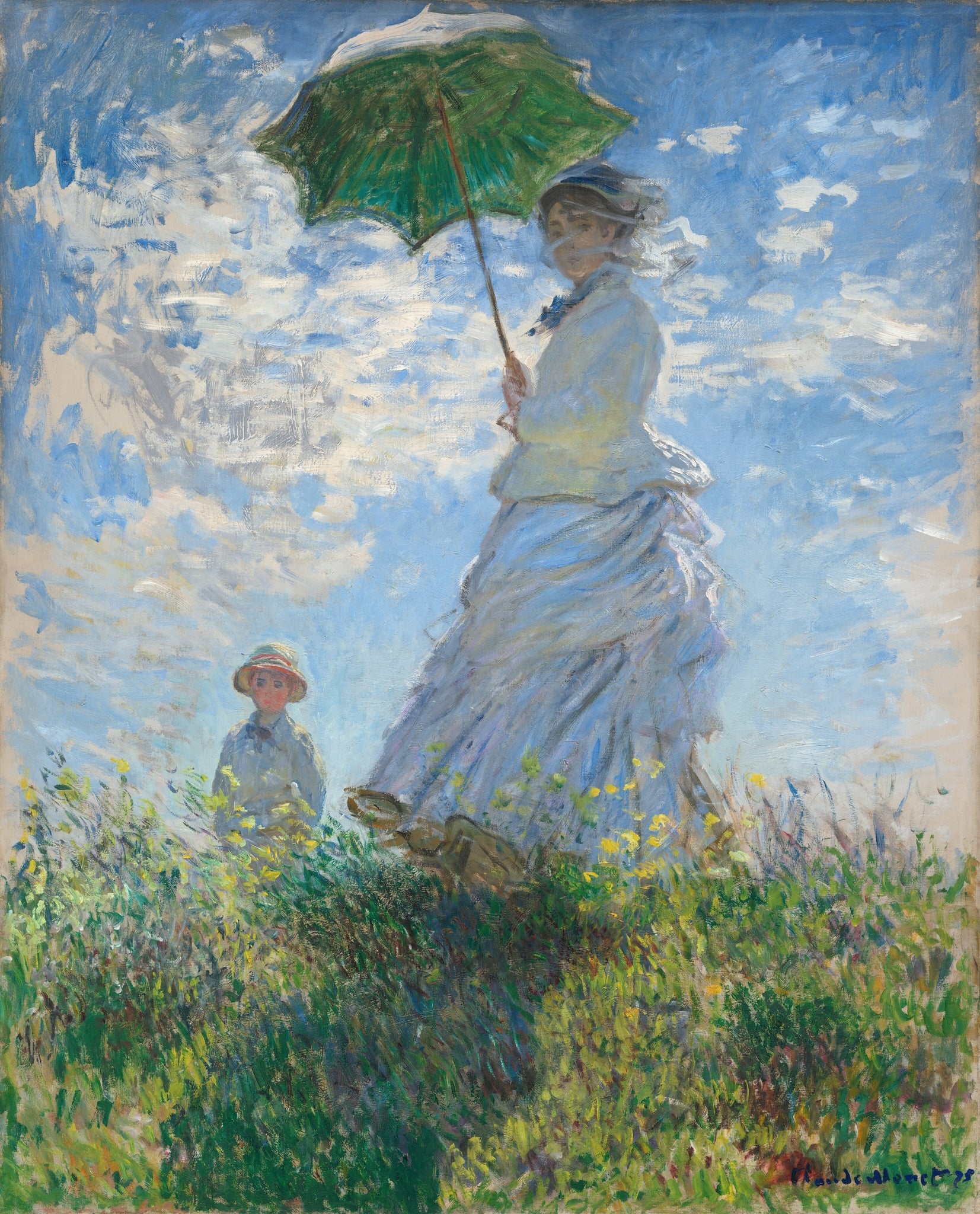
Woman with a Parasol
Claude Monet (1875)
Claude Monet’s Woman with a Parasol fixes a breezy hillside instant in high, shifting light, setting a figure beneath a <strong>green parasol</strong> against a vast, vibrating sky. The low vantage and <strong>broken brushwork</strong> merge dress, clouds, and grasses into one atmosphere, while a child at the rise anchors depth and intimacy <sup>[1]</sup>. It is a manifesto of <strong>plein-air</strong> perception—painting the sensation of air in motion rather than the contours of things <sup>[2]</sup>.
Related Themes
Related Symbolism Categories
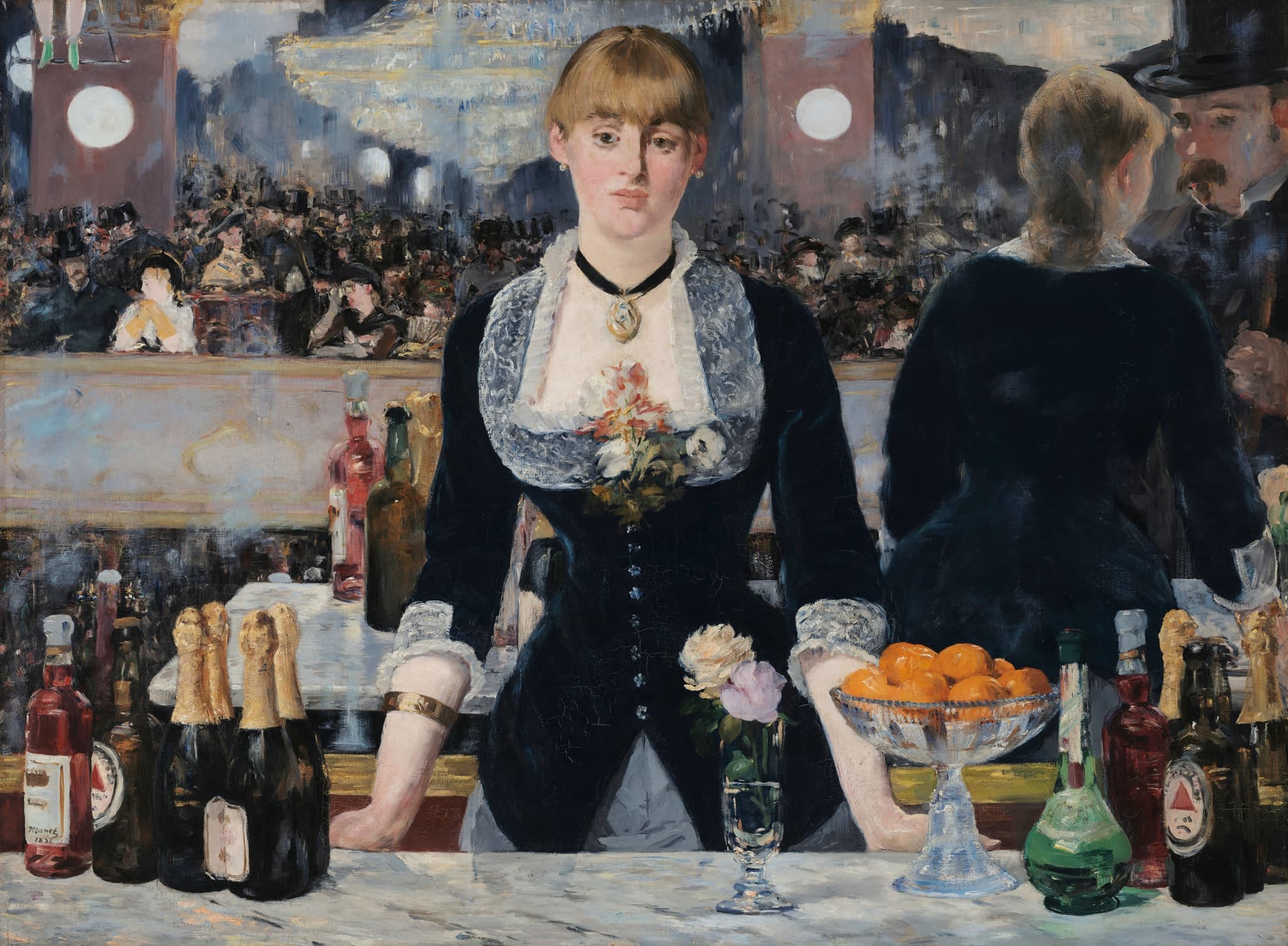
Intimacy
In the 'Intimacy' category, late nineteenth‑century artists redeploy traditional emblems of affection, care, and erotic exchange—hands, flowers, mirrors, and children—to probe the fragile, negotiated character of closeness in an age of public leisure, urban spectacle, and modern subjectivity.
Space
In modern painting, spatial symbols become active structures that organize perception, articulate social modernity, and reimagine depth as a charged field of circulation, isolation, and communal ritual.
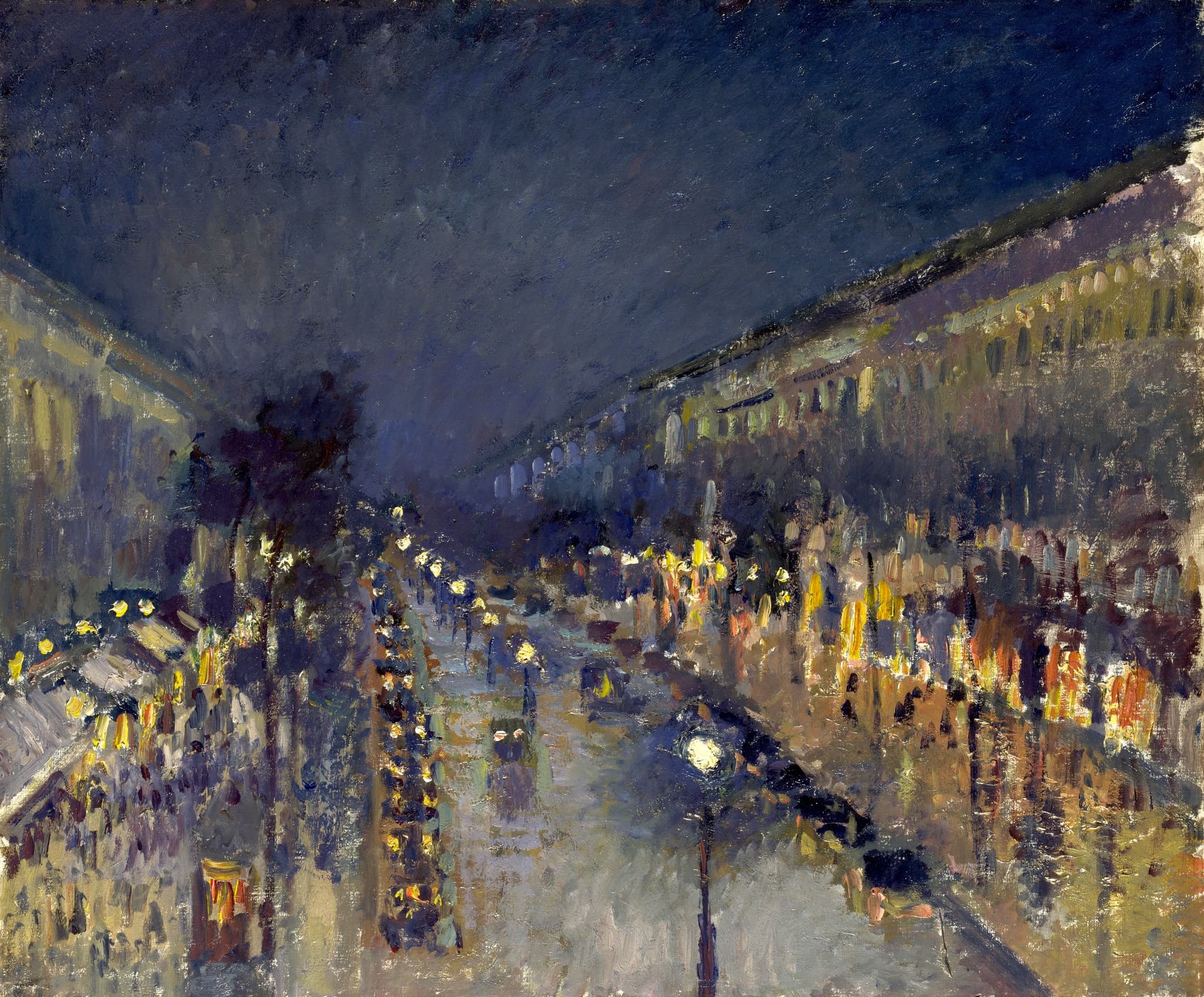
Light
The light symbolism category traces how artists transform illumination itself—from divine beam to industrial glare and atmospheric haze—into a primary bearer of meaning, mediating between revelation, modernity, and the phenomenology of perception.
Within Western art history, landscape has long functioned as more than a neutral backdrop; it is a semiotic field in which trees, watercourses, horizons, and paths operate as recurrent signs. From the religious topographies of the Renaissance to the pastoral inventions of the eighteenth century and the urban outskirts of Impressionism, such motifs organize not only space but meaning. The works and symbols gathered here register that tradition in transition. They show how modern painters mobilize streams, bridges, boats, bare trees, and flowering groves to negotiate industrial modernity, intimate sociability, and the phenomenology of vision itself.
Water is the most insistently charged element in this symbolic constellation. In Seated Bather, Renoir situates the nude at the lip of a flowing water/stream, whose “cool, flickering eddies” supply the “symbolic charge of water—renewal, sensuality, passage between states.” The stream here reprises a long iconographic history in which running water accompanies purification and transformation, particularly in bath and baptism scenes, but Renoir folds that lineage into a late-Impressionist sensibility. The stream is not merely allegorical; its broken strokes of blue and green literally enter the model’s flesh tones, so that, as the commentary notes, “the body seems to take on the atmosphere of the stream.” Water thus becomes both sign and medium: emblematizing renewal while enacting it chromatically across the surface.
Renoir’s The Large Bathers extends this logic into a more overtly classicizing framework. There, a flowing stream runs through an Arcadian grove, aligning the composition with “a long tradition of nymphs at a stream.” The brook’s glint and the grove’s sheltering foliage together naturalize the scene as timeless, Edenic leisure. Yet Renoir’s “dry, polished handling” and the “firm contours” of the figures resist Impressionist dissolution, signaling that Arcadia is here an artifice consciously reconstructed. The stream’s iconographic role—anchoring purification and communal play—is clear in the background bathers who “splash and groom,” but its semiotic function is doubled: it is at once an emblem of classical renewal and a modern stylistic problem, a strip of reflective, mobile surface against which the solidity of the sculptural nudes is asserted.
When water migrates to the urban periphery, its symbolism absorbs questions of labor, class, and time. In Seurat’s Bathers at Asnières, the Seine appears as a blue, shimmering river, defined as “flux, transience, and the optical field of Impressionist sensation; nature’s cool expanse.” Yet Seurat pointedly refuses to treat this expanse as purely optical ephemera. The river’s extended horizontal, accompanied by “a measured procession of bodies,” stabilizes rather than dissolves form; it becomes a band of suspended time within which working-class figures can inhabit leisure. The river’s shimmer is thus semiotically ambivalent: it registers modern optical science and fleeting light while, through its still, frieze-like treatment, it monumentalizes a moment of respite in lives structured by industrial temporality.
Monet’s Bathers at La Grenouillère shifts the emphasis back toward pure perceptual flux. The foreground is fractured into a dappled water reflection field, where boats, bridge, and bathers dissolve into “the river’s flicker, the quick cognition of sun and shade that remakes the scene at every instant.” Here the motif of dappled water reflections becomes a metonym for Impressionism’s temporal project: to figure seeing itself as momentary and unstable. Yet the resort’s “engineered setting”—rowboats, footbridge, and the famous islet—reminds us that this flicker is grounded in modern leisure infrastructure. The water registers both optical instantaneity and the new rhythms of suburban recreation.
Morisot’s The Harbour at Lorient introduces another inflection of aqueous symbolism. The basin of canal waters and the quay’s edge articulate “the flow of time and a slow, resistant force that must be crossed.” The diagonally thrust parapet marks a threshold between the seated woman’s interior reverie and the public movement of “anchored hulls and taut masts” across the harbor. Morisot’s “pearly palette and brisk brushwork make the water read as time itself,” such that the boats’ slight tremor in reflection stands for the perpetual drift of possibilities—departures deferred, trajectories imagined. Canal water thus becomes an image of temporality possessing both inertia and latent dynamism, against which the solitary figure’s modern subjectivity is staged.
Across these works, boats and bridges function as mediating signs of passage. In Morisot, “anchored boats and upright masts” crystallize “potential energy and deferred movement; the machinery of commerce awaiting action,” their verticals echoing the woman’s seated axis and thus tying private thought to collective circulation. Van Gogh radicalizes this pause in Fishing Boats on the Beach at Les Saintes-Maries-de-la-Mer, where beached working boats stand for “readiness paused before risk.” Their “curving prows thrusting diagonally toward the surf” and rigging that “leans seaward” describe an orientation toward the horizon that is, for the moment, held in check. Here landscape is a literal threshold—the sand-strip between village and sea—but also a symbolic one, encoding the precarious balance between subsistence labor and danger that structures coastal life.
The bridge over canal/stream in Monet’s Bathers at La Grenouillère introduces a more explicitly social dimension to the idea of passage. Described as “a social threshold,” the slim footbridge organizes the crowd into zones of strolling and of more concentrated interaction at the water’s edge. The bridge iconographically recalls earlier uses of crossings as markers of spiritual or moral transition, yet here it is redeployed within the vocabulary of modern recreation and access—integral to the same railway network that makes the resort possible. In this context, the bridge’s semiotic charge lies less in salvation than in circulation: it becomes a sign of metropolitan permeability and the choreographing of crowds within a commodified nature.
Trees and groves, finally, articulate cyclical time and emotional register. In van Gogh’s Garden with Courting Couples: Square Saint-Pierre, a canopy of flowering chestnut trees forms an urban Arcadian grove, translating the ideal “Edenic nature where harmony and leisure prevail” into a Montmartre park. The red-pink spikes of blossom “repeat through the foliage like a refrain,” their rhythm echoing the pairing of figures below. Nature in bloom “mirrors love in bloom”: the grove’s springtime renewal stands iconographically for erotic and affective newness, while the carefully generalized faces affirm the democratic, typological status of such renewal in the modern city. The grove thus fuses inherited pastoral symbolism with the social realities of Parisian leisure.
By contrast, the Surrealist landscape of Dalí’s Swans Reflecting Elephants harnesses barren trees to a more unsettling threshold. The “thicket of bare trees” that lines the Catalan lagoon signifies “death, desolation, and transformation,” but more crucially, it provides the structural “armature for metamorphosis” through which swans invert into elephants. Tree-trunks here are not seasonal markers so much as instruments of the paranoiac-critical method: linear frameworks that permit images to “flip identity.” Where van Gogh’s chestnuts stabilize a narrative of renewal, Dalí’s skeletal groves destabilize perception itself, making landscape the stage on which the unconscious reconfigures forms.
Taken together, these symbols trace a historical arc. Earlier religious and classical iconographies of flowing water and Arcadian groves persist in the nineteenth century but are increasingly mediated through the problems of modern vision, labor, and urban sociability. Impressionist and related painters turn rivers, harbors, and dappled reflections into fields where time and perception are negotiated in real time, while bridges and boats serve as emblems of mobility in an industrial age. By the early twentieth century, in Dalí’s Surrealism, the same repertory—still water, bare trees, distant shorelines—has been internalized and psychologized, functioning less as a stable symbolic code than as a flexible matrix for perceptual doubt. Landscape remains a bearer of meaning, but its symbols are now self-consciously provisional, staging not fixed allegories but the mutable relations between body, world, and mind.