Light
The light symbolism category traces how artists transform illumination itself—from divine beam to industrial glare and atmospheric haze—into a primary bearer of meaning, mediating between revelation, modernity, and the phenomenology of perception.
Member Symbols
Featured Artworks
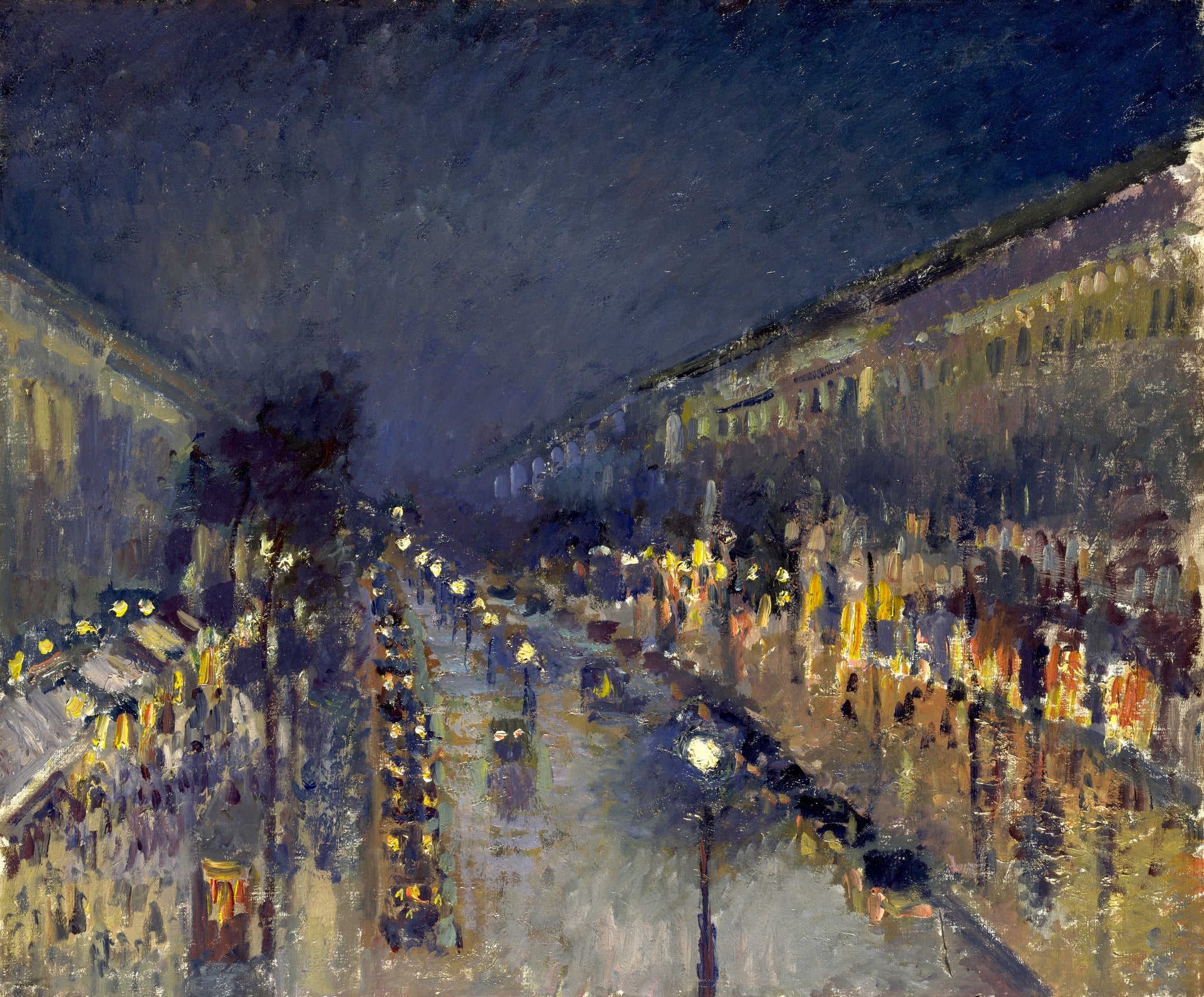
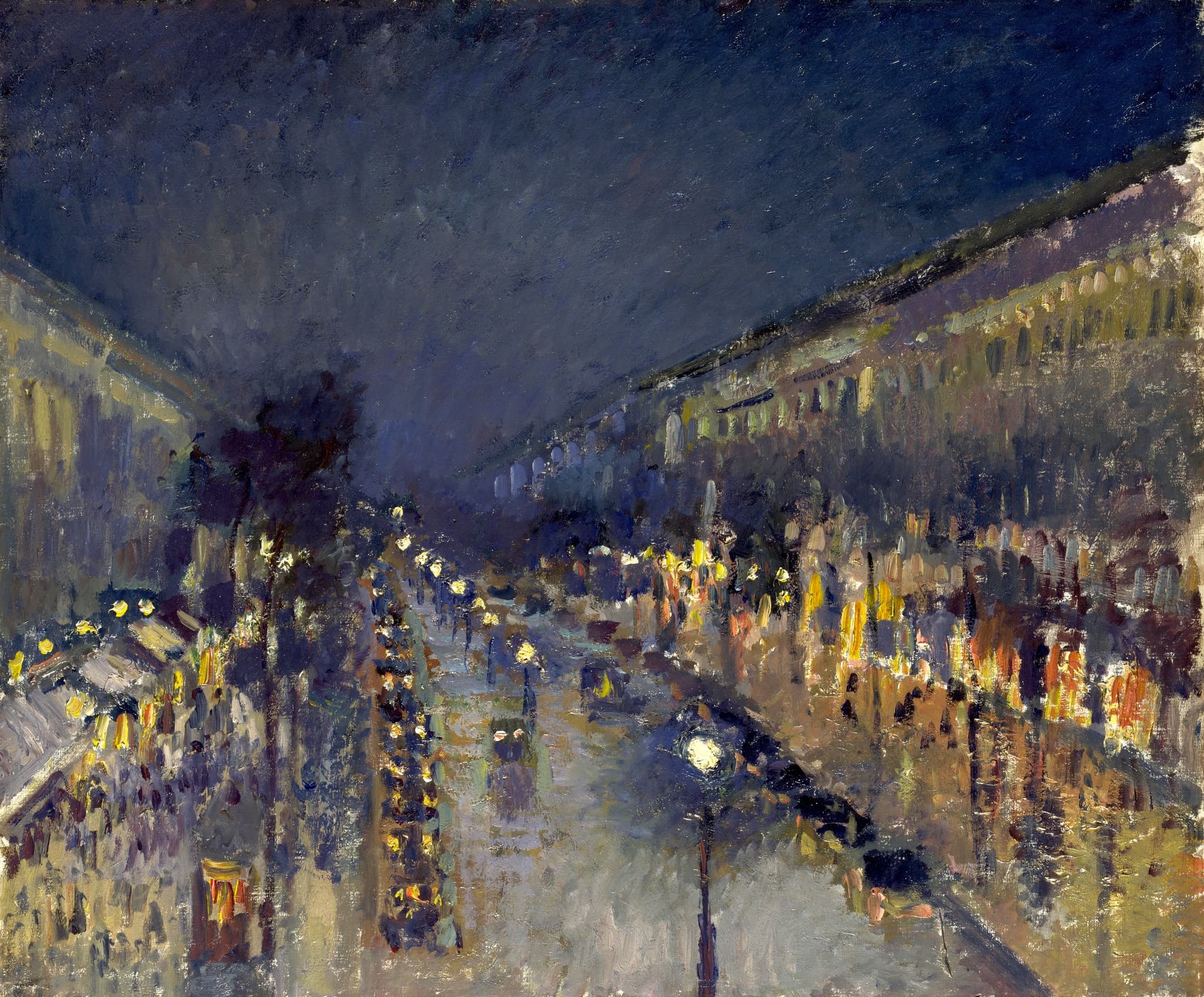
Boulevard Montmartre at Night
Camille Pissarro (1897)
A high window turns Paris into a flowing current: in Boulevard Montmartre at Night, Camille Pissarro fuses <strong>modern light</strong> and <strong>urban movement</strong> into a single, restless rhythm. Cool electric halos and warm gaslit windows shimmer across rain‑slick stone, where carriages and crowds dissolve into <strong>pulse-like blurs</strong> <sup>[1]</sup><sup>[2]</sup>.
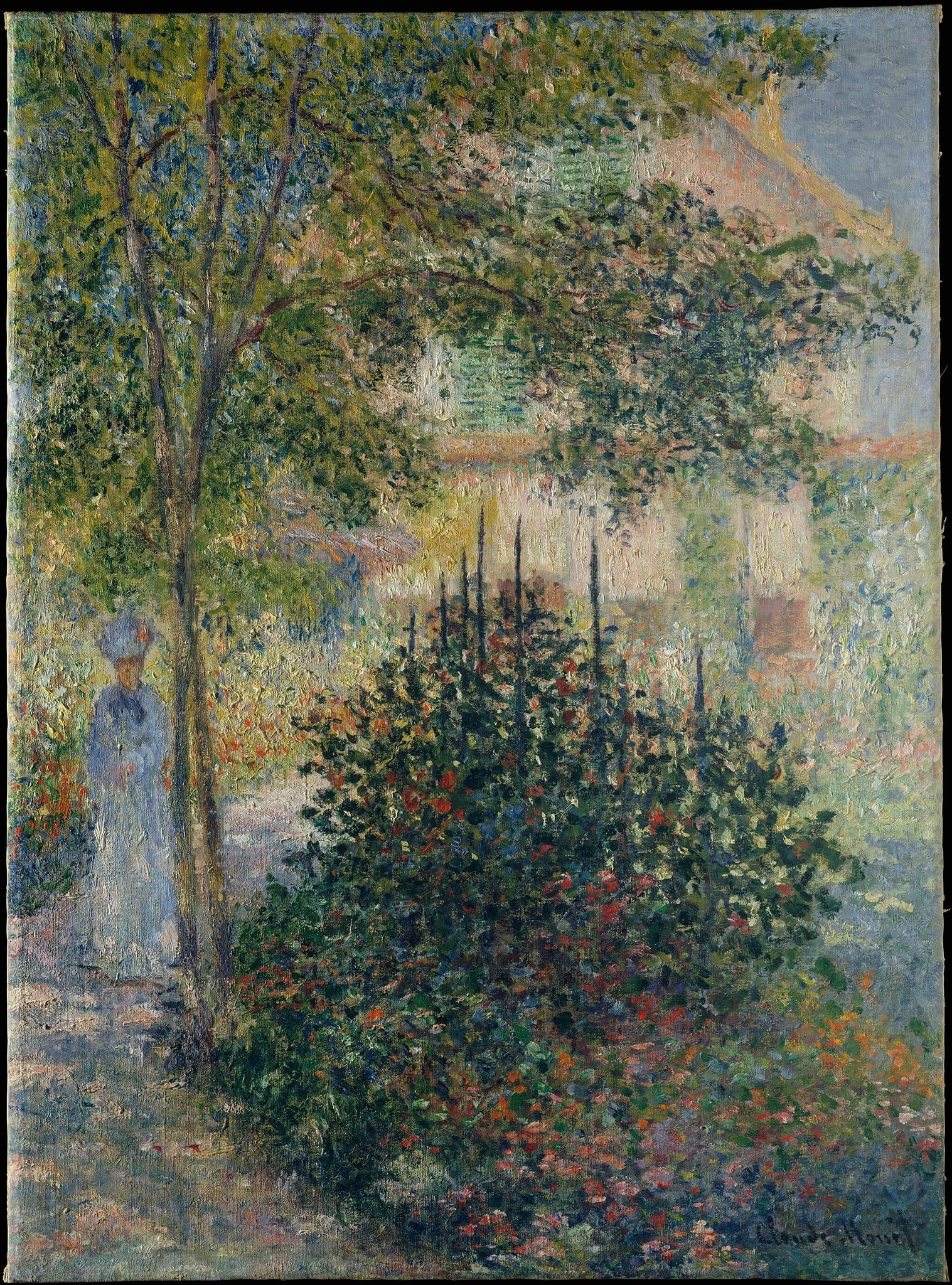
Camille Monet (1847–1879) in the Garden at Argenteuil
Claude Monet (1876)
Claude Monet’s Camille Monet (1847–1879) in the Garden at Argenteuil captures a fleeting, sunstruck interval where a blue‑clad figure hovers at the shaded path while a <strong>corbeille</strong> of spiked flowers ignites the foreground. The pink house with <strong>green shutters</strong> flickers through a veil of leaves, its surfaces dissolved into vibrating strokes of light. Monet subordinates likeness to the <strong>sensation of air and color</strong>, turning the garden into a living field of time and perception <sup>[1]</sup><sup>[2]</sup>.
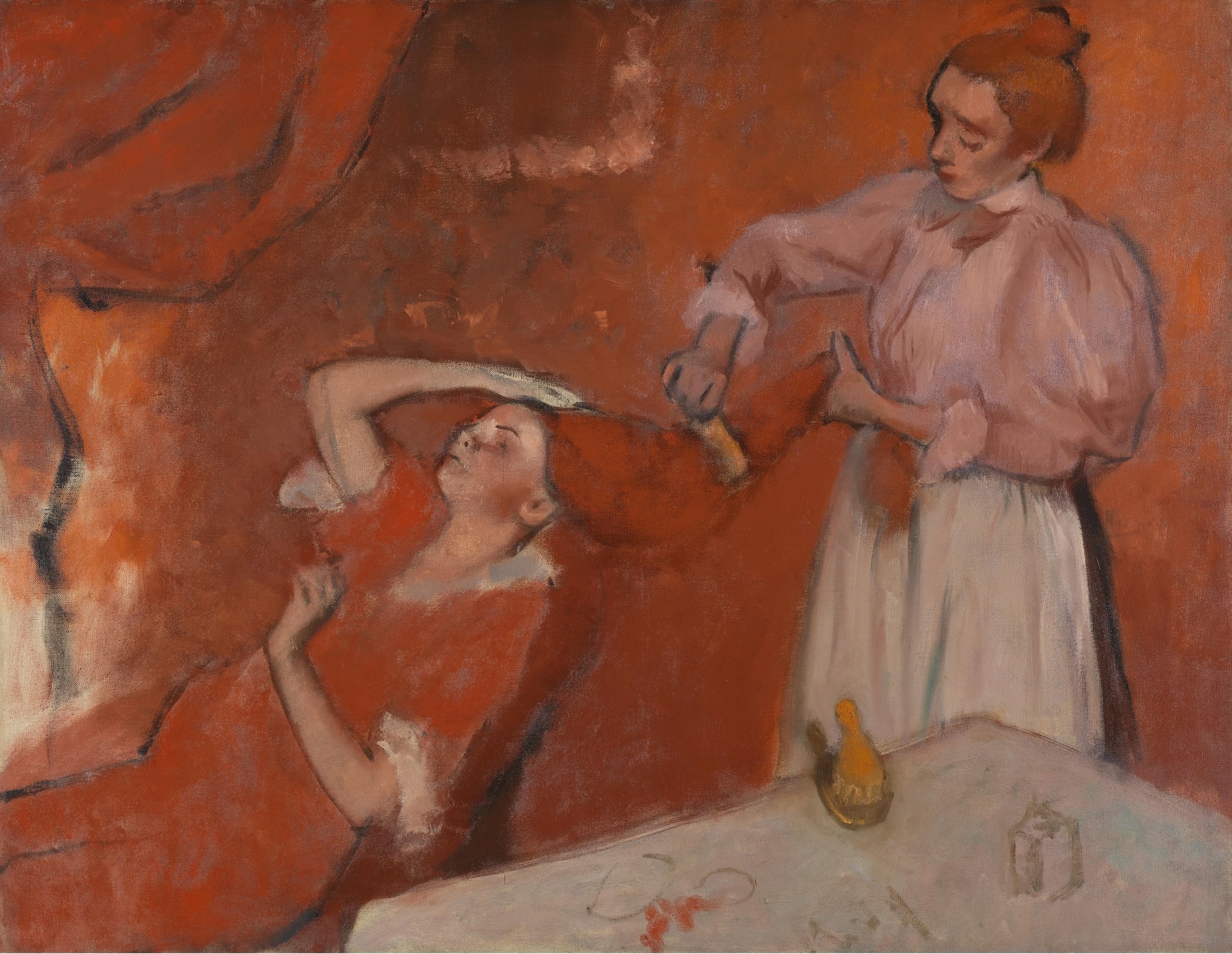
Combing the Hair
Edgar Degas (c.1896)
Edgar Degas’s Combing the Hair crystallizes a private ritual into a scene of <strong>compressed intimacy</strong> and <strong>classed labor</strong>. The incandescent field of red fuses figure and room, turning the hair into a <strong>binding ribbon</strong> between attendant and sitter <sup>[1]</sup>.
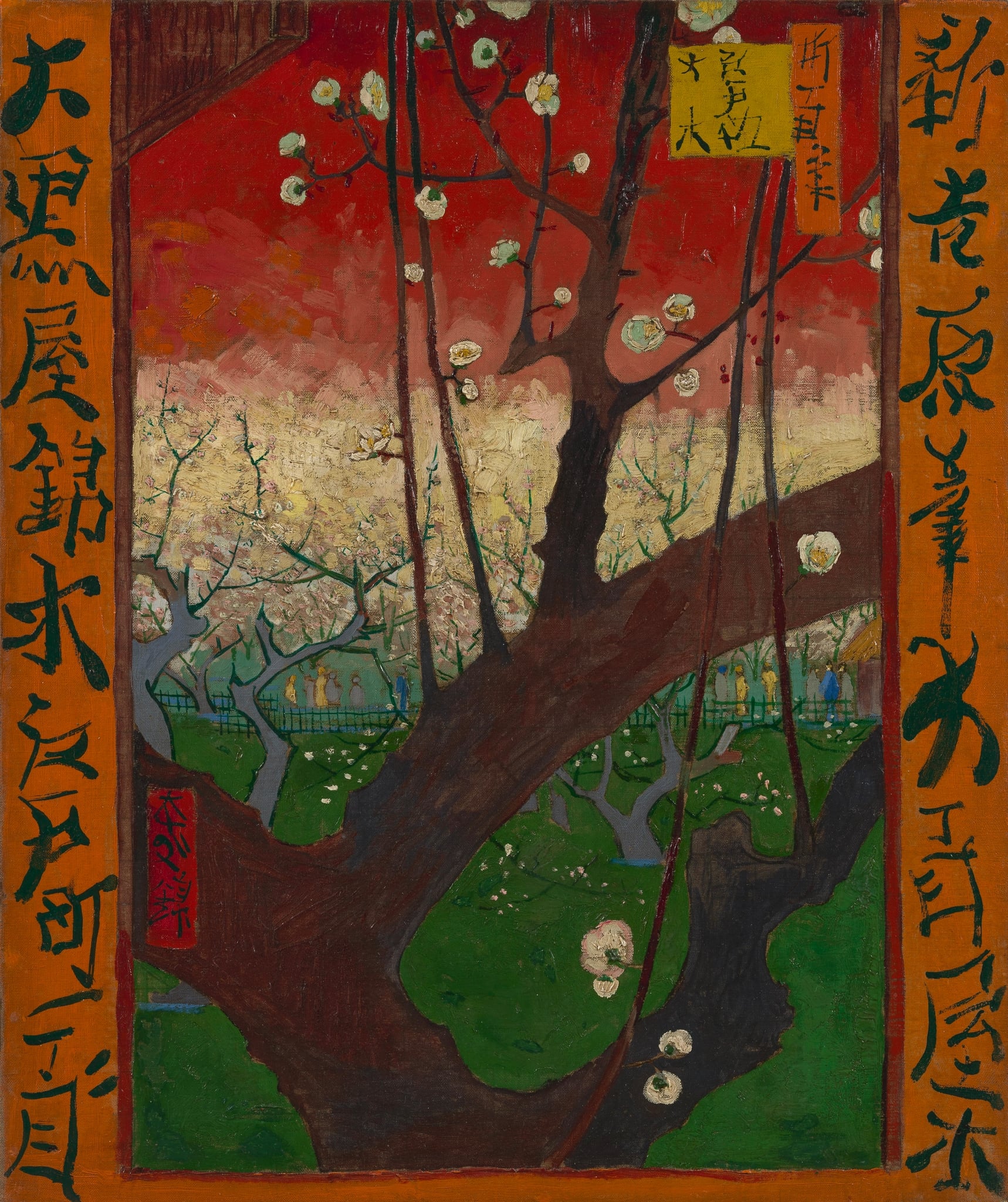
Flowering Plum Orchard (after Hiroshige)
Vincent van Gogh (1887)
In Flowering Plum Orchard (after Hiroshige), Vincent van Gogh fuses <strong>ukiyo-e design</strong> with <strong>post‑Impressionist color</strong>. A diagonal, calligraphic trunk cuts across a saturated green orchard, set against a <strong>blazing red sky</strong> and framed by <strong>orange borders with Japanese characters</strong>. The result is a vivid translation of Hiroshige’s motif into an oil painting charged with renewal and resolve <sup>[1]</sup><sup>[2]</sup>.
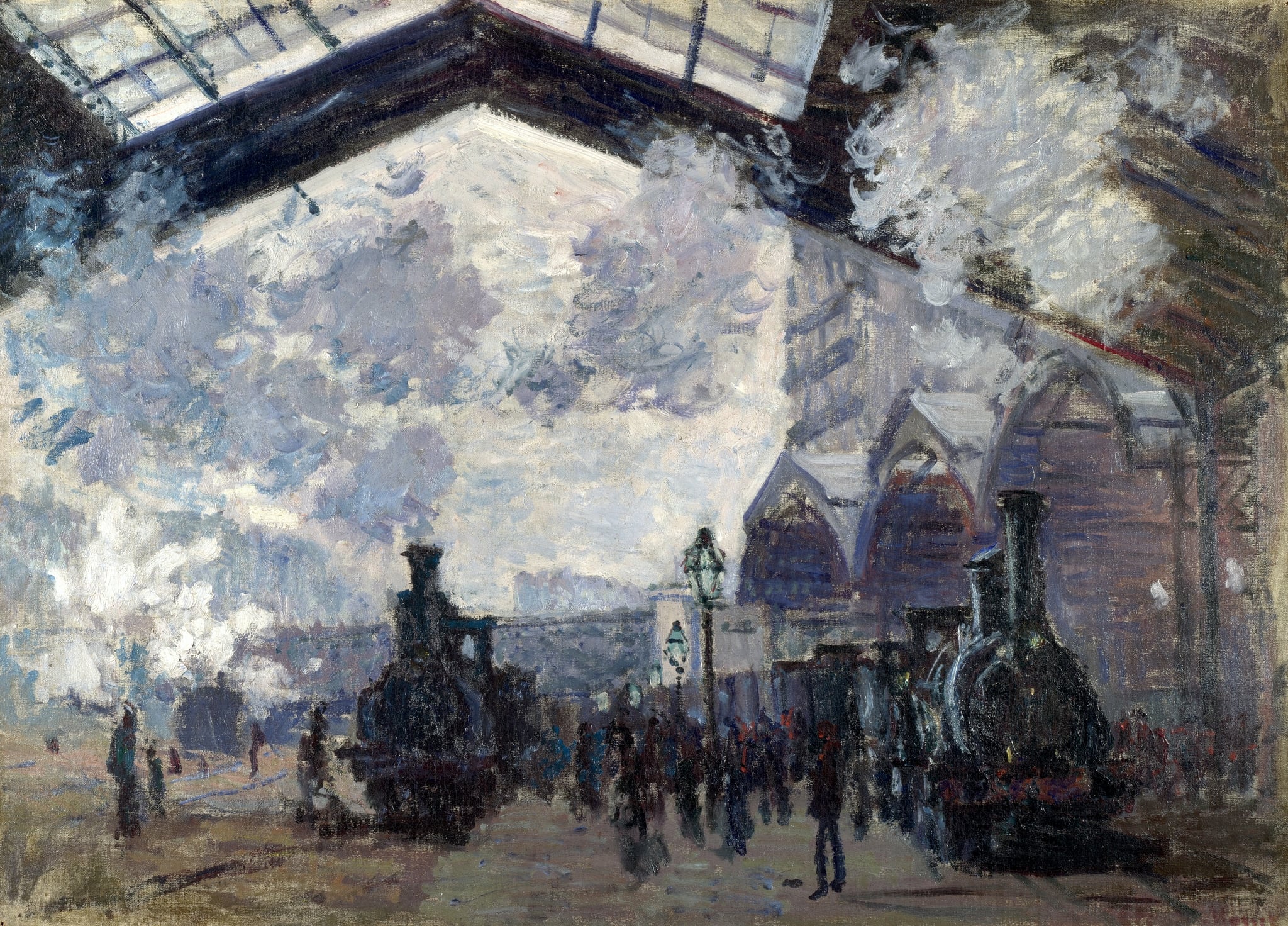
Gare Saint-Lazare
Claude Monet (1877)
Monet’s Gare Saint-Lazare turns an iron-and-glass train shed into a theater of <strong>steam, light, and motion</strong>. Twin locomotives, gas lamps, and a surge of figures dissolve into bluish vapor under the diagonal canopy, recasting industrial smoke as <strong>luminous atmosphere</strong> <sup>[1]</sup><sup>[2]</sup>.
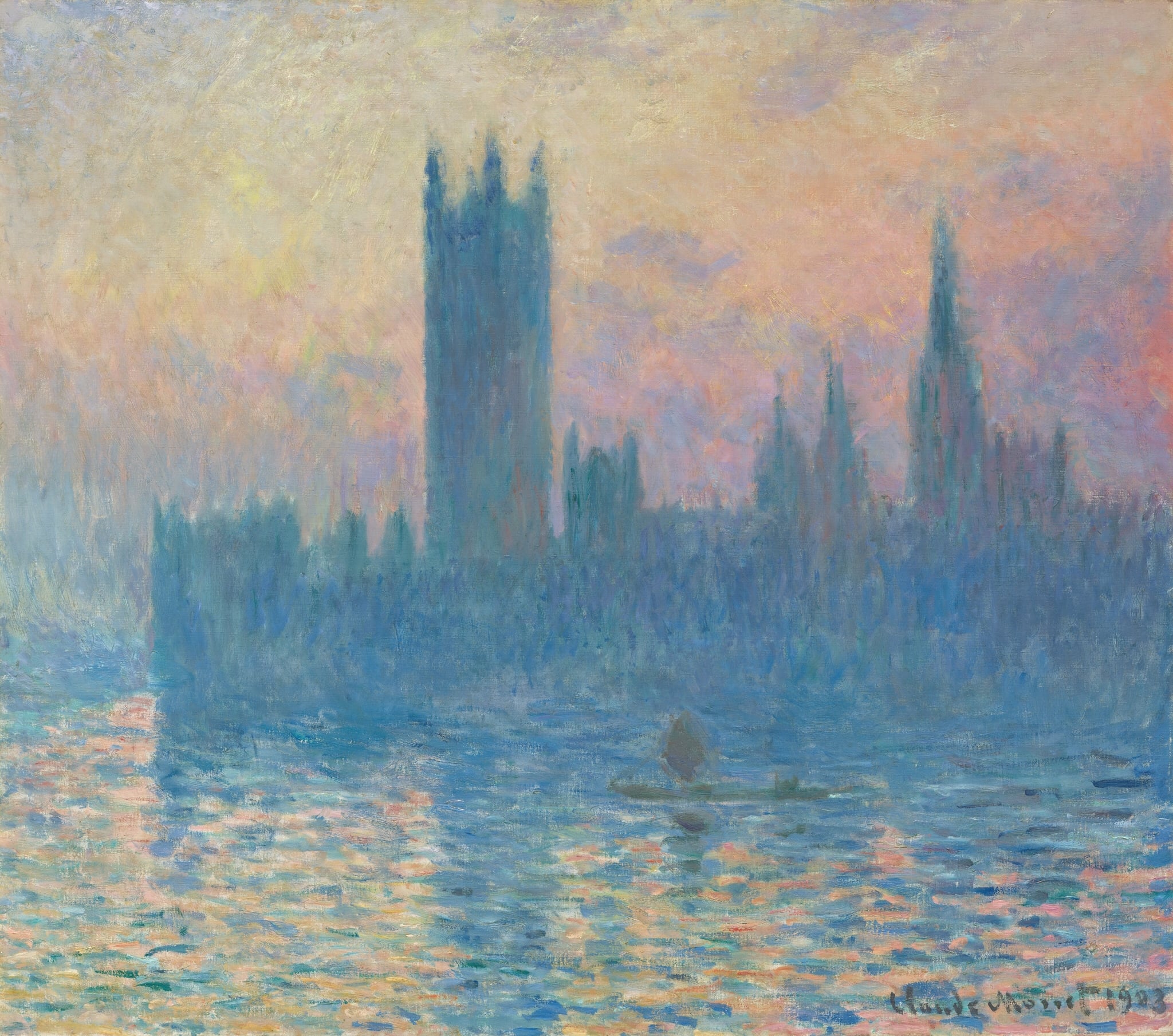
Houses of Parliament
Claude Monet (1903)
Claude Monet’s Houses of Parliament renders Westminster as a <strong>dissolving silhouette</strong> in a wash of peach, mauve, and pale gold, where stone and river are leveled by <strong>luminous fog</strong>. Short, vibrating strokes turn architecture into <strong>atmosphere</strong>, while a tiny boat anchors human scale amid the monumental scene.
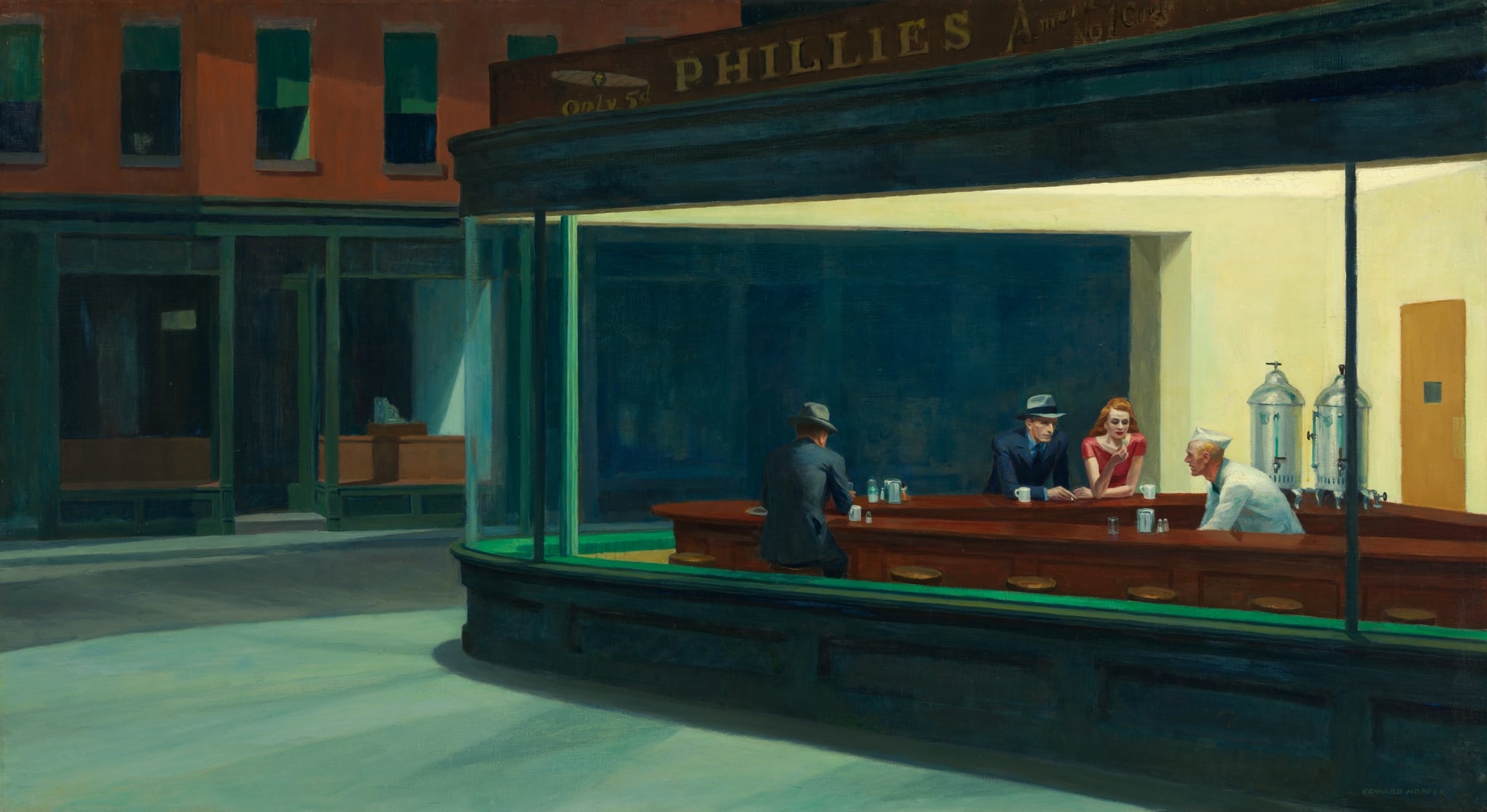
Nighthawks
Edward Hopper (1942)
Edward Hopper’s Nighthawks turns a corner diner into a sealed stage where <strong>fluorescent light</strong> and <strong>curved glass</strong> hold four figures in suspended time. The empty streets and the “PHILLIES” cigar sign sharpen the sense of <strong>urban solitude</strong> while hinting at wartime vigilance. The result is a cool, lucid image of modern life: illuminated, open to view, and emotionally out of reach.
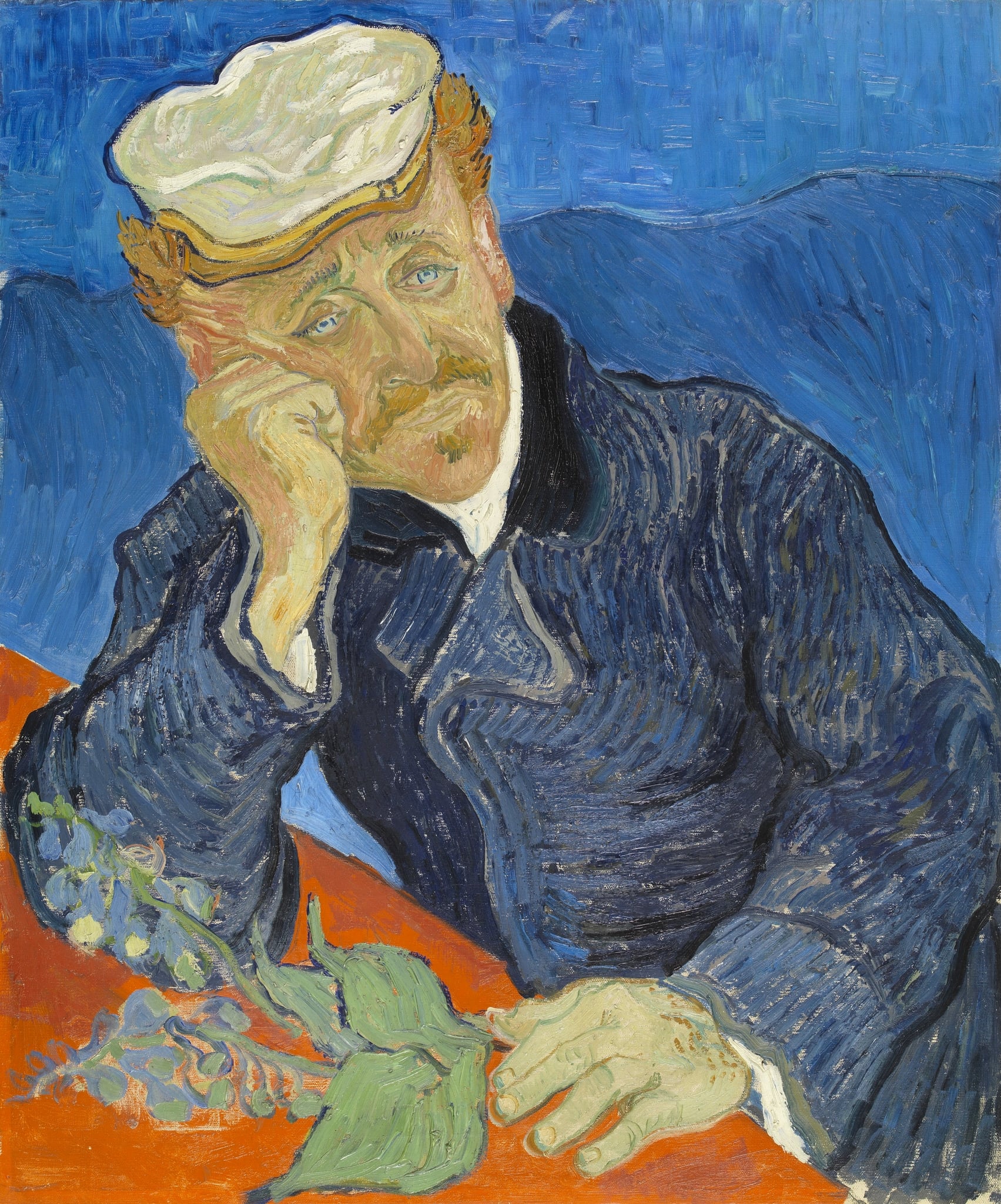
Portrait of Dr. Gachet
Vincent van Gogh (1890)
Portrait of Dr. Gachet distills Van Gogh’s late ambition for a <strong>modern, psychological portrait</strong> into vibrating color and touch. The sitter’s head sinks into a greenish hand above a <strong>blazing orange-red table</strong>, foxglove sprig nearby, while waves of <strong>cobalt and ultramarine</strong> churn through coat and background. The chromatic clash turns a quiet pose into an <strong>empathic image of fragility and care</strong> <sup>[1]</sup><sup>[2]</sup>.
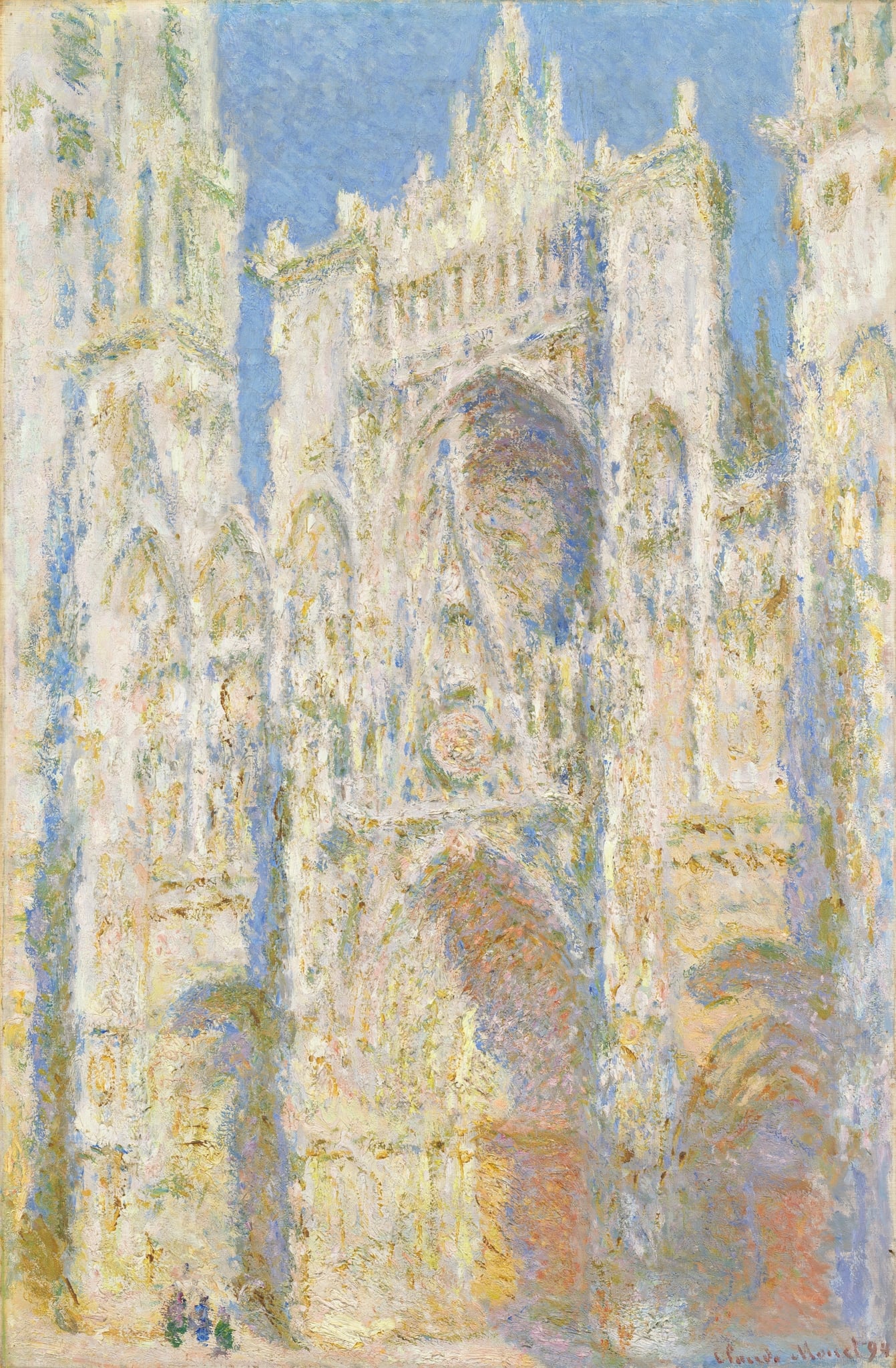
Rouen Cathedral Series
Claude Monet (1894)
Claude Monet’s Rouen Cathedral Series (1892–94) turns a Gothic monument into a laboratory of <strong>light, time, and perception</strong>. In this sunstruck façade, portals, gables, and a warm, orange-tinged rose window flicker in pearly violets and buttery yellows against a crystalline blue sky, while tiny figures at the base anchor the scale. The painting insists that <strong>light—not stone—is the true subject</strong> <sup>[1]</sup><sup>[2]</sup>.
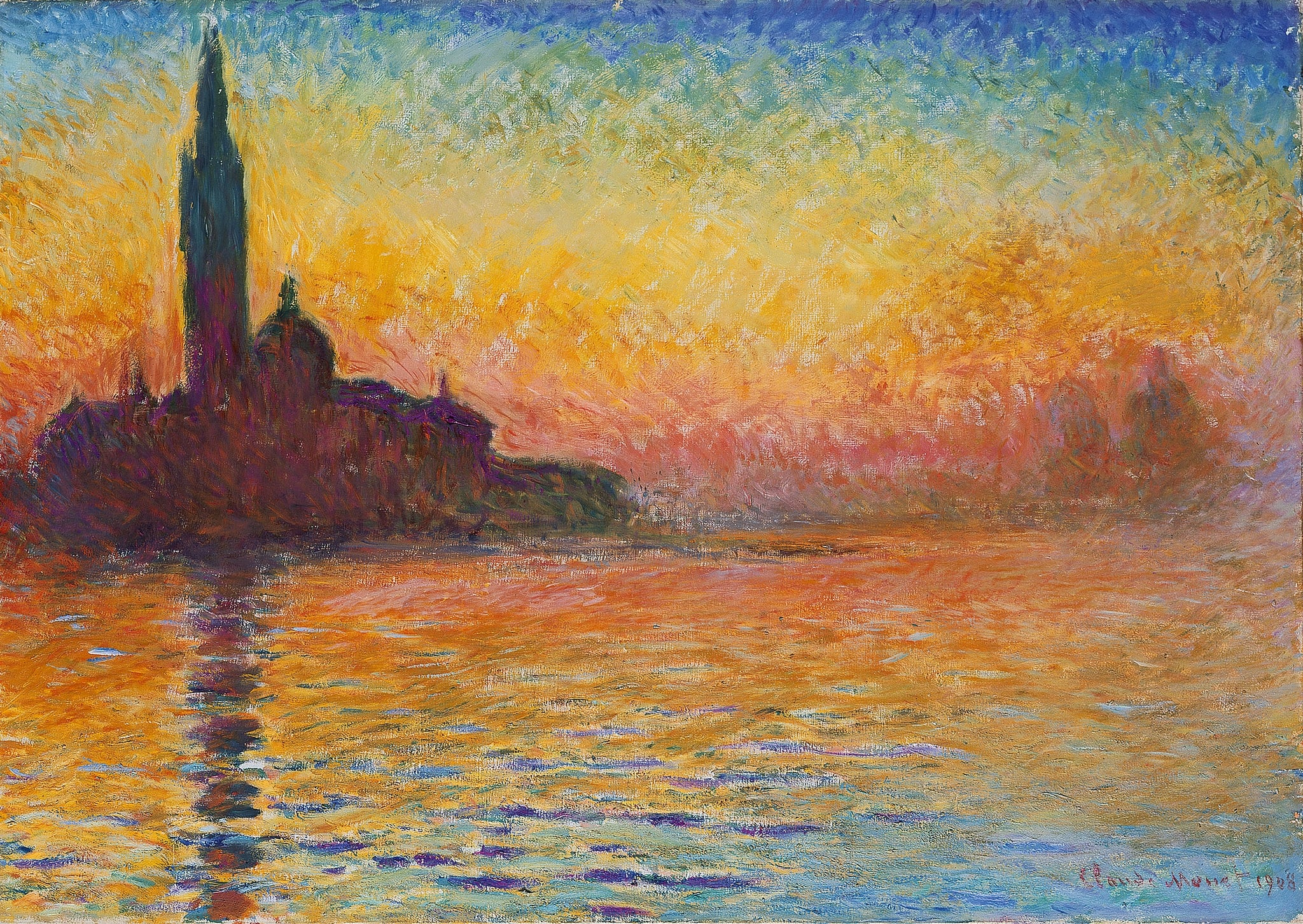
San Giorgio Maggiore at Dusk
Claude Monet (1908–1912)
Claude Monet’s San Giorgio Maggiore at Dusk fuses the Benedictine church’s dark silhouette with a sky flaming from apricot to cobalt, turning architecture into atmosphere. The campanile’s vertical and its wavering reflection anchor a sea of trembling color, staging a meditation on <strong>permanence</strong> and <strong>flux</strong>.
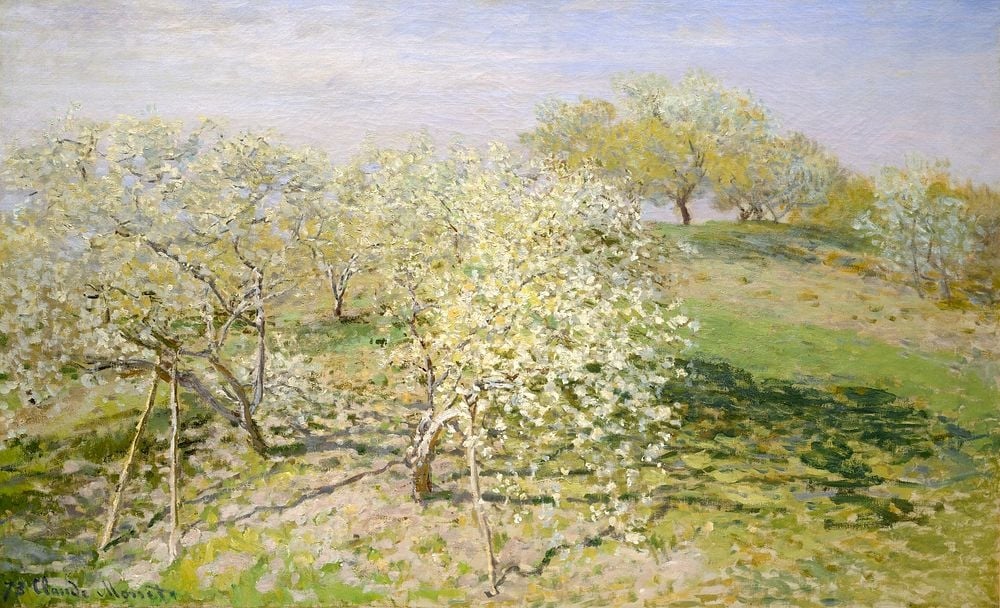
Spring (Fruit Trees in Bloom)
Claude Monet (1873)
Claude Monet’s Spring (Fruit Trees in Bloom) captures a hillside orchard at Argenteuil where pale blossoms flicker across a diagonal slope under a <strong>pearly, breathable sky</strong>. The canvas privileges <strong>light over contour</strong>, letting trunks, stakes, and petal-clusters resolve through vibrating touches of color that register passing air and sun <sup>[1]</sup><sup>[2]</sup>. The scene fixes a <strong>radiant instant</strong> while acknowledging its fragility.
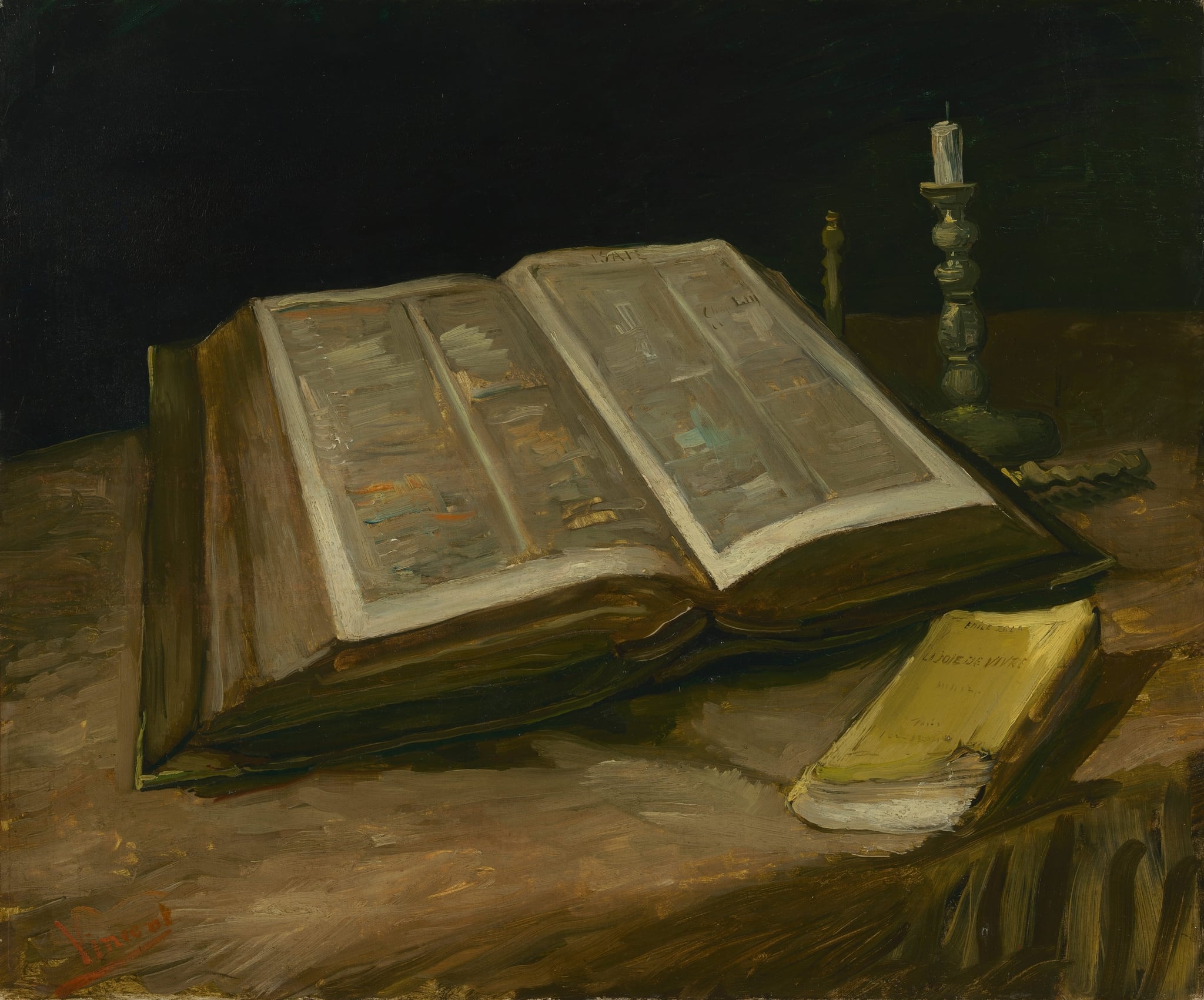
Still Life with Bible
Vincent van Gogh (1885)
Vincent van Gogh’s Still Life with Bible (1885) stages a stark encounter between a monumental family <strong>Bible</strong>, a snuffed <strong>candle</strong>, and Zola’s yellow‑covered <strong>La joie de vivre</strong>. The painting’s heavy, earthen brushwork and diagonal sweep forge a tense dialogue between <strong>inherited faith</strong> and <strong>modern experience</strong> <sup>[1]</sup><sup>[2]</sup>.
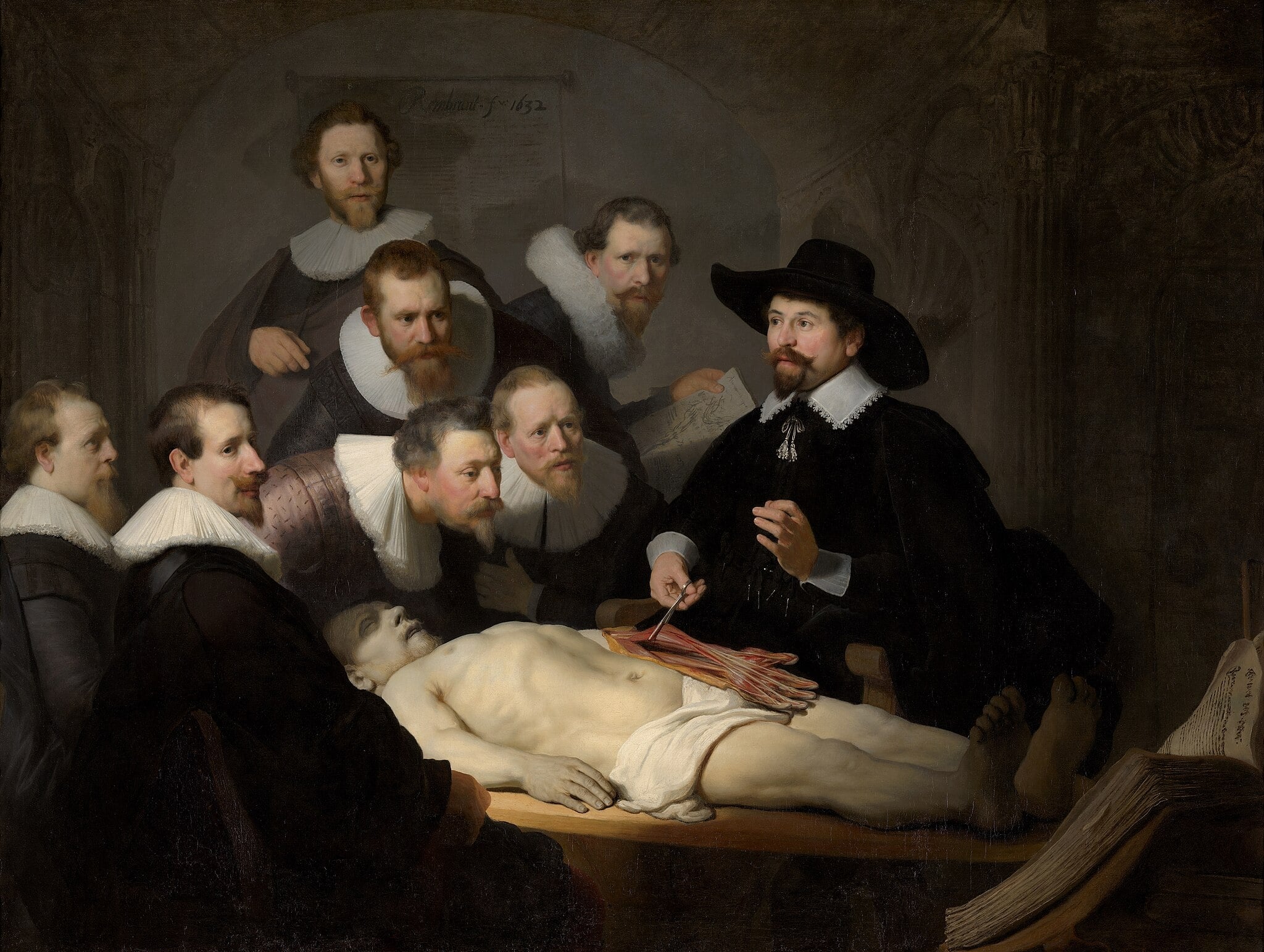
The Anatomy Lesson of Dr. Nicolaes Tulp
Rembrandt van Rijn (1632)
Rembrandt van Rijn turns a civic commission into a drama of <strong>knowledge made visible</strong>. A cone of light binds the ruff‑collared surgeons, the pale cadaver, and Dr. Tulp’s forceps as he raises the <strong>forearm tendons</strong> to explain the hand. Book and body face each other across the table, staging the tension—and alliance—between <strong>textual authority</strong> and <strong>empirical observation</strong> <sup>[1]</sup><sup>[2]</sup>.
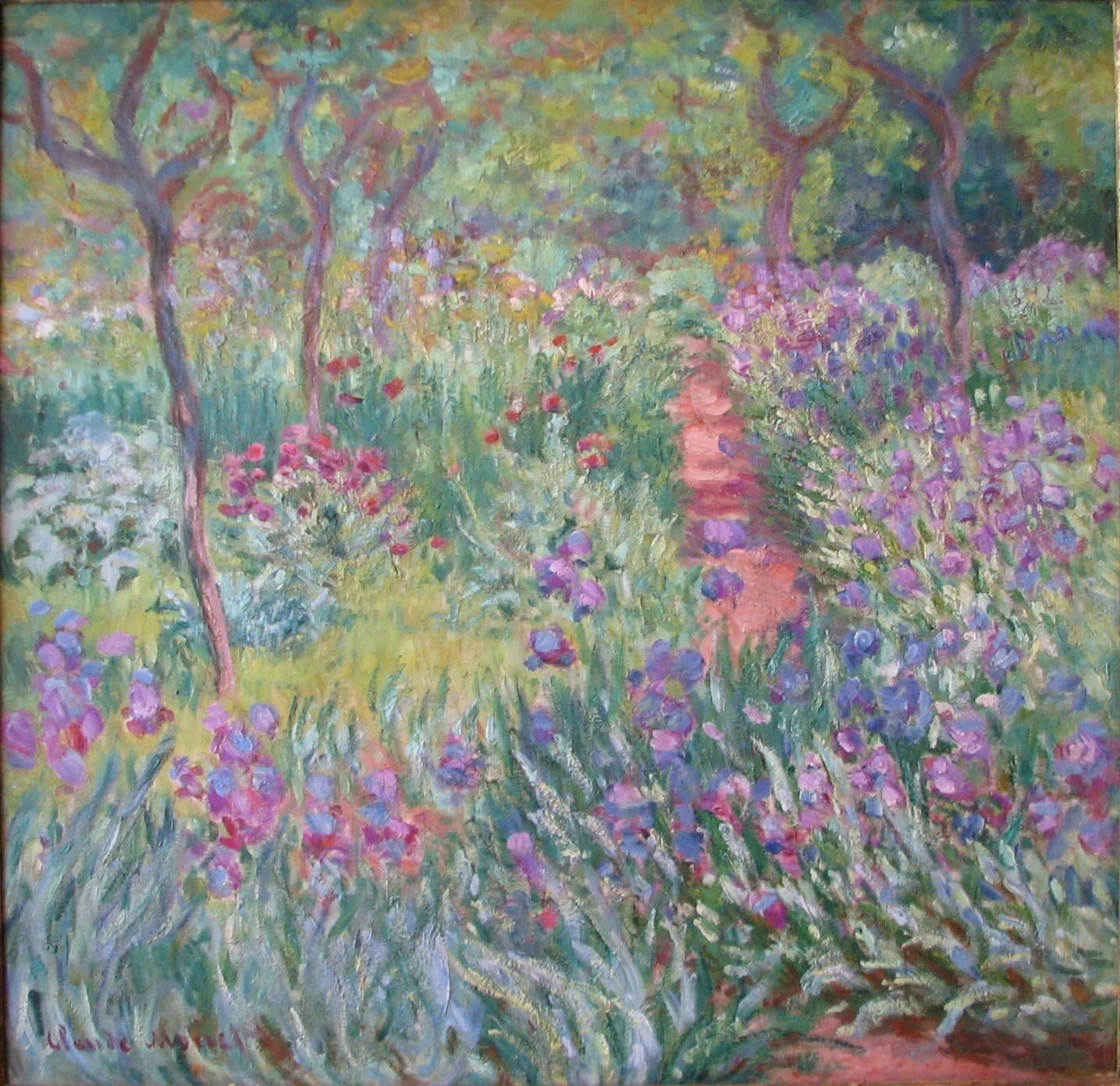
The Artist's Garden at Giverny
Claude Monet (1900)
In The Artist's Garden at Giverny, Claude Monet turns his cultivated Clos Normand into a field of living color, where bands of violet <strong>irises</strong> surge toward a narrow, rose‑colored path. Broken, flickering strokes let greens, purples, and pinks mix optically so that light seems to tremble across the scene, while lilac‑toned tree trunks rhythmically guide the gaze inward <sup>[1]</sup><sup>[3]</sup>.
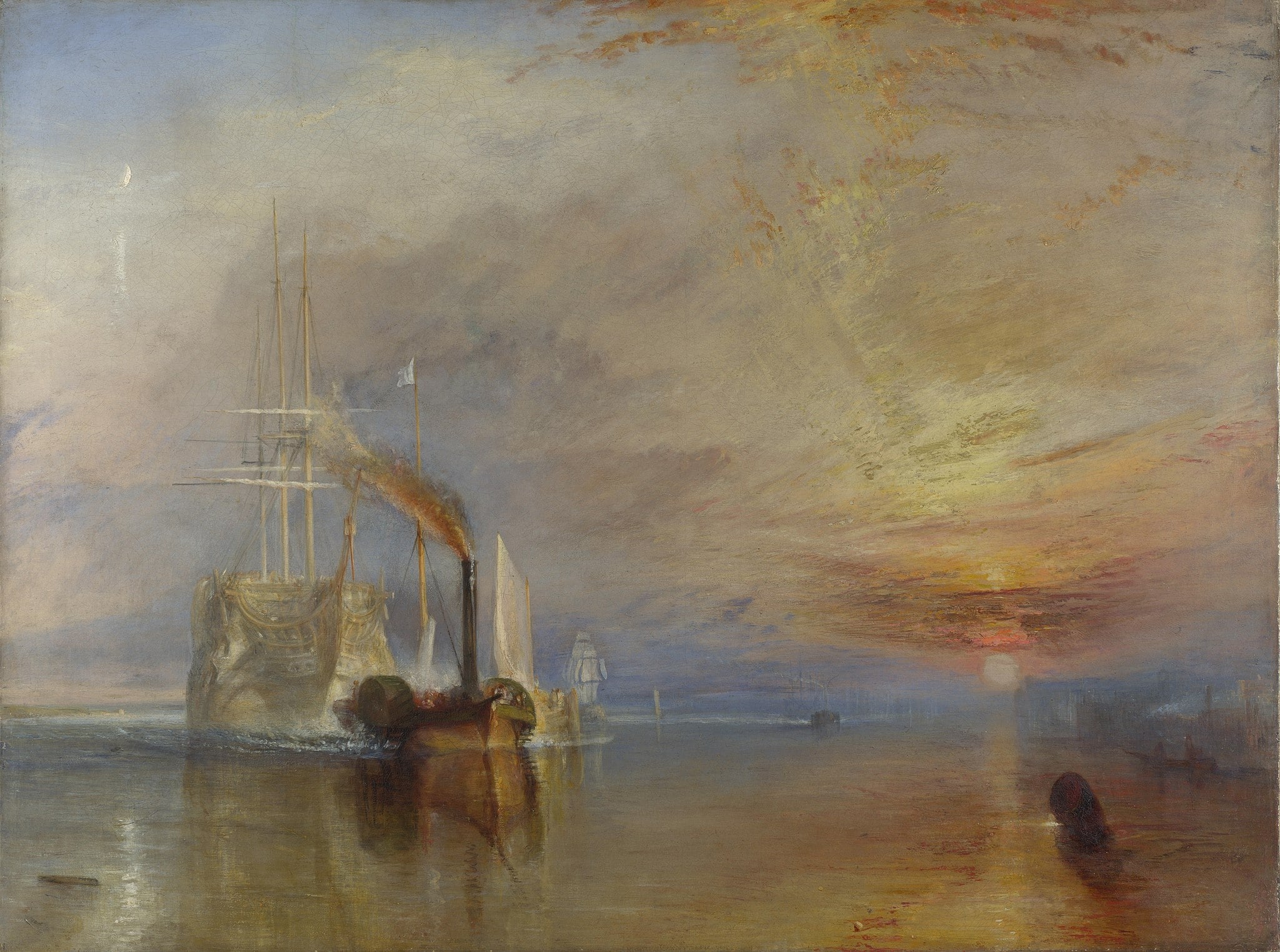
The Fighting Temeraire
J. M. W. Turner (1839)
In The Fighting Temeraire, J. M. W. Turner sets a <strong>ghostly man‑of‑war</strong> against a <strong>sooty steam tug</strong> under a blazing, emblematic sunset. The pale ship’s towering masts and slack rigging read like memory, while the tug’s black smoke cuts through the rigging where a flag once flew, signaling <strong>power passing from sail to steam</strong> <sup>[1]</sup><sup>[2]</sup>. A crescent moon and a humble buoy punctuate a river turned to molten gold, marking both ending and beginning <sup>[3]</sup><sup>[4]</sup>.
The Opera Orchestra by Edgar Degas | Analysis
Edgar Degas
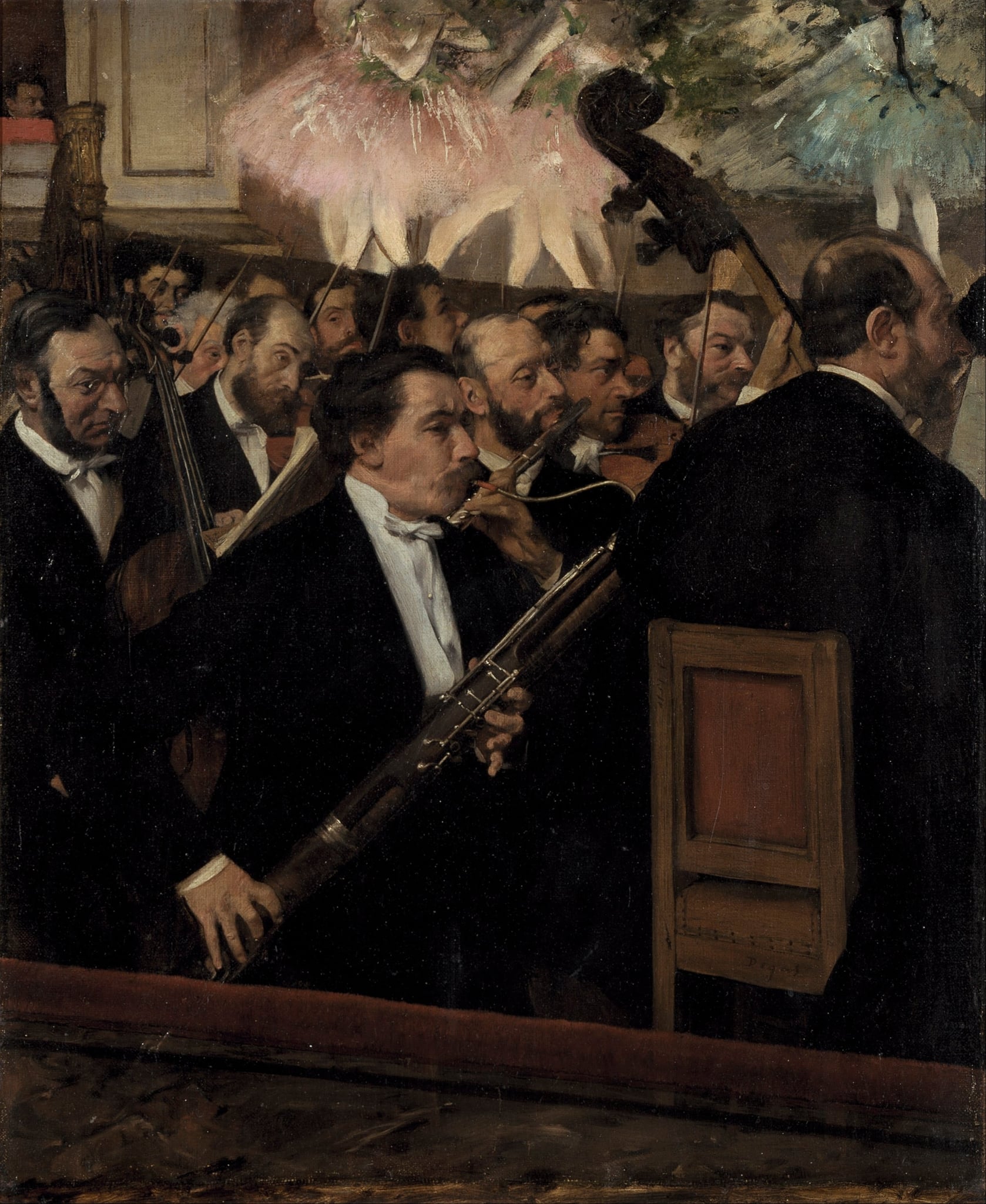
In The Opera Orchestra, Degas flips the theater’s hierarchy: the black-clad pit fills the frame while the ballerinas appear only as cropped tutus and legs, glittering above. The diagonal <strong>bassoon</strong> and looming <strong>double bass</strong> marshal a dense field of faces lit by footlights, turning backstage labor into the subject and spectacle into a fragment <sup>[1]</sup><sup>[2]</sup>.
The Red Vineyard
Vincent van Gogh (1888)
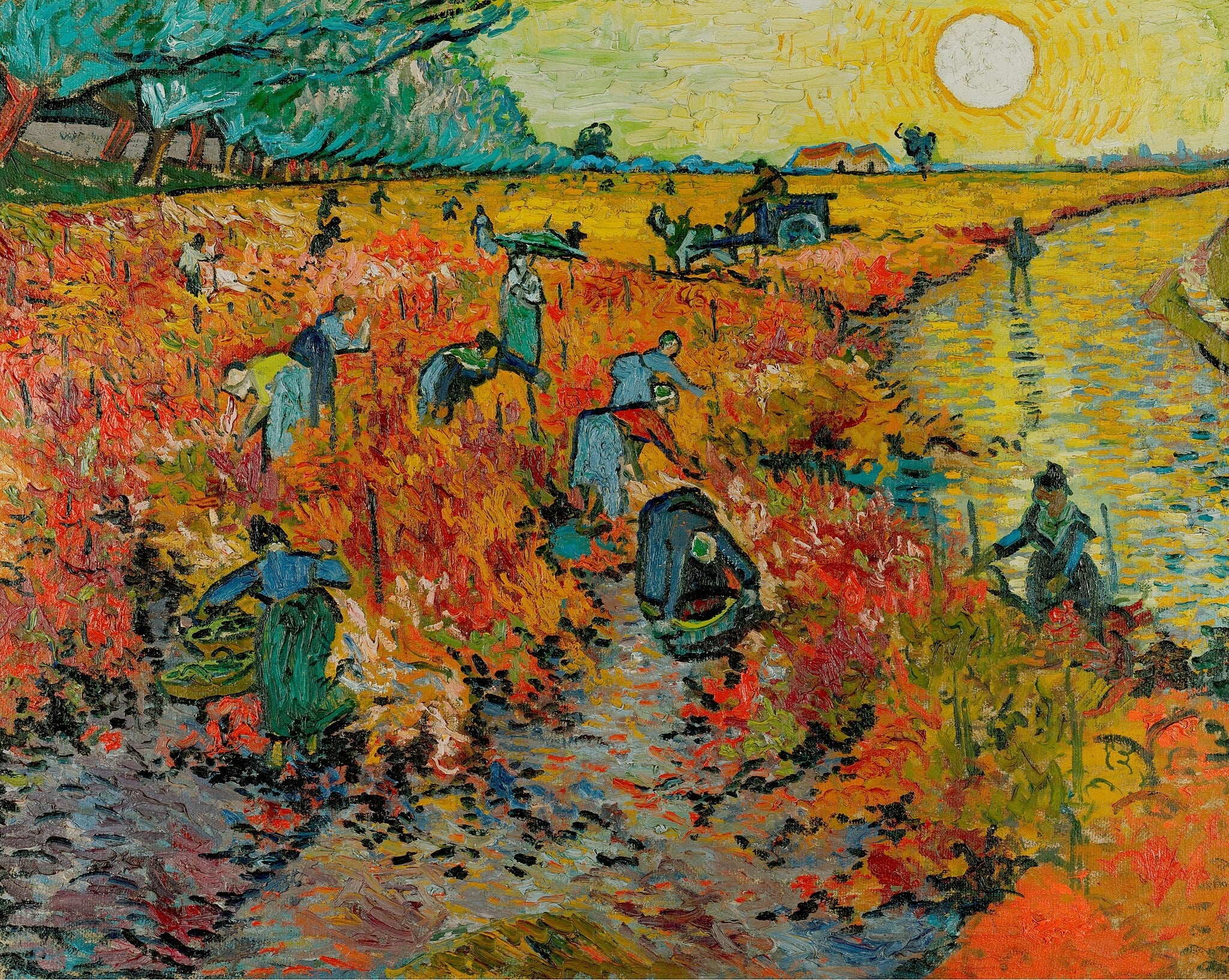
In The Red Vineyard, Vincent van Gogh forges a vision of <strong>autumn labor under a blazing sun</strong>, where harvesters flow diagonally through scarlet vines while a band of <strong>yellow light</strong> flares along a reflective roadway. The scene fuses <strong>exhaustion and ripeness</strong>, turning work into a rhythmic, almost liturgical procession <sup>[1]</sup><sup>[3]</sup>.
The Rehearsal of the Ballet Onstage
Edgar Degas (ca. 1874)
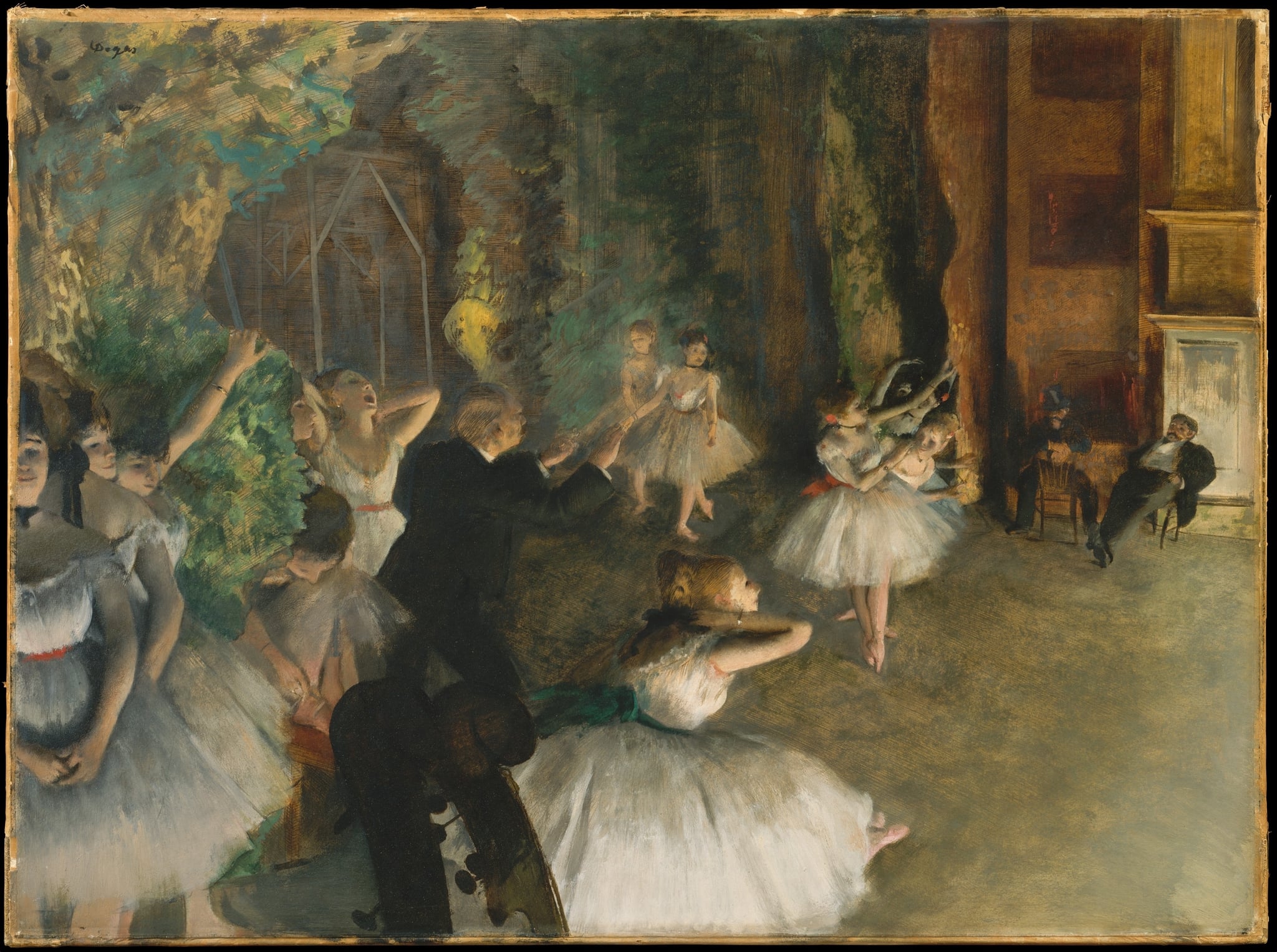
Degas’s The Rehearsal of the Ballet Onstage turns a moment of practice into a modern drama of work and power. Under <strong>harsh footlights</strong>, clustered ballerinas stretch, yawn, and repeat steps as a <strong>ballet master/conductor</strong> drives the tempo, while <strong>abonnés</strong> lounge in the wings and a looming <strong>double bass</strong> anchors the labor of music <sup>[1]</sup><sup>[3]</sup><sup>[4]</sup>.
The Swing
Pierre-Auguste Renoir (1876)
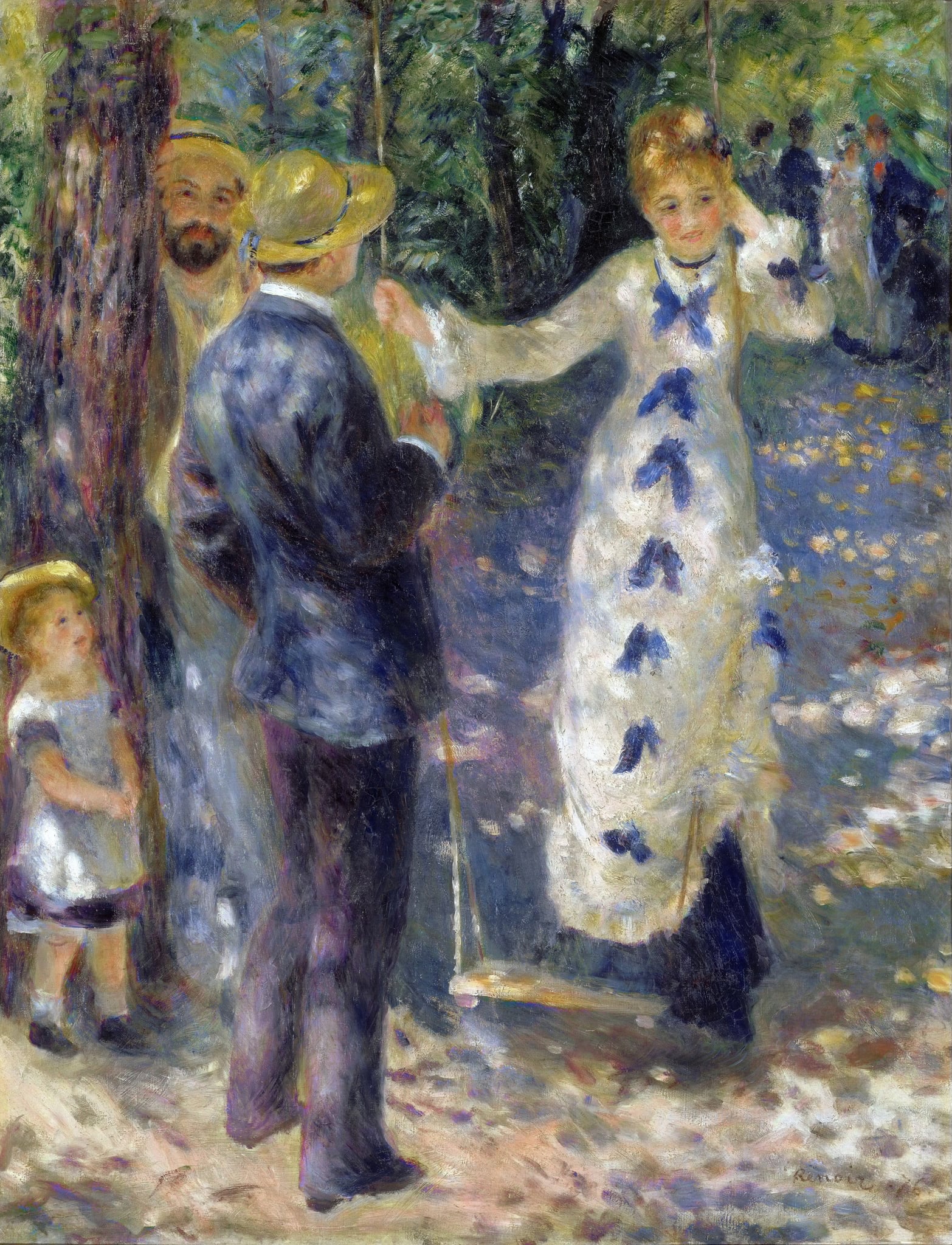
Renoir’s The Swing fixes a fleeting, sun-dappled exchange in a Montmartre garden, where a woman in a white dress with blue bows steadies herself on a swing while a man in a blue jacket addresses her. The scene crystallizes <strong>modern leisure</strong>, <strong>flirtation</strong>, and <strong>optical shimmer</strong>, as broken strokes scatter light over faces, fabric, and ground <sup>[1]</sup><sup>[4]</sup>.
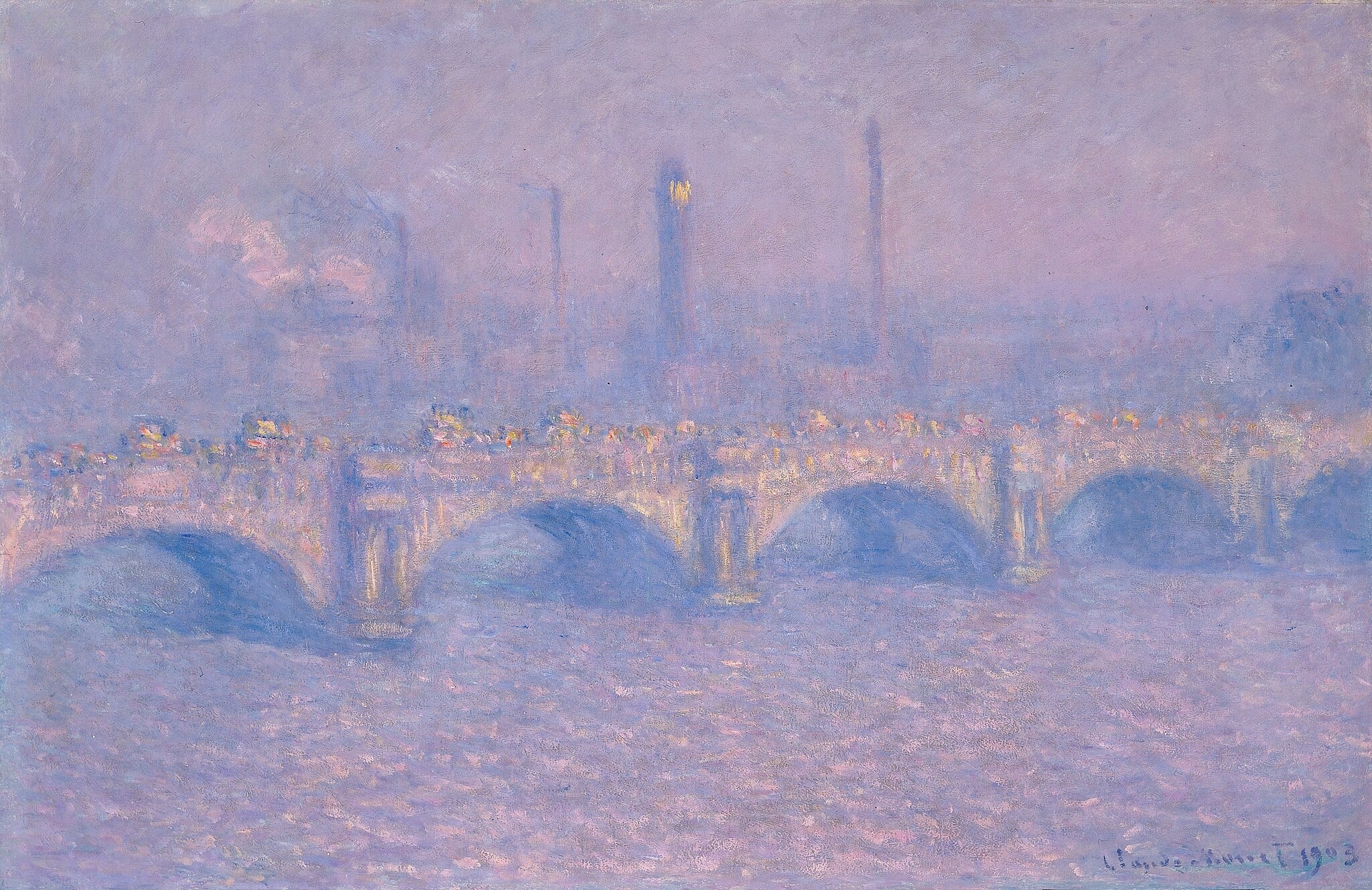
Waterloo Bridge, Veiled Sun
Claude Monet (1903)
Claude Monet’s Waterloo Bridge, Veiled Sun renders London as a field of vibrating color where <strong>atmosphere</strong> overtakes architecture. The bridge’s cool violet arches and the tiny <strong>veiled sun</strong>—a gold pin of light above the parapet—stage a dialogue between urban <strong>modernity</strong> and shifting light.
Related Themes
Related Symbolism Categories
Vision
The vision symbolism category traces how eyes, gazes, and optical devices become charged signs that negotiate power, interiority, and mortality from Renaissance sfumato to modernist mask-like faces and ornamental ‘eyes.’
Urbanity
Urbanity symbolism charts how modern artists turned lamps, boulevards, bridges, canopies, and crowds into a visual language for municipal order, technological illumination, and the new, anonymous sociability of the nineteenth- and early twentieth‑century city.
Landscape
Landscape symbolism in modern painting transforms rivers, trees, bridges, and distant horizons into active sign-systems for labor, leisure, perception, and cyclical time, reworking inherited Arcadian and religious motifs under industrial and Impressionist conditions.
Within the history of Western art, the representation of light gradually shifts from a subordinate means of rendering form to a primary vehicle of meaning. Illumination becomes not merely a technical problem but a symbolic language through which artists negotiate revelation, modernity, and the instability of perception. The symbols grouped under this category—ranging from the Baroque “beam of light” to the Impressionist “fog/haze” and the modern “electric arc lamps” and “fluorescent light”—mark key nodes in this evolution. They articulate how light structures moral attention, how new technologies reorder nocturnal life, and how atmosphere dissolves the apparent solidity of the world into time‑bound sensation.
At one pole stand symbols in which light functions as a theologically inflected sign of revelation and judgment. The “beam of light” codifies this tradition: a focused shaft that cuts through darkness to disclose truth. Even though the collection illustrates it via a Rembrandt example outside our holdings, the logic is clear. The beam isolates the morally decisive figure or action, staging what the entry calls “a moment of judgment while underscoring the possibility of mercy.” Semiotic force resides in selective visibility: to be held in the beam is to be subject to scrutiny yet also to grace. Related devices—“chiaroscuro (focused light and deep shadow),” “chiaroscuro light patches,” or “cone of light against deep shadow (tenebrism)”—share this grammar. They construe darkness as the realm of ignorance or uncertainty, while light, parceled out in concentrated zones, becomes a sign of knowledge, inward presence, or ethical emphasis.
The unrealized symbol of the “negative halo” (light and shadow around Christ’s head) extends this logic by stripping away the literal aureole and allowing contrast itself to function as the mark of sanctity. Here revelation is not attached to a drawn emblem but emerges from an event of illumination: the head ringed by a field of brightness or reserve of darkness. Even in its absence from the current collection, it is conceptually adjacent to the beam and cone: all three transpose theological claims into visual hierarchies of light.
As the nineteenth century unfolds, however, light’s authority becomes increasingly secular and technological. Camille Pissarro’s Boulevard Montmartre at Night (1897) is paradigmatic. The work hinges on the symbol of “electric arc lamps”: “cool electric halos and warm gaslit windows shimmer across rain‑slick stone,” organizing the boulevard into two parallel streams of illumination. Semiotic emphasis has shifted from divine intervention to civic infrastructure. The evenly spaced, bluish orbs of arc light establish a new rhythm for the nocturnal city, converting “darkness into a civic spectacle” and demonstrating that municipal lighting now determines what is visible and desirable in urban life. Pissarro differentiates light sources—cold electric, warm gas, advertising glows—not to moralize but to map a modern system of visibility in which individuals are subsumed into a “flowing current” of traffic and consumption.
Edward Hopper’s Nighthawks (1942) offers a later, American inflection of this technological symbolism through “fluorescent light.” Inside the corner diner, a “white fluorescent wash falls hard on the counter and faces, bleaching color toward the greenish end of the spectrum and giving the light an almost clinical authority.” Unlike the Baroque beam that isolates a figure for mercy, fluorescent glare exposes without consolation. It is a “beacon without warmth,” clarifying spatial relations and objects while intensifying psychological distance. The curved glass prevents physical approach; the light traps the figures in a sealed, hyper-visible interior set against an emptied, darkened street. Here modern illumination signifies both safety and surveillance, a condition of being perpetually on display yet existentially remote. If Pissarro’s arc lamps celebrate the metropolis as a collective spectacle, Hopper’s fluorescent field freezes modern subjects in a tableau of shared but solitary wakefulness.
Running alongside this technological strand is a distinct but related current in which light and atmosphere become the subject of painting itself. Claude Monet’s repeated engagement with fog, steam, and afterglow—Gare Saint‑Lazare (1877), Waterloo Bridge, Veiled Sun (1903), Houses of Parliament (1903), and San Giorgio Maggiore at Dusk (1908–1912)—anchors this transformation. In Gare Saint‑Lazare, “clouds of steam—painted in broken violets, blue‑grays, and milky whites—rise to occupy the very place a sky would be in a landscape,” turning industrial exhaust into the luminous atmosphere of a new kind of interior. The symbol “clouds of steam/smoke” thus re-signifies smoke: no longer mere by-product, it becomes a medium that “dissolve[s] into bluish vapor,” aligning industrial time with the fugitive meteorology previously reserved for landscape.
In Waterloo Bridge, Veiled Sun and Houses of Parliament, catalogued under “fog/haze (atmosphere)” and “dissolving atmospheric sky,” Monet pushes this further. London’s fog “overtakes architecture: the bridge’s cool violet arches loosen into tone,” while Westminster’s Gothic mass “becomes a transient envelope of color where authority is filtered by fog and time.” Semiotic emphasis has inverted the earlier beam-of-light model. Here power and structure are what risk disappearing; atmosphere is what persists. Light scattered through particulates—industrial haze, river mist—renders the seat of government and the city’s infrastructure as provisional silhouettes within a continuum of color. The symbol “diffused sun,” as in Waterloo Bridge, Veiled Sun, consolidates this: the solar disc is no longer a commanding, blazing taskmaster but a “tiny veiled sun” that registers the degree to which pollution and weather mediate perception.
San Giorgio Maggiore at Dusk introduces yet another light-symbolic inflection: “blazing sunset and molten path of light” transformed into a serial meditation on permanence and flux. The Benedictine church is reduced to a “purple-black silhouette” against a sky that “graduates from molten oranges at the horizon to greens and deep cobalt in the upper band,” its reflection forming a trembling vertical spine in the basin. The “dissolving horizon and pale sky” motif, present across Monet’s late work, stages transcendence not as a vision granted from above but as the world “thinning into the immaterial and infinite” through sheer chromatic vibration. The path of light across the water becomes a corridor of time rather than a theophany, connecting the viewer’s present to the monument’s historical endurance through a shared field of evening afterglow.
These atmospheric symbols are conceptually aligned with the more micro-scale Impressionist motifs of “dappled shadows,” “dappled light and leaf-shadows,” and “flickering brushstrokes,” apparent in works such as Monet’s Camille Monet in the Garden at Argenteuil. In that canvas, “the garden…pulsates with light”; trunks, blossoms, and architecture are “breathed into being by broken strokes” that prioritize the registration of passing illumination over stable contour. Dappled passages operate as signs of time-bound perception, asserting that to see is to witness continual change. Where the Baroque beam arrests time around a decisive moral instant, Impressionist flicker insists that no instant can be fully fixed.
Across these examples, the internal connections among light symbols become evident. The Baroque “beam of light,” the Christological “negative halo,” and the “cone of light against deep shadow” model illumination as selective revelation, ethically or spiritually charged. Nineteenth-century and modern urban motifs—“electric arc lamps,” “electric lights and chandeliers,” “fluorescent light”—translate this selective power into the register of technology and social experience: who or what is visibly included in the nocturnal city, under what kind of glare. Meanwhile, atmospheric symbols—“fog/haze,” “dissolving atmospheric sky,” “clouds of steam/smoke,” “diffused sun,” “dappled shadows”—shift emphasis from the lit object to the medium, redefining light as the unstable condition through which all forms are apprehended.
Seen diachronically, the evolution of these symbols charts a movement from metaphysical certainty toward phenomenological and technological complexity. Illumination once guaranteed meaning; the halo and beam ratified sanctity and truth. By the time of Monet and Hopper, light no longer guarantees but interrogates visibility: fog that dematerializes Parliament, fluorescent tubes that expose loneliness, arc lamps that reorder the street into an anonymous current. Yet the category retains a continuity: in every period, to manipulate light symbolically is to ask what deserves to be seen, under what conditions, and with what ethical or experiential charge. The history of these symbols is thus a history of how art reimagines revelation—divine, civic, psychological—as an event of illumination in a world where both darkness and glare remain in constant negotiation.