Space
In modern painting, spatial symbols become active structures that organize perception, articulate social modernity, and reimagine depth as a charged field of circulation, isolation, and communal ritual.
Member Symbols
Featured Artworks
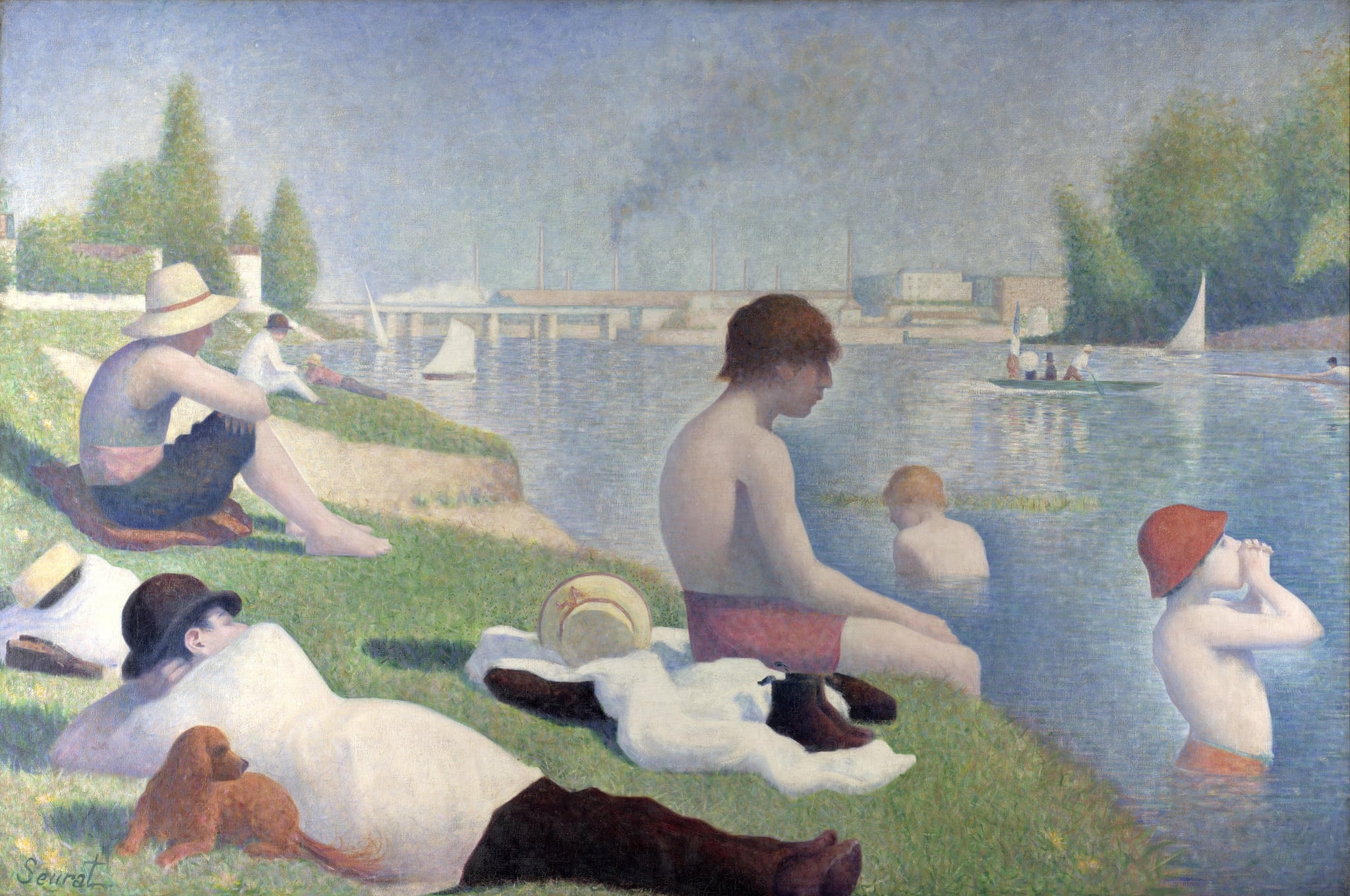
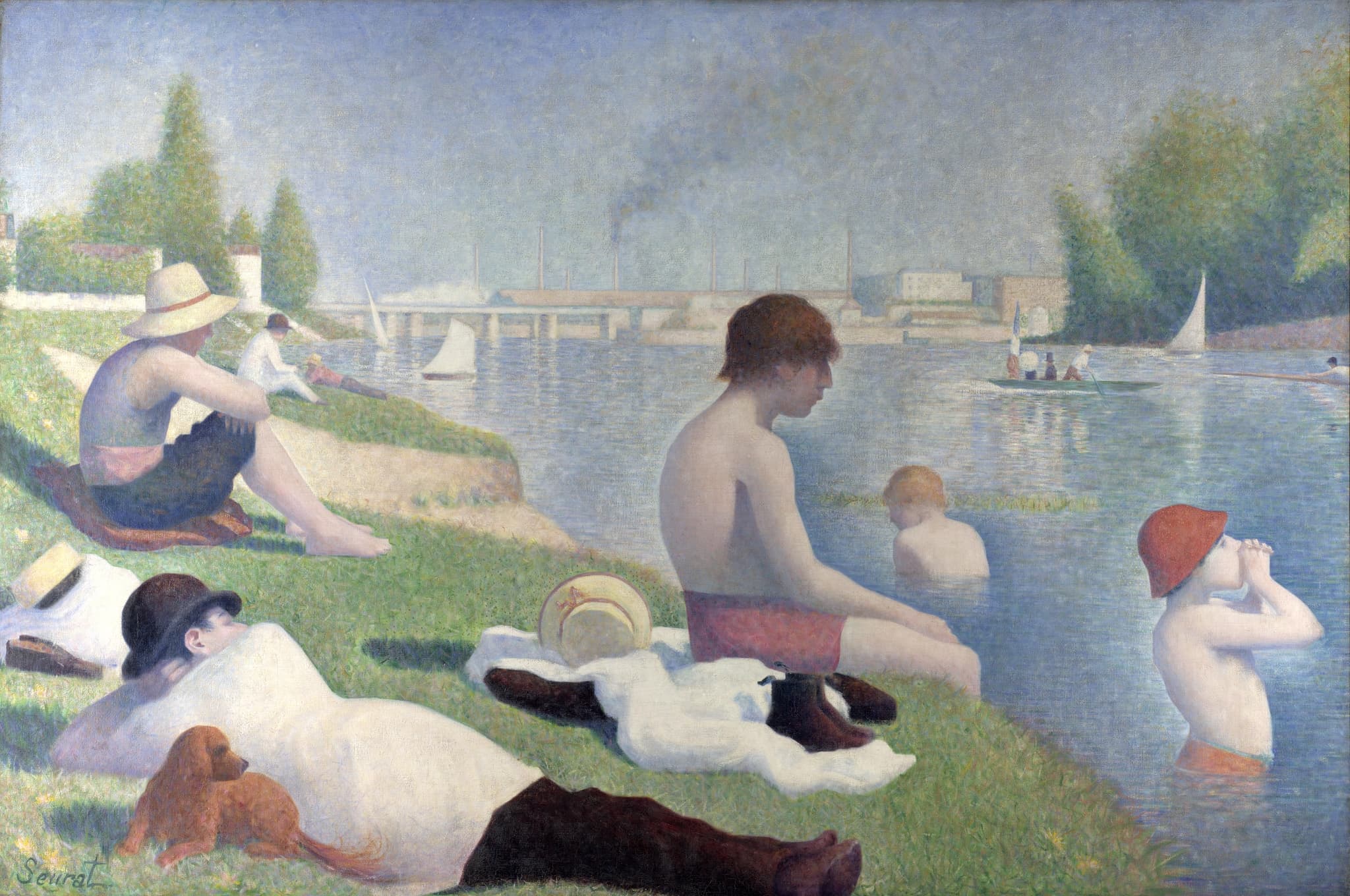
Bathers at Asnières
Georges Seurat (1884)
Bathers at Asnières stages a scene of <strong>modern leisure</strong> on the Seine, where workers recline and wade beneath a hazy, unified light. Seurat fuses <strong>classicizing stillness</strong> with an <strong>industrial backdrop</strong> of chimneys, bridges, and boats, turning ordinary rest into a monumental, ordered image of urban life <sup>[1]</sup><sup>[3]</sup>. The canvas balances soft greens and blues with geometric structures, producing a calm yet charged harmony.
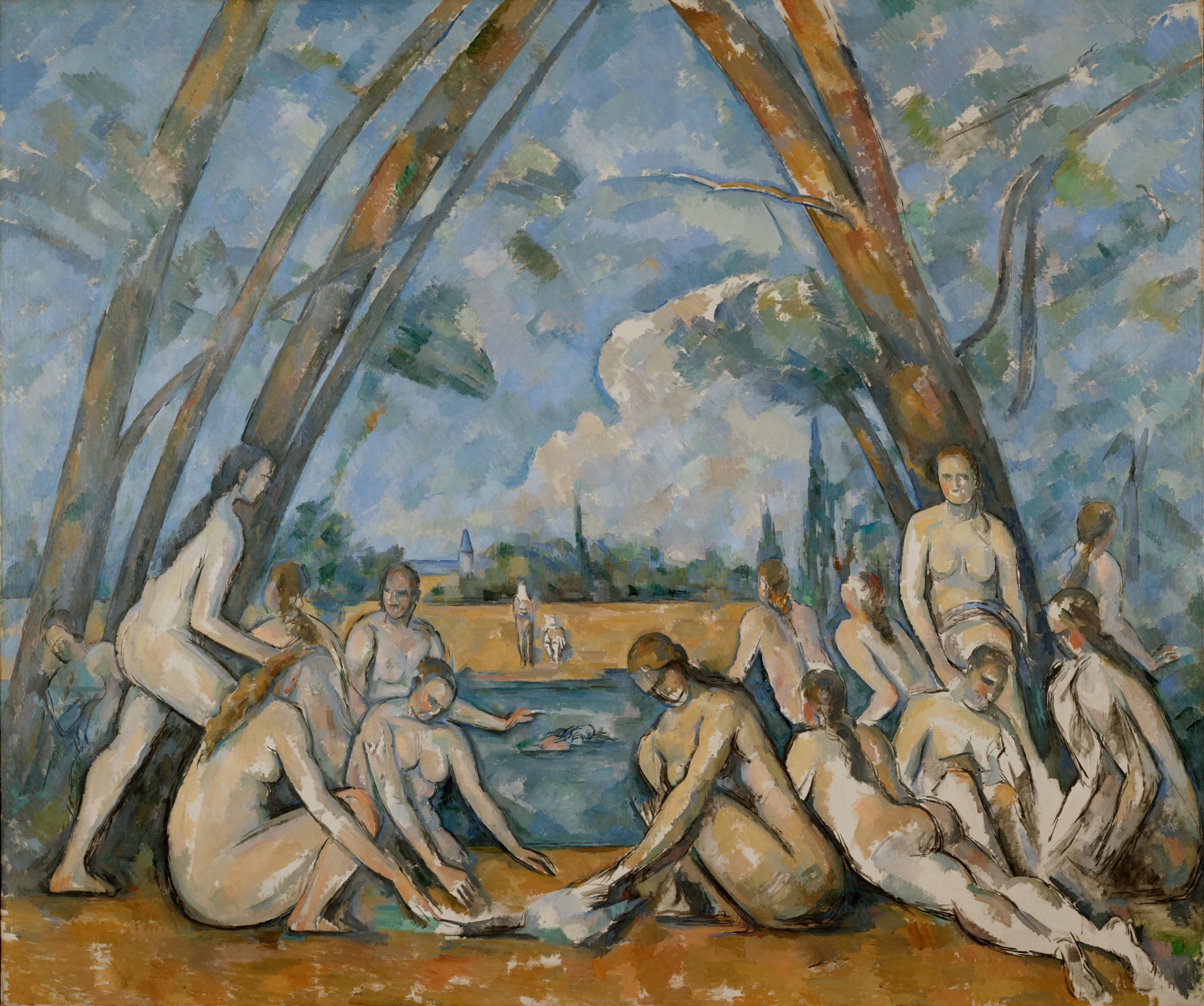
Bathers by Paul Cézanne: Geometry of the Modern Nude
Paul Cézanne
In Bathers, Paul Cézanne arranges a circle of generalized nudes beneath arching trees that meet like a <strong>natural vault</strong>, staging bathing as a timeless rite rather than a specific story. His <strong>constructive brushwork</strong> fuses bodies, water, and sky into one geometric order, balancing cool blues with warm ochres. The scene proposes a measured <strong>harmony between figure and landscape</strong>, a culmination of Cézanne’s search for enduring structure <sup>[1]</sup><sup>[2]</sup>.
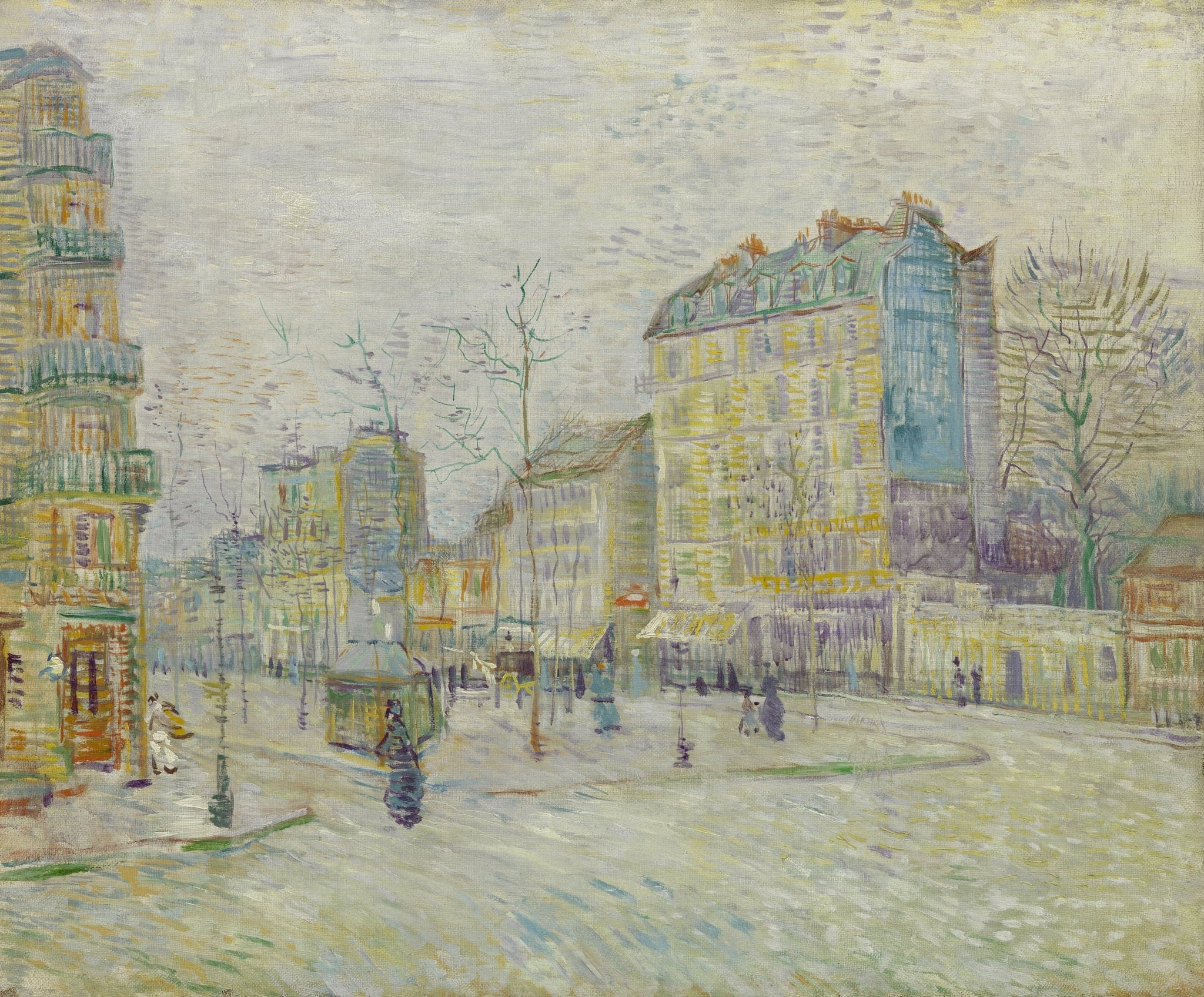
Boulevard de Clichy
Vincent van Gogh (1887)
Vincent van Gogh’s Boulevard de Clichy crystallizes a cool, wintry Paris into a <strong>vibrating field of light</strong> and motion. With leafless trees echoing lamp posts and façades stitched from lilac, blue, and sulfurous yellow strokes, the boulevard bends like a <strong>slow river of modernity</strong>. Tiny bundled figures drift across the cobbles, signaling the city’s <strong>anonymous flow</strong>.
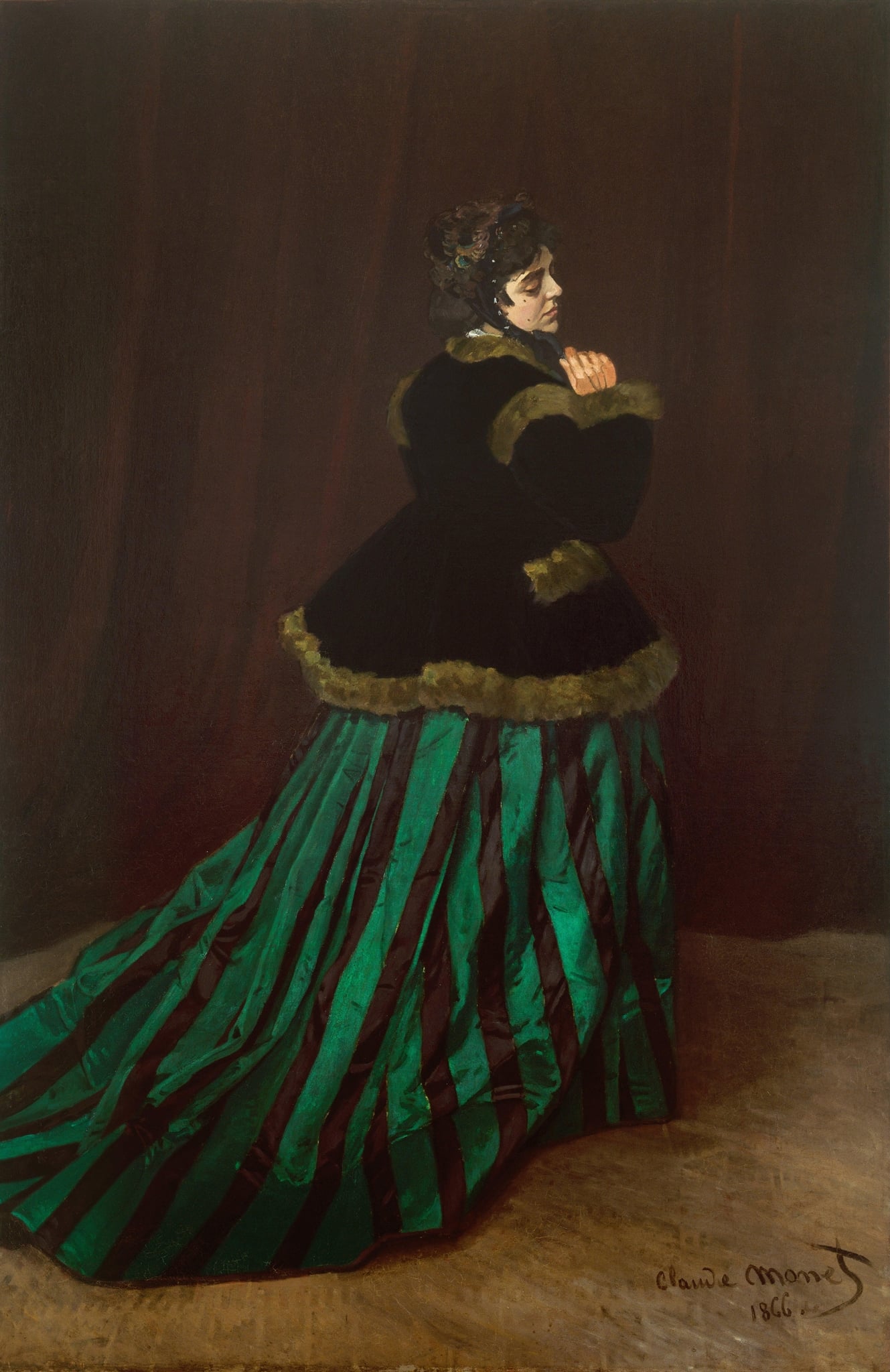
Camille (The Woman in the Green Dress)
Claude Monet (1866)
Monet’s Camille (The Woman in the Green Dress) turns a full-length portrait into a study of <strong>modern spectacle</strong>. The spotlit emerald-and-black skirt, set against a near-black curtain, makes <strong>fashion</strong> the engine of meaning and the vehicle of status.
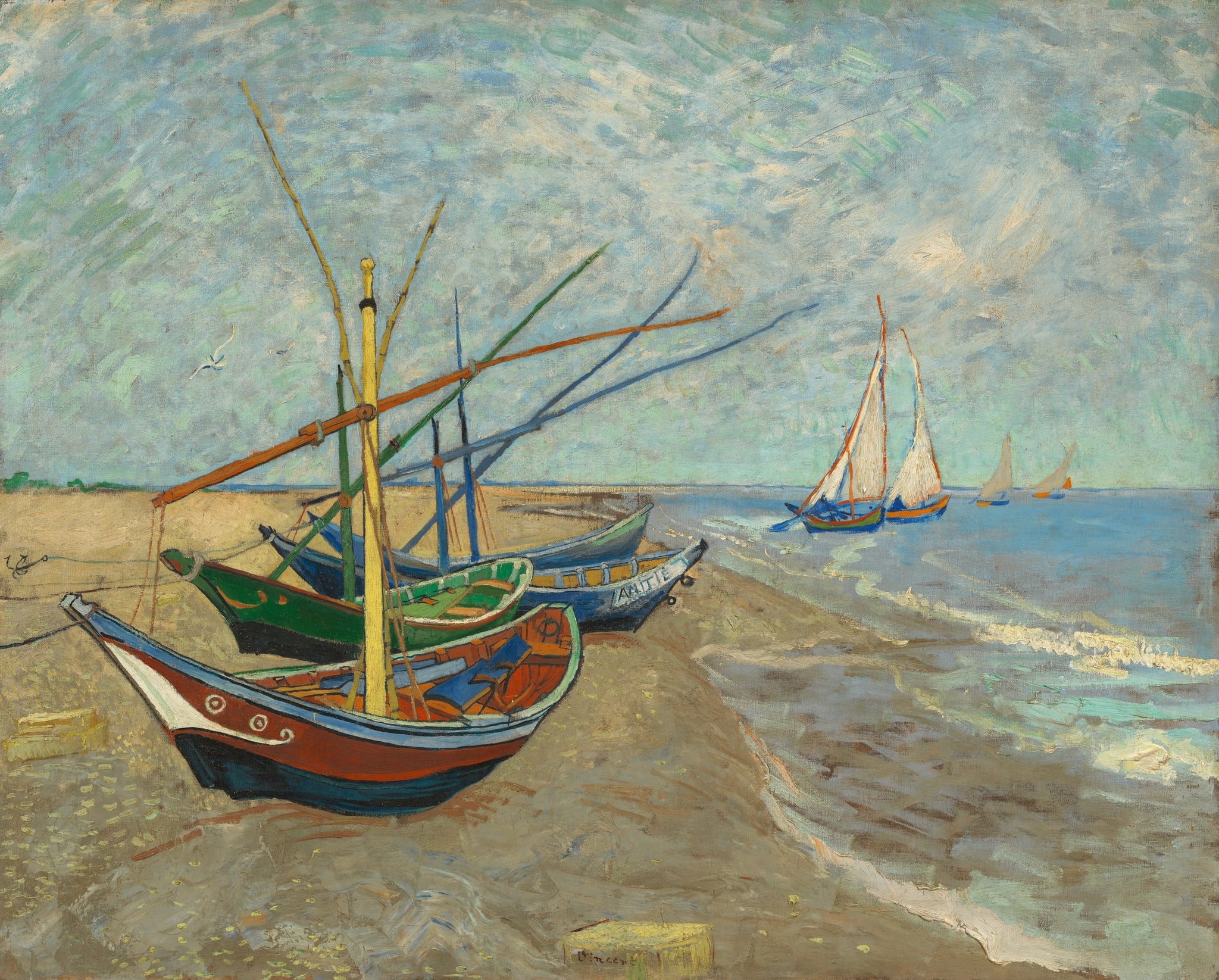
Fishing Boats on the Beach at Les Saintes-Maries-de-la-Mer
Vincent van Gogh (1888)
Vincent van Gogh lines up a file of beached craft like actors awaiting their cue, turning working boats into <strong>emblems of readiness and risk</strong>. Bold contours, flattened color, and the wind‑tossed sea and sky translate Mediterranean luminosity into a <strong>Japonisme/Cloisonnism</strong> idiom that clarifies form and heightens feeling. The scene suspends time at the edge of departure, where labor, hope, and the sea’s pull meet.
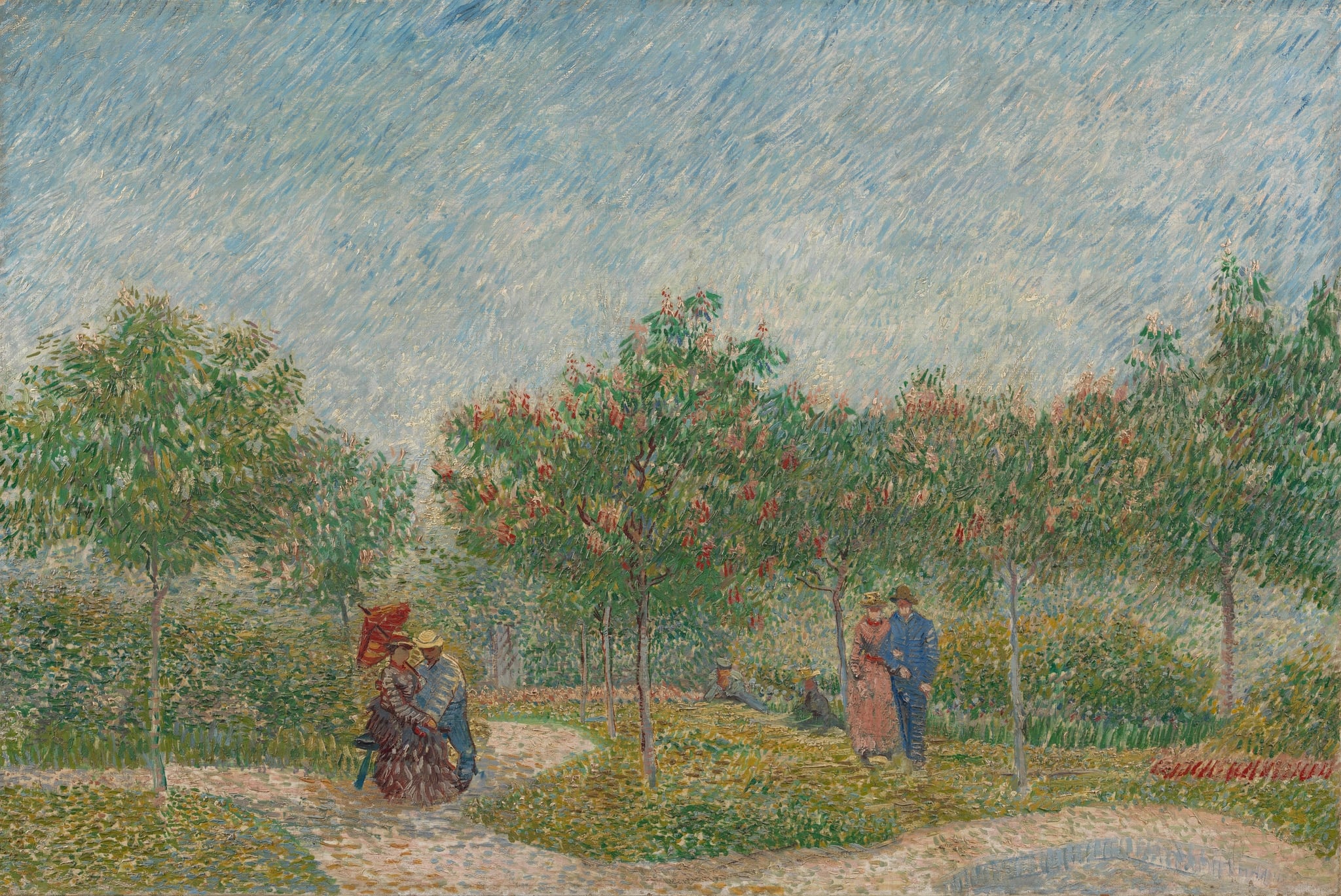
Garden with Courting Couples: Square Saint-Pierre
Vincent van Gogh (1887)
In Garden with Courting Couples: Square Saint-Pierre, Vincent van Gogh turns a small Montmartre park into a stage where <strong>spring</strong>, <strong>intimacy</strong>, and <strong>urban leisure</strong> converge. Short, shimmering strokes fuse pink chestnut blossoms, curving paths, and paired figures into one pulse of <strong>renewal</strong> and <strong>togetherness</strong> <sup>[1]</sup><sup>[2]</sup>.
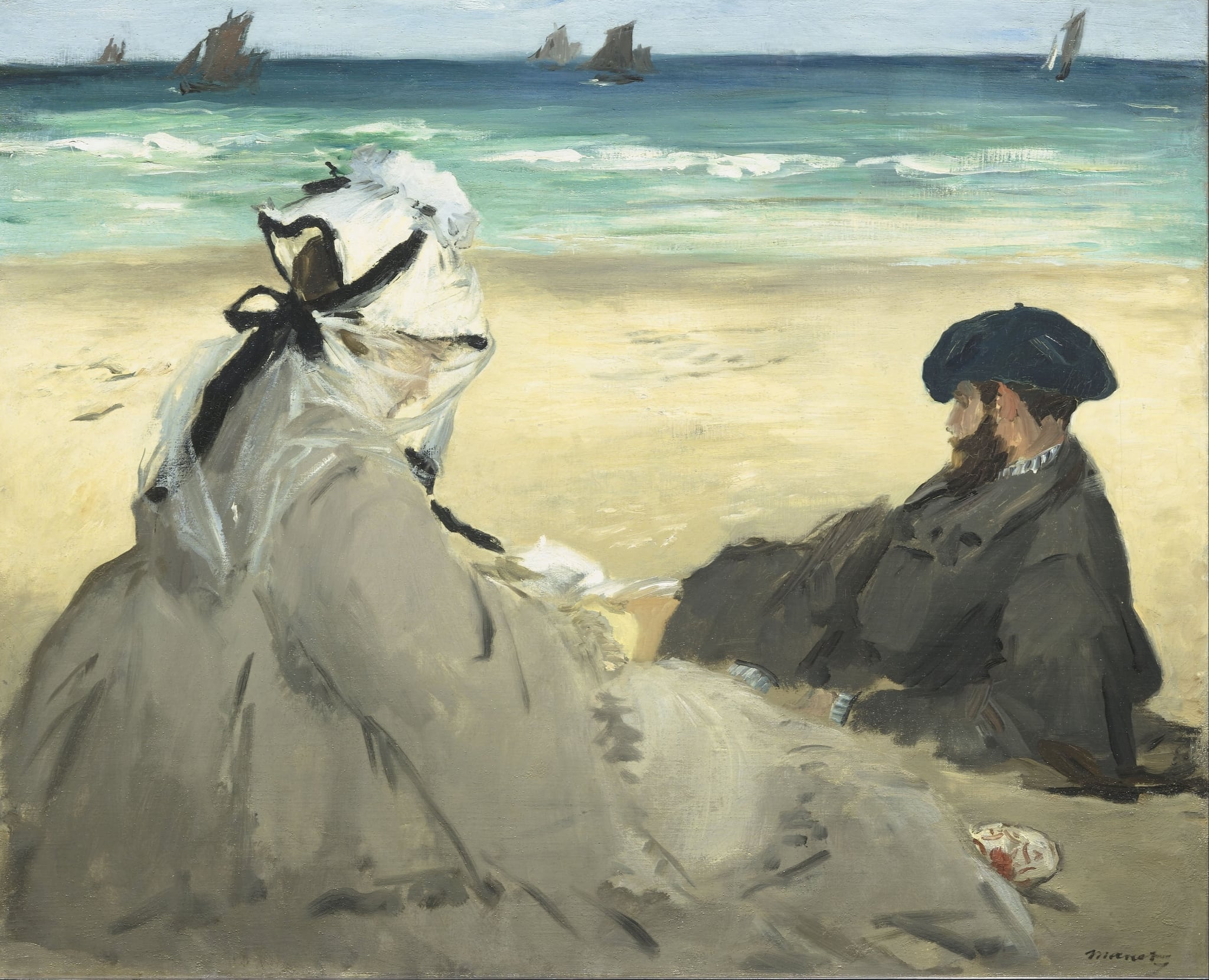
On the Beach
Édouard Manet (1873)
On the Beach captures a paused interval of modern leisure: two fashionably dressed figures sit on pale sand before a <strong>banded, high-horizon sea</strong>. Manet’s <strong>economical brushwork</strong>, restricted greys and blacks, and radical cropping stage a scene of absorption and wind‑tossed motion that feels both intimate and detached <sup>[1]</sup>.
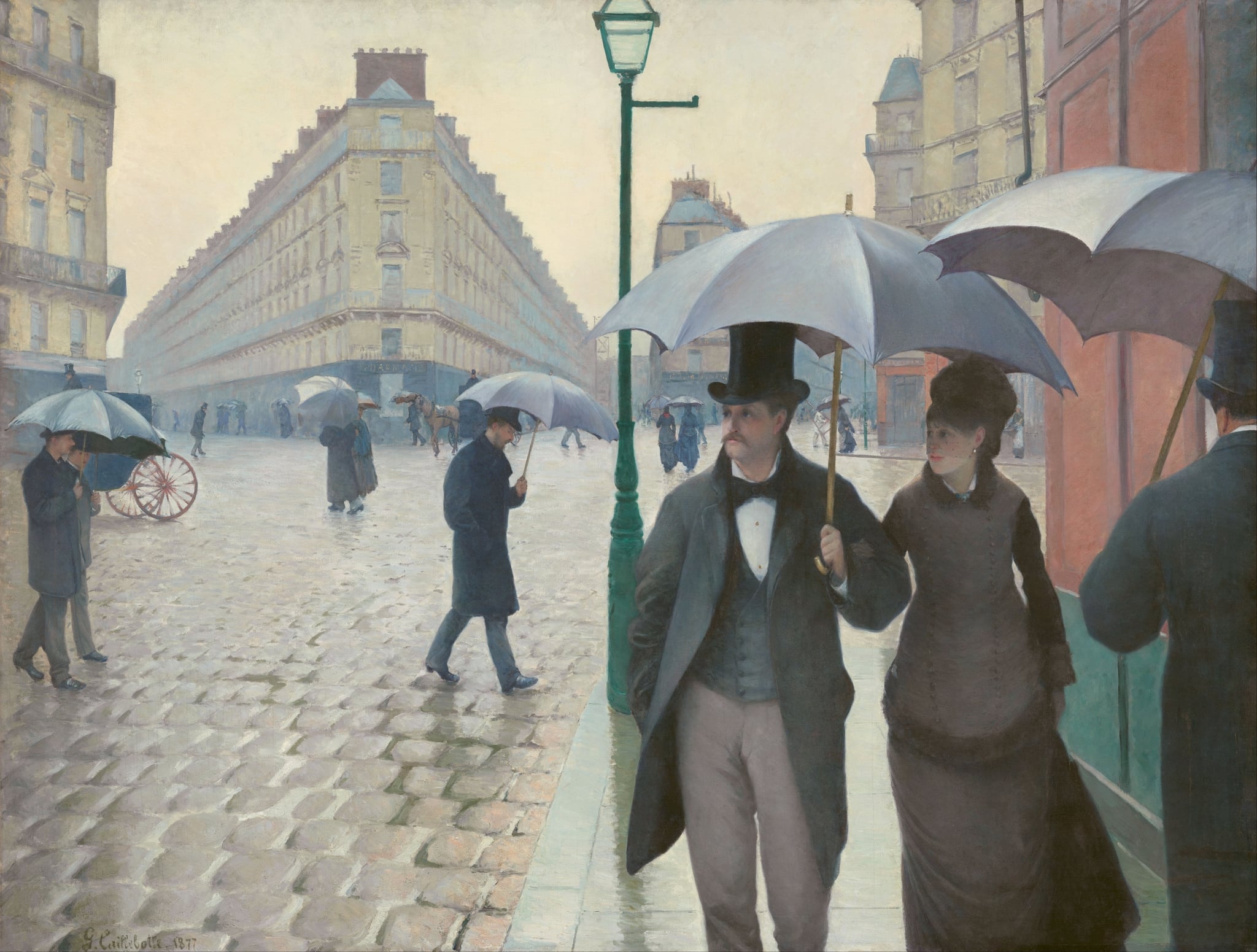
Paris Street; Rainy Day
Gustave Caillebotte (1877)
Gustave Caillebotte’s Paris Street; Rainy Day renders a newly modern Paris where <strong>Haussmann’s geometry</strong> meets the <strong>anonymity of urban life</strong>. Umbrellas punctuate a silvery atmosphere as a <strong>central gas lamp</strong> and knife-sharp façades organize the space into measured planes <sup>[1]</sup><sup>[2]</sup>.
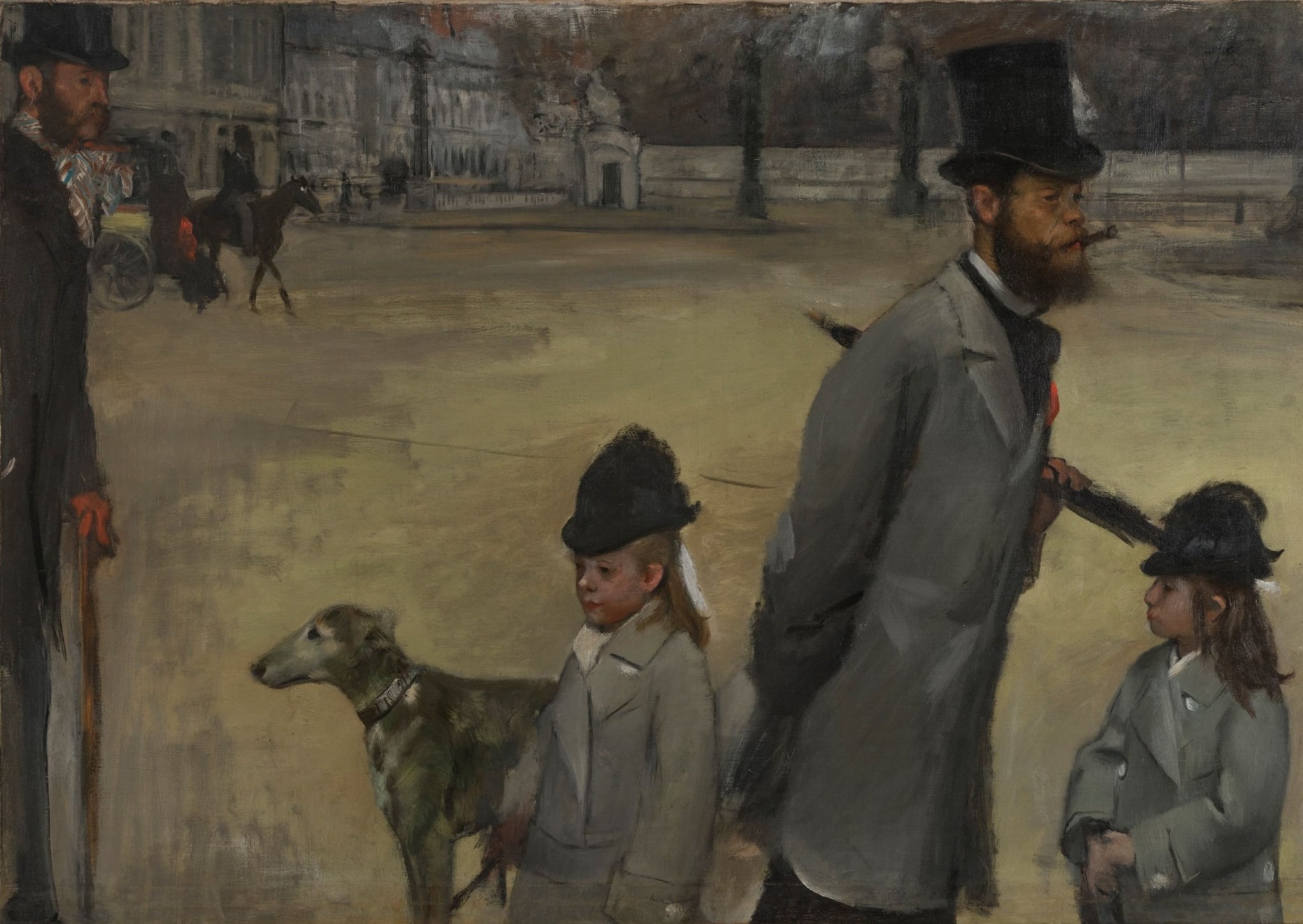
Place de la Concorde
Edgar Degas (1875)
Degas’s Place de la Concorde turns a famous Paris square into a study of <strong>modern isolation</strong> and <strong>instantaneous vision</strong>. Figures stride past one another without contact, their bodies abruptly <strong>cropped</strong> and adrift in a wide, airless plaza—an urban stage where elegance masks estrangement <sup>[1]</sup><sup>[2]</sup>.
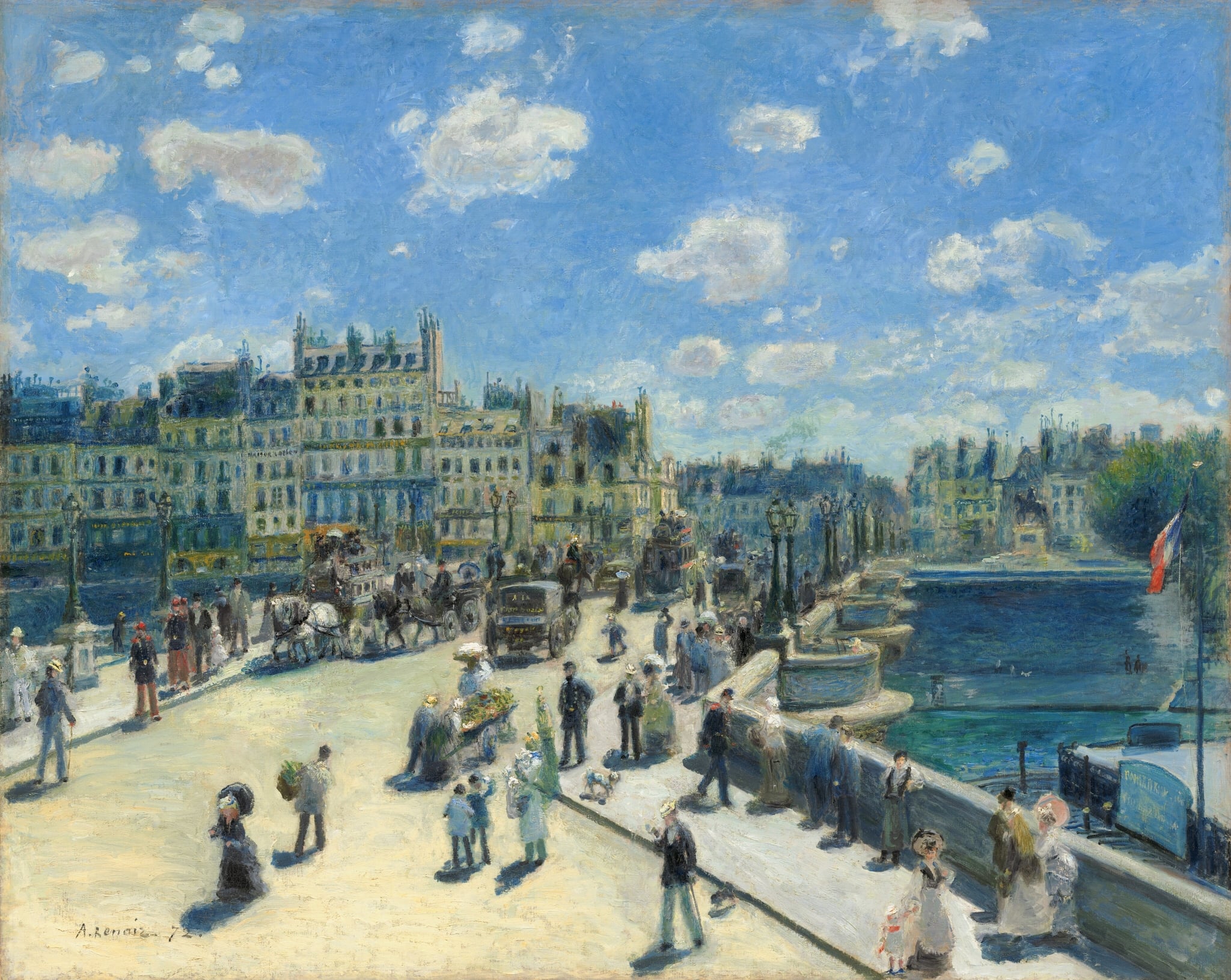
Pont Neuf Paris
Pierre-Auguste Renoir (1872)
In Pont Neuf Paris, Pierre-Auguste Renoir turns the oldest bridge in Paris into a stage where <strong>light</strong> and <strong>movement</strong> bind a city back together. From a high perch, he orchestrates crowds, carriages, gas lamps, the rippling Seine, and a fluttering <strong>tricolor</strong> so that everyday bustle reads as civic grace <sup>[1]</sup>.
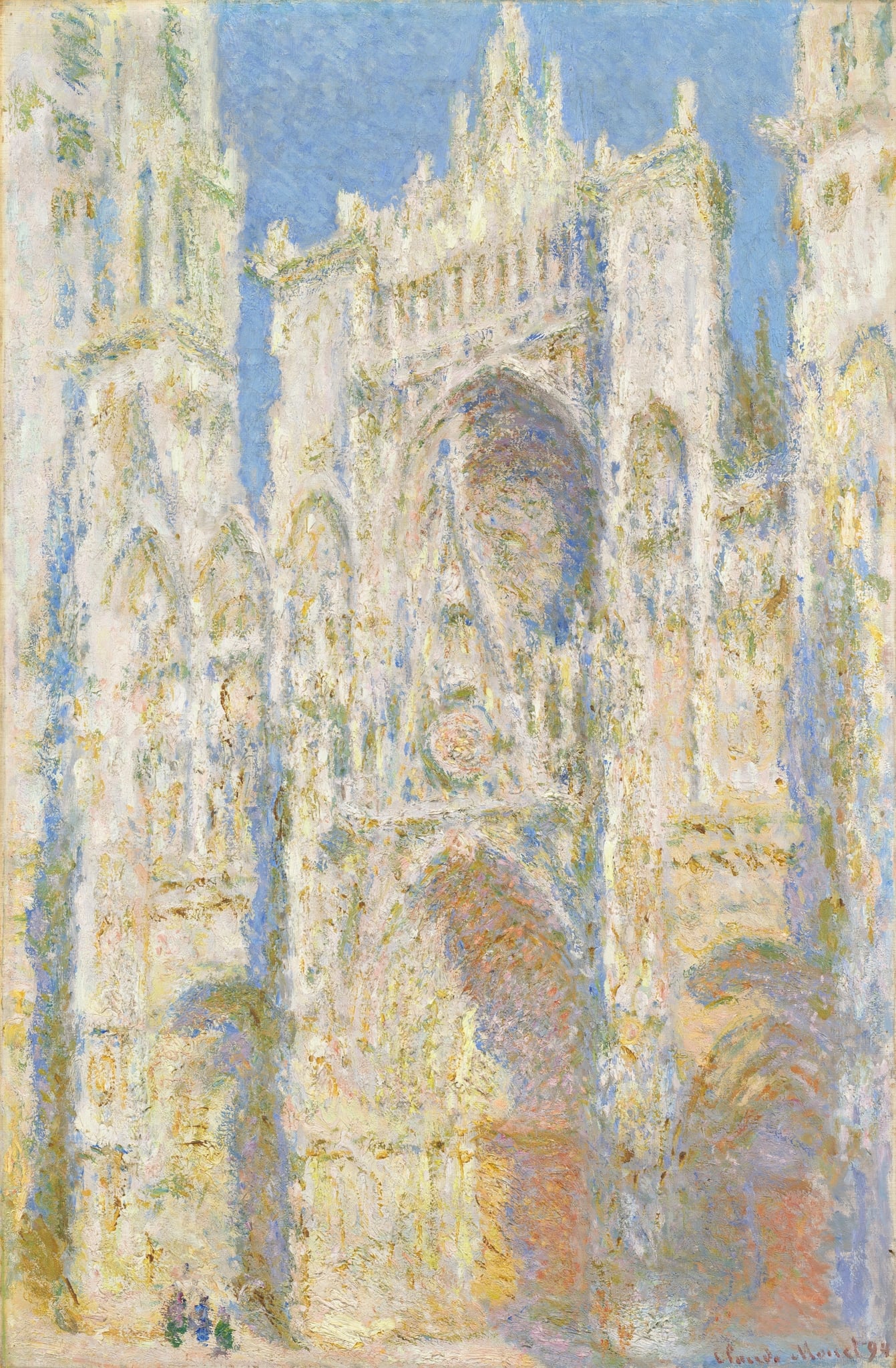
Rouen Cathedral Series
Claude Monet (1894)
Claude Monet’s Rouen Cathedral Series (1892–94) turns a Gothic monument into a laboratory of <strong>light, time, and perception</strong>. In this sunstruck façade, portals, gables, and a warm, orange-tinged rose window flicker in pearly violets and buttery yellows against a crystalline blue sky, while tiny figures at the base anchor the scale. The painting insists that <strong>light—not stone—is the true subject</strong> <sup>[1]</sup><sup>[2]</sup>.
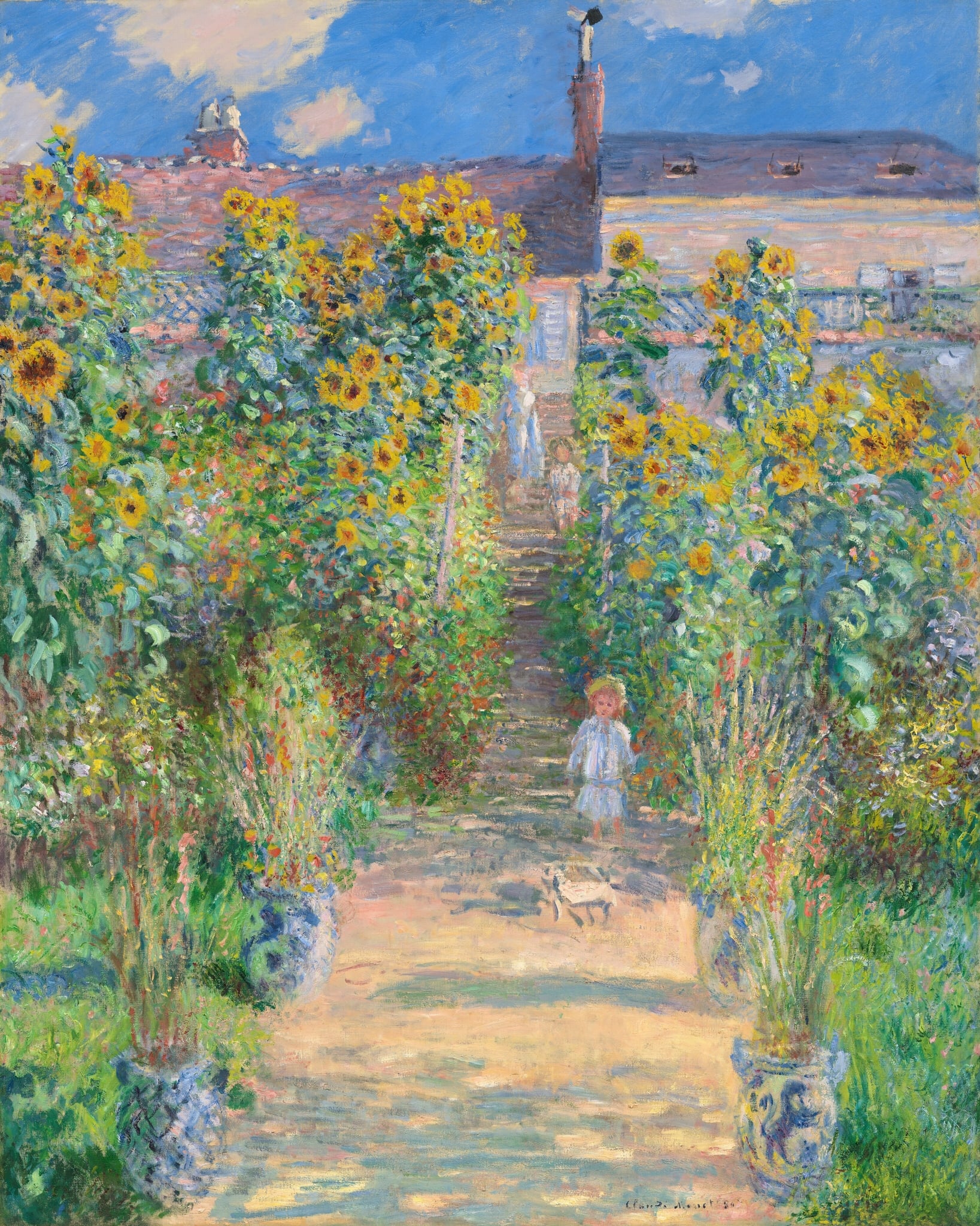
The Artist's Garden at Vétheuil
Claude Monet (1881)
Claude Monet’s The Artist’s Garden at Vétheuil stages a sunlit ascent through a corridor of towering sunflowers toward a modest house, where everyday life meets cultivated nature. Quick, broken strokes make leaves and shadows tremble, asserting <strong>light</strong> and <strong>painterly surface</strong> over linear contour. Blue‑and‑white <strong>jardinieres</strong> anchor the foreground, while a child and dog briefly pause on the path, turning the garden into a <strong>domestic sanctuary</strong> <sup>[1]</sup><sup>[2]</sup>.
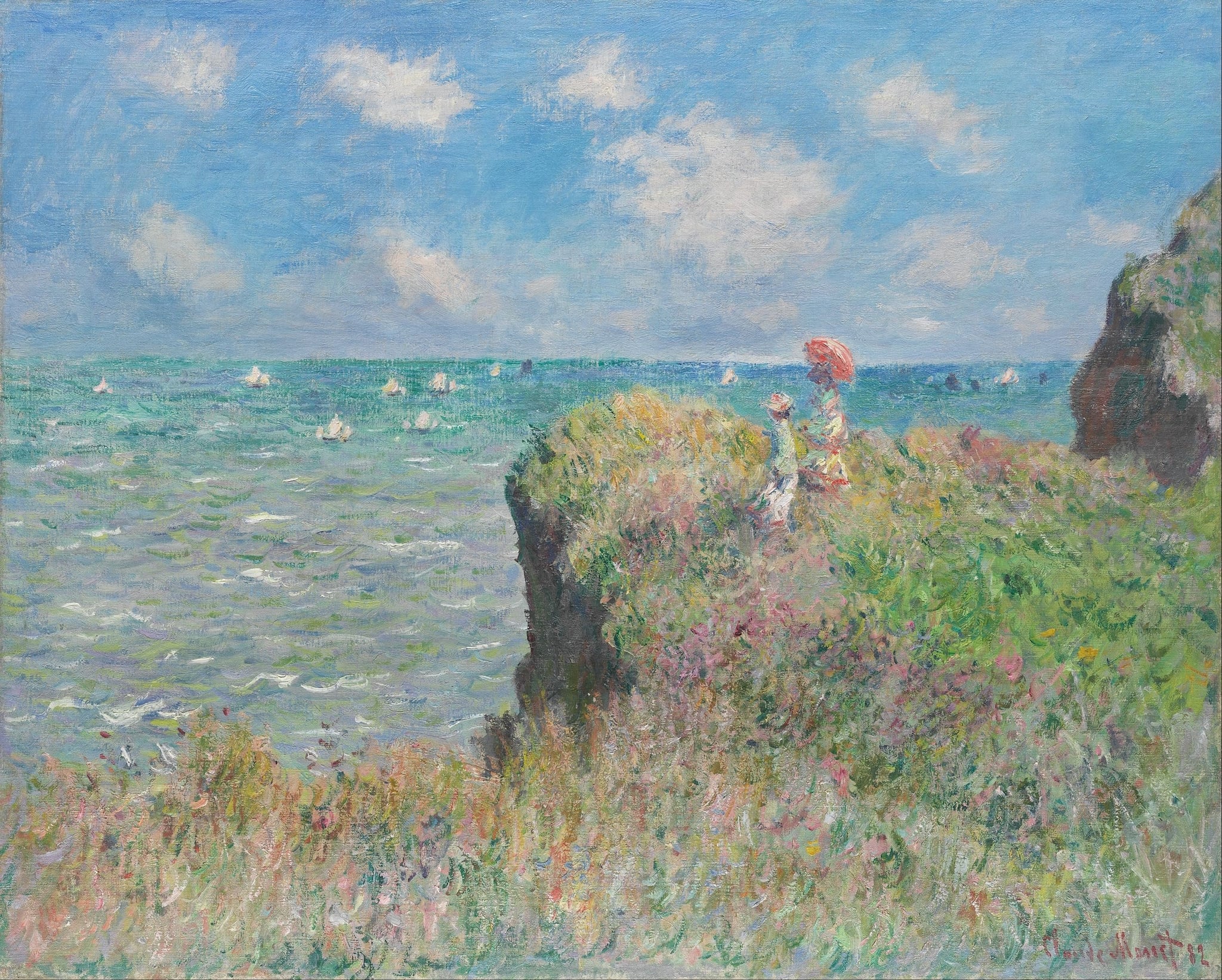
The Cliff Walk at Pourville
Claude Monet (1882)
Claude Monet’s The Cliff Walk at Pourville renders wind, light, and sea as interlocking forces through <strong>shimmering, broken brushwork</strong>. Two small walkers—one beneath a pink parasol—stand near the <strong>precipitous cliff edge</strong>, their presence measuring the vastness of turquoise water and bright sky dotted with white sails. The scene fuses leisure and the <strong>modern sublime</strong>, making perception itself the subject <sup>[1]</sup><sup>[2]</sup>.
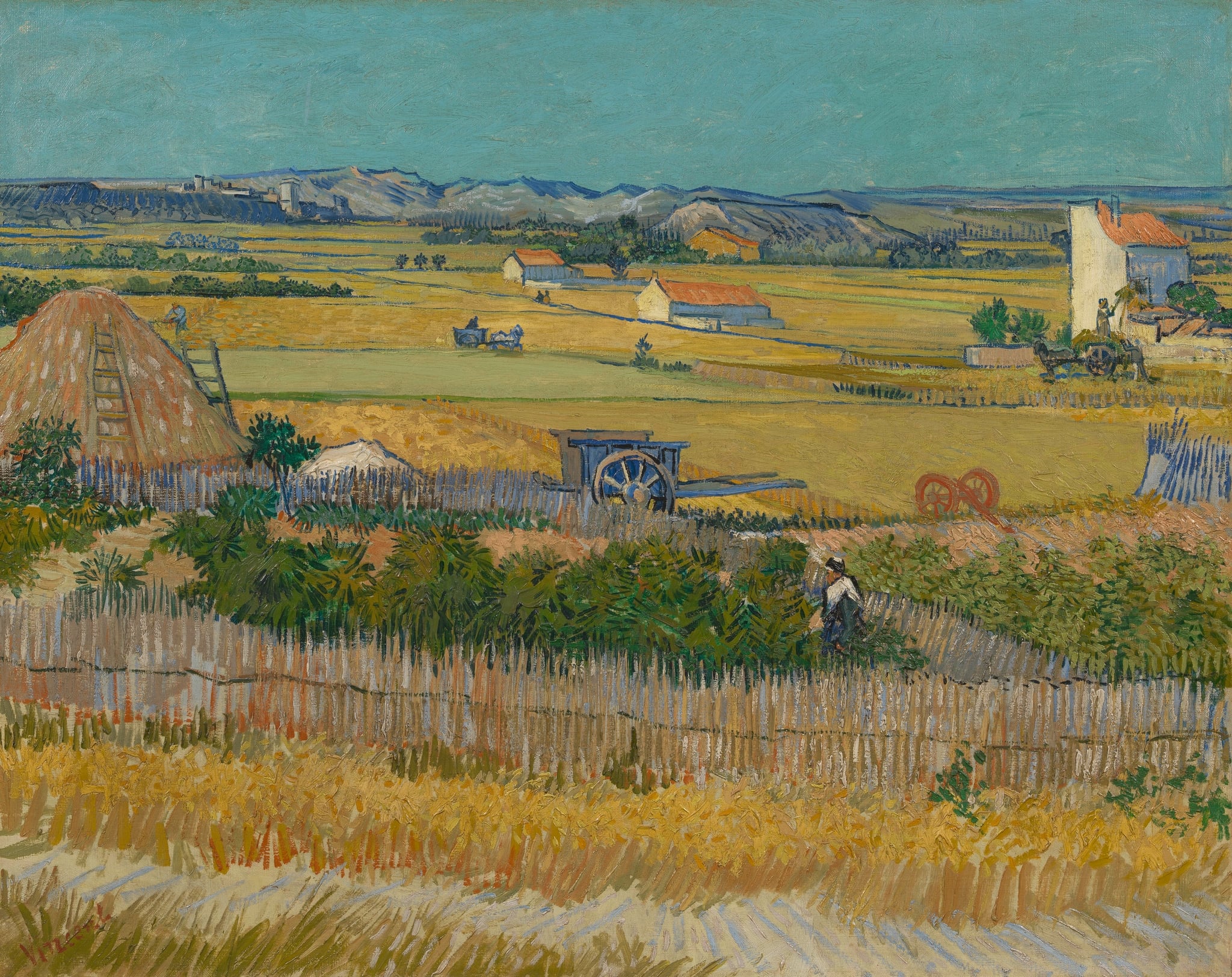
The Harvest
Vincent van Gogh (1888)
<strong>The Harvest</strong> surveys the La Crau plain as a luminous patchwork of ripe wheat, garden strips, and farm tracks under an <strong>azure</strong> sky. Van Gogh orchestrates tools and tasks—haystack with ladder, carts with <strong>red wheels</strong>, fenced plots—into a single, sunstruck order that turns labor into vision <sup>[1]</sup><sup>[2]</sup>. A lone reaper almost dissolves in the foliage, anchoring the panorama in human toil and seasonal time.
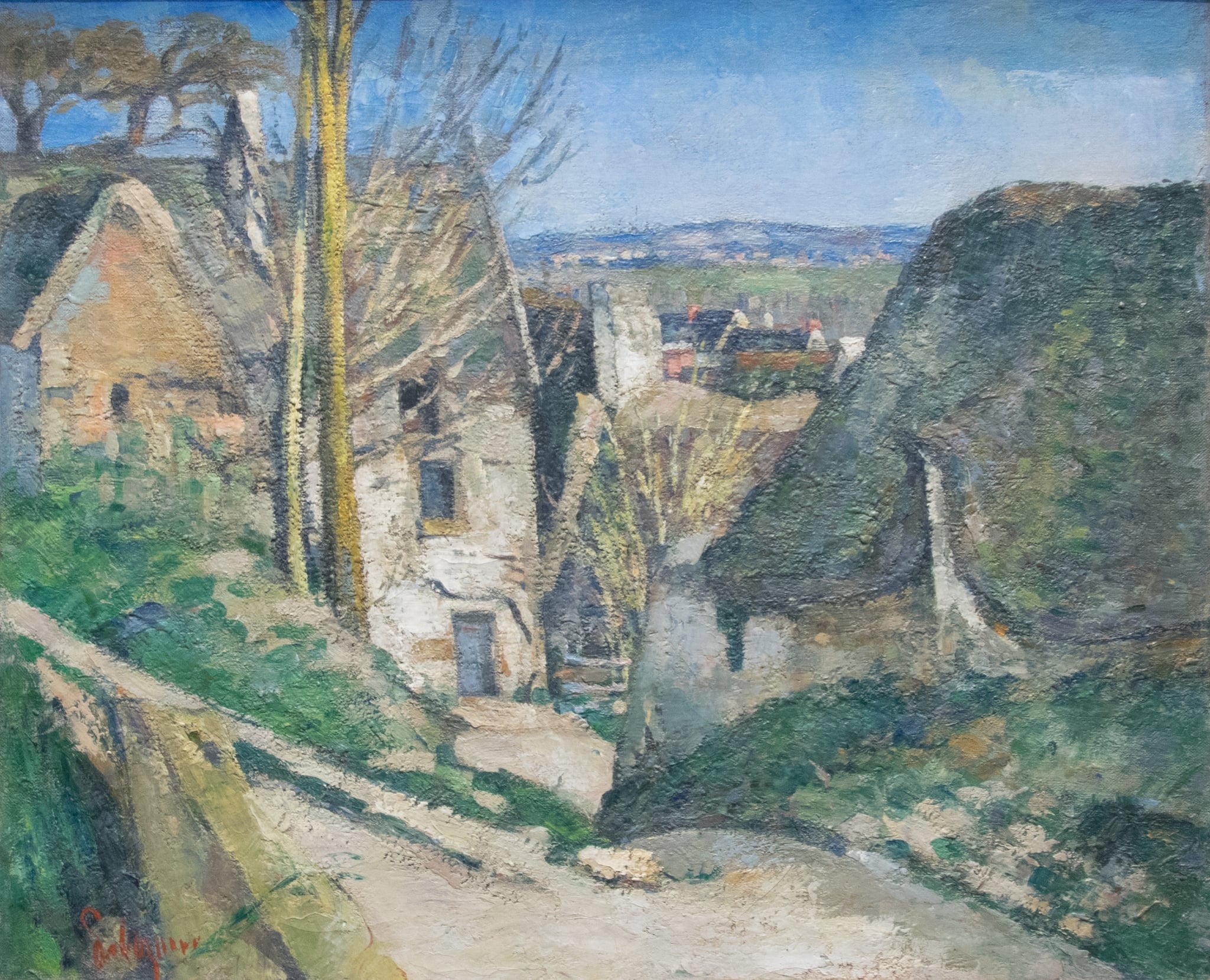
The House of the Hanged Man
Paul Cézanne (1873)
Paul Cézanne’s The House of the Hanged Man turns a modest Auvers-sur-Oise lane into a scene of <strong>engineered unease</strong> and <strong>structural reflection</strong>. Jagged roofs, laddered trees, and a steep path funnel into a narrow, shadowed V that withholds a center, making absence the work’s gravitational force. Cool greens and slate blues, set in blocky, masoned strokes, build a world that feels both solid and precarious.
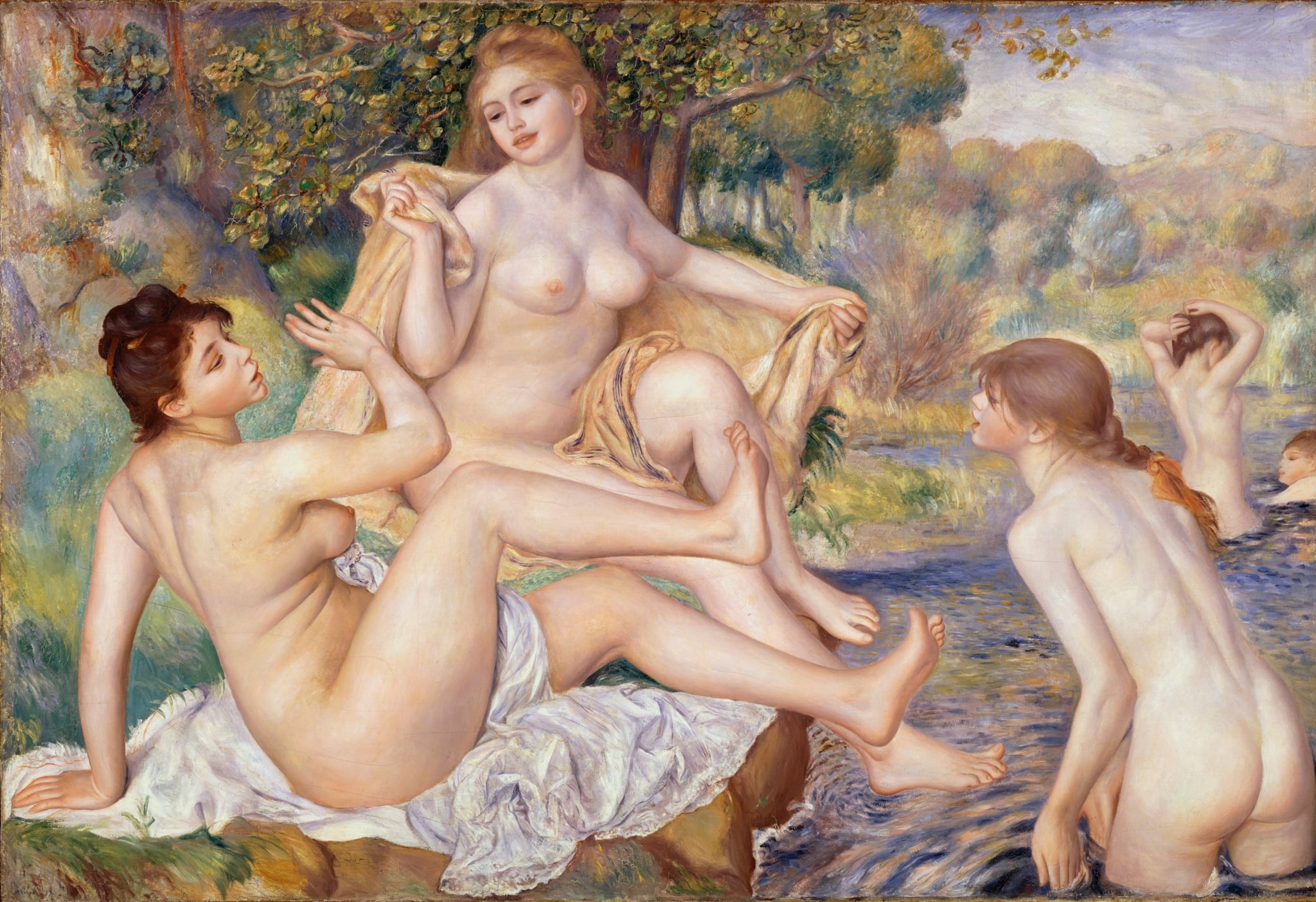
The Large Bathers
Pierre-Auguste Renoir (1884–1887)
Pierre-Auguste Renoir’s The Large Bathers unites modern bodies with a pastoral grove to stage an <strong>Arcadian ideal</strong>. Three monumental nudes form interlocking curves and triangles while two background figures splash and groom, fusing <strong>sensual warmth</strong> with <strong>classical order</strong> <sup>[1]</sup><sup>[2]</sup>.
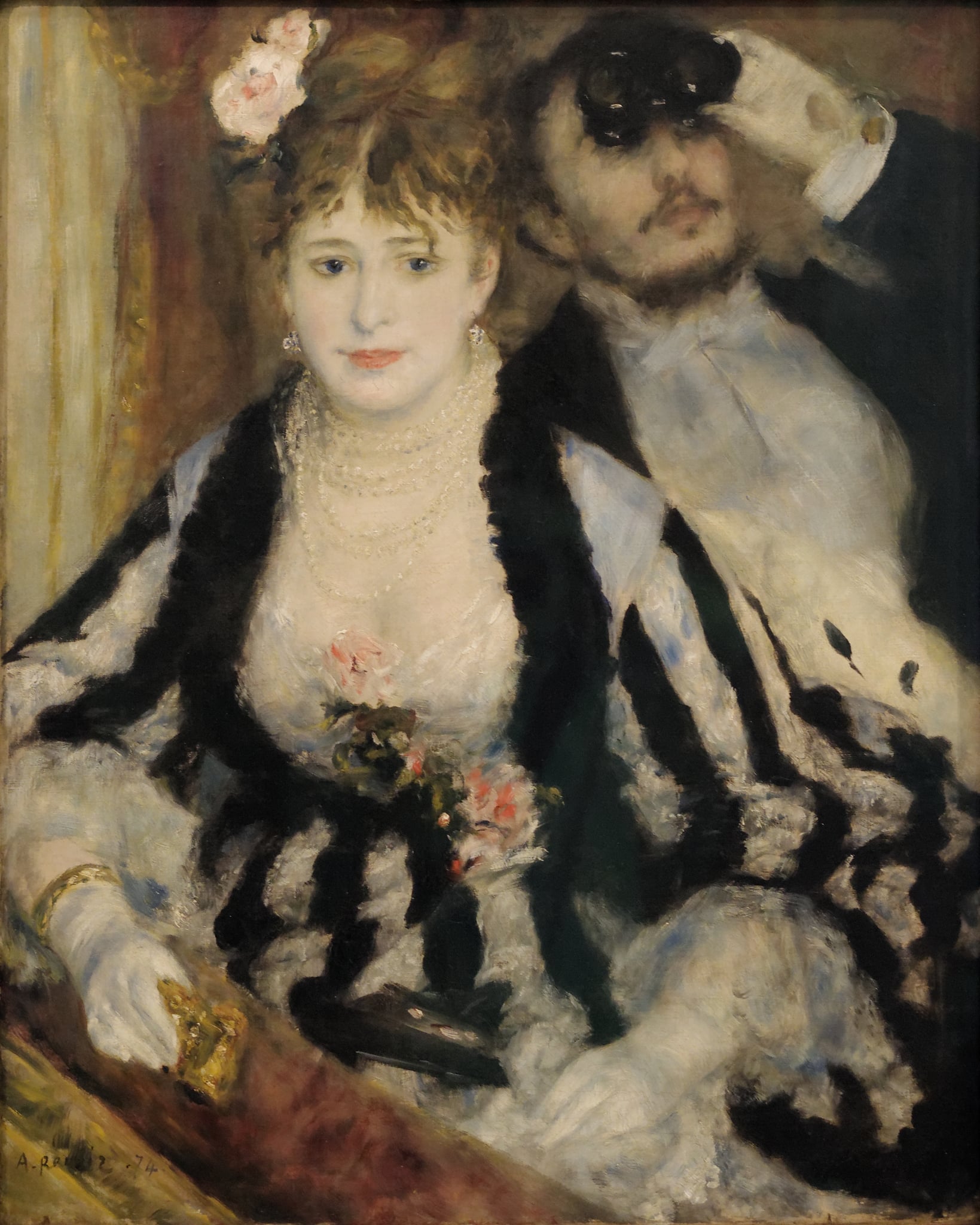
The Loge
Pierre-Auguste Renoir (1874)
Renoir’s The Loge (1874) turns an opera box into a <strong>stage of looking</strong>, where a woman meets our gaze while her companion scans the crowd through binoculars. The painting’s <strong>frame-within-a-frame</strong> and glittering fashion make modern Parisian leisure both alluring and self-conscious, turning spectators into spectacles <sup>[1]</sup><sup>[2]</sup>.
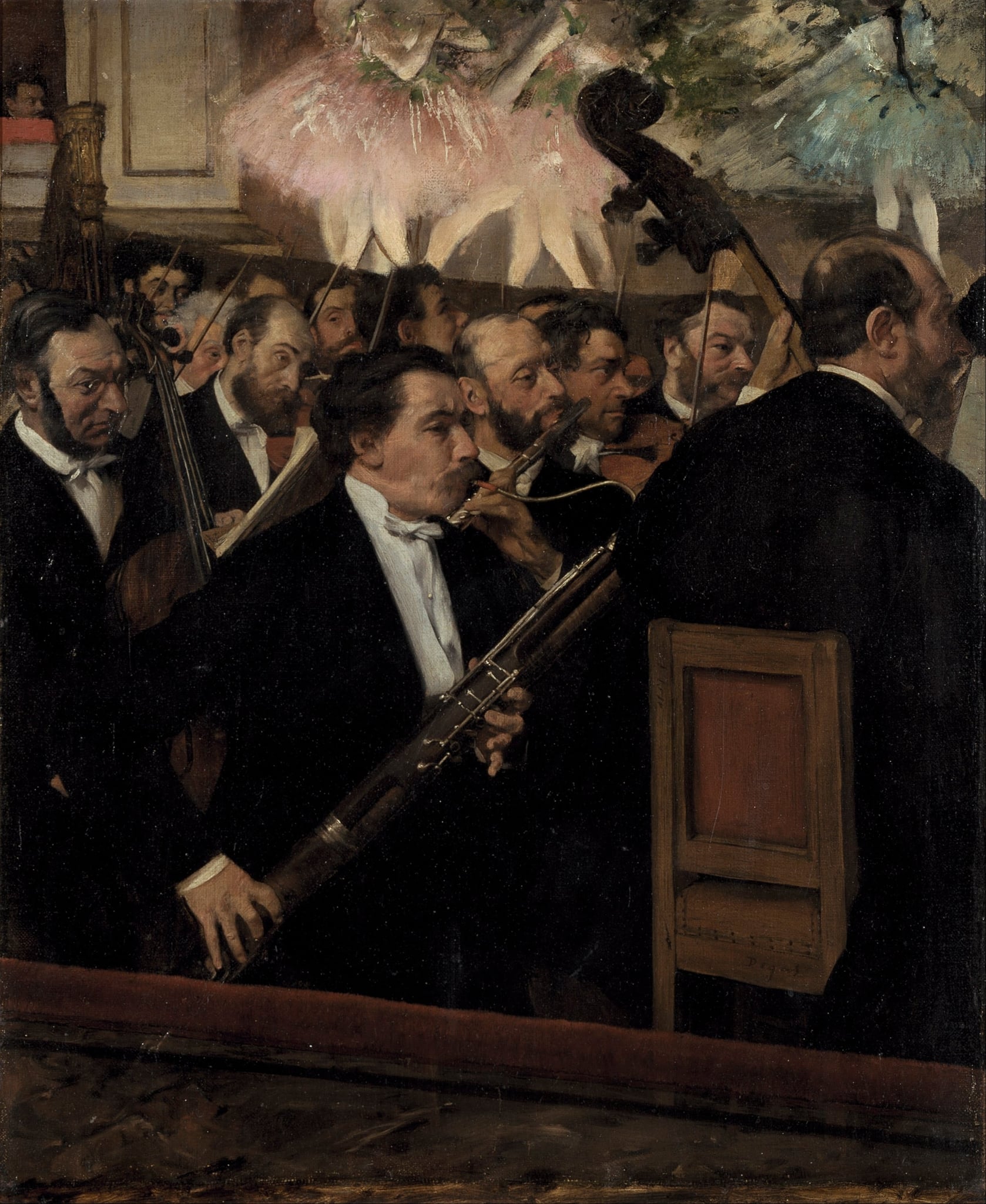
The Opera Orchestra by Edgar Degas | Analysis
Edgar Degas
In The Opera Orchestra, Degas flips the theater’s hierarchy: the black-clad pit fills the frame while the ballerinas appear only as cropped tutus and legs, glittering above. The diagonal <strong>bassoon</strong> and looming <strong>double bass</strong> marshal a dense field of faces lit by footlights, turning backstage labor into the subject and spectacle into a fragment <sup>[1]</sup><sup>[2]</sup>.
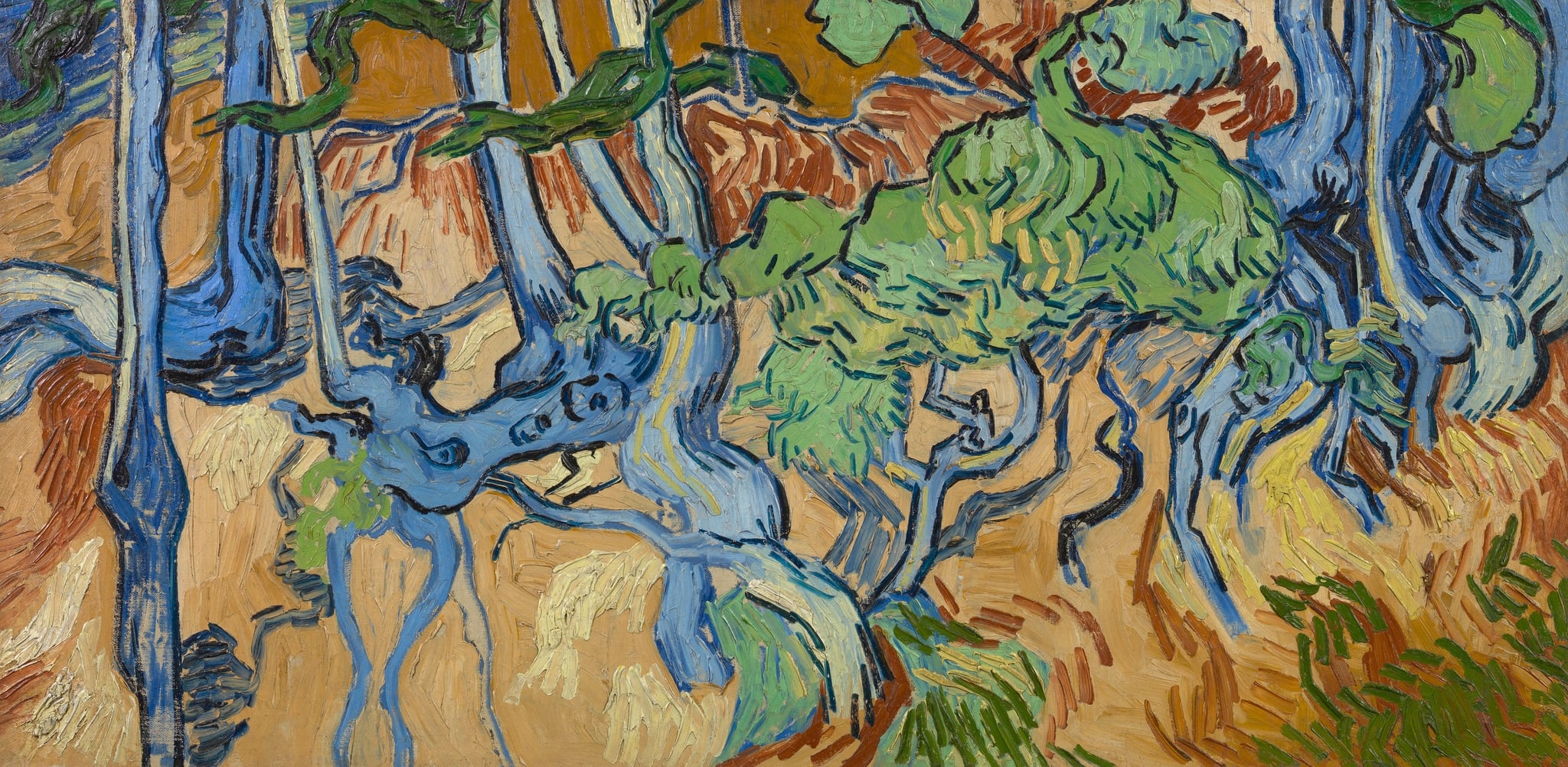
Tree Roots
Vincent van Gogh (1890)
Tree Roots is a late Auvers canvas in a rare, elongated "double‑square" format that compresses the view to nothing but interlaced trunks and roots. Thick, cobalt‑blue contours and vibrating oranges/ochres forge a field of near‑abstraction, turning a roadside bank into a <strong>charged meditation on resilience and exposure</strong> <sup>[1]</sup><sup>[6]</sup><sup>[2]</sup>.
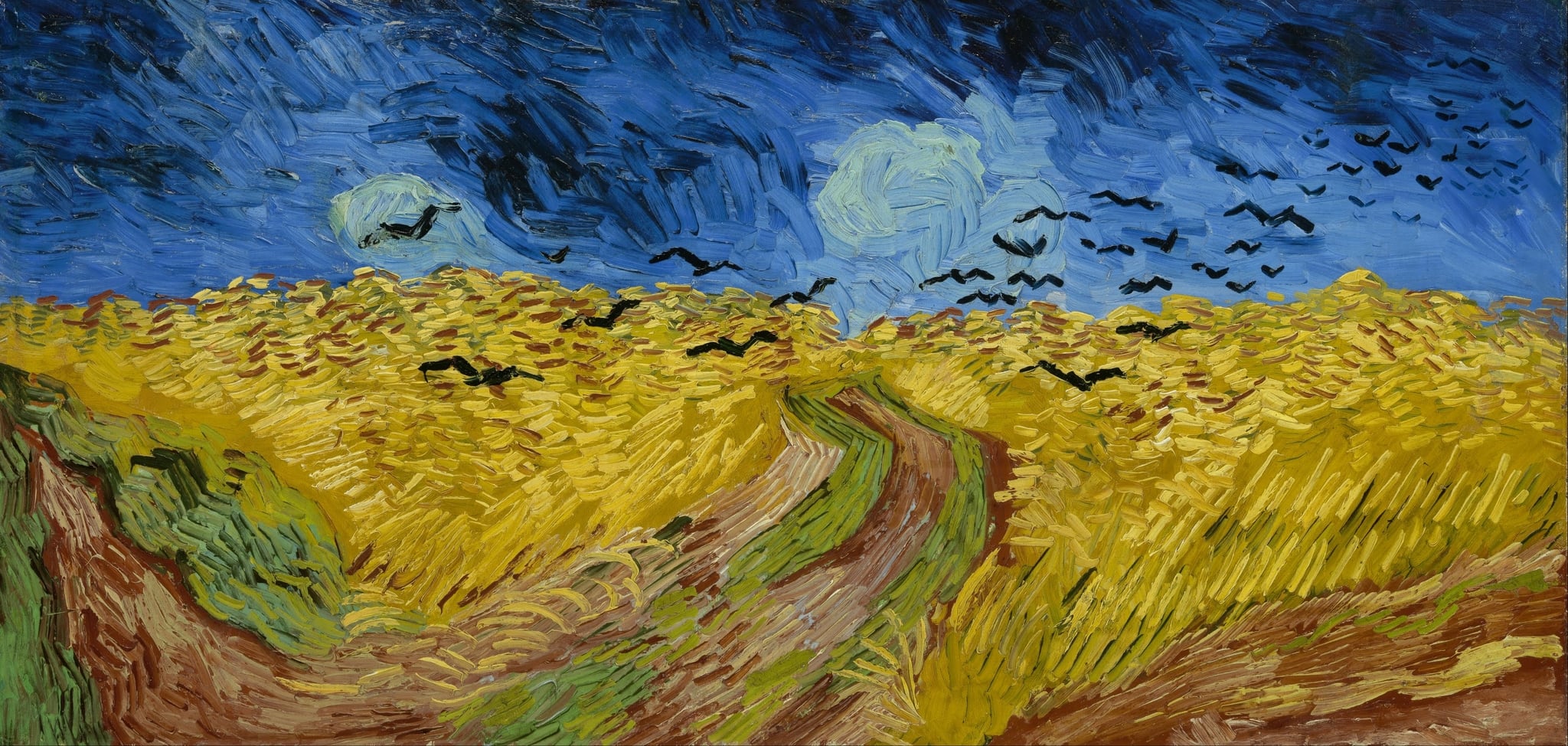
Wheatfield with Crows
Vincent van Gogh (1890)
A panoramic wheatfield splits around a rutted track under a storm-charged sky while black crows rush toward us. Van Gogh drives complementary blues and yellows into collision, fusing <strong>nature’s vitality</strong> with <strong>inner turbulence</strong>.
Related Themes
Related Symbolism Categories
Architecture
Architectural motifs in modern painting operate as charged thresholds between private and public, nature and culture, and individual perception and collective order, translating built form into a language for negotiating modernity’s social and psychological stakes.
Urban
Urban symbolism in modern painting transforms streets, stations, and squares into coded fields where infrastructure, light, and crowd dynamics visualize the social logics of the nineteenth- and early twentieth‑century city.
Urbanity
Urbanity symbolism charts how modern artists turned lamps, boulevards, bridges, canopies, and crowds into a visual language for municipal order, technological illumination, and the new, anonymous sociability of the nineteenth- and early twentieth‑century city.
Within Western art, the representation of space has long operated as more than neutral setting; it is a symbolic system through which artists negotiate power, perception, and the viewer’s relation to the depicted world. From Renaissance perspective grids to the dissolving atmospheres of Impressionism, spatial devices carry iconographic weight, staging thresholds between private and public, nature and city, labor and leisure. The works considered here—spanning Seurat, Cézanne, van Gogh, Manet, Caillebotte, Degas, Renoir, and Monet—demonstrate how “space” is encoded as modern subject matter in its own right, as boulevards, bridges, horizons, and enclosures become legible signs of social order, anonymity, and communal ritual.
In Georges Seurat’s Bathers at Asnières (1884), the riverbank is not a passive backdrop but a carefully ordered stage governed by Bridges (rail and road) and a distant industrial skyline. The bridges function as emblems of “modern infrastructure and connection,” binding the zones of the picture as they bind the Seine’s shores. Iconographically, they register the reach of urban planning into a scene of working-class leisure: chimneys, spans, and boats inscribe industrial time across bodies that rest in archaizing stillness. Semiotic emphasis falls on the tension between the workers’ frieze-like calm and the receding architectural web that structures their world. Space becomes a double register—foreground as pastoralized respite, distance as gridded circulation—so that the image of rest is bracketed by the signs of ongoing economic flow.
Cézanne’s Bathers organizes space according to a different symbolic logic. Here, the circle/frieze of bathers and the enclosing orchard “walls” of tree trunks and branches construct an Arcadian interior. The grove behaves as a hortus conclusus of the classical nude: arching trees converge into a “nave of open air,” so that landscape no longer recedes perspectivally but closes in as an architectural vault. Semiotic emphasis shifts from distance to enclosure. The nude bodies, generalized and serial, operate like structural piers within this circle, turning space into a communal, ritual container rather than a measurable vista. Iconographically, Cézanne reactivates ancient bathing and pastoral traditions, but under modern terms: the space is abstracted into geometry, a self-conscious construction that fuses figure and ground into one enduring order rather than a fleeting Impressionist effect.
If Cézanne’s enclosures sacralize nature, Vincent van Gogh’s urban and suburban scenes explore space as the grammar of modern circulation. Boulevard de Clichy (1887) hinges on the curving boulevard/pavement, which “bends like a slow river of modernity.” This curve is both compositional armature and symbolic riverbed for anonymous movement. The flanking “leafless trees, drawn as wiry glyphs,” echo lamp posts and façades, stitching natural and constructed verticals into a single city grid/calligraphic network. Semiologically, the boulevard’s sweep codes the inevitability of flow; individuals, reduced to small, bundled silhouettes, become mobile punctuation in an infrastructural sentence. The curvature suggests temporal unfolding—one advances along its arc—while the reiterated verticals and cross-hatching slow the eye into granular perception of light. Space thus oscillates between the experiential (a walk through late-winter Paris) and the systemic (Haussmannized order).
In Garden with Courting Couples: Square Saint-Pierre (1887), van Gogh transfers this logic of circulation into a more intimate register. The park is articulated by curving, intersecting paths that “braid and separate,” threading together and differentiating pairs of lovers beneath an enclosing greenery of flowering chestnuts. These paths are diagrammatic: they stand for the “meandering courses of relationships,” a social semiotics in which spatial choices imply emotional ones. Unlike the strict linearity of Haussmann boulevards, the garden’s curves suggest contingency and play. Yet the enclosing foliage and modest scale also define a bounded arena of urban leisure, a crafted spatial type of the modern city in which nature is domesticated into a social stage.
Édouard Manet’s On the Beach (1873) and Monet’s Fishing Boats on the Beach at Les Saintes-Maries-de-la-Mer (1888) both test how coastal space can be flattened or charged as threshold. Manet’s composition is dominated by a banded, high-horizon sea, whose horizontal stripes “compress depth and turn nature into tonal fields.” The horizon is thrust upward; boats hover as small, graphic signs. Semiologically, this flattening denies escapist depth and reads the seascape as a modern planar screen. Leisure is experienced laterally—figures sit before an almost abstract banding of color—rather than as an opening onto boundless nature. By contrast, van Gogh’s beached boats, aligned diagonally on sand and answered by “distant lateen sails,” use the shoreline as a field of suspended potential. The boats are emblems of “readiness paused before risk,” and the empty interval between hulls and sea signifies a charged pause before departure. Space here is dynamic not through perspectival recession but through implied movement across a narrow threshold between land and water.
The Parisian street scenes of Gustave Caillebotte, Degas, and Renoir refine a related iconography of urban space as social theater. In Caillebotte’s Paris Street; Rainy Day (1877), the city is built around a Central Gas Lamppost and “converging façades and vanishing point.” The lamppost, a “visual pivot organizing urban space,” indexes standardized infrastructure and acts as a surrogate axis mundi of the secular metropolis. The flanking wedge-shaped block and radiating streets funnel figures into a shared yet emotionally disconnected trajectory. Iconographically, Haussmann’s geometry becomes both promise and constraint: the spaciousness and even light suggest rational order, while cropping and umbrella-domes underscore isolation. Space is at once rationalized and estranging.
Degas’s Place de la Concorde (1875) radicalizes this estrangement by converting the square into a “flat, empty ground” of pale, scumbled stone: a quasi-void that “stretches between the figures and the distant Tuileries wall.” The plaza reads as an empty center space around which figures orbit without encounter. Semiologically, this open expanse functions as an evacuated public sphere, a non-communal space in which modern subjects share coordinates but not connection. Whereas Caillebotte’s vanishing point organizes shared trajectory, Degas withholds such teleology: the spatial field becomes a diagram of disjunction, its very openness a symbol of social non-adhesion.
Renoir’s Pont Neuf Paris (1872) offers a counter-image of space as civic cohesion. The bridge, lining up aligned gas lamps and a rhythmic balustrade, is the literal and symbolic “stage where light and movement bind a city back together.” Bridges here are not distant tokens, as in Seurat, but the inhabited foreground architecture that gathers carriages, pedestrians, and flower sellers into a single current. The equestrian statue of Henri IV anchors the far end, tying the modern flow to “dynastic memory.” Spatially, horizontals and diagonals articulate a shared civic artery; iconographically, the bridge as connective tissue figures a reconciled urban body after the fractures of mid-century Paris.
Taken together, these works trace an evolution in spatial symbolism from depth as theological or courtly order to space as the visible grammar of modern life. Cézanne still imagines nature as an enclosing, quasi-sacral architecture, but with an abstracted, structural emphasis. Seurat, Caillebotte, Degas, van Gogh, Manet, and Renoir examine boulevards, plazas, bridges, beaches, and parks as spatial types charged with social meaning—sites where anonymity, class mixture, flirtation, labor, and isolation are negotiated. Compositional devices such as the banded sea, the curving boulevard, the enclosing grove, or the empty plaza become legible signs in a new semiotic of space, one in which the organization of the field itself is a primary bearer of meaning.