Symbolism
The Symbolism category here traces how modern and contemporary artists redeploy a heterogeneous repertoire of signs—from religious mirrors and dynastic portraits to tricolor flags and corporate emblems—to interrogate vision, power, national identity, and consumer culture across changing regimes of representation.
Member Symbols
Featured Artworks
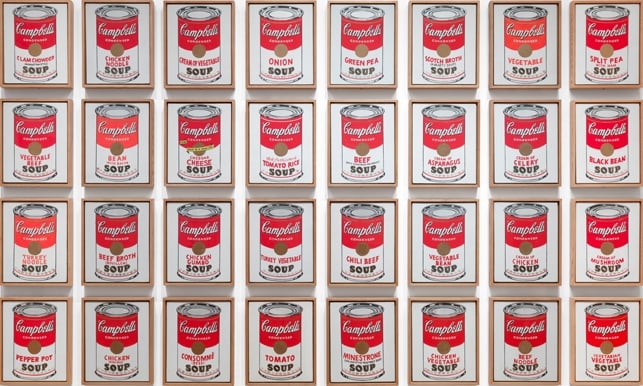
Campbell's Soup Cans
Andy Warhol (1962)
Warhol’s Campbell’s Soup Cans turns a shelf-staple into <strong>art</strong>, using a gridded array of near-identical red-and-white cans to fuse <strong>branding</strong> with <strong>painting</strong>. By repeating 32 flavors—Tomato, Clam Chowder, Chicken Noodle, and more—the work stages a clash between <strong>mass production</strong> and the artist’s hand <sup>[1]</sup><sup>[3]</sup>.
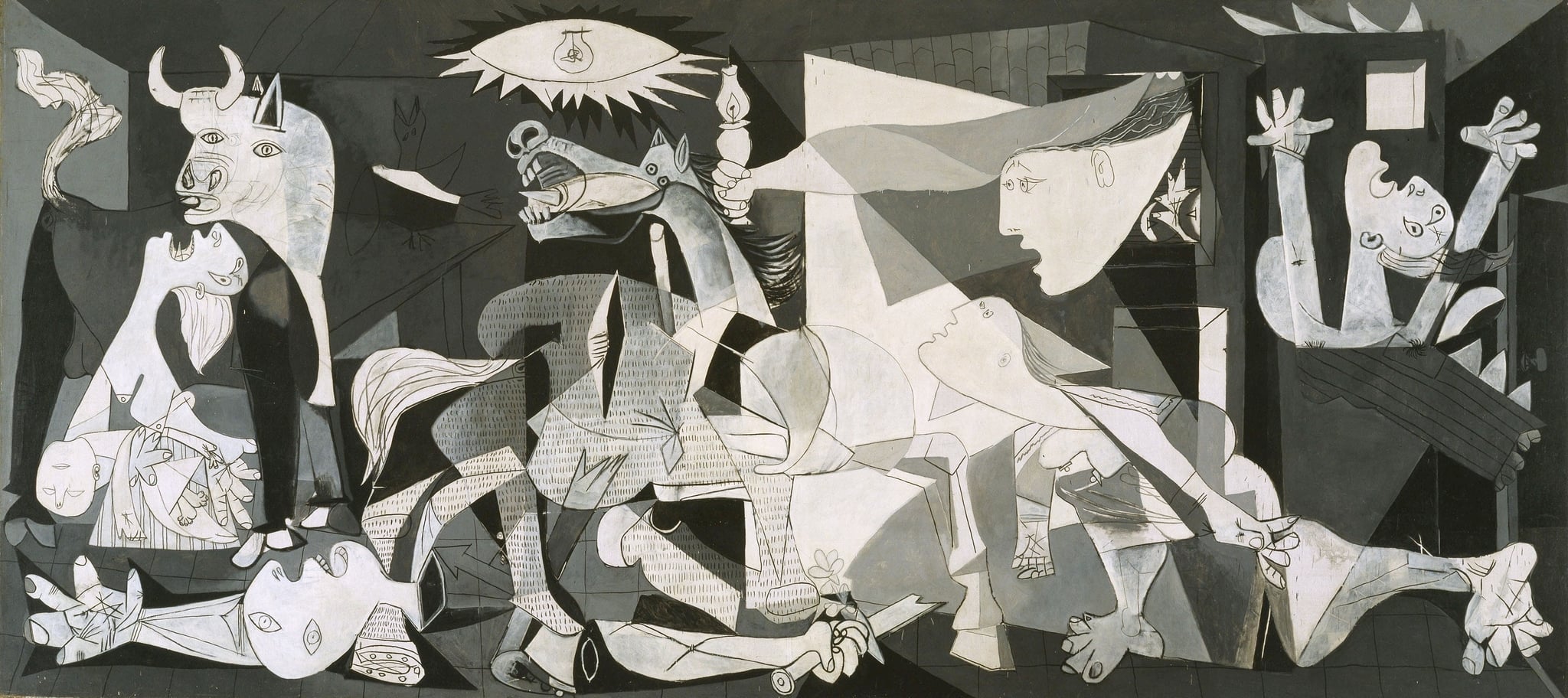
Guernica
Pablo Picasso (1937)
Guernica is a monumental, monochrome indictment of modern war, compressing a town’s annihilation into a frantic tangle of bodies, beasts, and light. Across the canvas, a <strong>shrieking horse</strong>, a <strong>stoic bull</strong>, a <strong>weeping mother with her dead child</strong>, and a <strong>fallen soldier</strong> stage a civic tragedy rather than a heroic battle. The harsh <strong>electric bulb</strong> clashes with a fragile <strong>oil lamp</strong>, turning the scene into a stark drama of terror and witness.
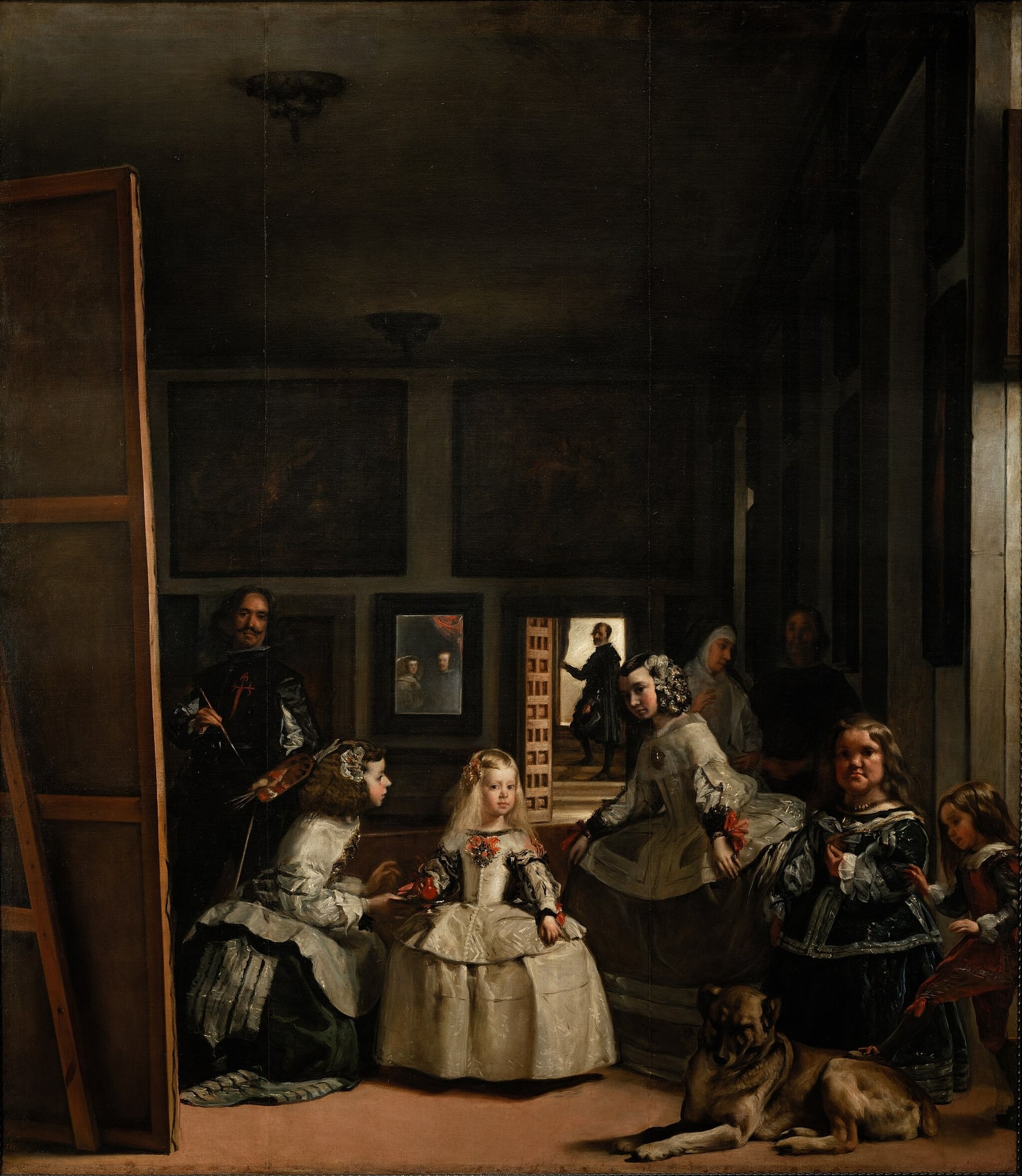
Las Meninas
Diego Velazquez (1656)
In Las Meninas, a luminous Infanta anchors a shadowed studio where the painter pauses at a vast easel and a small wall mirror reflects the monarchs. The scene folds artist, sitters, and viewer into one reflexive tableau, turning court protocol into a meditation on <strong>seeing and being seen</strong> <sup>[1]</sup><sup>[3]</sup>. A bright doorway at the rear deepens space and time, as if someone has just entered—or is leaving—the picture we occupy <sup>[1]</sup><sup>[5]</sup>.
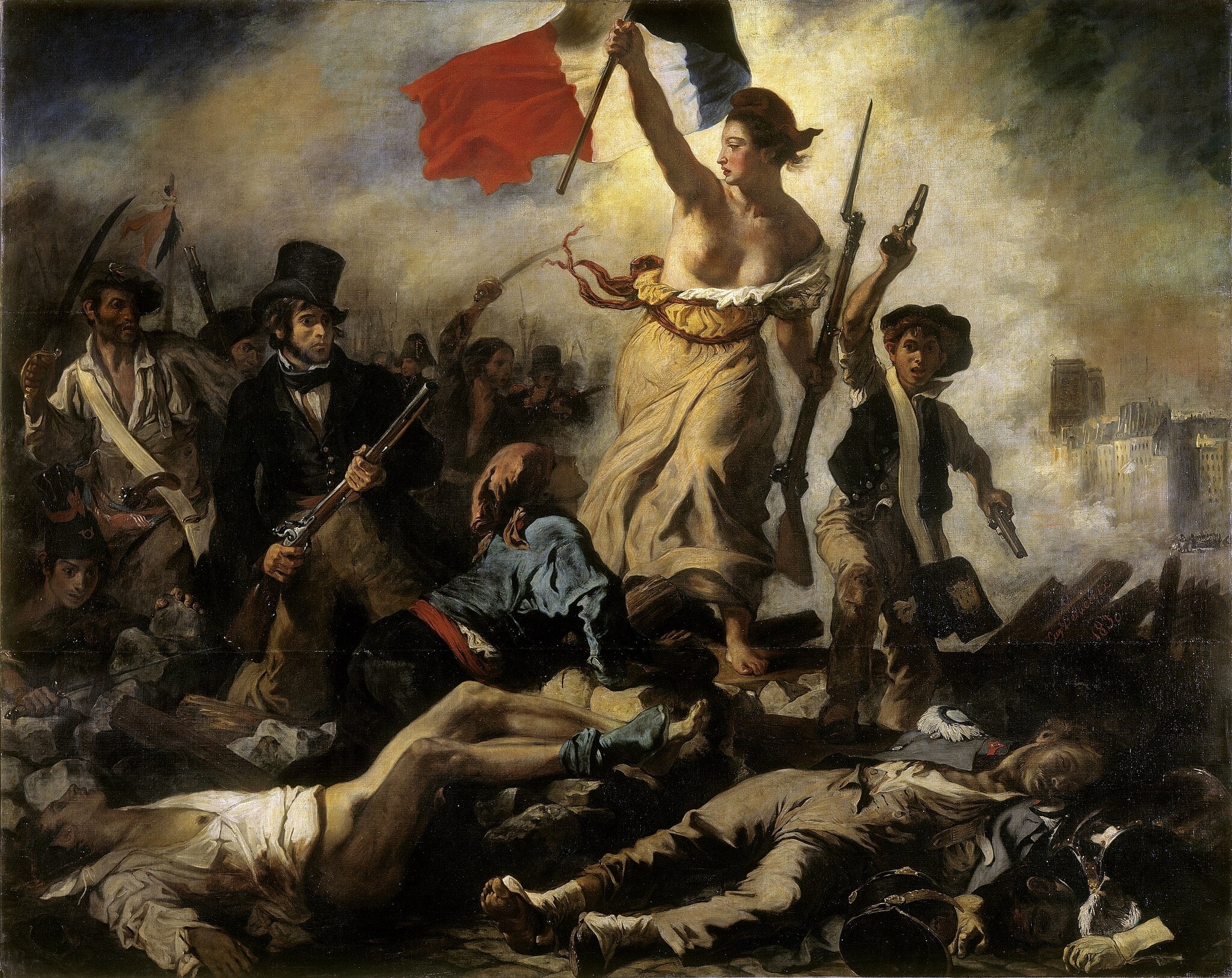
Liberty Leading the People
Eugene Delacroix (1830)
<strong>Liberty Leading the People</strong> turns a real street uprising into a modern myth: a bare‑breasted Liberty in a <strong>Phrygian cap</strong> thrusts the <strong>tricolor</strong> forward as Parisians of different classes surge over corpses and rubble. Delacroix binds allegory to eyewitness detail—Notre‑Dame flickers through smoke, a bourgeois in a top hat shoulders a musket, and a pistol‑waving boy keeps pace—so that freedom appears as both idea and action <sup>[1]</sup><sup>[2]</sup>. After its 2024 cleaning, sharper blues, whites, and reds re‑ignite the painting’s charged color drama <sup>[4]</sup>.
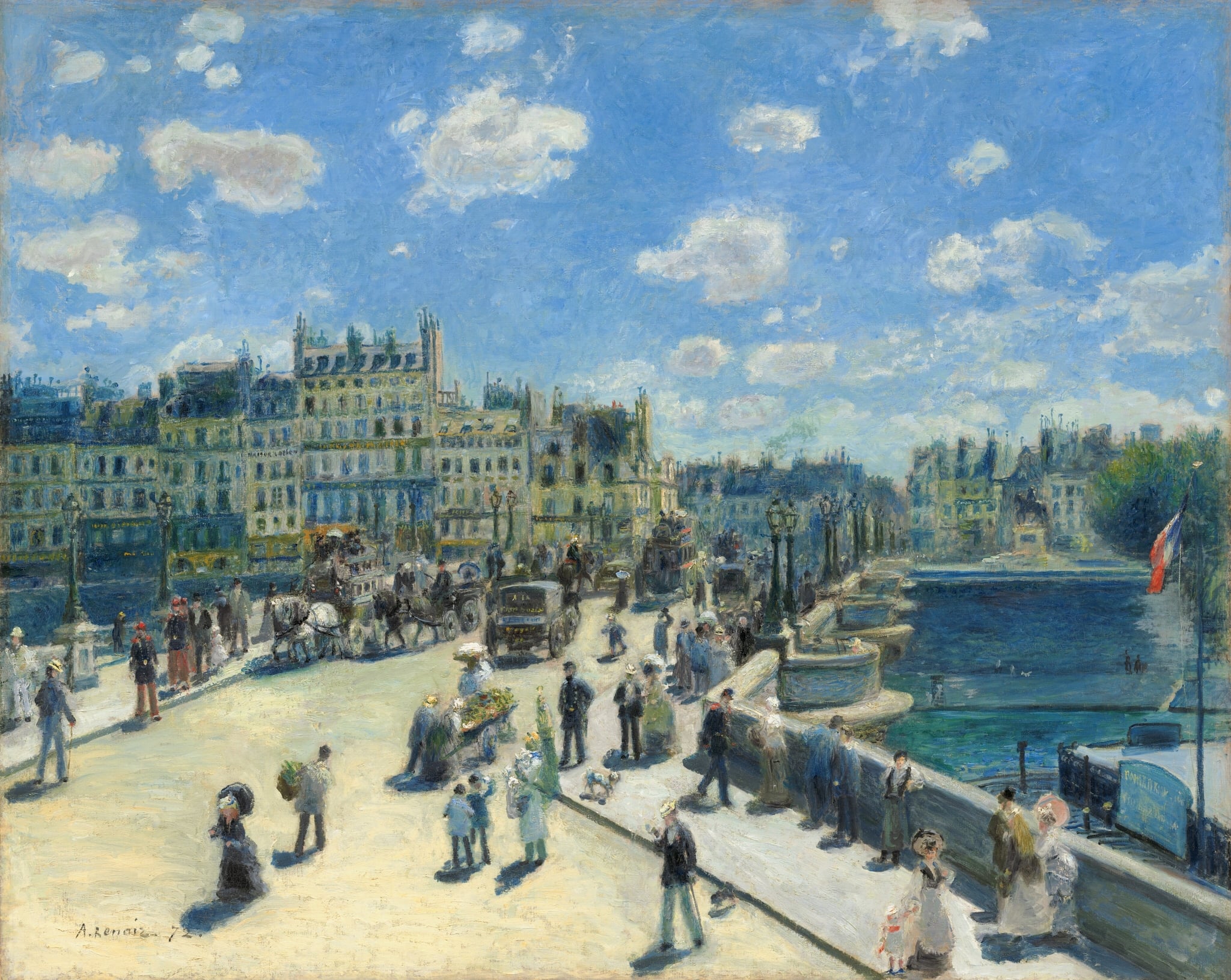
Pont Neuf Paris
Pierre-Auguste Renoir (1872)
In Pont Neuf Paris, Pierre-Auguste Renoir turns the oldest bridge in Paris into a stage where <strong>light</strong> and <strong>movement</strong> bind a city back together. From a high perch, he orchestrates crowds, carriages, gas lamps, the rippling Seine, and a fluttering <strong>tricolor</strong> so that everyday bustle reads as civic grace <sup>[1]</sup>.
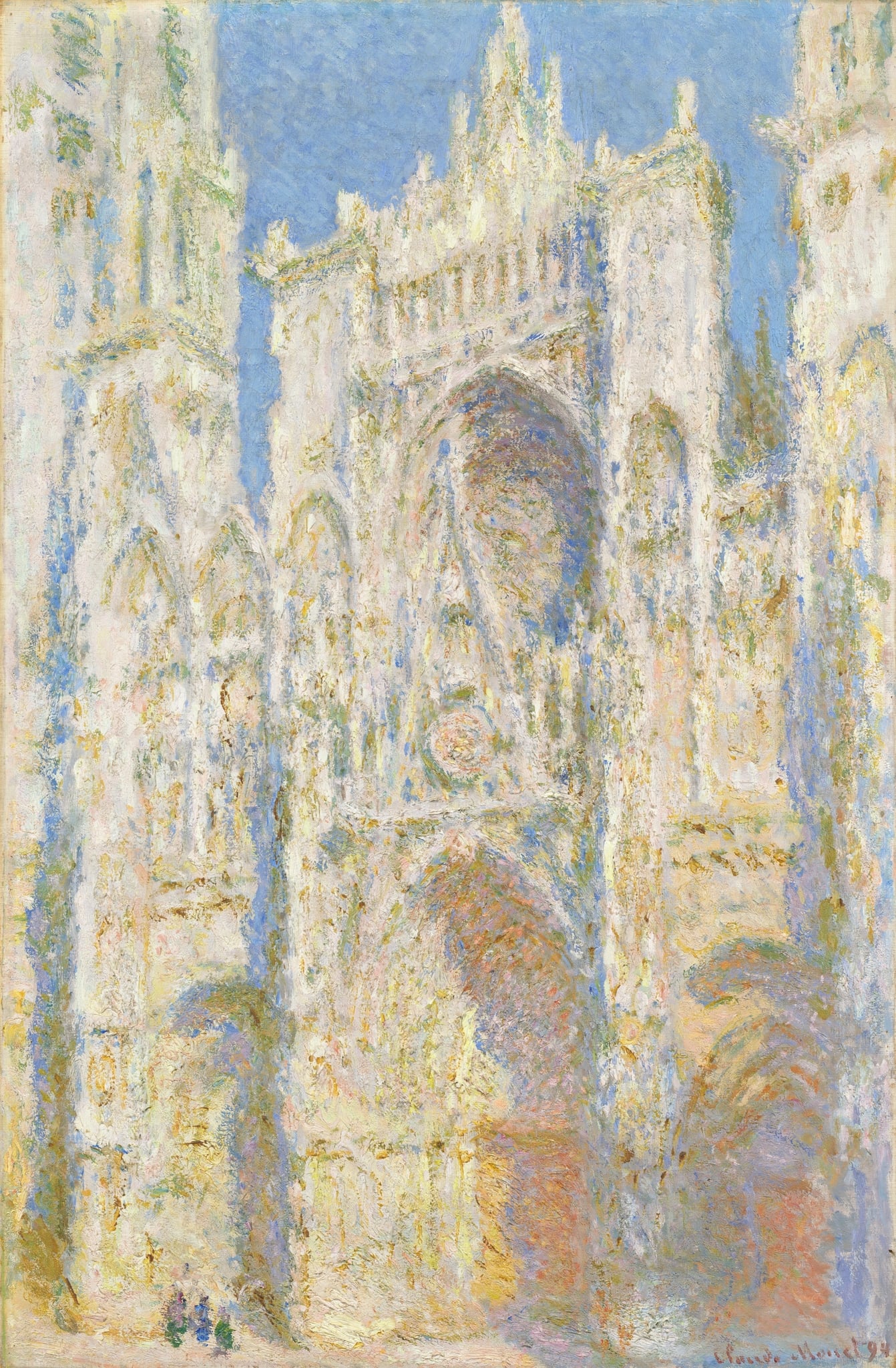
Rouen Cathedral Series
Claude Monet (1894)
Claude Monet’s Rouen Cathedral Series (1892–94) turns a Gothic monument into a laboratory of <strong>light, time, and perception</strong>. In this sunstruck façade, portals, gables, and a warm, orange-tinged rose window flicker in pearly violets and buttery yellows against a crystalline blue sky, while tiny figures at the base anchor the scale. The painting insists that <strong>light—not stone—is the true subject</strong> <sup>[1]</sup><sup>[2]</sup>.
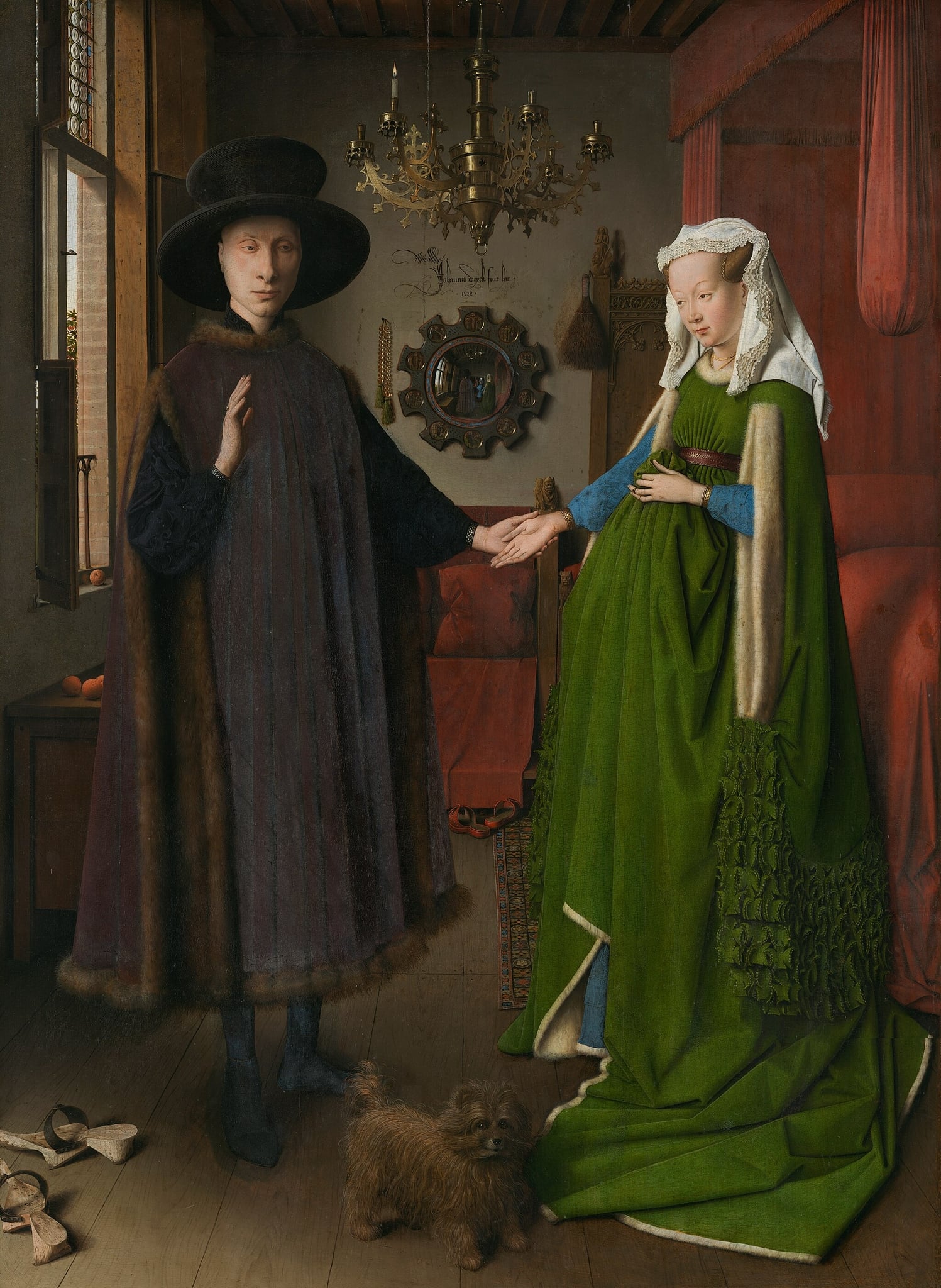
The Arnolfini Portrait
Jan van Eyck (1434)
In The Arnolfini Portrait, Jan van Eyck stages a poised encounter between a richly dressed couple whose joined hands, a single burning candle, and a convex mirror transform a domestic interior into a scene of <strong>status and sanctity</strong>. The painting asserts the artist’s own <strong>presence</strong>—"Johannes de eyck fuit hic 1434"—as if to validate the moment while showcasing oil painting’s power to make belief tangible through light, texture, and reflection <sup>[1]</sup><sup>[2]</sup>.
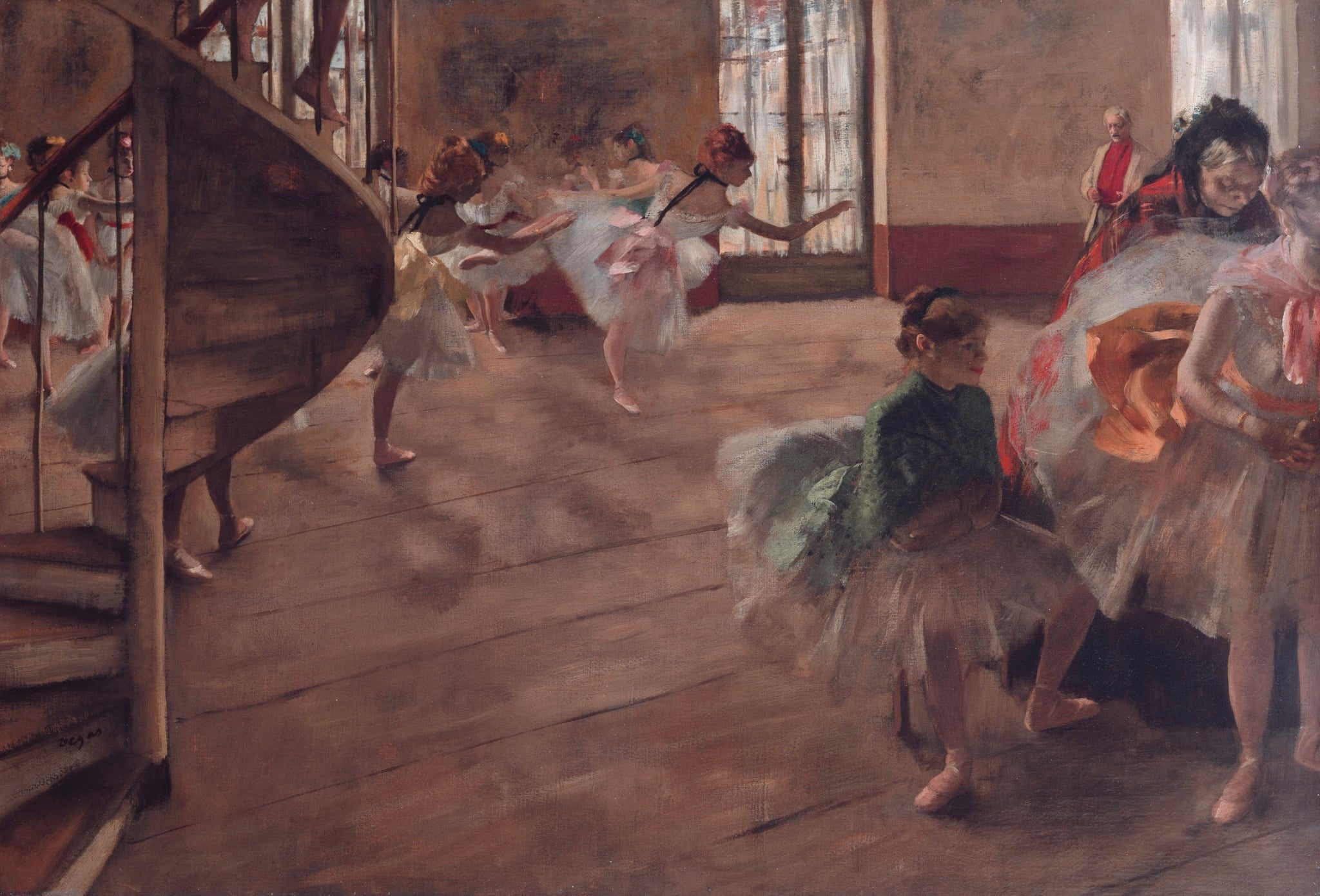
The Ballet Rehearsal
Edgar Degas (c. 1874)
In The Ballet Rehearsal, Edgar Degas turns a practice room into a modern drama where <strong>discipline and desire</strong> collide. A dark <strong>spiral staircase</strong> slices the space, scuffed floorboards yawn open, and clusters of dancers oscillate between poised effort and weary waiting <sup>[1]</sup><sup>[4]</sup>.
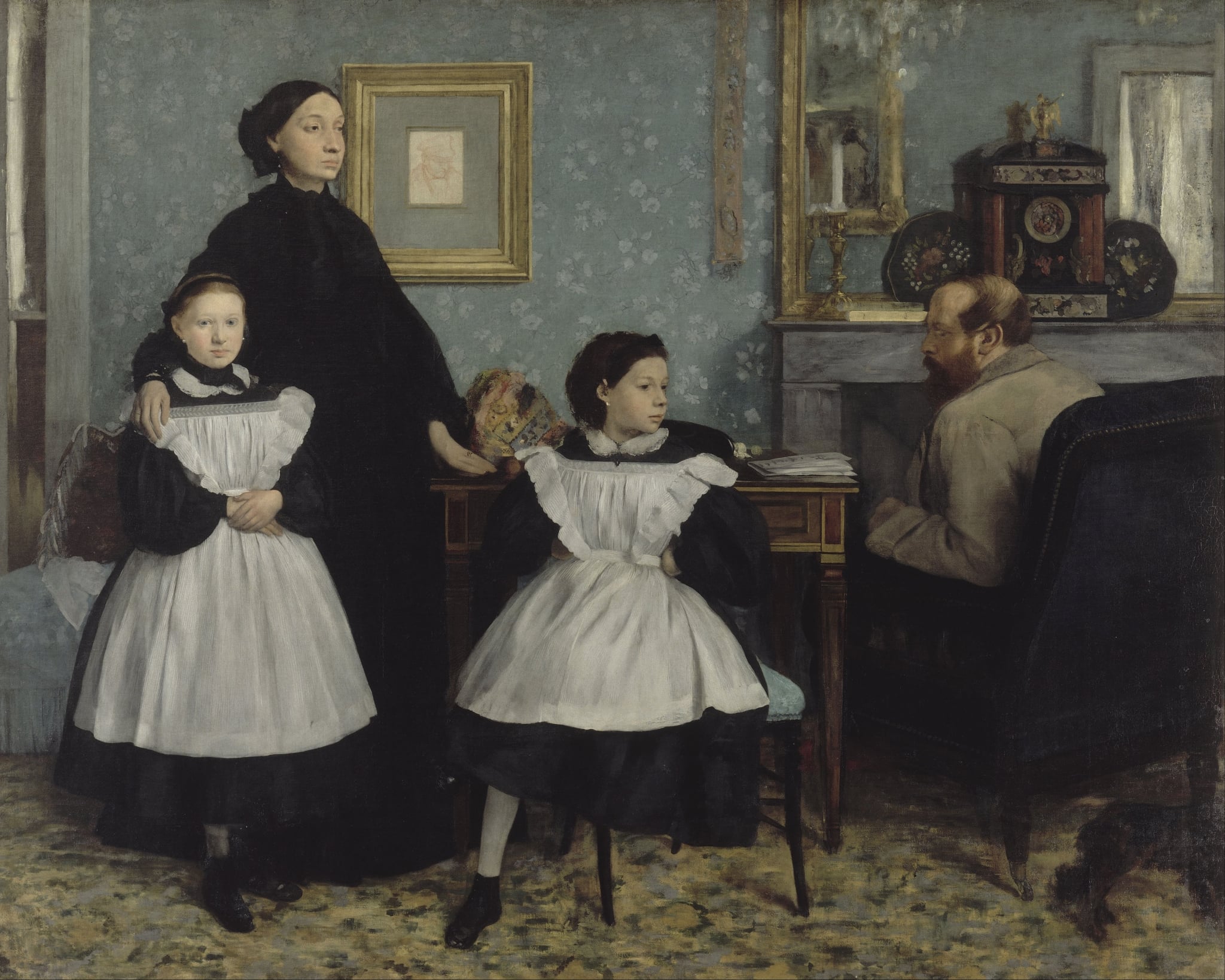
The Bellelli Family
Edgar Degas (1858–1869)
In The Bellelli Family, Edgar Degas orchestrates a poised domestic standoff, using the mother’s column of <strong>mourning black</strong>, the daughters’ <strong>mediating whiteness</strong>, and the father’s turned-away profile to script roles and distance. Rigid furniture lines, a gilt <strong>clock</strong>, and the ancestor’s red-chalk portrait create a stage where time, duty, and inheritance press on a family held in uneasy equilibrium.
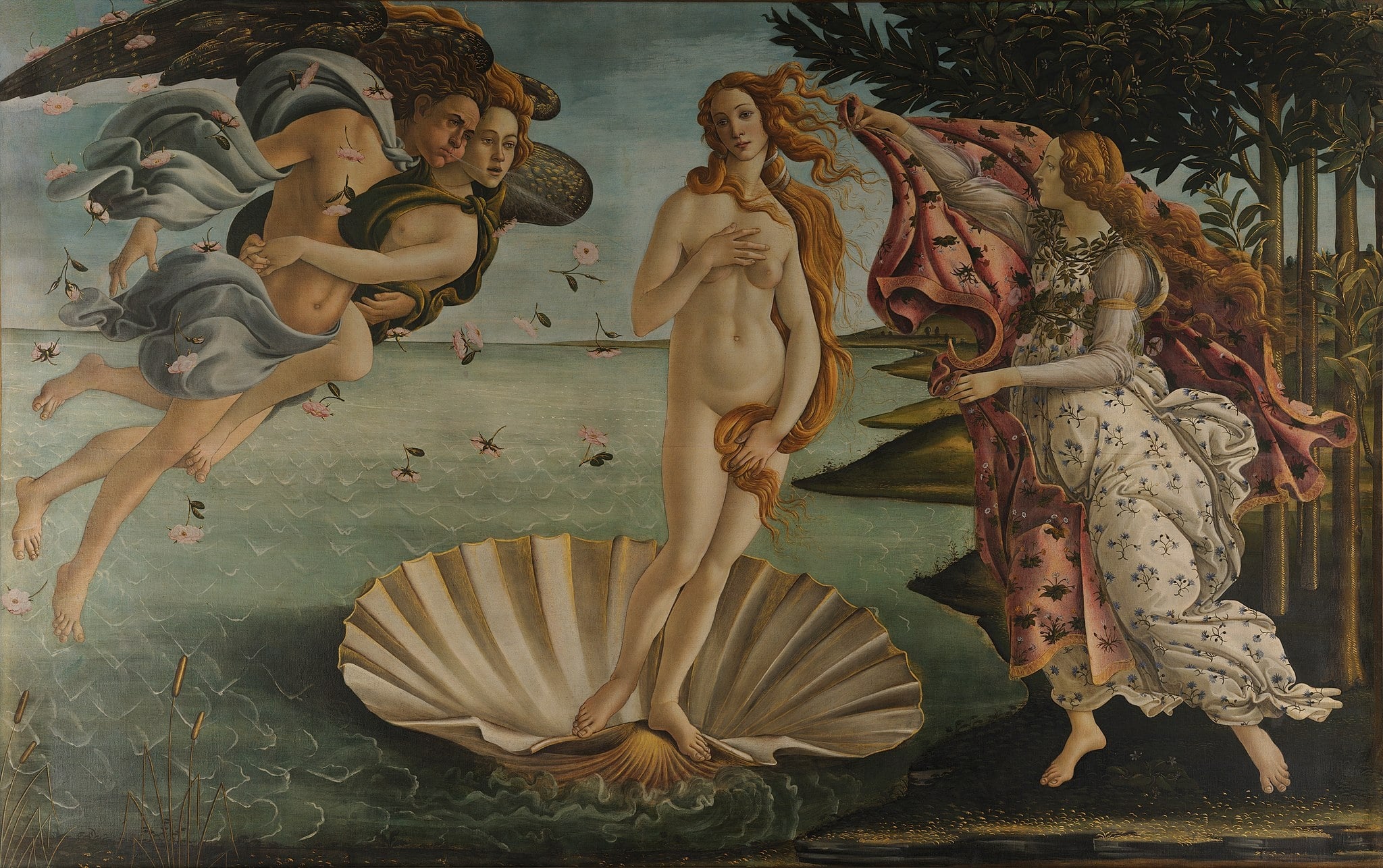
The Birth of Venus
Sandro Botticelli (c. 1484–1486)
In The Birth of Venus, <strong>Sandro Botticelli</strong> stages the sea-born goddess arriving on a <strong>scallop shell</strong>, blown ashore by intertwined <strong>winds</strong> and greeted by a flower-garlanded attendant who lifts a <strong>rose-patterned mantle</strong>. The painting’s crisp contours, elongated figures, and gilded highlights transform myth into an <strong>ideal of beauty</strong> that signals love, spring, and renewal <sup>[1]</sup><sup>[2]</sup>.
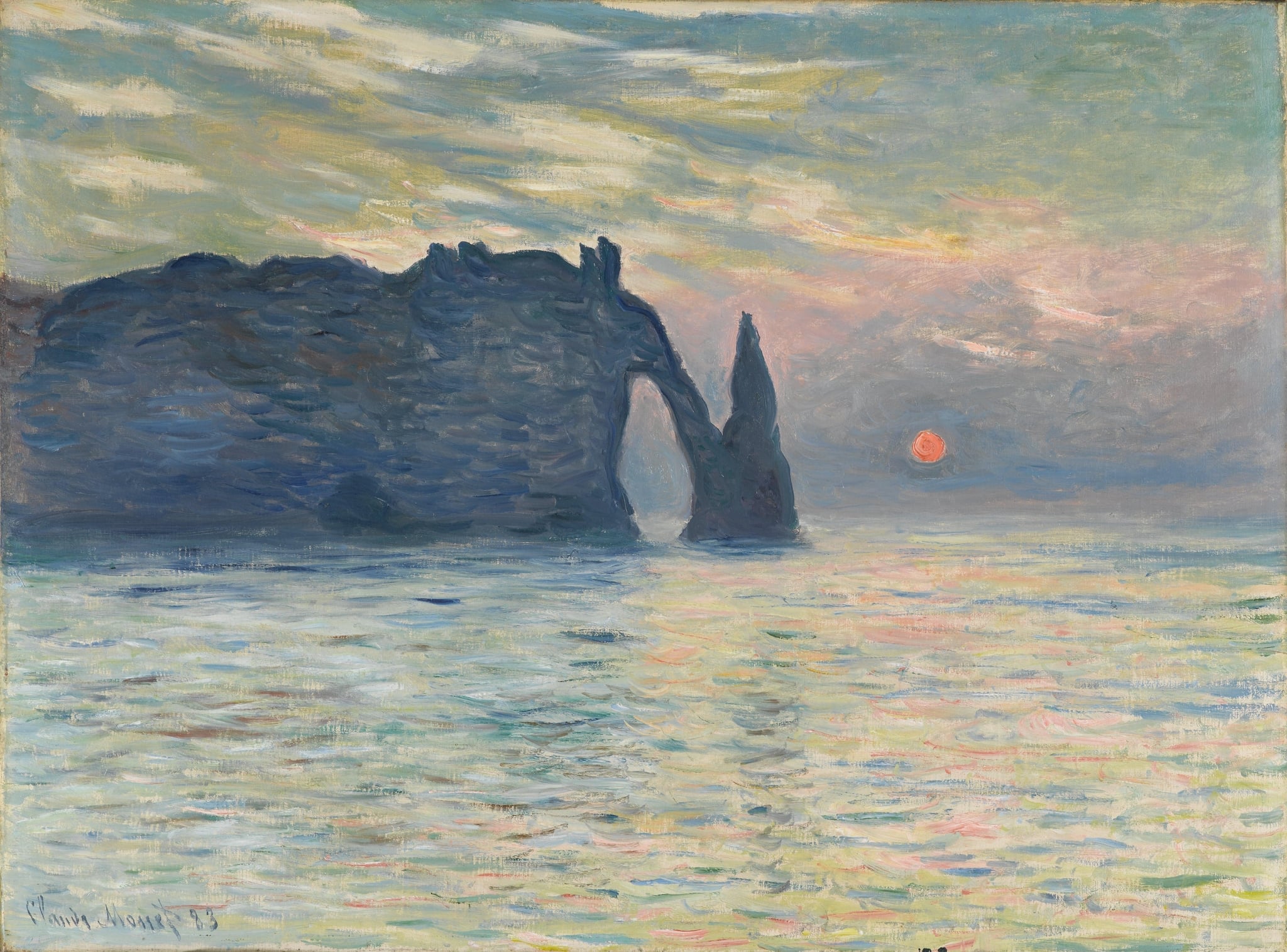
The Cliff, Etretat
Claude Monet (1882–1883)
<strong>The Cliff, Etretat</strong> stages a confrontation between <strong>permanence and flux</strong>: the dark mass of the arch and needle holds like a monument while ripples of coral, green, and blue light skate across the water. The low <strong>solar disk</strong> fixes the instant, and Monet’s fractured strokes make the sea and sky feel like time itself turning toward dusk. The arch reads as a <strong>threshold</strong>—an opening to the unknown that organizes vision and meaning <sup>[1]</sup><sup>[2]</sup>.
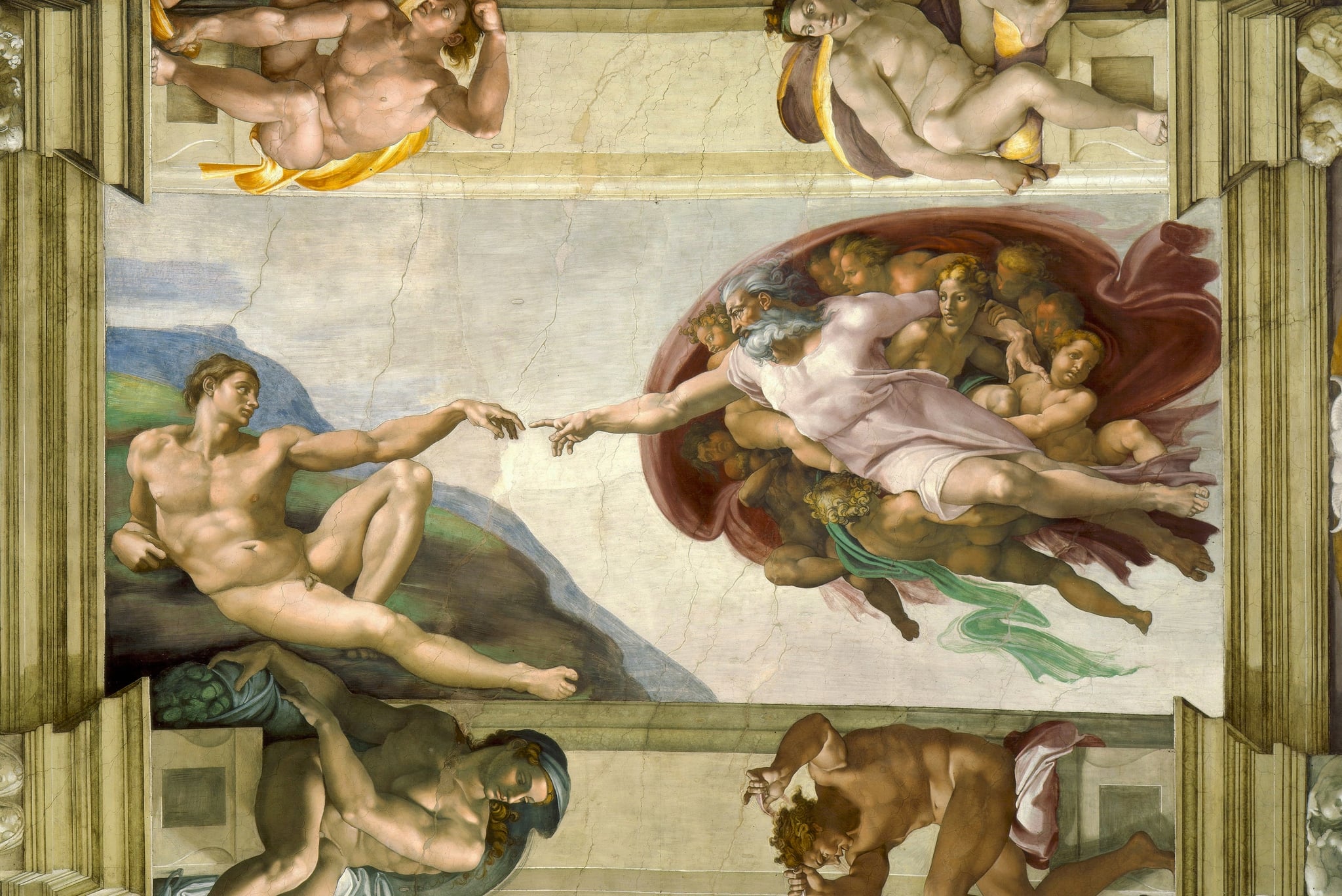
The Creation of Adam
Michelangelo (c.1511–1512)
Michelangelo’s The Creation of Adam crystallizes the instant before life is conferred, staging a charged interval between two nearly touching hands. The fresco turns Genesis into a study of <strong>imago Dei</strong>, bodily perfection, and the threshold between inert earth and <strong>active spirit</strong> <sup>[1]</sup><sup>[2]</sup>.
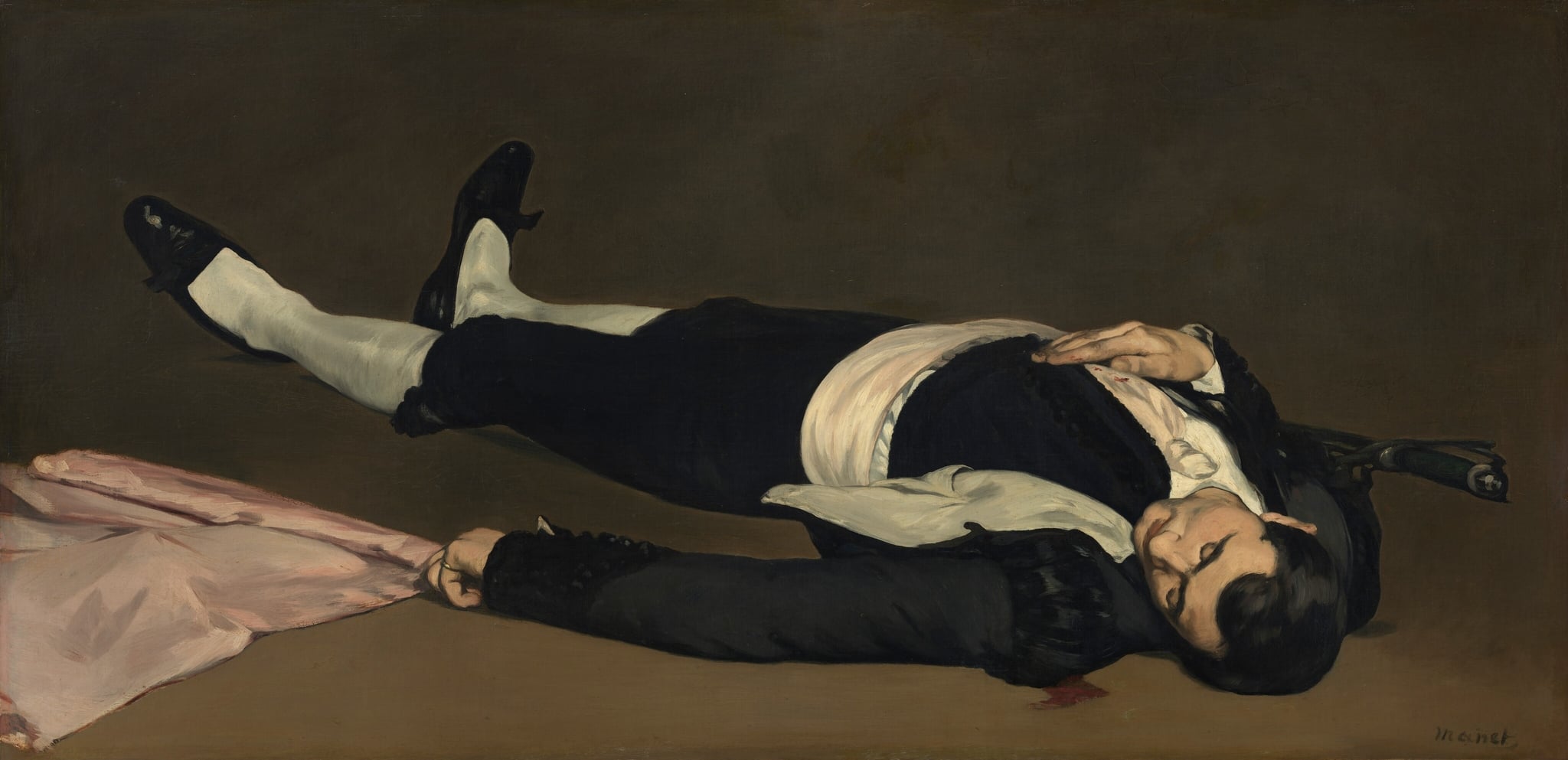
The Dead Toreador
Édouard Manet (probably 1864)
Manet’s The Dead Toreador isolates a matador’s corpse in a stark, horizontal close‑up, replacing the spectacle of the bullring with <strong>silence</strong> and <strong>abrupt finality</strong>. Black costume, white stockings, a pale pink cape, the sword’s hilt, and a small <strong>pool of blood</strong> become the painting’s cool, modern vocabulary of death <sup>[1]</sup>.
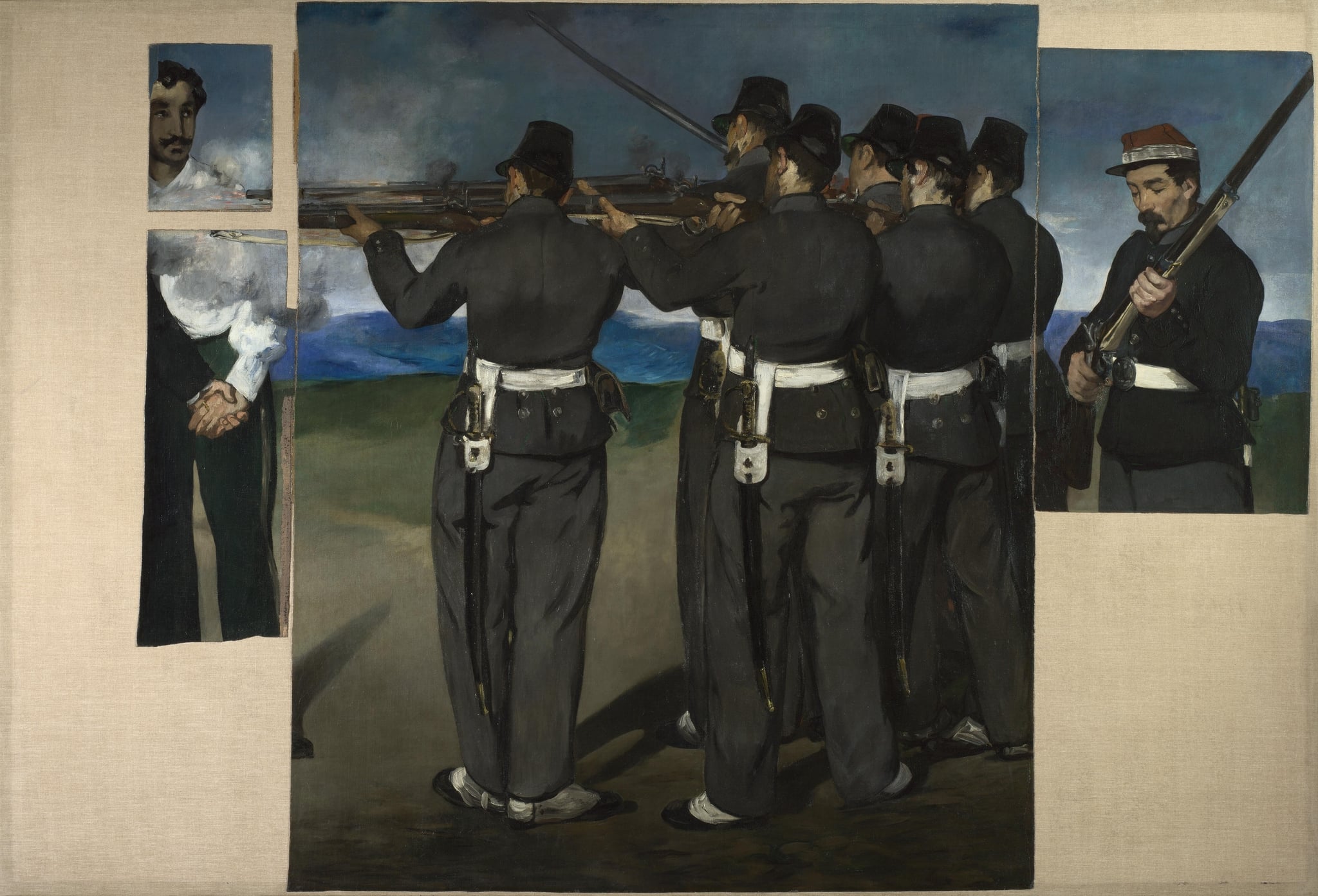
The Execution of Emperor Maximilian
Édouard Manet (1867–1868)
Manet’s The Execution of Emperor Maximilian confronts state violence with a <strong>cool, reportorial</strong> style. The wall of gray-uniformed riflemen, the <strong>fragmented canvas</strong>, and the dispassionate loader at right turn the killing into <strong>impersonal machinery</strong> that implicates the viewer <sup>[1]</sup><sup>[2]</sup>.
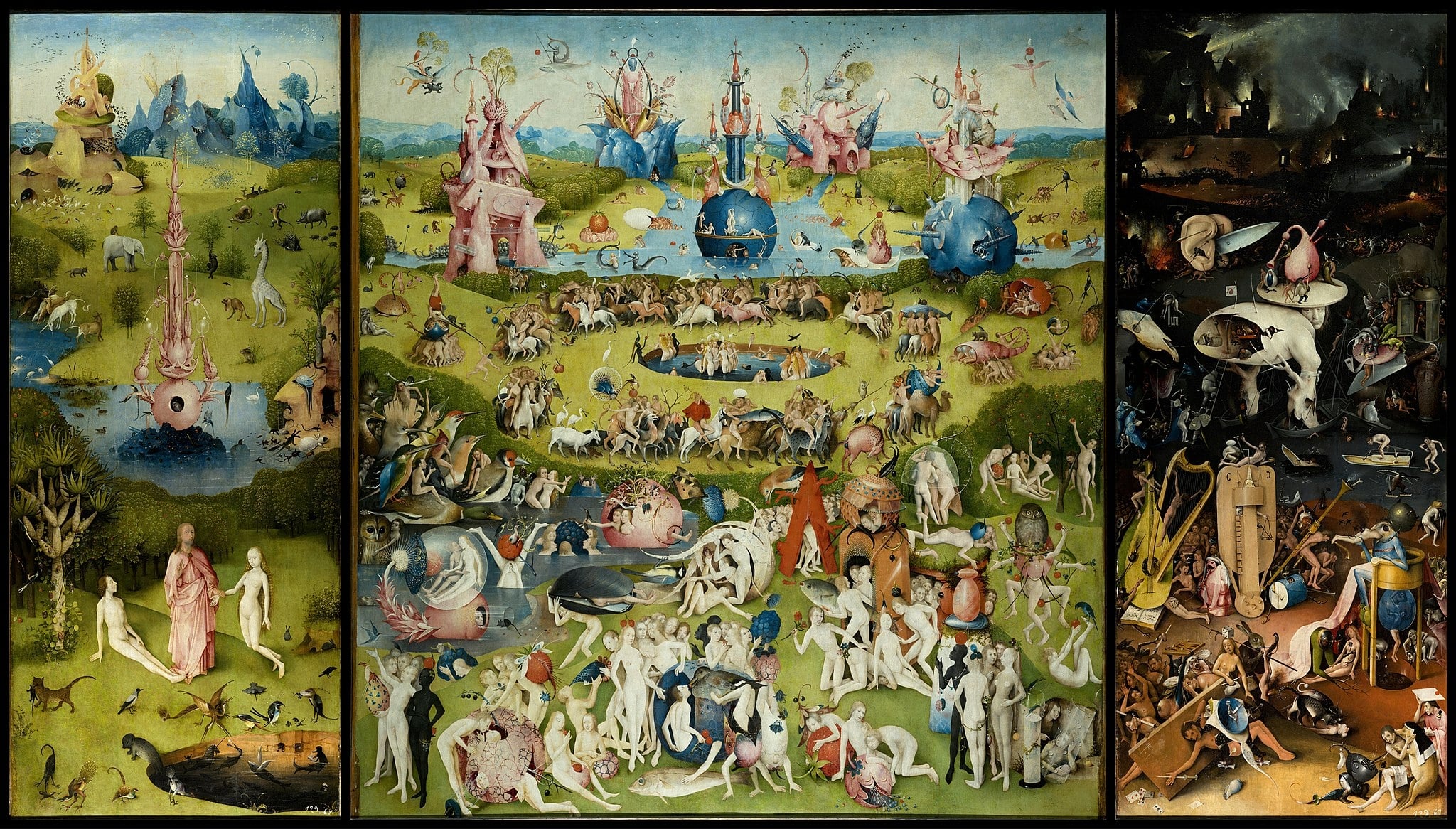
The Garden of Earthly Delights
Hieronymus Bosch (c.1490–1500)
The Garden of Earthly Delights unfolds a three‑act moral narrative—<strong>innocence</strong>, <strong>seduction</strong>, and <strong>retribution</strong>—from Eden to a punitive <strong>Musical Hell</strong>. Bosch binds the scenes through recurring emblems (notably the <strong>owl</strong>) and by echoing Eden’s crystalline fountain in the center’s fragile, candy‑colored architectures, then in Hell’s broken bodies and instruments. The work dazzles with invention while insisting that <strong>sweet, ephemeral pleasures</strong> end in ruin <sup>[1]</sup>.
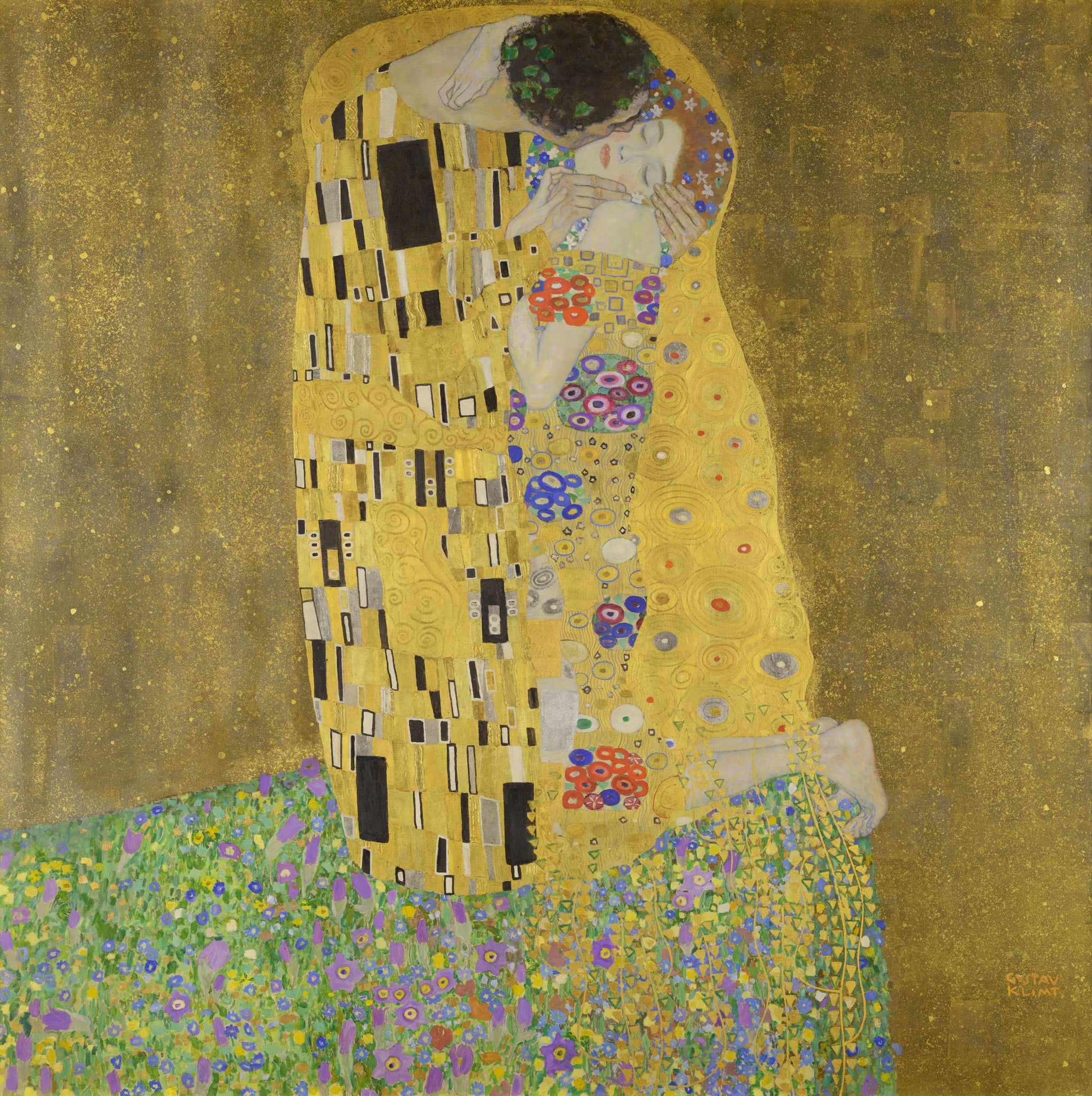
The Kiss
Gustav Klimt (1908 (completed 1909))
The Kiss stages human love as a <strong>sacred union</strong>, fusing two figures into a single, gold-clad form against a timeless field. Klimt opposes <strong>masculine geometry</strong> (black-and-white rectangles) to <strong>feminine organic rhythm</strong> (spirals, circles, flowers), then resolves them in radiant harmony <sup>[1]</sup><sup>[2]</sup>.
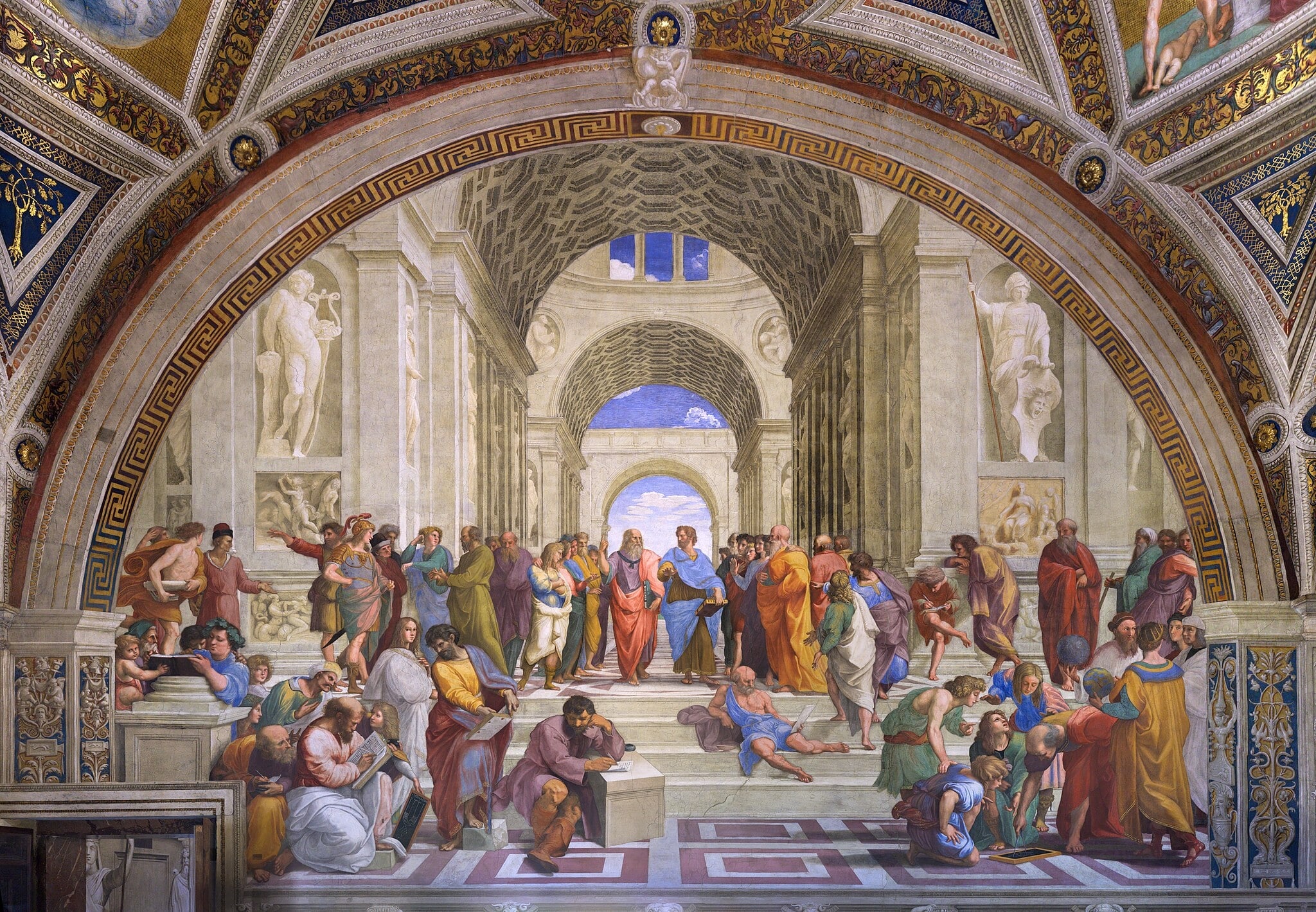
The School of Athens
Raphael (1509–1511)
Raphael’s The School of Athens orchestrates a grand debate on knowledge inside a perfectly ordered, classical hall whose one-point perspective converges on the central pair, <strong>Plato</strong> and <strong>Aristotle</strong>. Their opposed gestures—one toward the heavens, one level to the earth—establish the fresco’s governing dialectic between <strong>ideal forms</strong> and <strong>empirical reason</strong> <sup>[1]</sup><sup>[2]</sup>. Around them, mathematicians, scientists, and poets cluster under statues of <strong>Apollo</strong> and <strong>Athena/Minerva</strong>, turning the room into a temple of <strong>Renaissance humanism</strong> <sup>[1]</sup><sup>[3]</sup>.
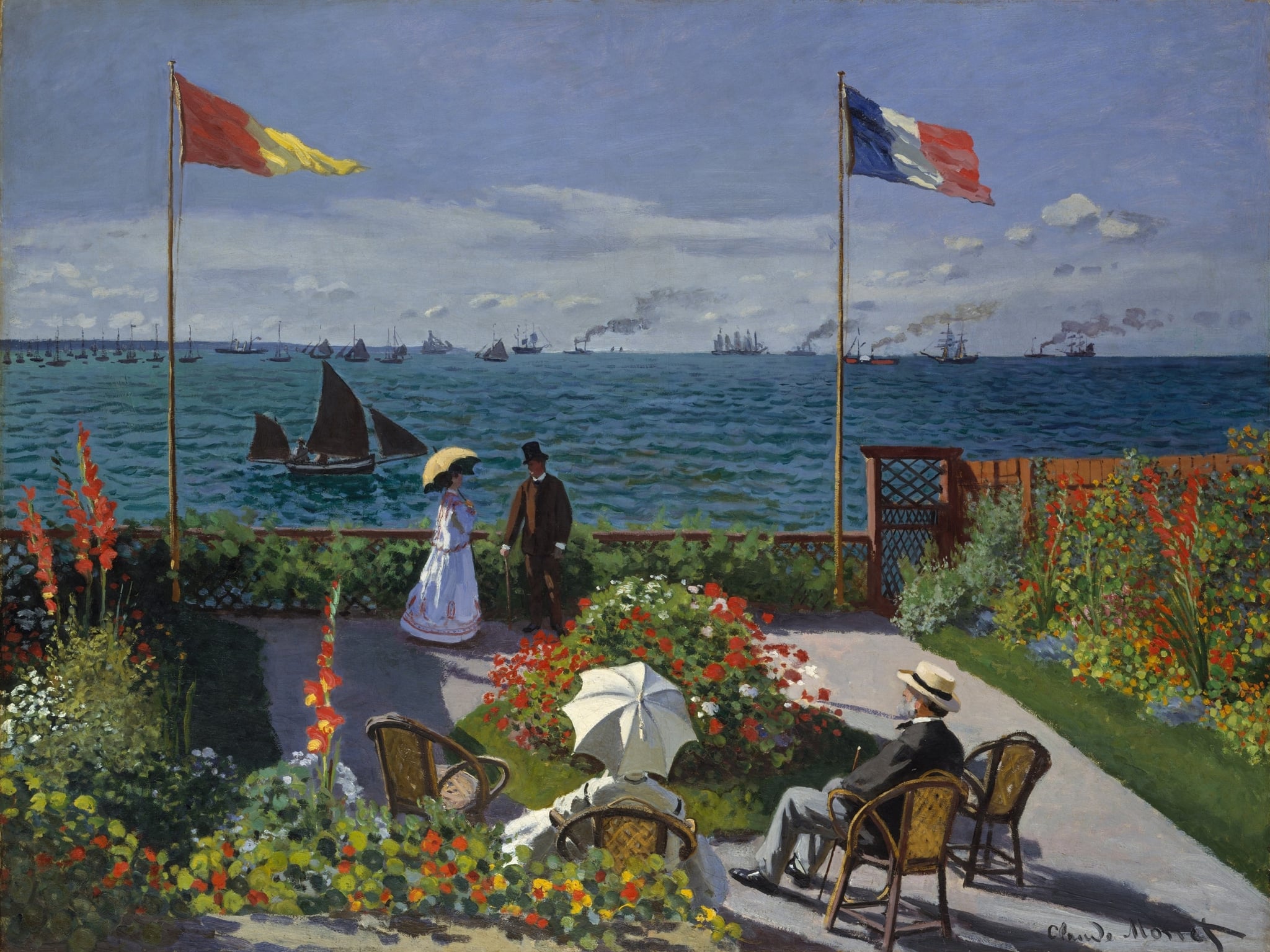
The Terrace at Sainte-Adresse
Claude Monet (1867)
Claude Monet’s The Terrace at Sainte-Adresse stages a sunlit garden against the Channel, where <strong>bourgeois leisure</strong> unfolds between two wind-whipped flags and a horizon shared by <strong>sail and steam</strong>. Bright flowers, wicker chairs, and a white parasol form an ordered foreground, while the busy harbor and snapping tricolor project a confident, modern nation. The banded design—garden, sea, sky—reveals Monet’s early <strong>Japonisme</strong> and his drive to fuse fleeting light with a consciously structured composition <sup>[1]</sup>.
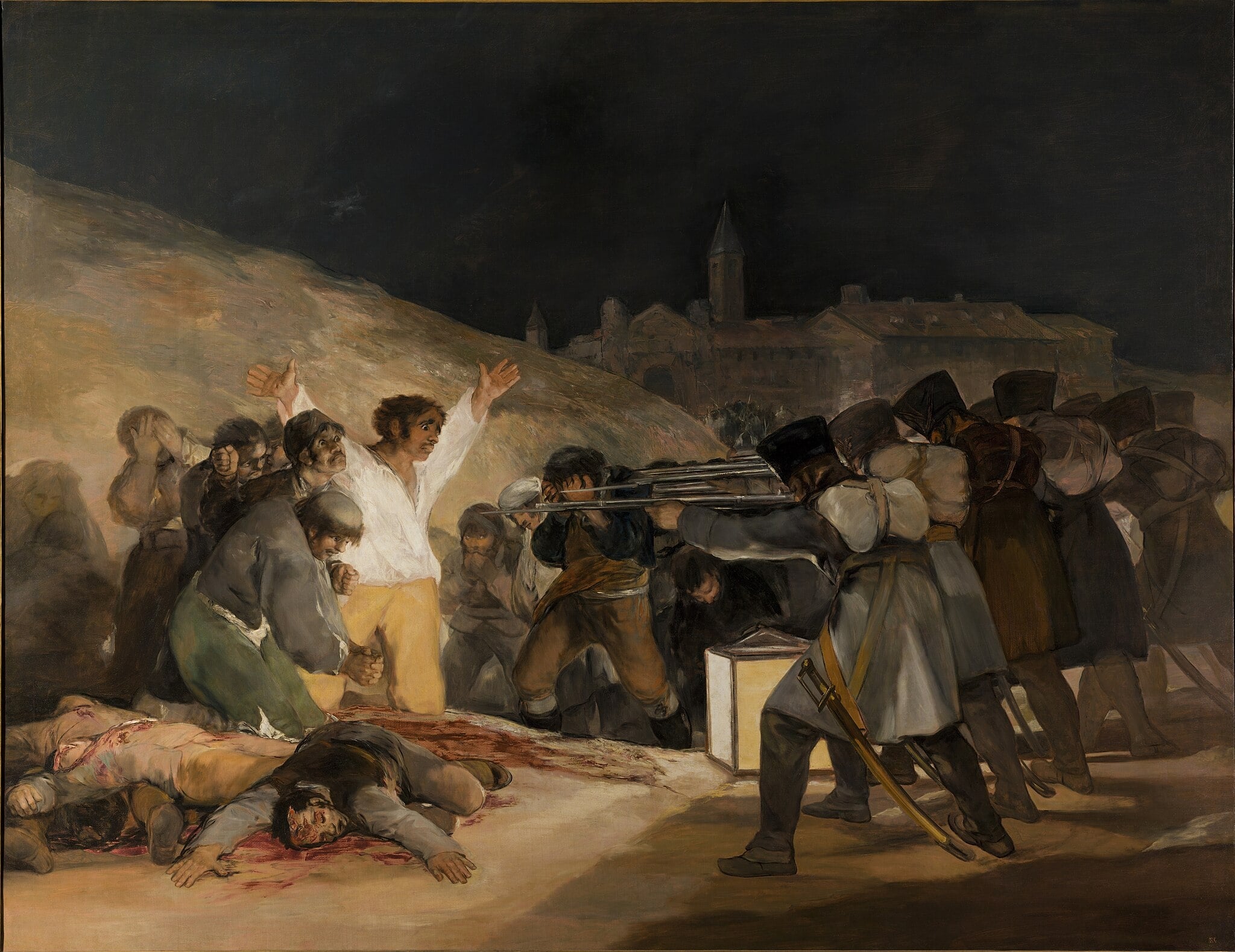
The Third of May 1808
Francisco Goya (1814)
Francisco Goya’s The Third of May 1808 turns a specific reprisal after Madrid’s uprising into a universal indictment of <strong>state violence</strong>. A lantern’s harsh glare isolates a civilian who raises his arms in a <strong>cruciform</strong> gesture as a faceless firing squad executes prisoners, transforming reportage into <strong>modern anti-war testimony</strong> <sup>[1]</sup><sup>[2]</sup>.
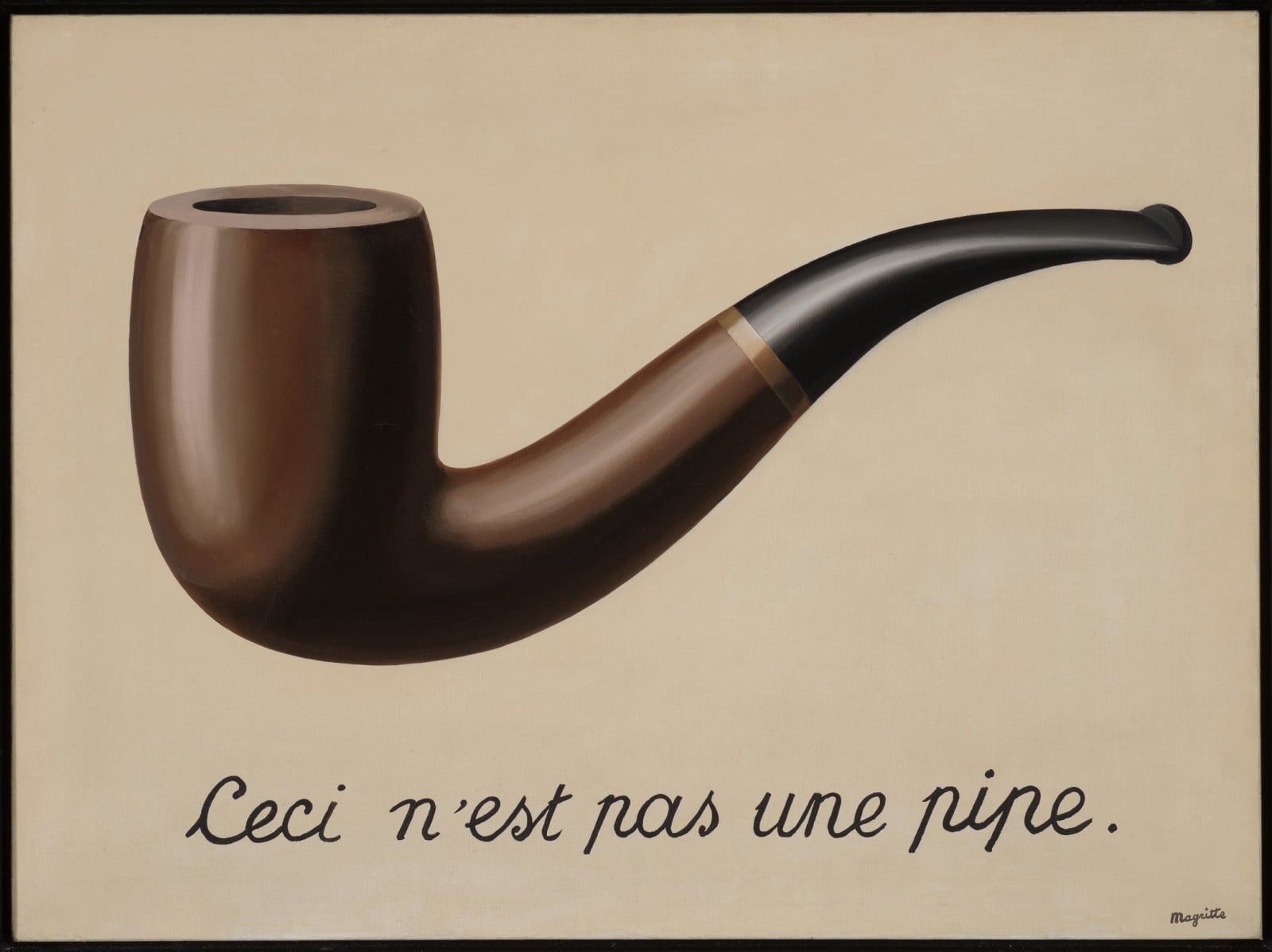
This is Not a Pipe
Rene Magritte (1929)
A crisply modeled tobacco pipe hovers over a blank beige field, while the cursive line "Ceci n’est pas une pipe" coolly denies what the eye assumes. The clash between image and sentence turns a familiar object into a <strong>thought experiment</strong> about signs and things. Magritte’s deadpan exactitude and ad‑like layout stage a <strong>philosophical trap</strong>: you can see a pipe, but you cannot smoke this picture. <sup>[1]</sup><sup>[2]</sup>
Related Themes
Related Symbolism Categories
Identity
The “Identity” symbolism category traces how modern and early modern artists encode social role, class, gender, and selfhood in clothing, pose, and gaze, turning the human figure into a densely signifying site where personal agency and institutional structures intersect.
Figure
Figure symbolism in modern painting turns the human body into a calibrated sign-system in which posture, gesture, and gaze encode shifting relations among desire, labor, authority, and spectatorship.
Object
Object symbolism charts how seemingly ordinary tools, vessels, and furnishings—books, bottles, clocks, tables, instruments—become dense sign-carriers of labor, leisure, desire, and modern perception from early modern iconography to Impressionist and post‑Impressionist painting.
Within the long history of Western art, symbolism has never been a fixed code so much as a mobile repertoire of signs that artists continually renegotiate. The symbols gathered in this corpus reveal how, from the fifteenth century to the twentieth, painters shift from the dense theological allegory of late medieval and early Renaissance practice toward increasingly reflexive, political, and commercial sign-systems. Far from disappearing, symbolic thinking adapts: halos yield to convex mirrors, coats of arms to corporate logos, dynastic banners to the tricolor flag. What persists is the conviction that discrete visual elements—whether a tiny flower, a gold medallion seal, or a national standard—can carry meanings out of proportion to their scale, structuring how images are read and how viewers understand their own place within them.
Semiotically, these works dramatize the tension between symbol as transparent vehicle of meaning and symbol as self-conscious sign. Jan van Eyck’s Arnolfini Portrait is exemplary in this respect. The convex mirror with reflected figures and Passion roundels anchors the room in a regime of divine oversight and truthful witnessing: it both expands the visual field to include unseen onlookers and embeds salvation history around the mirror’s frame. Here symbol operates analogically. The tiny roundels narrate Christ’s Passion; the single burning candle in the chandelier, improbably lit by day, functions as a concentrated sign of sanctity within the household. Yet technical analysis showing that many details were added late undercuts a purely fixed iconographic program and suggests van Eyck’s freedom to intensify meaning as he worked. The painting therefore sits at a hinge: it still relies on inherited religious symbolism, but it also anticipates later reflexivity by inscribing the artist’s presence (“Johannes de eyck fuit hic”) as a kind of verbal seal guaranteeing the scene’s truth.
By the nineteenth century, symbolic language shifts decisively toward social and political registers. In Edgar Degas’s The Bellelli Family, the ancestor’s red-chalk portrait hanging above the mother’s shoulder functions as a compressed image of lineage, memory, and inherited duty. The portrait literalizes the weight of the past pressing down on the living figure who upholds it, binding maternal authority to the claims of ancestry. The gilt clock on the mantel extends this logic: time becomes the measure of obligation, the visible mechanism by which duty is transmitted across generations. Unlike van Eyck’s Passion roundels, which locate the couple’s life within a cosmic redemptive arc, Degas’s symbols remain resolutely this-worldly. They still “speak” allegorically, but their language concerns domestic hierarchy, psychological distance, and the burdens of bourgeois continuity rather than eschatological salvation.
Degas’s later The Ballet Rehearsal pushes this secularization of symbolism further. Authority figures appear not as glorified saints or patrons but as quiet overseers—an older woman in black and a red-sashed figure—embodying the supervision and hierarchy that govern training. Their presence, together with the scuffed floorboards and the slicing spiral staircase, transforms the rehearsal space into a symbolic machine of discipline. The authority figures become stand-ins for institutional power, their very ordinariness signaling the internalization of control within modern life. Symbol here is almost structural: it is less a discrete sign picked out by the eye than a role in a choreography of bodies, space, and time that the image itself enacts.
National emblems in the nineteenth century take on a parallel, but more overtly collective, symbolic charge. In Pierre-Auguste Renoir’s Pont Neuf Paris, the French tricolor flag punctuates a bustling urban panorama, binding the unruly movement of pedestrians and carriages into a scene of civic unity. The flag’s diagonal echoes the bridge’s thrust, so that its symbolism—national identity, public belonging—is woven into the city’s very circulation. Renoir’s tricolor is not an abstract emblem but a rhythmic accent in a visual field, naturalized as part of everyday life. In Eugène Delacroix’s Liberty Leading the People, by contrast, the tricolor flag assumes an explicitly mythic dimension. Held aloft by Allegorical Liberty (Marianne), it becomes the focal point of a pyramidal composition in which corpses form the base and revolutionary advance the apex. Here the flag and the personification fuse: Marianne’s bare-breasted, striding form and the flaring tricolor together condense the idea of the French Republic as popular sovereignty in motion. The symbol is doubled—figure and fabric—and this doubling intensifies the painting’s claim that national identity is constituted through embodied, often violent, collective action.
The same tricolor reappears in reduced, almost offhand form in Renoir’s urban vista, and again in the discreet tricolor-like beach pennant of later modern scenes (not represented in the present holdings but conceptually akin), registering a broader semiotic shift. What in Delacroix is a charged revolutionary banner becomes, by the 1870s, a sign woven into the fabric of everyday leisure and urban circulation. The symbolic code remains legible—blue, white, red still connote national belonging—but its rhetorical temperature drops from heroic allegory to civic decor.
By the time of Andy Warhol’s Campbell’s Soup Cans, the locus of symbolic authority has migrated decisively into the sphere of commodity culture. The Campbell’s cursive script logo and the gold medallion seal are corporate descendants of the heraldic and dynastic devices that structure power in earlier works. The logo’s handwriting-like authority mimics the personal guarantee of a signature, while the medallion appropriates the visual language of medals and institutional awards to promise quality. Warhol’s serial grid, however, exposes these devices as reproducible graphics rather than unique guarantees. Repeated across thirty-two canvases, the seal’s claim to prestige becomes a pattern; its very sameness hollows out its exceptionalism. In semiotic terms, Warhol shifts the viewer’s attention from the symbol’s referent (quality, tradition, trust) to its status as signifier—a printed circle that gains force only through repetition and brand recognition.
This reflexive unmasking of symbolism returns us to the early modern mirror, but in a secular key. Just as van Eyck’s convex mirror acknowledges the viewer as witness and folds them into the painting’s truth-claim, Warhol’s grid acknowledges the viewer as consumer, replicating the visual logic of the supermarket shelf. Where the mirror once guaranteed the presence of God and human observers within a sanctified domestic space, the logo and medallion now guarantee the presence of corporate identity within a gallery space that mimics commercial display. In both cases, symbolic devices mediate between image and world; what changes is the institution—Church, family, nation, corporation—that authorizes their meanings.
Across these works, then, one can trace less a decline of symbolism than its continual reconfiguration. Religious emblems in The Arnolfini Portrait yield to dynastic and familial signs in The Bellelli Family, to institutional and disciplinary figures in The Ballet Rehearsal, to national flags and allegorical Liberties in Liberty Leading the People and Pont Neuf Paris, and finally to the logos and seals of consumer capitalism in Campbell’s Soup Cans. At each stage, symbols both anchor and interrogate the social orders they serve. The evolution from convex mirror to corporate medallion does not abolish the symbolic impulse; it relocates it, inviting viewers to recognize that every image, however matter-of-fact, is structured by signs that ask to be read.